
Huang Yongyu: A renowned eccentric genius in the Chinese art world, a native of Fenghuang County, Hunan
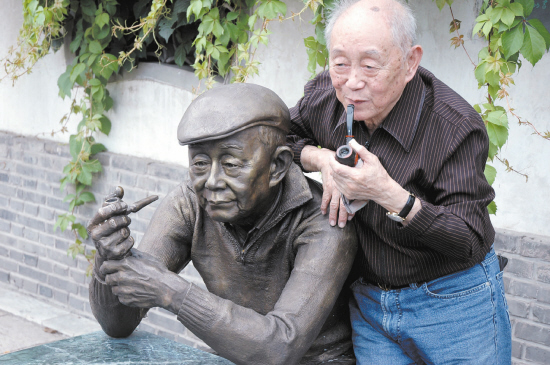
Huang Yongyu, 85 years old this year, a nephew of Mr. Shen Congwen, of Tujia ethnicity, and vice chairman of the Chinese Artists Association. Huang Yongyu taught himself art and literature, and is an eccentric genius of his generation, a man of broad learning and wide knowledge, excelling in poetry, calligraphy, and painting, and also a master of poetry, essays, prose, fiction, and drama. He has held exhibitions in Australia, Germany, Italy, mainland China, and Hong Kong, and his artistic achievements earned him the Italian Commander's Award, bringing him great renown at home and abroad. In May 1980, Huang Yongyu went to Zhang
Huang Yongyu
At the age of 85 this year, he is a nephew of Mr. Shen Congwen, of Tujia ethnicity, and vice chairman of the Chinese Artists Association.
Huang Yongyu taught himself art and literature, and is a “genius” of his generation. He is erudite and knowledgeable, excelling in poetry, calligraphy, and painting, and is also a master of poetry, essays, prose, fiction, and drama. He has held exhibitions in Australia, Germany, Italy, mainland China, and Hong Kong. His artistic achievements have won the Italian Commander's Award, and he enjoys a high reputation at home and abroad.
In May 1980, Huang Yongyu went to Zhangjiajie and spoke highly of its natural scenery. He painted a work titled “Two Thousand Eight Hundred Pillars” and wrote in the colophon on landscape: “In my hometown there is an unnamed mountain called Zhangjiajie…… The wise who visit this mountain all sigh at its wonder and mystery.” On May 16 of the same year, at a forum of art workers, he said: “I have been to Guilin, Huangshan, and other places, and have seen many famous mountains. When I first arrived at Zhangjiajie, I felt there was nothing especially good, just ordinary mountains. But after going deeper in and taking a look, I fell silent and had nothing to say. I felt it really is a good place, with majestic, peculiar, and serene scenery, and it can be developed into a tourist resort.” In the spring of 1989, he created “Zhangjiajie Random Thoughts, Not to Be Taken Seriously,” which was publicly published in 1996 in the Hunan Fine Arts Publishing House’s “China Zhangjiajie Travel Souvenir Album” (painting album), playing an important role in the early development of Zhangjiajie.
Famous painter. A native of Tuojiang Town, Fenghuang County, born in 1924 into a poor family. After graduating from primary school, he left home with a small schoolbag to make a living, drifting to the mountainous areas of Anhui and Fujian, working as a child laborer in small workshops, and living very hard. Later he moved around to Shanghai, Taiwan, Hong Kong, and other places, working to make a living while diligently studying and learning painting. He began publishing works at the age of 14, and by 16 had already published many works, becoming famous for his uniquely styled woodcuts.
In 1949, when the People's Republic of China was founded, he loved the new republic very much and was determined to contribute to the motherland's construction. In 1952, he and his wife Zhang Ximei came to Beijing from Hong Kong. In 1953 he was appointed professor at the Central Academy of Fine Arts, and later served as vice chairman of the Chinese Artists Association and a member of the Standing Committee of the National Committee of the Chinese People's Political Consultative Conference.
Huang Yongyu was diligent and eager to learn, tirelessly pursuing superb artistic skills. He originally focused on woodcuts, and later on traditional Chinese painting. He loved painting plum blossoms and lotus. For a period, he took binoculars every day to the Old Summer Palace to paint the lotus of the people's communes. Over time, he actually painted more than 8,000 ink lotuses. In his “Red Dragonfly and White Lotus,” the lotus stands gracefully, emerging unstained from the mud; the dragonfly rests quietly on the leaf, full of vitality. His “Hometown Red Plum” braves frost and snow, with fragrance overflowing, and can be called a masterpiece.
Huang Yongyu paints in a particularly unusual way. In addition to various painting brushes, he often uses twigs, fingers, loofah sponge, and other things as brushes. He paints with amazing speed; whether the painting is large or small, he usually has the whole picture in mind and completes it in one go. His paintings cover a wide range of subjects: pine, bamboo, plum, and chrysanthemum; flowers, birds, grass, and insects; birds and beasts; landscapes and figures; and even myths and allusions. Whatever passes through his hands, cold and heat are born at the tip of his brush, wind and clouds change beneath his wrist, and the scenery has both spirit and form, becoming extraordinary masterpieces that leave people marveling endlessly. Huang Yongyu's painting ideas are novel and have a strong national character, winning considerable favor from people at home and abroad. In 1956, the People's Fine Arts Publishing House published “Huang Yongyu's Woodcut Collection.” In 1978, The Times of Britain used six pages for a special report on Huang Yongyu and his paintings. In 1980, Hong Kong Artists Publishing House published a color-printed edition of “Huang Yongyu's Painting Collection.” Hunan Fine Arts Publishing House successively published Huang Yongyu's “Sketches of Western Hunan,” “Scenery That Never Returns,” and others. His representative works include “Lotus in Wind and Rain,” “Hometown Red Plum,” “Spring Tide,” “Red Dragonfly and White Lotus,” “Evening Clearing,” “Sparrow Mound,” and “Ashima.”
Huang Yongyu had a clear sense of love and hate, and he expressed his feelings through cartoons. His painting "Boasting" is inscribed: "Gradually, even he himself believes it to be true." His painting "Speed" depicts a two-faced head, inscribed: "The forms of material movement, for example, a bad person suddenly turning into a good person, so fast that even lightning feels quite ashamed." This satirizes those who are good at disguising and changing in politics. His painting "Rank" shows a long-legged mosquito and two human heads, inscribed: "The mosquito knows nothing about such matters; it even dares to bite bureau chiefs and directors." This satirizes those who judge people by their status. His painting "Five Deer Stand Tall, Zhu Yun Breaks Their Antlers" portrays Zhu Yun of the Western Han dynasty, who mastered the I Ching. At that time, the Shaofu Wulu Chongzong, relying on imperial favor, debated the I Ching with Confucian scholars, and none could stand against him; all claimed illness to avoid meeting him. Only Zhu Yun, unafraid of his power, repeatedly struck Wulu's vital points in debate. Thus the scholars said of him: "Five deer stand tall, Zhu Yun breaks their antlers." The painting's meaning is very profound, with a distinct personality. He dared both to praise the true, the good, and the beautiful, and to lash out at the false, the ugly, and the evil. Huang Yongyu is not only renowned at home and abroad for his paintings, but also has deep attainments in poetry and prose. Published in Hong Kong in 1984, "Miscellaneous Notes from the Pot Studio" and "Miscellaneous Notes from the Mustard Seed Garden" are models of blending poetry and painting into one. His prose is also very beautiful; works such as "Scenery Under the Sun" and "Uncle Shen Congwen's Poetry and Calligraphy" have a profound tone, witty language, and far-reaching implications, making readers unable to put them down.
Huang Yongyu loves his motherland, is loyal to art, and nostalgic for his hometown. Despite life's ups and downs, his childlike heart burns even hotter. He often returns to his hometown to create, and even built a "Duocui Tower," adding a unique highlight to the local scenic spots.
Some of the above images are from the internet, source unknown; please contact this site if you are the author.