
Ticket prices, opening hours, and other details for this attraction may be adjusted according to season and policy. Before traveling, please refer to the latest official announcements from the scenic area.
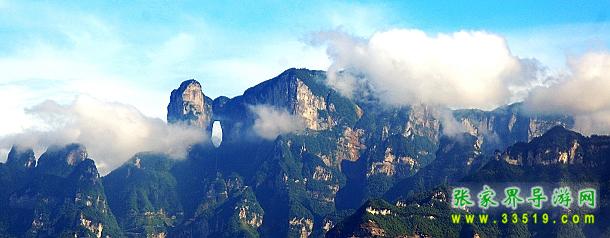
Tianmen Mountain, anciently called Yunmeng Mountain and Songliang Mountain, is the earliest famous mountain in Zhangjiajie to be recorded in historical records. In the sixth year of Yong'an of Eastern Wu during the Three Kingdoms period (263 AD), the cliff of Songliang Mountain suddenly opened, bright and clear like a gate, forming the rare world wonder Tianmen Cave, and from then on the mountain was named Tianmen Mountain. Tianmen Mountain is only 8 kilometers from Zhangjiajie city center, with an elevation of 1,518.6 meters. The mountain body is surrounded by sheer cliffs, rising into the air, with soaring momentum, and has developed mature karst landforms. Amid its lofty, extraordinary, and perilous nature, it is even more beautiful and pleasant. It has always been a place admired by celebrities and officials, with extremely profound cultural deposits. It is the cultural holy land of Zhangjiajie, honored as the "Soul of Zhangjiajie," and has the reputation of "the First Sacred Mountain of Xiangxi."
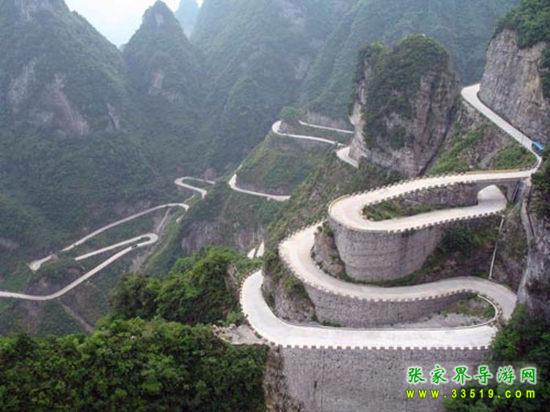
The summit area of Tianmen Mountain is relatively flat, reaching 2 square kilometers, and preserves a complete primitive secondary forest. It has a rare alpine Davidia involucrata community, full of wild charm in all four seasons, like a breathtaking sky garden. In July 1992, Tianmen Mountain was approved by the Ministry of Forestry as Zhangjiajie's second national forest park. As development of Tianmen Mountain has continued to increase, various tourism facilities and scenic area attractions have basically been completed. There is the Tianmen Mountain high-mountain passenger sightseeing cableway spanning the lofty cliffs, famous worldwide for its rare length of 7,455 meters and world-class technology; the winding Tongtian Avenue, known as the world's number one highway wonder for threading through the perilous cliffs of the mountain; and the tour paths winding through the primeval sky garden with towering grotesque rocks and verdant vegetation, further revealing the fragrant charm of a winding path leading to secluded beauty.
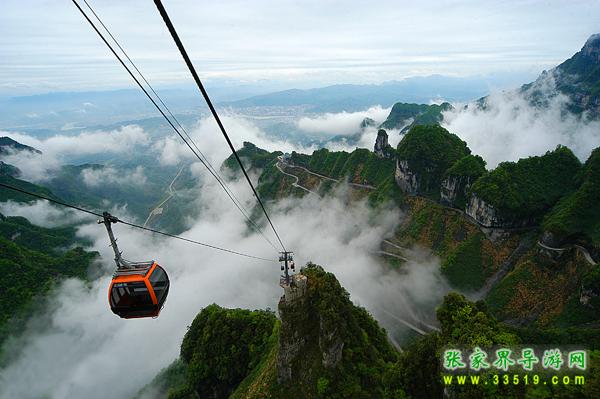
Among them, the Tianmen Mountain high-mountain passenger sightseeing cableway is the essence of Tianmen Mountain's magnificent chapter. Its single-line total length is 7,455 meters, with a height difference of 1,279 meters, making it one of the longest single-line circulating passenger sightseeing cableways in the world. It starts from the city garden in downtown Zhangjiajie and goes directly to the primeval sky garden at the top of Tianmen Mountain, with a maximum climbing angle of 38.6 degrees and a one-way travel time of 28 minutes. It is like a rainbow crossing between the "human world" and "heaven," and also like a giant dragon soaring through the white clouds and sky, clinging to the mountain and cliffs, rising into the sky, magnificent and spectacular. It not only condenses the wisdom and sweat of Chinese and foreign construction participants, but also integrates the most advanced scientific and technological achievements of contemporary cableway engineering. It can be called a miracle and a milestone in contemporary cableway engineering construction.
The extremely perilous and spectacular Tianmen Mountain winding road, "Tongtian Avenue," is another magnificent sight of Tianmen Mountain. Tongtian Avenue is dangerously steep and soul-stirring, and is even more "worthy of being called the world's number one highway wonder" for winding through the natural peril of the mountain's sheer cliffs. It is 10.77 kilometers long in total, running from the landmark gate directly to the foot of Tianmen Cave. The elevation rises sharply from 200 meters to 1,300 meters, with a total of ninety-nine bends. On both sides of the avenue are towering cliffs and deep empty valleys. The 180-degree sharp turns rise one after another, layer upon layer. After walking Tongtian Avenue, Mr. Shen Peng, executive vice chairman of the Chinese Calligraphers Association, gladly inscribed it with the words "Winding Road to Heaven." The vigorous and upright calligraphy blends perfectly with the incomparable wonder of Tongtian Avenue.
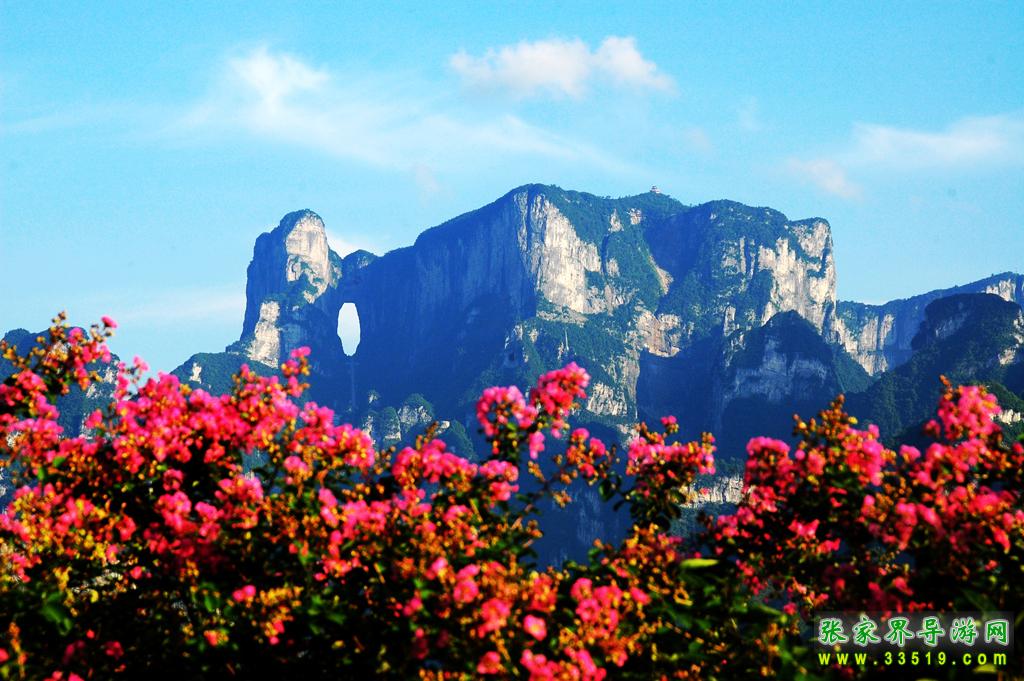
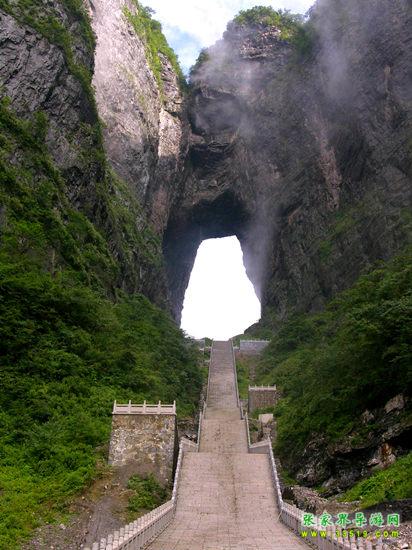
Tianmen Cave is located in the middle and upper part of the Tianmen Mountain massif. It is the world's highest natural mountain-piercing karst cave, at an elevation of 1,300 meters. It is 131.5 meters high, 57 meters wide, and 60 meters deep. It opens north and south on a vast white cliff, soaring upward to heaven, like a bright mirror or a heavenly gate inlaid on the vast sky curtain. It swallows clouds and spits mist all year round, magnificent and even more mysterious and unfathomable. "When Tianmen Cave opens, cloud energy flows through; even Jiangdong and Emei are inferior." The famous Yuan dynasty poet Zhang Dui once praised it in this way, and its majestic momentum can be seen from this. For more than 1,700 years, this incomparable wonder of the world has attracted countless visitors. Especially in 1999, world stunt flying masters flew aircraft through Tianmen Cave, causing a sensational effect globally, with as many as 800 million viewers watching the live broadcast.
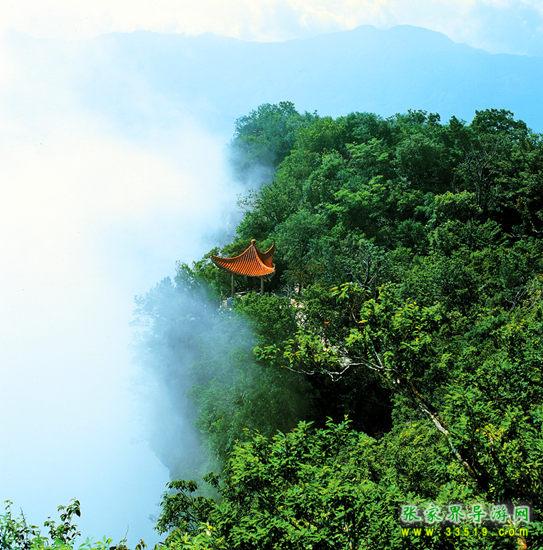
The primeval sky garden is even more full of wild charm and endless delight. Along the way, karst hills and stalactites are widely distributed, stone forests appear in strange forms, wild vines entangle, and grotesque rocks and beautiful trees grow together, making every place resemble a miniature landscape. Among them, forests and rocks alternate, with different forms, some long and some short, intricately arranged, forming a marvelous scene of uncanny workmanship. If observed and savored carefully, one will find that it has completely shed that beauty and charm confined to form, and what follows is a kind of incomparable wonder beyond human imagination and divine inspiration. Further set off by the vitality bursting from the trees and rocks themselves and the moss covering them, a natural miniature landscape kingdom from a fairy tale is vividly presented before one's eyes.
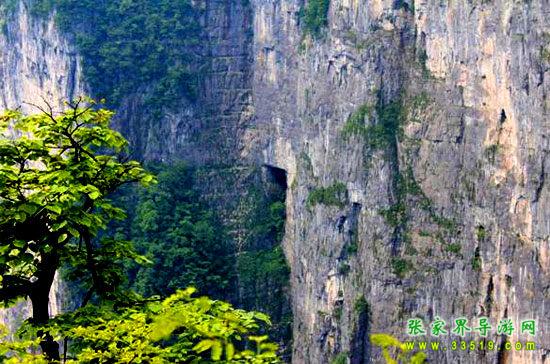
The mysterious Guigu Cave hangs on the hundred-zhang cliff of the Mixian Wonderland Scenic Area on the west route of Tianmen Mountain. Due to its dangerous terrain, it is temporarily not open to the public. Viewed from a distance, the cave mouth looks like an inverted trapezoid. At the cave entrance there is a tree, the rare national first-class protected plant Torreya grandis, called by locals the "Guigu Sacred Tree," and a waterfall splashes outward from the cave, misty like smoke. Legend has it that Guiguzi, a famous scholar of the Warring States period, once faced the wall inside the cave to study the Yi, founded the world-famous "Guigu Divine Skill," and hid in the cave the martial arts secret manual "Tianmen Thirty-Six Heaven-Measuring Rulers." Later generations therefore called this cave Guigu Cave. From ancient times to the present, countless brave men have ventured into Guigu Cave, all without success. Only one person once happened to photograph the head of Guiguzi facing the wall and studying the Yi. Later photographs no longer showed the head, and Guigu Cave naturally became a confusing and mysterious place.
"Beyond heaven there is heaven, and heaven is not night; among mountains there is no mountain, and this mountain alone is supreme," with the horizontal inscription "Tianmen Immortal Mountain." This couplet was found on a remaining stone tablet at Tianmen Mountain Temple. Tianmen Mountain Temple was originally called Lingquan Temple and Yunbo Nunnery. Its original site was east of the top of Tianmen Cave and was first built in the Tang dynasty. In the early Ming dynasty it was moved to the south of the summit of Tianmen Mountain, which is the present location, and renamed Tianmen Mountain Temple. The temple faces south from the north, with Gui Cave on the east side and Snake Cave on the west side, and there is a legend of "divine ghosts and spirit snakes protecting the temple." The whole temple has three courtyards and two halls, with a Guanyin Hall behind the halls, grand in momentum. Outside the temple, ancient trees reach the sky, and not far away there is a seven-story pagoda, truly ancient, elegant, quiet, and secluded. After the Republic of China period, the old temple of Tianmen Mountain gradually declined, and now ruins of Tianmen Mountain Temple can still be found.
The present Tianmen Mountain Temple was rebuilt on the original site, covering an area of more than 10,000 square meters. It adopts the official style of the Qing dynasty and is composed of buildings such as the mountain gate, bell and drum towers, Hall of Heavenly Kings, Mahavira Hall, Guanyin Pavilion, Sutra Library, and Dharma Hall. Among them, the Guanyin Pavilion is especially ingenious in shape, with floors set as two visible and three hidden. Its complex structure can rival famous classical towers in China. The temple sits in a mountain hollow, with a broad field of vision. Looking far to the southeast, all the mountains appear small, truly possessing the spirit of one mountain standing supreme.
On the afternoon of June 8, 2009, at the newly renovated Tianmen Mountain Temple in Zhangjiajie City, Hunan Province, solemn and resounding horn sounds echoed through the mountains and Buddhist music reverberated in all directions. The relics welcomed by the Chinese Buddhist community's first delegation to Lumbini, Nepal, the birthplace of Buddhism's founder Shakyamuni, were formally enshrined here.