This attraction introduction is compiled from historical materials in the "Zhangjiajie Tour Guide Network" (33519.com · Scenic Spots section). Ticket prices, opening hours, transportation, and contact information mentioned in the text may be outdated. Please refer to the latest official announcements from the scenic area before traveling; some content consists of historical background/cultural introductions and is for reference only.
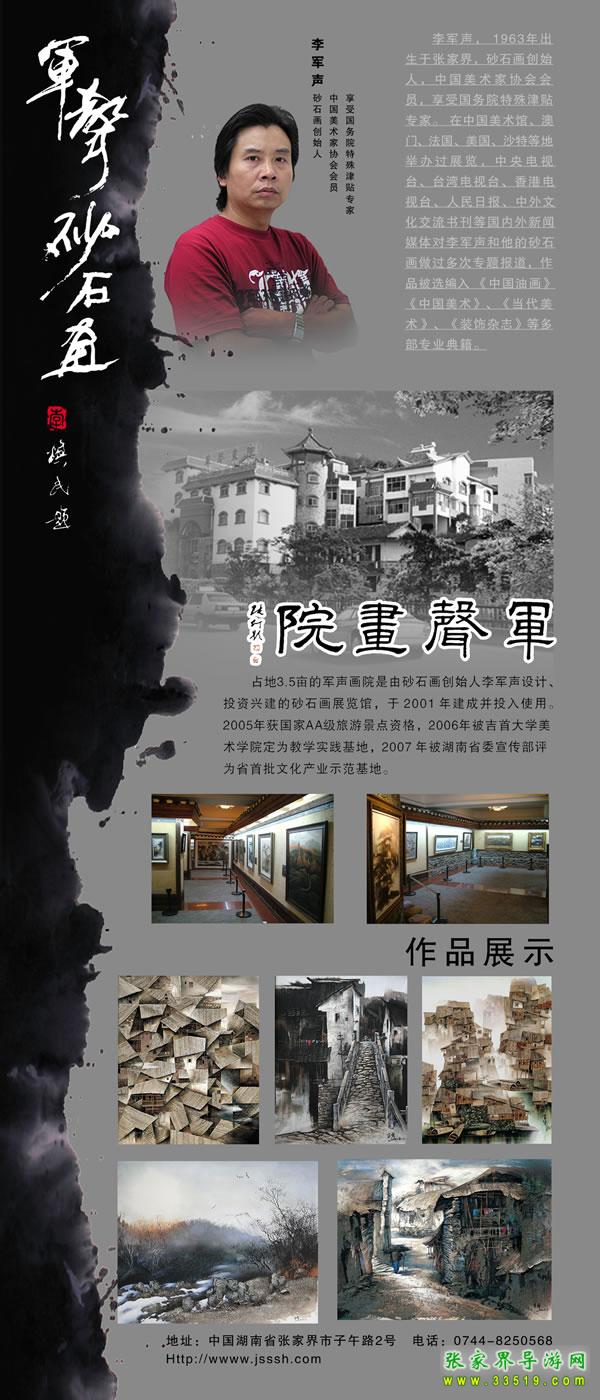
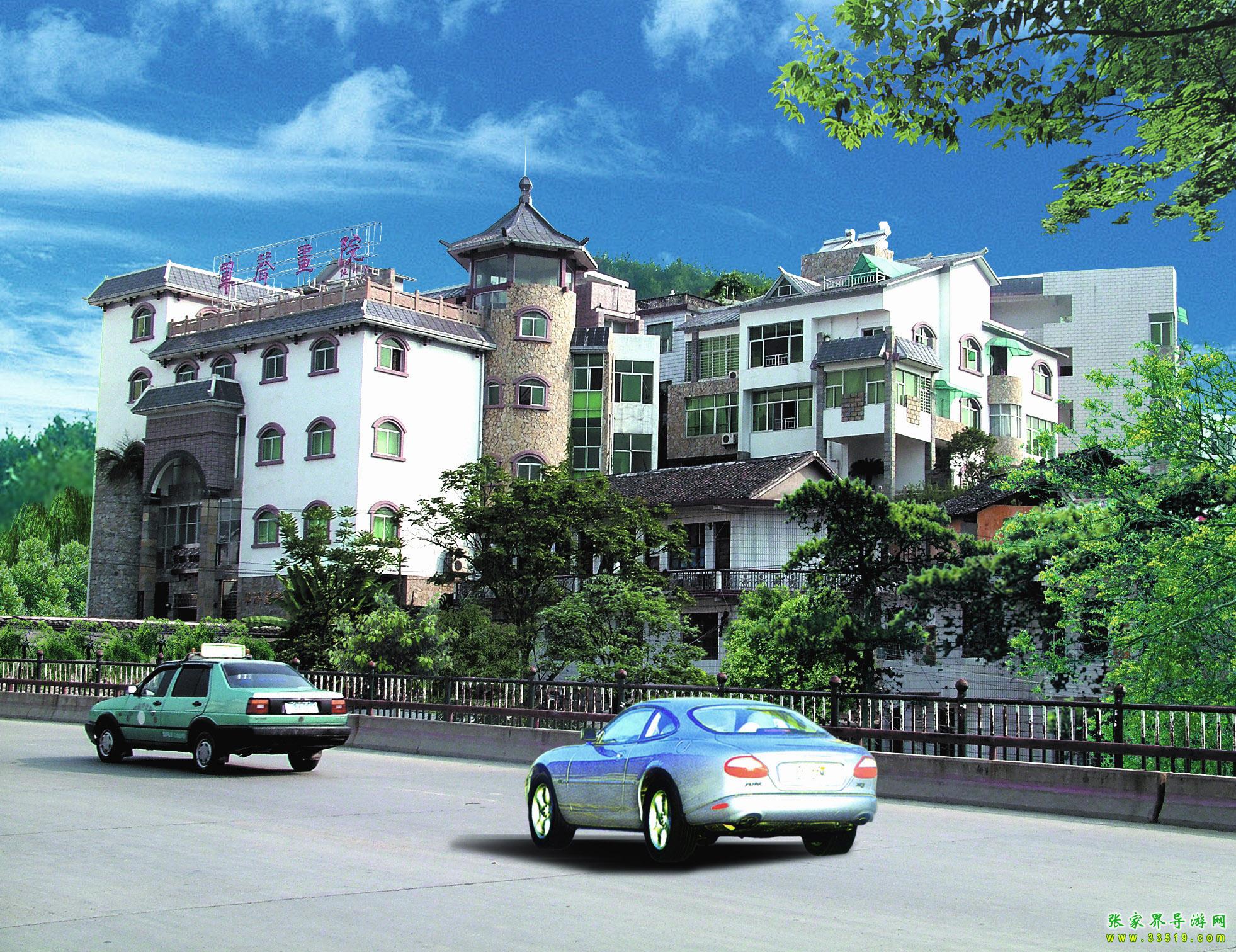
Located at Fengwan Bridge in Zhangjiajie City, Hunan Province, Junsheng Painting Academy was invested in and built in 1999 by Mr. Li Junsheng, a famous young Tujia painter and founder of sandstone painting, in order to promote and publicize the art of sandstone painting. It was officially opened in 2001 as an art research institute integrating research, exhibition, and exchange of sandstone painting. In 2004, the academy successfully applied to the National Tourism Administration and became a national AA-level tourist attraction.
In the 3,000-square-meter, four-story exhibition hall, series of artworks mainly featuring sandstone painting are displayed one after another, giving the viewer a visual impact, shaking the soul, making you linger and forget to leave, and marveling at the artistic charm of sandstone painting! It has thus also become a rare cultural landscape in Zhangjiajie City.
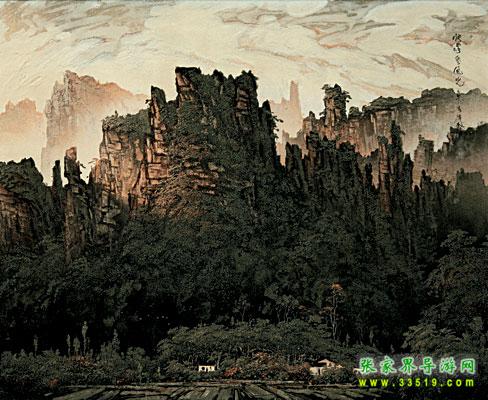
Li Junsheng's sandstone painting belongs to a kind of mixed-media art. Collage or mixed media is a medium commonly used in modern Western art. In the early 20th century, Western modern painters such as Picasso had already begun trying to collage various materials onto canvas. In the mid-20th century, the French painter Dubuffet once used sand, earth, plaster, glue, asphalt, and other materials to smear the surface of canvases; the Spanish painter Tàpies also once painted with mixed materials such as sand, slaked lime, and glue; the American painter Pollock, inspired by the "sand paintings" of Native American Indians, dripped oil paint mixed with sand, glass fragments, and other materials onto canvas. These are all typical examples of modern Western mixed-media art. However, Li Junsheng's sandstone painting is not an appropriation or imitation of Western modern mixed-media art, but rather a unique mixed-media art that he discovered and created through his own aesthetic perception—a modern art born and grown on Chinese soil. Li Junsheng may not know Western modern painters such as Dubuffet, Tàpies, or Pollock, but the sandstone painting he created has achieved a visual effect comparable to the mixed-media art of Western modern painters, and is even richer in Chinese local artistic characteristics, especially those of Zhangjiajie, Hunan. Junsheng sandstone painting is a new art category that uses natural sand, stone, and plants from nature as materials. It breaks through the materials of traditional painting while being rooted in the fertile soil of national art, absorbing other categories, using natural materials to express nature and objects to express objects—more directly, more vividly, and with greater visual impact and artistic appeal.
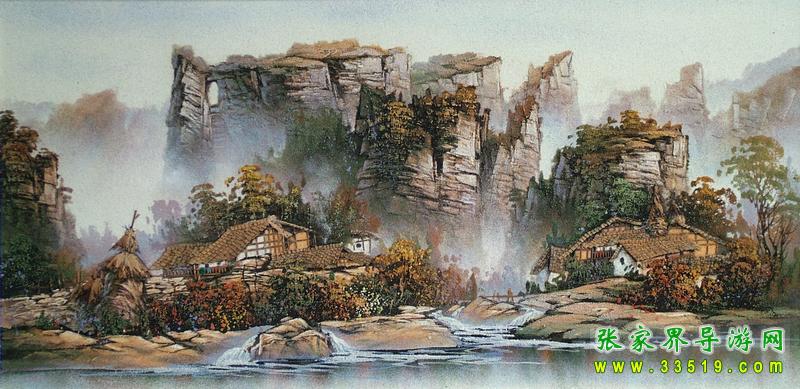
Junsheng sandstone painting has the spirit of Chinese painting, the freshness of watercolor, the gravity of oil painting, the exquisiteness of craft painting, and the three-dimensional feel of semi-relief. It can be said to blend the strengths of many schools, forming its own artistic style and standing alone in the art world.
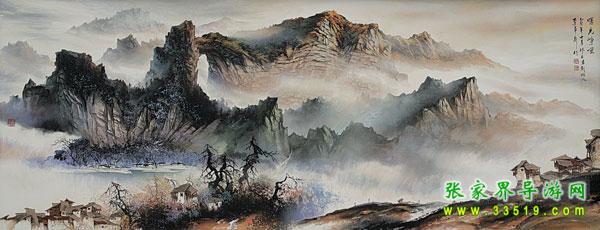
Li Junsheng's work: Splendid Dawn
Junsheng sandstone painting inherits national tradition and, with the creative principle of "art, soul, nature, source," pursues the highest realm of art and life...
Painting is a silent language, a symbol for recording events and conveying emotions. Professional painter Li Junsheng, relying on his solid artistic foundation, conducted an in-depth return-oriented exploration of painting art—using nature to directly depict nature, using objects to express objects. He processed sandstone, a natural material that had lain silent in the natural world for tens of thousands of years, and gave birth to a completely new painting category—sandstone painting. Sandstone painting is the most natural reverence and perception of life, the sedimentation of Li Junsheng's art. Because it draws its materials from nature, people affectionately call it a "green painting genre" and an "environmentally friendly painting genre."
Let us walk together into Li Junsheng and savor his colorful artistic life; let us walk together into the world of sandstone painting and feel its unique artistic charm.
A cultural landscape with unique artistic charm—Junsheng Painting Academy
In Zhangjiajie, Hunan, where the "World Natural Heritage Wulingyuan" is located, the natural scenery is beautiful. As a distinctive cultural landscape of Zhangjiajie, "Junsheng Painting Academy," which shines alongside the natural mountain and water scenery, has become a beautiful scenic line. Large numbers of domestic and international tourists experience the rich artistic atmosphere at "Junsheng Painting Academy" and receive the baptism of a completely new art—the art of sandstone painting.
The Junsheng Painting Academy presents a concentrated display of the sand-and-stone painting art that Mr. Li Junsheng, founder of the genre, has devoted more than twenty years of painstaking research and exploration to. The academy he founded takes "simplicity, nature, and innovation" as its artistic creed, elevating sand-and-stone painting from its original creation to a new height of development. At the main entrance, two stone pillars so thick that two people with outstretched arms could barely encircle them are carved with Tujia folk legends, character stories, and ethnic customs; in the courtyard, within a skylight well inlaid with bluestone slabs, flowers and trees flourish and grotesque rocks are exquisitely arranged; in the reception hall, a one-of-a-kind indoor waterfall cascades down from a height of five stories, sending up flying pearls and splashing jade. In the 3,000-square-meter, three-story exhibition hall, a series of artworks centered on sand-and-stone painting is on display, striking the eye and shaking the soul, making visitors linger and forget to leave, marveling at the artistic charm of sand-and-stone painting! Knock on the door of sand-and-stone painting art, step into the Junsheng Painting Academy, and you step into the artistic palace of the creative mind of Mr. Li Junsheng, founder of sand-and-stone painting.
Li Junsheng, this man who writes legends with sand and stone, successfully held a solo exhibition of sand-and-stone painting at the National Art Museum of China in Beijing in 1994; in 1999, his sand-and-stone painting Wuling Scenery Is the Finest Under Heaven was collected by the China Pavilion of the Kunming World Expo; in 2000, his sand-and-stone painting Ancient City won the gold award at the Third China Arts and Crafts Masterpieces Expo; in 2003, his sand-and-stone painting Landscape was collected by Zhongnanhai; in 2004, his sand-and-stone painting Landscape Reproduced was exhibited at the "Paris · Chinese Painting and Calligraphy Exhibition" in France, and The Soul of Wuling, Tianmen Mountain was selected by the China Council for the Promotion of International Trade as the only painting work to be displayed and collected in the reception hall of the China Pavilion at the 2005 Japan International Expo, while his sand-and-stone painting Tujia Stilted House was sent to the International Exhibitions Bureau; in 2006, his sand-and-stone painting Majestic Tianmen was collected by the Great Hall of the People. His artistic achievements have been featured in special reports by numerous media at home and abroad, and his name has been included in many biographical directories.
The sand-and-stone painting created by Li Junsheng boldly breaks through traditional painting materials, using the colors of natural plants to creatively employ nature, and possesses great artistic value and collectible value. He once said: "A fine work of art is not bound by materials and techniques, but depends on the creator's spiritual insight." The Junsheng Painting Academy and Junsheng sand-and-stone painting are precisely such a cultural landscape of unique artistic charm, shining amid the beautiful scenery of Zhangjiajie.
Painter's Resume
Li Junsheng, founder of sand-and-stone painting, member of the China Artists Association, senior arts and crafts master, member of the China Arts and Crafts Society, and guest professor in the Fine Arts Department of Jishou University.
1994: Held a solo exhibition of sand-and-stone painting at the National Art Museum of China in Beijing;
1997: Founded the Junsheng Sand-and-Stone Painting Research Institute;
1999: His sand-and-stone painting Wuling Scenery Is the Finest Under Heaven was selected by the Hunan Provincial Government for the '99 Kunming World Expo and collected in the China Pavilion;
2000: His sand-and-stone painting Ancient City won the gold award at the Third China Arts and Crafts Masterpieces Expo; in 2003 this work received the "Five-One" Project Award;
2002: His sand-and-stone painting Early Dawn was exhibited in the Hunan exhibition area of the celebration of Mao Zedong's Talks at the Yan'an Forum on Literature and Art held by the China Artists Association, won the bronze award, and was selected for the National Art Exhibition;
2003: The first sand-and-stone painting collection, Junsheng Sand-and-Stone Painting Collection, was published and distributed by the China Federation of Literary and Art Circles Publishing House;
2003: Awarded the Outstanding Contribution Award by the China Arts and Crafts Society;
2003: His sand-and-stone painting Landscape was selected for the 17th New Artists New Works Exhibition held by the China Artists Association;
2004: His sand-and-stone painting Landscape was collected by Zhongnanhai;
2004: His oil painting Lingering Charm of the Tribe won the Excellence Award in the Hunan exhibition area of the 10th National Art Exhibition;
2004: His sand-and-stone painting Landscape Reproduced traveled to France to participate in the "Paris · Chinese Painting and Calligraphy Exhibition";
2004: His sand-and-stone painting The Soul of Wuling, Tianmen Mountain was selected by the China Council for the Promotion of International Trade as the only painting work to be exhibited and collected in the reception hall of the China Pavilion at the 2005 Japan Aichi World Expo;
2004: His sand-and-stone painting Tujia Stilted House was selected by the China Council for the Promotion of International Trade for BIE (International Exhibitions Bureau);
2004: His oil painting Clouds Drifting into the Cloth won the Excellence Award at the Second National Ethnic Minority Painting Exhibition;
2005: Listed as a senior expert directly managed and contacted by the Hunan Provincial Party Committee;
2005: From November 6 to 12, the Macao Foundation held a solo exhibition for Li Junsheng at the Macao Civic and Municipal Affairs Bureau;
2006: His sand-and-stone painting Majestic Tianmen was collected by the Great Hall of the People;
2006: His oil painting Annals of a Small Town was exhibited at the 7th Dalian Art Expo held by the China Artists Association and won the Excellent Work Award;
2007: His sand-and-stone painting Lingering Style won the "China Arts and Crafts Cultural Creativity Gold Award" at the Third Shenzhen International Cultural Industry Fair;
2007: His sand-and-stone painting Strolling Along a Path Through Green Clouds was collected by the State Bureau for Letters and Calls;
2008: His work Great Mountain was selected for the "08 Plastic Arts New Artists Exhibition" hosted by the China Artists Association;
2008: Invited to the United States to participate in the Las Vegas International Art Expo.
CCTV, Taiwan Television, Hong Kong Television, People's Daily, and Chinese and Foreign Cultural Exchange journals and other domestic and international news media have produced numerous special reports on Li Junsheng and his sand-and-stone painting. At the same time, Li Junsheng and his sand-and-stone painting works have been selected for inclusion in many professional volumes such as Chinese Oil Painting, Chinese Art, Contemporary Art, and Decoration Magazine.
Four Major Patents of Sand-and-Stone Painting
Patent One: Seven-Color Sand-and-Stone Painting Technique
The "Junsheng brand" seven-color sand-and-stone painting made with this technique is richer in color, more beautiful in appearance, and highly practical compared with the original sand-and-stone painting.
Patent Two: Portable Sand-and-Stone Painting Technique
The "Junsheng brand" portable sand-and-stone painting made with this technique solves the problem for a great many tourists that sand-and-stone paintings are relatively heavy and inconvenient to carry, meets the needs of different tourists for sand-and-stone painting, and makes it convenient for sand-and-stone painting to go abroad and toward the world.
Patent Three: Door and Window Sand-and-Stone Painting Technique
The "Junsheng brand" door and window sand-and-stone paintings made with this technique are more primitive and elegant, and possess a certain participatory and entertaining quality.
Patent Four: Hidden Painting Technique
The "Junsheng brand" hidden paintings made with this technique make full use of natural materials to express the art of sand-and-stone painting, giving people a feeling of returning to simplicity and authenticity, and pushing the art of sand-and-stone painting to a new peak. Tourists praise this product endlessly.
Transportation
It can be reached within the city by taking the No. 10 ring-line bus.