This attraction introduction is compiled from historical materials in the "Zhangjiajie Tour Guide Network" (33519.com · Scenic Spots section). Ticket prices, opening hours, transportation, and contact information mentioned in the text may be outdated. Please refer to the latest official announcements from the scenic area before traveling; some content consists of historical background/cultural introductions and is for reference only.
About 25 kilometers east of Cili County town, the eastern gateway of Zhangjiajie City, stands a famous mountain—Wulei Mountain. Wulei Mountain is located on the eastern edge of the Wuling Mountains, with its main peak at 980 meters. Because the main peak splits into several ridges extending in a radial pattern, like the earthly bonds described in the Huainanzi: Tianwenxun, it was also called "Dawei Mountain." Later, because the Dawei Mountain Daoist temple experienced the miracle of "thunder sweeping its hall, bells and drums sounding of themselves, and dust cleaning itself away," it was renamed "Wulei Mountain."
The mountain has a pleasant climate, elegant surroundings, dense vegetation, and fresh air. Temperatures are high by day and low by night, cold in winter and cool in summer, with a maximum temperature of 32°C and an average temperature of 11.6°C. As early as the Ming Dynasty, Emperor Shenzong conferred on it the title "Grotto-Heaven Blessed Land." It is even more a holy site of Daoism, long known as "the finest scenic realm south of Chu."
Climbing to the summit and gazing in all directions, one sees swirling clouds and mist, perilous cliffs and sheer walls, layered peaks and ridges, majestic and vast, stretching endlessly. The thousand-year-old Wulei Mountain Temple sits among the peaks. According to the Cili County Gazetteer: "Wulei Mountain rises as a high screen encircling the county 30 li to the south; at its summit is Zhenwu, with Dragon Head Rock, Meeting-Immortals Bridge... and other scenic spots, where the Daoshui River originates. The Wulei Mountain temples and monasteries were built by the Rong Prince of Changde and assisted in repair by the Huayang Prince of Lizhou." "It began in the Tang, flourished in the Song, and reached its height in the Ming and Qing." Repeatedly destroyed and rebuilt, it has now lasted more than 1,300 years. The Wulei Mountain temples were built following the mountain's ridges and ravines, stretching for 15 li, like a long dragon supporting houses, arranged in a pattern of eight inside and seven outside, with more than 100 temples and monasteries large and small, including 36 halls, 72 palaces, and 48 strongholds, in order: Chaozhen Gate, Doumu Palace, Chidi Palace, God of Wealth Hall, Jade Emperor Hall, Prince Hall, Guanyin Pavilion, and Golden Hall. Second only to Wudang Mountain in Hubei, its architectural style and scale are basically the same or similar, so Wulei Mountain also has the elegant title "Southern Wudang."
Inside the mountain gate is the Dragon Head scenic spot. During the Tianshun era of the Ming Dynasty, a county magistrate from Hangzhou brought his wife and children to worship here, leaving a stele inscription: "Observing the shape of the rock, it resembles a flying dragon's head, with prominent horns and angles. This is an ancient site of Zhenwu, a wonder of nature, the finest scenic spot south of Chu."
When touring Wulei Mountain, what strikes one most strongly is the dense atmosphere of Daoist faith. According to local gazetteers: "Wulei Mountain... vast for a hundred li, its peaks arrayed for all to behold. On every pilgrimage gathering, prayers are like a forest and the flow of people like a sea, numbering more than 30,000." Since ancient times there has been a folk couplet: "Whether you go or not, a hundred and eight thousand come each year." Whenever Daoist festivals arrive—the third day of the third lunar month (the birthday of Patriarch Zhenwu), the ninth day of the ninth month (the day the Divine Master ascended to heaven), the fifteenth day of the eighth month (the Hanlin Gathering), and the nineteenth day of the eleventh month (Guanyin Bodhisattva's day)—pilgrims swarm in, many "kowtowing every three steps and bowing every five steps," creating a lively scene of "incense never ceasing in the temples, people never ceasing on the roads, fire never going out in the stoves, and the wooden fish never stopping its sound."
The statue of the Great Emperor Zhenwu sits firmly in the Golden Hall, with hair unbound and black robes, holding a precious sword, treading on a turtle and snake. Guardian generals hold black banners, with golden boys and jade maidens on either side, and the two generals of water and fire standing awe-inspiring, receiving the homage of believers from twenty-eight counties across northwestern Hunan and southwestern Guangdong.
Immersed in such an atmosphere, one feels as if lost in the fog of religion and history. Who exactly was this Patriarch Zhenwu, that he should deserve such worship?
Legend says he was the crown prince of the Kingdom of Pure Joy. His mother carried him for 14 months before giving birth. At age 14, Doumu Yuanjun guided him to find a pure place for cultivation. To this end, the prince searched painstakingly everywhere for a geomantically blessed site, but wherever he went, the mountains could not withstand the tread of his sacred foot—some shook and trembled, some collapsed and crumbled. Only Wulei Mountain actually grew three chi and three cun taller. The prince then piled up a stone chamber there and cultivated himself bitterly. But his arrival alarmed five evil dragons: the Azure Dragon of the East, the Red Dragon of the South, the White Dragon of the West, the Black Dragon of the North, and the Yellow Dragon of the Center. Fighting for the kingship of the holy site of Wulei Mountain, each displayed its divine power, causing eerie winds to blow and stones to fly one moment, and torrential rain and flooding waters the next. Living beings suffered cruelly and fled their homeland with their children. The prince was furious and ordered the Five Thunder Gods to raise their divine hammers and sound five peals of thunder, striking at the evil dragons. The prince then drew the Three Terraces Seven Stars Sword and pointed it angrily at the dragons, and the five dragons instantly turned into five mountains. This is the scene we see today called "Five Dragons Paying Homage." Thereafter, the weather was favorable, and the people lived and worked in peace. The prince also achieved complete merit and finally attained the fruit of enlightenment, throwing himself off the Sacrifice Cliff to shed his mortal body and become an immortal. He was conferred by the Jade Emperor as the Mysterious Supreme Emperor of Infinite Longevity. To commemorate the Great Emperor Zhenwu, people built the Patriarch Hall to enshrine his statue.
The blessed site chosen by the Great Emperor Zhenwu is indeed extraordinary. Not only is the scenery beautiful, but it also displays four great wonders: First, on a clear day, climbing high and gazing out, one can clearly see the urban areas of Changde and Lixian hundreds of li away. Second, the worship platform at the Golden Summit is less than 10 square meters, yet no matter how many people come to worship, they never touch one another, and it can simultaneously accommodate ten dragon lanterns tumbling and battling. Third, every year before the third day of the third month, there is sure to be heavy rain, yet the next day is clear as jade. It is said that the Patriarch descends at this time. Fourth, although the Golden Summit is the highest peak, there is a spring whose water is sweet and delicious, never drying up all year round, flowing continuously even in long droughts. Legend has it that during the Shunzhi era of the Qing Dynasty, Li Zicheng, the Chuang King, traveled to Wulei Mountain in the guise of a monk and happened to fall slightly ill. After drinking this spring water, he recovered, and marveling repeatedly, bestowed on it the name "Golden Summit Divine Spring."
Even more exquisite is the "Hundred Birds Paying Homage to the Phoenix." The Golden Summit, as if cast of gold and carved of jade, is as beautiful as a phoenix. Standing on the Golden Summit and looking down at the whole scene, hundreds of mountain peaks large and small resemble birds with raised heads, encircling the Golden Summit, just like a hundred birds paying homage to the phoenix. When clouds float or thin mist veils the scene, the "hundred birds" seem to raise their heads and spread their wings, floating on waves and about to fly.
Known as "the most perilous spot south of Chu," the Sacrifice Cliff has a rock body like a tongue, jutting out into the air, overlooking a bottomless abyss below. In 1950, when Cili was liberated, the bandit leader Zhu Bazi was pursued by the People's Liberation Army all the way here. Seeing that he was about to be captured alive, Zhu Bazi steeled himself, gritted his teeth, opened an umbrella, and imitating Patriarch Zhenwu, leaped from the Sacrifice Cliff—and surprisingly landed without a scratch. Although Zhu Bazi was caught by soldiers the moment he landed and was ultimately executed, the Sacrifice Cliff has undoubtedly gained another layer of mystery.
The saying that "the Bodhisattvas of Wulei Mountain bless those far away but not those nearby" is known to everyone. What is the reason? A story heard in childhood seems to corroborate it. One year in the twelfth lunar month, the weather was unusually cold, and Daoist priests from near and far gathered at the Wulei Mountain temple. In the Golden Hall they shut the doors and windows tightly, lit fires for warmth, ate meat and drank wine, and reveled all night. The next morning, laypeople discovered that the morning bell, punctual every day, no longer rang. They hurried over and opened the doors of the Golden Hall, and saw those more than 20 Daoist priests lying stiff on the ground with blue-purple faces and foam at the mouths. From then on, the Bodhisattvas of Wulei Mountain "blessed those far away but not those nearby," meaning they protected people from afar but did not care so much for those close by. Although today we can fully understand that the deaths were caused by asphyxiation from lack of oxygen due to their ignorance, the efficacy of the Bodhisattvas remains inexplicable—perhaps the sacred place was defiled, damaging the Bodhisattvas' spiritual power; or perhaps the Bodhisattvas were angry and punished these people who despised Daoist rules. Even so, it should not have brought disaster upon everyone. What is undeniable is that Patriarch Zhenwu is still enshrined on the Sumeru Altar—truly a miracle. Perhaps what people worship is the Bodhisattva in their own hearts, inclined toward goodness, the Dao, and blessings!
In October 2004, Zhangjiajie Wulei (Xian) Mountain Tourism Co., Ltd. began development and construction of Wulei (Xian) Mountain, integrating resources, improving service facilities, raising service standards, and striving to build the tourism brand of China's Southern Wudang—Wulei (Xian) Mountain's distinctive Daoist culture. This not only protects and promotes Wulei (Xian) Mountain's Daoist culture, but also integrates Wulei (Xian) Mountain into the greater Xiangxi tourism circle, relying on Zhangjiajie tourism, using Changde City and the Chang-Zhu-Tan area as connection points, and linking up with the nation's tourism arteries. At present, Wulei (Xian) Mountain tourism is flourishing and has become a new favorite destination for travelers.
Wulei (Xian) Mountain is mysterious, magical, and sacred, ancient yet profound, ethereal yet substantial. It is a dazzling pearl at the eastern gateway of greater Xiangxi.
Wulei (Xian) Mountain is ancient and profound, mysterious and steeply beautiful, divided into four distinctive scenic areas: the Golden Summit Patriarch Mountain Daoist Culture Tourism Area, the Ciji Pagoda International Summer Resort Mountain Villa Vacation Area, the Xingzi Mountain and Chaqi Mountain Taiji Culture Tourism Area, and the Sanwang Laopeng Natural Landscape Adventure Tourism Area.
Main Scenic Spots
Jade Emperor Hall
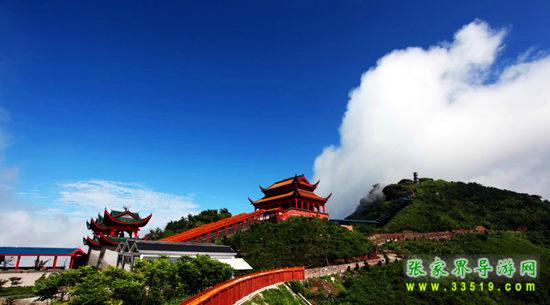
The Jade Emperor Hall was built in the late Ming and early Qing dynasties by the Rong Ding Prince of Changde and the Huayang Prince of Lizhou. Because it was damaged during the Cultural Revolution, the Jade Emperor Hall before us now was restored and rebuilt in 2006, with a grand consecration ceremony held on November 11, 2007. The buildings on both sides are the Bell and Drum Towers—evening drums and morning bells—that fairyland on earth people have yearned for over thousands of years. The Jade Emperor Hall enshrines the Jade Emperor, who is the emperor of all heavens, king of immortals and perfected beings, and lord of the holy and venerable. He is one of the highest deities in the Daoist realm, second only to the Three Pure Ones, overseeing the Dao of Heaven, ruler of the Three Realms, and holding the central axis governing heaven, earth, and humanity. Everyone may come and pay homage.
Meeting-Immortals Bridge
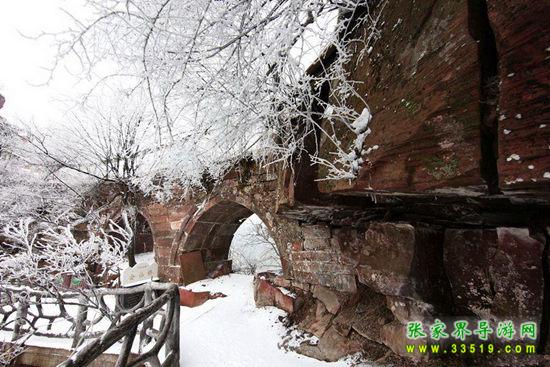
This is a two-arch stone bridge first built in the Tang Dynasty (630–641 CE?), only a few decades after the Zhaozhou Bridge (605 CE). According to successive editions of the Cili County Gazetteer: Li Jing of the Tang Dynasty, during the eighth year of Wude, while on campaign, took note of Wulei Mountain and funded the initial construction of a Daoist temple, and built this bridge leading to the main peak. In the late Wanli era of the Ming Dynasty, the Rong Ding Prince of Changde repaired this bridge, and it was repaired again in the ninth year of the Qianlong era of the Qing Dynasty. Because Daoist practitioners, when attaining immortality, had to descend from the summit (Golden Hall) to the Dressing Terrace to purify themselves, then pass over this bridge to the Sacrifice Cliff to "sacrifice the body" and become immortals, later generations called this bridge the "Immortal-Crossing Bridge."
Golden Hall
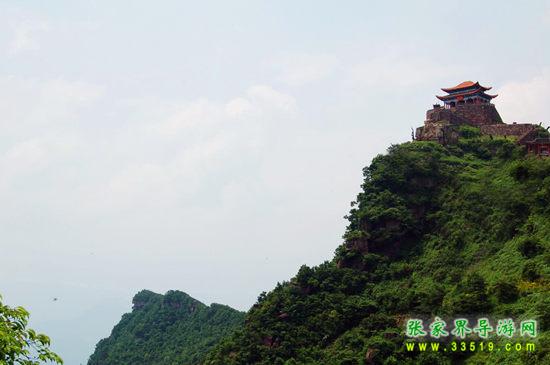
Also called the Golden Summit, it is the highest peak of Wulei Xian Mountain. Legend says it was built by Zhang Dui, who was instructed in a dream by the Patriarch to invite the Huayang Prince and the Rong Ding Prince to construct it. The Golden Hall is built in the ancient palanquin-top style, covered with purple-copper-colored glazed tiles, with beast heads along the eaves, walls built of stone blocks, cliffs on three sides, and a stone stairway winding up on one side, making it magnificent, solemn, and quiet. In the hall is enshrined the statue of Patriarch Zhenwu, cast of nine-fire copper, weighing more than two thousand jin, tightly embedded on a camphor tree stump, made by the Huayang Prince of Lizhou. There are also golden boys and jade maidens, with the Four Time Merit Officers arrayed on both sides, mighty and imposing. In front of the hall were originally two incense burners and a stone pillar inscribed with Zhang Dui's words "The famous mountains south of Chu rank first." Here incense smoke curls and bells sound repeatedly; it is the main hall for holding Daoist rituals and for devout men and women to worship. Though the Golden Hall is perilous, it has four wonders. First, standing at a high point on the borders of Changde, Lizhou, and Hunan-Hubei, on any clear day one can see the Golden Hall shining brilliantly like a pearl, and the urban areas of Changde and Lixian hundreds of li away are clearly visible, while from other places higher than the Golden Hall, the urban areas of Changde and Lixian cannot be seen. Second, the worship platform at the Golden Hall is less than ten square meters, yet no matter how many people come to worship the Patriarch, they never brush against one another, as if no one were there. Third, every year before the third day of the third month, there is sure to be great thunder and heavy rain, yet the next day is clear for thousands of li. It is said that the Patriarch descends at this time. Fourth, although the Golden Summit is the highest peak of Wulei Mountain, there is a spring at the summit whose water flows continuously even in long droughts. Legend has it that in the late Shunzhi era of the Qing Dynasty, Li Zicheng, the Chuang King, traveled to Wulei Mountain in the guise of a monk and happened to fall slightly ill. After drinking this spring water, he recovered and called it the "Golden Summit Divine Spring."
Hundred Birds Paying Homage to the Phoenix
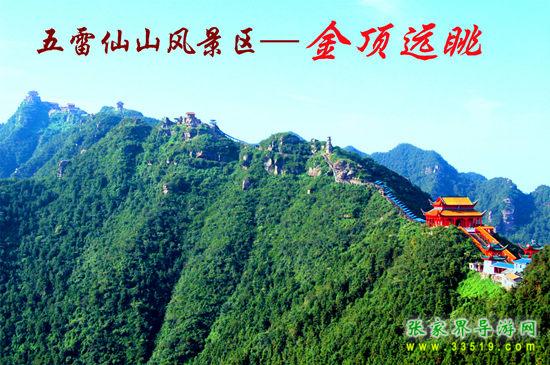
The Golden Summit, as if cast of gold and carved of jade, is as beautiful as a phoenix. Standing on the Golden Summit and gazing around, hundreds of mountain peaks large and small resemble birds with raised heads, encircling the Golden Summit, as if paying homage to the Golden Hall, long known as "Hundred Birds Paying Homage to the Phoenix." When clouds float or thin mist veils the scene, the "hundred birds" seem faintly about to fly; when thick clouds fill the valleys and ravines, hundreds of peaks seem like birds floating on waves—exquisite beyond words.
Five Dragons Supporting the Sage
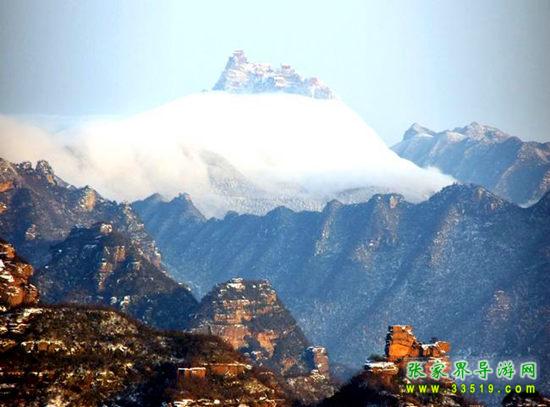
Let us stand on the Golden Summit and gaze in all directions. Around it are five mountain ridges—some surging and galloping in the south, some winding and coiling in the east, some soaring aloft in the north—majestic and varied in form, just like five dragons encircling the Golden Summit, long known as "Five Dragons Supporting the Sage." When the rising sun shoots forth ten thousand golden rays, the dragon bodies rise in smoke and fly in rosy clouds, full of vitality. Especially after rain when the sky first clears and the sunlight is bright, purple vapors swirl, now thick, now thin, casting a layer of mystery over the "dragon bodies," captivating the imagination. Sometimes the clouds and mist suddenly disperse, now high, now low, and the "dragon bodies" are even more beautiful as they pierce the clouds and thread the mist. Legend says the five dragon-shaped ridges are the transformed bodies of five evil dragons after they were subdued by the Patriarch of Wulei Mountain. The myth of the Patriarch subduing the dragons has been passed down to this day.
Wulei Mountain Booking Information
① Scenic area opening hours: 7:00–19:00
② Senior tickets are free with a senior citizen certificate according to relevant national regulations; children under 1.2 meters are free; those between 1.2 and 1.4 meters are charged the student ticket price of 30 yuan
③ Those who purchase tickets at the settlement price will no longer be charged for riding the scenic sightseeing bus within the scenic area (listed price: 15 yuan per person per one-way trip)
④ Special reminder: 63 = ticket 48 + one-way sightseeing bus 15
Wulei Mountain Transportation
It takes only 25 minutes to arrive from Cili County town.