This attraction introduction is compiled from historical materials in the "Zhangjiajie Tour Guide Network" (33519.com · Scenic Spots section). Ticket prices, opening hours, transportation, and contact information mentioned in the text may be outdated. Please refer to the latest official announcements from the scenic area before traveling; some content consists of historical background/cultural introductions and is for reference only.
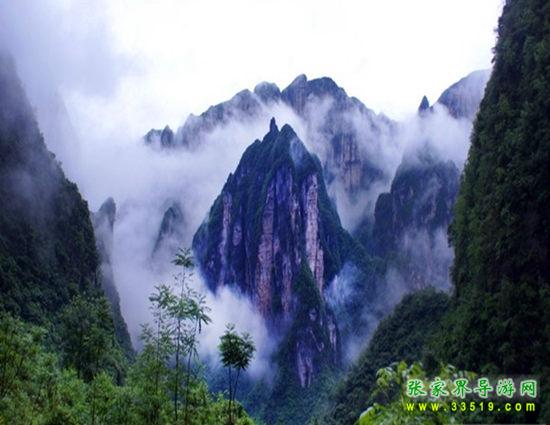
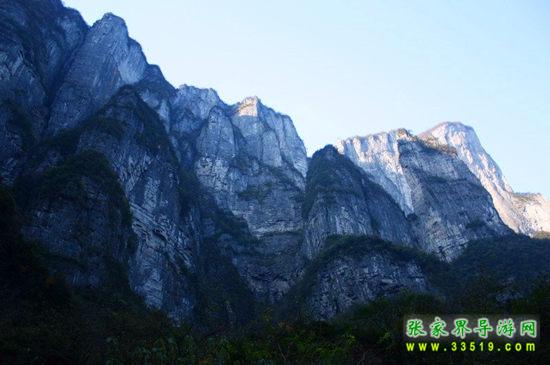
Qixing Mountain stands majestically within the territory of Daping, Yongding. This mountain is the hardest to climb in Zhangjiajie. Its solitary peak rises high, with sheer cliffs on all four sides, standing side by side with Tianmen Mountain. Its highest elevation is 1,528.6 meters, 10 meters higher than Tianmen Mountain. Its total area on the national land resources horizontal map is 19,044 mu, and its actual total area is about 35,000-40,000 mu, more than three times that of Tianmen Mountain. The mountaintop is a huge hilly platform, with an average elevation of 1,400 meters and 280 mu of cultivated land. The average temperature at the mountaintop is about 9C°, with no summer all year round. Forest coverage is 87%, mostly shrub forest, among which nearly 2,000-plus mu of primeval forest are preserved. Rare animals and plants here are very abundant. Animals include macaques, masked palm civets, muntjacs, hedgehogs, pangolins, bamboo rats, white-faced monkeys, hares, wild boars, wild dogs, wild cats, golden pheasants, spotted pheasants, rock eagles, seven-colored pheasants, yellow weasels, and so on, with the red monkey being the most precious. Plants include Chinese tulip tree, magnolia officinalis, Wuling pine, wild mountain pear, Xishan, thousand-year-old ancient boxwood, dove tree, gastrodia, Siliangma, gallnut, lacquer tree, coptis, and so on, and it is listed as one of Zhangjiajie's four major Chinese herbal medicine storehouses (Tianmen Mountain, Badagong Mountain, Zhangjiajie, and Qixingce Mountain).
Qixing Mountain's 'Three Treasures': raw lacquer (the most famous hometown of raw lacquer in the greater Xiangxi region), gallnut, which is currently a scarce raw material worldwide for industry, agriculture, national defense, aviation, medicine, mining, petroleum, food preservation, and so on (wild gallnut is everywhere across the mountains), and honey (the honey of Qixing Mountain is sold far and wide). Wild buckwheat that grows for many years can not only be eaten as food, but is also a good remedy for stomach cancer; its roots can treat diarrhea in children. This longevity green food is worth further research and development.
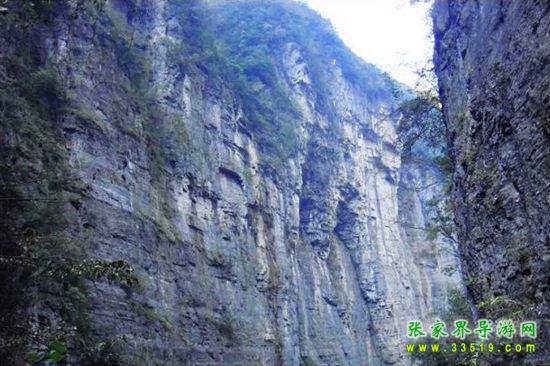
Qixing Mountain lies between Tianmen, Xiongbi Mountain, and Chong Mountain. All four mountains are surrounded by sheer, knife-cut cliffs on all sides, and all stand at elevations above 1,500 meters, forming the most magnificent and spectacular community of vertical isolated-peak landforms on Chinese soil. Among them, Qixing Mountain is the highest and largest.
As early as ancient times, people lived in seclusion on Qixing Mountain. A decade ago, there was still an established village here, with 3 villager groups under it, totaling 34 households and 158 people. Due to blocked transportation and difficult living conditions, the entire village eventually moved out. On June 1, 2009, Zhangjiajie Huahao Agriculture and Forestry Company signed a 50-year equity cooperation agreement with the villagers, and part of the land at the summit has now been opened up as a 12,000-mu gallnut development base.
I. Qixing Mountain — the Birthplace of the Ancient Chinese Zhuanxu Calendar
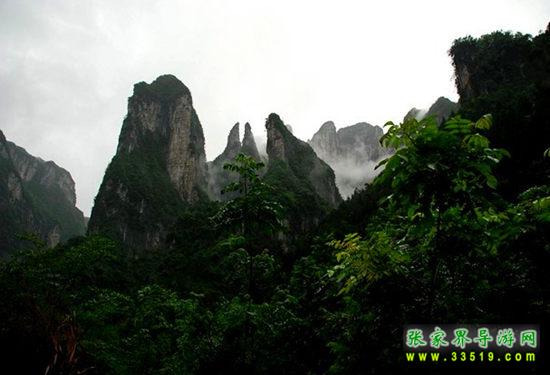
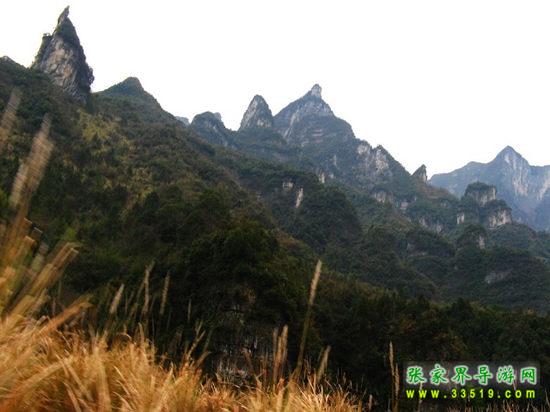
At the top of Qixing Mountain there are about a hundred large and small peaks, among which seven peaks have the highest elevations and are distributed in the pattern of the "Big Dipper." The seven mountains are also named after the seven stars: Tianshu Peak, Tianxuan Peak, Tianji Peak, Tianquan Peak, Yuheng Peak, Kaiyang Peak, and Yaoguang Peak. These seven peaks cluster around the side of the northernmost main peak. This peak is Qixing Mountain, with an elevation of 1,509 meters (not the highest peak). The main peak of Qixing Mountain happens to sit exactly at the intersection of a line of longitude and a line of latitude on modern maps.
At the summit of Qixing Mountain, legend has it that in ancient times this was the observatory where Zhuanxu observed celestial phenomena. Through long-term observation of the movement patterns of the sun, moon, and stars, Zhuanxu created ancient China's first calendar, commonly known as the "Zhuanxu Calendar," which was ranked alongside the Huangdi Calendar, Xia Calendar, Yin Calendar, Zhou Calendar, and Lu Calendar as the Six Ancient Calendars. Later, after expert verification, it was confirmed that among these six ancient calendars, except for the Yin Calendar and the Zhuanxu Calendar, all were falsely attributed by people of the Eastern Han dynasty (see Zhongguo Cidian, Zhejiang Ancient Books Publishing House, 1987 edition). The Zhuanxu Calendar took the Beginning of Spring as the start of the year, midnight as the start of the day, and a tropical year as 365.25 days, while the other five calendars all took the Winter Solstice as the start of the year. After Qin Shi Huang unified China, the Zhuanxu Calendar was promoted throughout the country and remained in use until the first year of Emperor Wu of Han's Taichu era (104 BCE), when the calendar was revised.
Zhuanxu, also known as Emperor Gaoyang, was one of the humanistic ancestors, one of the Five Emperors, and the Great Emperor of the North in mythology. He was also a pioneer in observing celestial phenomena and studying the natural laws of the sun, moon, and stars. The Records of the Grand Historian: Basic Annals of the Five Emperors states: "Emperor Zhuanxu Gaoyang was the grandson of the Yellow Emperor and the son of Changyi. He recorded the seasons by observing the heavens..." The Guoyu: Zhou Yu states: "The stars and the sun and moon all move along their paths; these were what Zhuanxu observed." Legend has it that Zhuanxu was born at Ruoshui and lived at Diqiu (southeast of present-day Puyang, Henan), and his final resting place is unknown. However, we have found an important piece of information in the Guoyu: Zhou Yu:
"When Yu of Xia rose, (Zhu) Rong descended at Chong Mountain."
This means that at the beginning of the Xia dynasty, Zhurong was born at Chong Mountain. Chong Mountain is the Chong Mountain southwest of Zhangjiajie city.
The Records of the Grand Historian: Collected Explanations on the Hereditary House of Chu explains Zhurong as follows: "Zhu means great. Rong and Yong sound the same and were used interchangeably in ancient times," and "Zhurong is Dayong."
The Classic of Mountains and Seas: Great Wilderness West Classic states: "In the midst of the Great Wilderness there is a mountain called Sun-Moon Mountain, which is the Celestial Pivot. Wu Ji's Heaven Gate is where the sun and moon enter... Zhuanxu begot Laotong, and Laotong begot Zhong and Li. The Emperor commanded Zhong to lift up the heavens, and commanded Li to press down the earth. The one who pressed down the earth begot Ye, who dwelt at the Western Extremity to regulate the movements of the sun, moon, and stars."
This means: In the Great Wilderness of the southern barbarians there is a Sun-Moon Mountain, which is the Heaven Gate connecting humans and heaven. The woman of Wu passed through this Heaven Gate to move between the sun and moon. Not far from Sun-Moon Mountain, Zhuanxu begot Laotong, and Laotong begot Zhong and Li. Zhuanxu commanded his grandson "Zhong" to be the Southern Rectifier, in charge of sacrifices to the heavenly gods; and commanded his grandson "Li" to be the Fire Rectifier, that is, the Northern Rectifier, in charge of civil affairs. "Li" is Zhurong. Zhurong's son "Ye" inherited his grandfather's mantle and continued to observe the changes of the sun, moon, and stars. (See Zhongguo Minjian Shenpu, Liaoning People's Publishing House, 2007 edition)
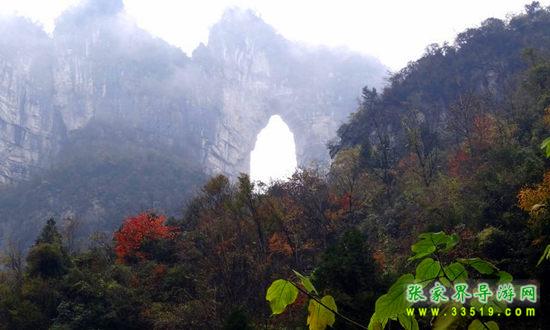
The above records tell us: In order to observe celestial phenomena and create a calendar, Zhuanxu traveled throughout the four directions. Henan, which had only three seasons a year, clearly could not provide an ideal observation point, so he left Diqiu and moved to Chong Mountain by the Lishui River, where he multiplied his descendants. Near Chong Mountain is Qixing Mountain. Behind Qixing Mountain is Houtian Gate, which together with the gate of Tianmen Mountain forms "Sun-Moon Mountain." This passage describes precisely Tianmen Mountain and Qixing Mountain.
Practice has proven that Zhuanxu's migration to Chong Mountain and his use of Qixing Mountain as a base for astronomical research were entirely correct. These seven peaks may well have been named by Zhuanxu. It is also possible that his grandfather the Yellow Emperor did indeed study astronomy and calendrics but did not succeed, and this task was instead completed by his grandson Zhuanxu.
But observing celestial phenomena and mastering nature was no easy task. Zhuanxu created the calendar, but its perfection was accomplished by his grandsons Zhong and Li (Zhurong) and even his great-grandson "Ye." From the Yellow Emperor to "Ye," this astronomical family carried on generation after generation, advancing wave upon wave, making no small contribution to their homeland and to the world.
To commemorate the merits of Zhong and Li (Dayong), when Dayong Guard City was built in the third year of the Hongwu era of the Ming dynasty, two main streets were specially named "Beizheng Street" and "Nanzheng Street."
The mountain behind present-day Zhangjiajie city is an ancient astronomical place name: Ziwu Terrace. Ziwu Terrace happens to form a line of longitude with Qixing Mountain. Twenty li to the west is "Fengxiang Gang" (Wind Direction Ridge) for observing wind direction, and seventy li to the east is "Kemu Mountain." These ancient astronomical place-name clues are all related to Zhuanxu's astronomical family. Such a dense concentration of observatory sites is rare in China.
After the era of Zhuanxu and Zhurong (Dayong), four place-name symbols appeared on Qixing Mountain:
Tianshi (Heavenly Master): the founding ancestor of celestial observation, referring to the astronomical and calendrical family of Zhuanxu and Zhurong;
Tianshi Cave: said to be the place where Zhuanxu first lived when he came up Qixing Mountain;
Tianshi Yong: the residence of the ancient Heavenly Master Dayong (Zhurong);
Tianshi Temple: built in the early Ming dynasty to offer sacrifices to Zhuanxu's astronomical family.
The greatest value of Qixing Mountain lies in the fact that it is the birthplace of the Zhuanxu Calendar. This is the foremost cultural lineage of the "Castle in the Sky" project.
II. Xia Dezhong Created the Qixing Mountain "Castle in the Sky" in the Ming Dynasty
In the 22nd year of the Hongwu era of the Ming dynasty (1389), Xia Dezhong, a chiliarch of the Anfu Garrison in Cili, joined with the native people of Jiuxi in an uprising against the government, and successively captured Cili and Shimen counties. Emperor Taizu of Ming ordered Marquis of Jingning Ye Sheng, Marquis of Dongchuan Hu Hai, and the Southern Campaign General Zhou Dexing to lead 100,000 troops to suppress them. The two armies fought successively at Jiuxi, Yongding, Tianhuo Ridge, Lumao Border, and Liugubei Cave. Xia's army was defeated and, with 9,000 remaining troops, held fast on Qixing Mountain, building three camps — upper, middle, and lower. All three camps used huge timbers as fences, with many hidden traps placed between the fence rails. Once the Ming army attacked up the mountain, they could build three gates at the three passes — southeast (from Chisong Village), northwest (from Xiami Stream), and west (from Houtian Gate) — forming an indestructible fortress. This was a unique castle in the sky in ancient Chinese military history. In Chinese history, there was Diaoyu Fortress in Hejiang, Sichuan, Hailongtun in Zunyi, Guizhou, and Qinian Fortress in Maogang, Dayong. But none could compare with the Qixing Mountain Castle in the Sky.
The Qixing Mountain Castle in the Sky was surrounded by knife-cut cliffs over 1,400 meters high, impassable to birds and unclimbable by apes, shrouded in clouds and mist like a heavenly palace. Yet even the strongest fortress, after three years under siege with ammunition and provisions exhausted, was breached by the Ming army. The rebel troops fought camp by camp and man by man; most of the 9,000 soldiers starved or died in battle. Xia led 800 remaining troops, cut a bloody path out, and fled to Tianhuo Ridge, where he was later captured and executed by slow slicing. Although this castle was utterly destroyed by the Ming army, it left behind a most fascinating legend of a castle in the sky.
III. Prince Zhu Ruhui of Wuchang in the Ming Dynasty and Footprint Mountain
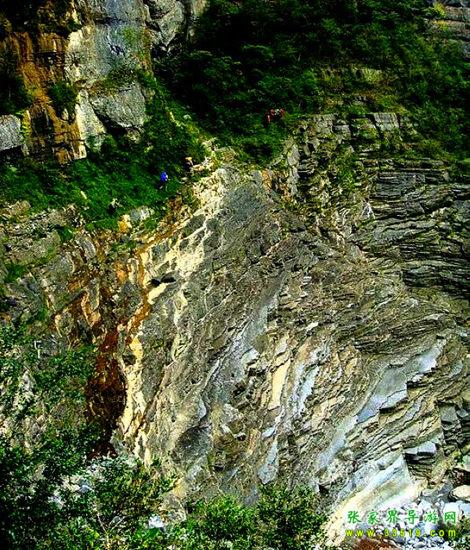
During the Tianqi era of the Ming dynasty (1621–1627), the great traitor Wei Zhongxian threw the party and the country into chaos. Zhu Ruhui, then 16 years old and a prince of Wuchang, participated in a secret "Clear the Emperor's Side" movement initiated by a group of civil and military officials at court. When the plot was discovered, Zhu Ruhui was pursued by Wei's eunuch faction and forced to take refuge in Longhua Temple, where he shaved his head and became a monk with the dharma name Hengxing. Thereafter, constantly hunted, he wandered far and wide and went into hiding on Footprint Mountain in the seventh year of the Chongzhen era (1634). Footprint Mountain (called Jueyun Mountain in ancient steles) is part of Qixing Mountain. It became an isolated island due to a fissure in the mountain body over 100 meters high, more than 50 meters wide, and over 100 meters deep. Footprint Mountain is surrounded on all sides by knife-cut cliffs, and on top is a hilly plateau of about 2,000 mu. Such an isolated peak is a geological and landform marvel, rarely seen in the world. An ancient stele records: "Master Hengxing, from the seventh year of Chongzhen, jiaxu (1634), traveled to Yongyi, strict in monastic discipline, and people vied to pay him respect. He then made a quiet chamber on Jueyun Mountain, drawing from cliffs and perching there for twenty-eight years." In the seventeenth year of Chongzhen (1644), Li Chuang captured the capital, and Chongzhen hanged himself. In the eighteenth year of Shunzhi of the Qing dynasty (1661), "as the cliffs were high and steep and visits were inconvenient, all requested him to come down the mountain to reside" (Dabei Nunnery Stele). Hengxing then moved the temple to Maoping (present-day airport).
Zhu Ruhui cultivated himself on Footprint Mountain for a full 27 years and created the unique "Jueyun Buddhist Tea Ceremony," which is the Tianchong Maojian tribute tea.
IV. Zengjiawan, Zeng Daokun, and the Tianmen Poetry Society
Zeng Daokun (1882–1960) was a xiucai (licentiate) of the late Qing dynasty. He graduated from the Hunan Higher Police School. He successively served as police chief of Cili, Lixian, Longshan, and Dayong, and acting county magistrate of Longshan. Later he was transferred to be head of the Hunan Police Department, but declined the post due to unsettled times. In 1954 he was elected a county people's representative. A lifelong avid learner and diligent reader, steeped in the classics until his hair turned white, he was especially skilled in poetry and medicine and was a renowned physician of his region. He wrote Linzheng Tiyan, which has been handed down through the generations. In the late 1940s, together with the famous local poet Tuo Ya, he initiated the restoration of the Tianmen Poetry Society, and Mr. Zeng was elected president of that session by virtue of his high prestige and poetic accomplishments. Zeng Daokun should be regarded as Qixing Mountain's foremost talent, poet, and medical scientist. His son Zeng Xiangwei inherited his father's aspirations, was widely read in poetry and books, and became a renowned physician and great scholar of the Yongding generation.
The above four cultural lineages are the very soul of this project and the original source of the project's stories. A project without stories lacks appeal, and a project without culture cannot generate market competitiveness. In other words, it is because Qixing Mountain is adorned with these four cultural lineages that it appears noble and rich.
In addition to the above four cultural lineages, outstanding historical and cultural figures abound around Qixing Mountain. For example, at the eastern foot there are Chisong Flat, Chisong Village, Chisong Stream, and Chisong Bridge, and the Chisong Stele still survives today; at Daping Huangjia River there was Yang Zhou, a Hanlin Academician and jinshi of the Yuan dynasty, and the Hanlin Willow he planted by hand still flourishes; to the west, Xianren Stream is a mysterious gorge recorded in historical texts, where the Song dynasty Tujia hero Tian Hu's body was buried at Shamao Mountain; and Chong Mountain, neighboring Qixing Mountain, is the homeland of Emperor Gaoyang (Zhuanxu), where he begot Zhurong and from whom descended the great patriotic poet Qu Yuan (Qu Yuan's poem: "I am a descendant of Emperor Gaoyang; my late father was named Boyong"), and so on. These historical giants cast a brilliant halo over Qixing Mountain and are invaluable cultural symbols for future external promotion. For outside investors and the many tourists fortunate enough to join Qixing Mountain, being accompanied by these giants is one of life's great blessings.