This attraction introduction is compiled from historical materials in the "Zhangjiajie Tour Guide Network" (33519.com · Scenic Spots section). Ticket prices, opening hours, transportation, and contact information mentioned in the text may be outdated. Please refer to the latest official announcements from the scenic area before traveling; some content consists of historical background/cultural introductions and is for reference only.
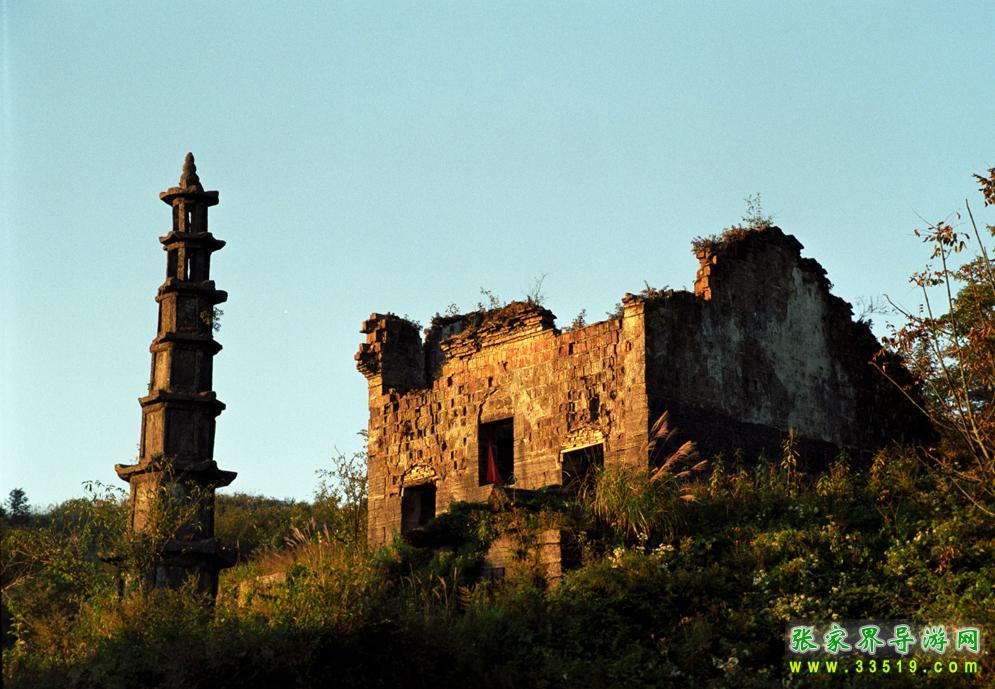
Longfeng Nunnery
Longfeng Nunnery is located at Huaxiang Slope on the northwest side of Zhangjiajie, facing south with its back to the north, with two stone mountains resembling a dragon and a phoenix facing each other on either side. "The stone cliffs rise steeply, embracing the posture of a crouching dragon; the mountain forests are like jade, taking the form of a soaring immortal phoenix." Hence the name Longfeng (Dragon-Phoenix) Nunnery. According to the stone stele at Longfeng Nunnery, the nunnery was built in the Ming dynasty and was repaired seven times during the Qing dynasty, eventually reaching a scale of two courtyards and three halls, with an area of more than 1,100 square meters. Longfeng Nunnery was built on the ancient post road between Sangzhi and Cili, and in former days incense was abundant and it was famous throughout the region. Today, apart from the damaged enshrined statues and some dilapidated halls, the nunnery still retains the front hall, the Huaxiang Incense Burner Stone Pagoda, the left and right Dragon Gates, and the left and right Phoenix Pools. There are also nine stone inscriptions, well preserved, with elegant text and exquisite carving.
Dabei Nunnery
Dabei Nunnery is located at Mune Li in Xingjiaxiang Township, 7 kilometers southwest of Zhangjiajie, and was founded by the Ming monk Hengxing. Hengxing, courtesy name Ruling, was a prince of Wuchang in the Ming dynasty and inherited the title of General Who Guards the State. During the Tianqi era, the eunuch Wei (Zhongxian) monopolized power and persecuted loyal officials. Hengxing, then only 16, intended to punish him to clear the emperor's side. When the plot was discovered, he fled to Longhua Temple in Hunan and shaved his head to become a monk; at his ordination Hengxing wept loudly. Afterwards he wandered to famous sites such as Mount Heng and Mount Emei. In the seventh year of Chongzhen (1635) he traveled to Yongding, where on Jueyun Mountain (now within Dayong's Xianren Stream) he built a wooden temple and thatched a nunnery. During the Kangxi era the temple was moved to Mune Li, initially named Dahui Hall and later changed to Dabei Nunnery. Hengxing passed away at the age of 77 and was honored as the founding patriarch of the nunnery. Dabei Nunnery was built facing northwest, also implying Hengxing's longing for the capital. It has three courtyards and three halls, covering 5 mu. Today there remain the second courtyard's main hall, the right elixir pool, and some stone inscriptions. The hall has a single-eave hip-and-gable roof, with a depth of 10 meters; the central bay is 5 meters wide and the side bays 4.2 meters wide, all of wooden structure with single-layer bracket sets, whose arms are large and whose form is grand and spectacular. In former times Dabei Nunnery was extremely popular because of Hengxing's fame and was one of the famous temples of western Hunan. It suffered several calamities and nearly fell into ruin, but was repeatedly repaired, and the villagers and local government also repeatedly punished unruly monks, so that it has been passed down to this day. During the Republic of China period, when village schools were established, Dabei Nunnery was converted into school buildings, which are still in use today.
Chaotian Temple
Chaotian Temple is built at Zhangjiajie. Chaotian Mountain: "The mountain is named Chaotian, meaning to look up at the vast heavens." Chaotian Mountain has an elevation of 1,227.3 meters, and its terrain is extremely precipitous. The original temple site was on the mountain not far from the present site, and over time it suffered several calamities and nearly fell into ruin. During the Kangxi era, a monk named Xingzuo climbed to Chaotian Temple to practice austerities and moved the temple to its present site, whereby the temple was able to regain its former appearance. During the Qianlong era, the Li brothers, mountain villagers, found a bronze statue of Zhenwu while plowing and enshrined it in the temple; from then on incense was abundant. After repeated repairs, it reached a scale of three courtyards and two halls with more than 20 rooms, covering more than 1,900 square meters, becoming another famous ancient temple of Wuling. Chaotian Temple is unique in architectural art: the temple is surrounded by double walls, and the doors, windows, pillars, and plaques are all of stone structure and all carved; the statues of the deities are all gilded and painted. During the Republic of China period, Chaotian Temple was destroyed by bandits; today only part of the stone walls and the mountain gate remain. There are 17 gate openings of various sizes and 42 stone inscriptions from successive dynasties.
Guan Temple
Guan Temple is on the north side of Jiefang East Road in Zhangjiajie city, adjoining Puguang Zen Temple to the west and the tourism vocational school to the east, with a total area of 1,783 square meters. It was built in the late Ming and early Qing dynasties and was formerly a place for sacrifices, opera performances, and martial arts contests. Guan Temple is divided into several parts: the mountain gate, the square, the front hall, the Guandi Hall, and the resting hall, with high walls forming a rectangular layout. Outside the mountain gate stands a pair of mighty stone lions with bases, 3.35 meters tall; on both sides are 4 meditation rooms in a half-slope style. Passing through the mountain gate one enters the square, with an area of 515 square meters, flanked by 6 side halls on each side. The second courtyard is the front hall, with a single-eave hip-and-gable roof, and the ridge decorated with porcelain inlay. The lintel above the main door has a relief of two dragons contending for a pearl. Behind the hall, on either side of the elixir pool, each has a hexagonal pavilion with a double-eave pointed top, each eave having six upturned corners, exquisite and delicate. The Guandi Hall is the main hall of the entire temple, with four doors and three bays, 13.25 meters deep; the central hall is 5.6 meters wide and the side bays 3.3 meters wide. The holy statue of Guandi is enshrined in the central hall, with Guan Ping and Zhou Cang standing in attendance on either side. The pedestal is carved with landscape and figure stories, simple in composition, as if it were a traditional Chinese painting. The resting hall has three bays, with a single-eave hip-and-gable roof, the same width as the front hall. Guan Temple's architecture is mainly of wooden structure, and its pillar bases, elixir pools, and so on are all finely carved and exquisitely crafted. After the founding of the People's Republic, it was once used as an exhibition hall, and later transferred to Yongding School, where most of the halls were converted into classrooms and dormitories. In 1986 the state allocated funds to restore Puguang Zen Temple, and Guan Temple was subsequently repaired as well; it is now open to visitors. The Yongding District Cultural Relics Exhibition Room is now located in Guan Temple.
Chongwen Pagoda
Located at Baotagang east of Zhangjiajie city, it was built in the 19th year of the Qianlong reign of the Qing Dynasty (1754), funded by Ma Sui of Yongding County. According to the "Yongding County Local Gazetteer": "Ma Sui, a native of Shangyu, Zhejiang, took office in the 18th year of Qianlong (1753). He was kind and generous, carried out many beneficial policies, was skilled in geomancy, and delighted in fostering literary culture. The eastern hill of the county was low and weak, so he assessed its yin and yang and specially built the Chongwen Pagoda and established the Dongyue Palace to extend auspicious energy." After the pagoda was completed, Magistrate Ma asked every household to donate two wine pots, and metal wine pots as well, collecting over 400 wine pots in total, which were cast into the pagoda finial, one meter tall and weighing about 200 kilograms. The Chongwen Pagoda is octagonal, seven stories, with a total height of 25 meters. The pagoda body is of pavilion style, tapering gradually from bottom to top. There are no columns inside the pagoda; each level uses wall brackets to support wooden floorboards, and the staircase spirals upward along the walls, connecting all levels. Climbing level by level, one can reach the top of the pagoda. Looking down from the top, the Lishui River and Yongcheng city are all taken in at a glance.