This attraction introduction is compiled from historical materials in the "Zhangjiajie Tour Guide Network" (33519.com · Scenic Spots section). Ticket prices, opening hours, transportation, and contact information mentioned in the text may be outdated. Please refer to the latest official announcements from the scenic area before traveling; some content consists of historical background/cultural introductions and is for reference only.
He Long's Former Residence
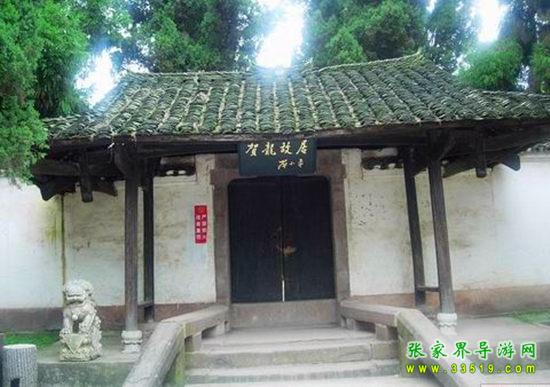
Marshal He Long was born here on March 22, 1896. He Long's Former Residence is located at the western end of Hongjiaguan in Sangzhi County. It was built by He Long's grandfather, He Liangshi, and was burned down by "divine soldiers" in 1918. The current preserved house was restored to its original appearance in 1977. This resource has now been developed for tourism. He Long was a heroic figure who "started the revolution with two kitchen knives" in his early years. After joining the revolution, he participated in the "August 1st" Nanchang Uprising and made outstanding contributions to the creation of the people's army and the founding of New China. After the founding of the People's Republic, he served as a member of the Political Bureau of the CPC Central Committee, Vice Premier of the State Council, and other important positions, and was awarded the rank of Marshal of the People's Republic of China. Therefore, his former residence was selected in March 2005 as a classic scenic spot for national red tourism.
He Long Memorial Hall, He Long Bridge
The He Long Memorial Hall and He Long Bridge are both located opposite He Long's Former Residence in Hongjiaguan, Sangzhi County. The He Long Memorial Hall, completed in 1996, covers an area of 9,335 square meters with a building area of 2,080 square meters. It is surrounded by water on three sides, with the clear Yuquan River, Tianlong Stream, and Yulin Stream winding around it, nestling the memorial hall amidst mountains and green waters.
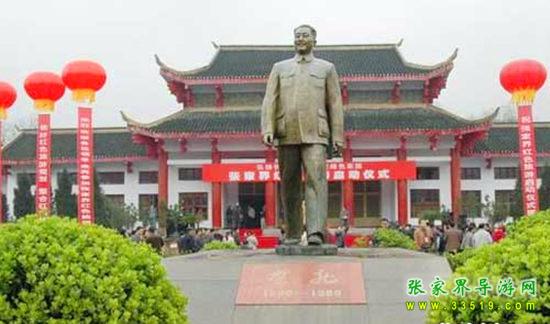
Eighty meters in front of the He Long Memorial Hall stands a small stone arch bridge with unique ethnic characteristics, named "Bailong Bridge." It connects He Long Bridge, He Long's Former Residence, and the He Long Memorial Hall into one integrated whole, complementing each other. A tall bronze statue of He Long stands on a large bluestone pedestal in the center of the memorial hall square. Above the majestic main entrance of the memorial hall are five golden characters reading "He Long Memorial Hall," inscribed by Jiang Zemin, then General Secretary of the CPC Central Committee, President of the State, and Chairman of the Central Military Commission. The hall has one introductory hall and seven exhibition halls, displaying the glorious life and revolutionary achievements of Marshal He Long across different historical periods.
On March 25, 1996, Zhang Wannian, Vice Chairman of the Central Military Commission, Liao Hansheng, former Vice Chairman of the National People's Congress Standing Committee, and Xue Ming, Marshal He's wife, made a special trip to Hongjiaguan to attend the grand gathering commemorating the 100th anniversary of He Long's birth and to unveil the bronze statue of He Long. Zhang Wannian delivered an important speech on behalf of the CPC Central Committee and the Central Military Commission and presented a flower basket. Zhang Wannian, Liao Hansheng, Xue Ming, and others were the first guests to visit the exhibition room of He Long's life and achievements. From then on, the memorial hall was officially opened to the public. The He Long Memorial Hall is listed as a patriotism education base in Hunan Province. In March 2005, it was selected as a classic scenic spot for national red tourism.
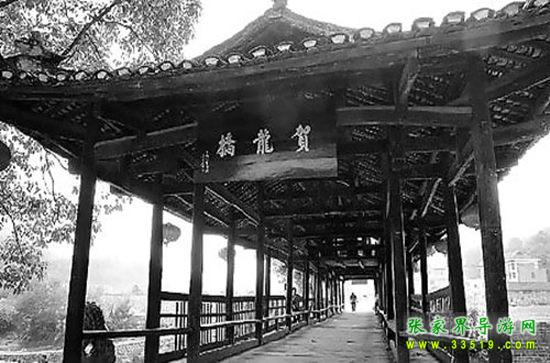
He Long Bridge was originally called "Yong'an Bridge." It spans the Yuquan River on the right side of He Long's Former Residence and is a covered bridge with stone piers, wooden beams, and a riding gallery. It is 40 meters long from east to west, 7 meters wide, and 8 meters high. With dragon-claw upturned eaves, a fortress pavilion rising in the middle, and eight stone lions placed at the bridge ends and on the stone piers, it has a robust and ancient style rich in ethnic characteristics. This bridge was originally the only route connecting the inner and outer halves of Sangzhi County, a key crossing point from Sichuan and Hubei down to Jin and Li, and the starting point of the salt bureau gun seizure and the Sangzhi Uprising. It was first proposed and funded by He Long's great-grandfather, He Tingzai, and was rebuilt and collapsed several times. By 1916, it was finally completed with the assistance of He Long's father, He Shidao. In the winter of 1929, Chen Cexun, the Sangzhi "anti-communist" commander, ordered the bridge destroyed, claiming it would break the "He family's feng shui." After liberation, the Sangzhi County People's Government restored it to its original appearance in the winter of 1952 and named it "He Long Bridge." During the "Cultural Revolution," Lin Biao and the "Gang of Four" framed He Long and directed the "Red Guards" to destroy the bridge, but the masses rose up to protect it, and it narrowly escaped destruction. In May 1983, at the request of the county government, He Xiaoming, Marshal He's daughter, obtained a plaque inscribed with "He Long Bridge" by Xie Deping, Secretary-General of the National Calligraphers Association, which was hung high at the east and west ends of the bridge as a permanent memorial. In 1978, He Long's Former Residence, its life and achievements exhibition room, and He Long Bridge were listed as provincial key cultural relics protection units. This is a must-pass place for all tourists visiting He Long's Former Residence and the He Long Memorial Hall.
Liujiaping, the Starting Point of the Long March of the Red Second and Sixth Army Groups (Red Second Front Army)
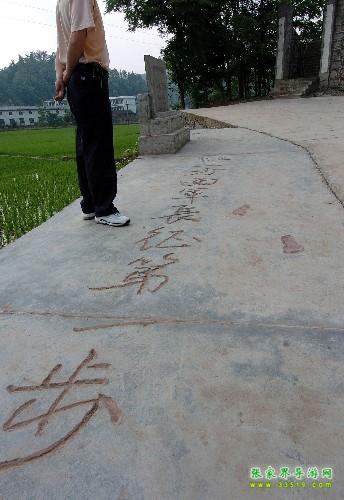
Liujiaping, also known as Zhujita, is 13 km from Sangzhi County seat. During the Agrarian Revolutionary War, this was one of the central areas for establishing the Hunan-Hubei Border, Hunan-Hubei West, and Hunan-Hubei-Sichuan-Guizhou revolutionary base areas. In early and mid-October 1935, the Red Second and Sixth Army Groups (in July 1936, the Red Second and Sixth Army Groups and the Red 32nd Army formed the Second Front Army of the Chinese Workers' and Peasants' Red Army) gathered their troops in the Liujiaping area of Sangzhi County to coordinate and support the Central Red Army's Long March and to prepare for their own breakout and expedition. In early November, the general headquarters of the Red Second and Sixth Army Groups, the Hunan-Hubei-Sichuan-Guizhou Branch of the Central Revolutionary Military Commission, the CPC Hunan-Hubei-Sichuan-Guizhou Provincial Committee, the Provincial Revolutionary Committee, and the Provincial Military District moved from Sangzhi County seat to this location. On November 4, He Long, Ren Bishi, Guan Xiangying, Xiao Ke, Wang Zhen, and other leaders of the army groups and the provincial committee held a meeting to study and deploy the strategic transfer policy and breakout action plan for the Red Army. After full preparations following the meeting, on November 19, the Red Second and Sixth Army Groups held a mobilization rally in Liujiaping in the rain. He Long, commander of the Red Second Army Group, announced the order for the breakout and expedition. That night, after three cannon shots, over ten thousand Red Army officers and soldiers from the two army groups set out from Liujiaping, Gantianba, and Fengshuta to carry out a strategic transfer (later known as the Long March). Since then, "Liujiaping" has been recorded in history alongside the Long March.
On November 19, 1985, the Sangzhi County Party Committee and County Government decided to build a Red Army Long March Monument in Liujiaping, which received strong support from relevant higher-level departments and central leaders. The monument was completed on November 19, 1986, and a grand unveiling ceremony was held. Central leaders including Liao Hansheng and Deng Liqun made a special trip to unveil the monument. The front of the monument is finely inlaid with the inscription by Wang Zhen, former Vice President of the State: "Liujiaping, the Starting Point of the Long March of the Second Front Army of the Chinese Workers' and Peasants' Red Army." The monument is 21 meters high, with a base 1.9 meters wide, topped with golden glazed tiles. It covers an area of 1,400 square meters. Around the monument stand four marble reliefs symbolizing "Long March Departure," "Victorious Meeting," and others. Surrounding the base are 35 lion-head pillar designs, and the bluestone railings are truly majestic and spectacular.
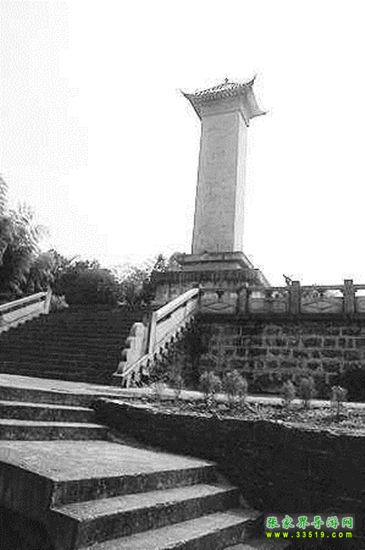
Adjacent to the monument is the "Red Second Front Army Long March Memorial Hall." The hall's name was inscribed by Liao Hansheng, former Vice Chairman of the National People's Congress Standing Committee. The hall displays historical photos, cultural relics, and documentary materials from before and after the Red Second Front Army's Long March departure. In 1986, it was declared a provincial key cultural relics protection unit. In March 2005, it was listed as one of the nation's finest red tourism routes.
Hunan-Hubei-Sichuan-Guizhou Revolutionary Base Area (Hunan-Hubei-Sichuan-Guizhou Soviet Area) Memorial Hall
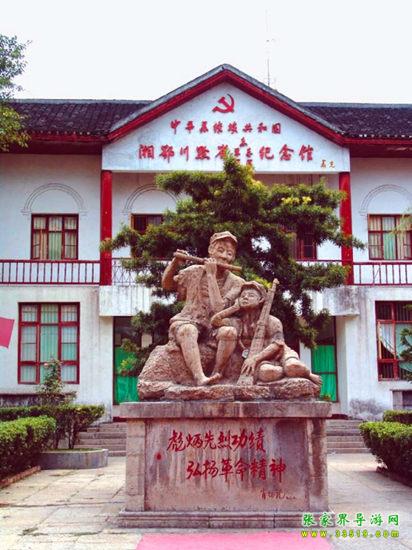
The memorial hall is located on Jiefang Road in the urban area of Yongding. The Hunan-Hubei-Sichuan-Guizhou Revolutionary Base Area was created in the winter of 1933 and lasted until the spring of 1936. Its area centered on the four counties of Dayong, Sangzhi, Yongshun, and Longshan in Hunan, including parts of 31 counties and cities: Baojing, Cili, Yuanling, Taoyuan, Changde, Shimen, Linli, Li County, and Jinshi in Hunan; Xuan'en, Laifeng, Xianfeng, Songzi, Hefeng, and Lichuan in Hubei; Youyang, Xiushan, Qianjiang, Pengshui, and Shizhu in Sichuan; and Yanhe, Yinjiang, Dejiang, Songtao, Jiangkou, Shiqian, and Sinan in Guizhou (most of which were guerrilla base areas). On November 24, 1934, Ren Bishi, He Long, Guan Xiangying, Wang Zhen, Xiao Ke, and others led the Red Second and Sixth Army Groups to liberate Dayong (now Yongding District). On the 26th, in accordance with the spirit of the Central Committee's telegram, the CPC Hunan-Hubei-Sichuan-Guizhou Provincial Committee, Provincial Military District, and Provincial Revolutionary Committee were successively established here (later relocated to Tawo and other places in Yongshun). Under the leadership of the provincial committee, provincial revolutionary committee, and provincial military district, the military and civilians of the base area established Soviet red political power and carried out vigorous revolutionary
struggles, dealing heavy blows to the Kuomintang reactionaries and feudal forces. The Red Army's military struggles against encirclement and suppression on this land created many brilliant battle examples. With its unique value and contributions, the base area wrote a glorious page in the history of the Chinese revolution. To commemorate the achievements of the martyrs and carry forward the revolutionary spirit, the municipal and district party committees and governments began restoring the former sites of the Hunan-Hubei-Sichuan-Guizhou Provincial Committee, Provincial Military District, and Provincial Revolutionary Committee in the summer of 1991, and built a new exhibition hall (while preserving three original house sites). The name of the exhibition hall was inscribed by Xiao Ke, one of the leaders of the base area. Wang Enmao, former Secretary-General of the Hunan-Hubei-Sichuan-Guizhou Provincial Committee and former Vice Chairman of the National Committee of the Chinese People's Political Consultative Conference, visited the memorial hall on December 5, 1993. The hall was completed and opened on December 26, 1993.
The memorial hall covers an area of 2,800 square meters, of which the building area is 1,600 square meters and the courtyard area is 1,200 square meters. The hall displays over 300 revolutionary historical photos and cultural relics from the creation of the base area. It also features a Generals' Hall and Red Army sculptures. This hall is listed as a provincial cultural relics protection unit and a national patriotism education demonstration base.
Longyanyu, the Former Site of the Headquarters of the Red Second and Sixth Army Groups
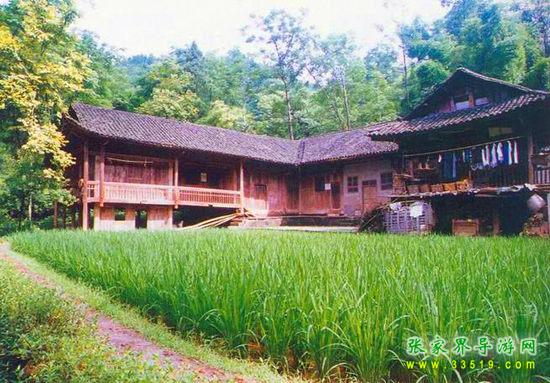
Located in Liujiaping, Sangzhi County, 14 km from the county seat. The former site consists of 15 wooden-structured houses. There is a three-section corner stilted building. It has green tile roofing, a lotus pond in front, green pines and bamboo behind, and three inner courtyards. In early November 1935, it housed the leading organs of the Provincial Committee, Provincial Revolutionary Committee, Central Military Commission Branch, Provincial Military District, and the general headquarters of the Red Second and Sixth Army Groups. The two stilted rooms extending from the right side of the house were the bedroom and office of Political Commissar Ren Bishi and Commander-in-Chief He Long, containing original items such as a carved wooden bed with drip patterns, redwood tables and chairs, document cabinets, and horse lanterns. On November 4, 1935, the leaders of the provincial committee and the Red Second and Sixth Army Groups held a meeting in the main room by the left courtyard, deciding to carry out a strategic transfer and march north on the Long March. The stone platform 30 meters to the left of the house is the former site of the headquarters sentry post. In a residential house 70 meters away is the former site of the army group's political department. The Zhong Shanfu compound at Zhongjiagang, 1.5 km south of the valley, is the former site of the army group's supply department. In 1979, the three main rooms and corner building of the right courtyard were converted into the "Liujiaping Exhibition Room of the Long March Departure Point of the Red Second and Sixth Army Groups," a provincial key cultural relics protection unit.
Jinbian Stream, the Route of the Long March of the Red Second and Sixth Army Groups (Red Second Front Army)
On November 19, 1935, the Red Second and Sixth Army Groups (predecessors of the Red Second Front Army) set out from Liujiaping and Ruitapu in Sangzhi to begin the Long March. On November 20, the Red Army led by Xiao Ke, commander of the Red Sixth Army Group, passed through Zhonghu and Huaxiangpo, traversed the Jinbian Stream of Zhangjiajie (formerly known as Qingyan Mountain, now part of Zhangjiajie National Forest Park scenic area), and proceeded through Xinqiao and Huangjiapu. On the 21st, after joining forces with the troops led by He Long, commander of the Red Second Army Group, they forcibly crossed the Lishui River and continued their westward expedition.
From December 21 to 22, 1983, General Xiao Ke, accompanied by relevant personnel, inspected Huangshizhai and Jinbian Stream in Zhangjiajie National Forest Park. While enjoying the scenery, he recounted to his companions the combat course of the Red Army's Long March through this area. Before leaving, he happily composed a poem titled "Returning to Qingyan Mountain": "Daring to ride the yellow lion up to the blue sky, bamboo shoots stand on green rocks, steep and magnificent. Gazing at the nine heavens rich with new spirit, looking back at Xizhou to trace old footsteps. The great victory at Wanping laid the foundation for the great cause, the high monument at Tawo inspires reverence for the peak. Parting again from Jinxi, the whip never rests, on the ten-thousand-li journey, still calm and composed."
In order to develop and make good use of this unique red tourism resource, the Zhangjiajie National Forest Park Management Office built a new "Red Army Road" in the upper reaches of Jinbian Stream and specially erected a Red Army monument, which is deeply loved by tourists.
The Former Site of He Long Splitting the Bamaoxi Salt Bureau with a Knife
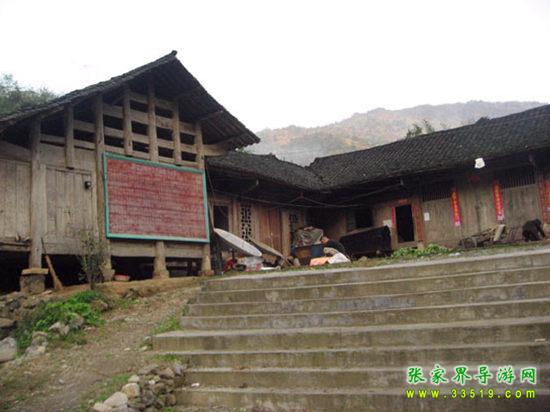
Bamaoxi is 75 kilometers from Sangzhi county town, a small town adjacent to Hefeng in Hubei. Silvergrass (bamao grass) grows on the northern slope of the valley, hence the name. In the late Qing Dynasty, the Hunan authorities set up a tax checkpoint here to control the entry of Sichuan salt into Hunan. In the 4th year of the Republic of China (1915), a salt bureau was formally established at the Xiang family compound to exploit passing merchants. The salt bureau was built against the mountain, a two-story, six-room building of square timber and stone. It was garrisoned by 13 men under Bureau Chief Li Peiqing, armed with Mauser nine-round rifles. In those years, He Long, who drove mules and horses to transport salt, often passed this way and suffered greatly at the hands of the salt police. With the support of the Chinese Revolutionary Party, together with his eldest brother-in-law Gu Jiting (Gu Hu), he rallied fellow townsmen and friends Wei Jingzhai, He Xunchen, Wang Jinmen, Wang Zhanbiao, Xu Yunchen, and members who came to assist from the Tongmenghui—Ran Fengwu, Tian Ziyun, Chen Minqing, Huang Xingyuan—21 patriots in all. On March 16, 1916, they set out from Hongjiaguan, armed with daggers, sabers, firearms, and kitchen cleavers, and rushed there under the stars. They stormed the salt bureau with blades and seized all its weapons in one stroke. At dawn the next day, on their way back through Cangguan Valley, they captured another 4 rifles from the local militia. Joining forces with more than a hundred men and guns of the local armed force of Gu Xinzhai (Gu Hu's elder brother), they marched to Hongjiaguan, raised the banner of "Oppose Yuan, Save the Nation," and formed a people's army—enacting the historical episode known as the "Xiangxi Uprising—Cleaving the Bamaoxi Salt Bureau with Blades."
The former site of the salt bureau had 1 wing of 2 rooms dismantled in the early 1950s; 3 wings of 4 rooms of the original building and furnishings remain. In 1979 it was designated a key revolutionary cultural relic protection unit of the Xiangxi Autonomous Prefecture.
Site of the Sangzhi Uprising, Liyuan Town
At the end of February 1928, Zhou Yiqun and He Long, following the instructions of the Party Central Committee, returned through many hardships to Hongjiaguan in Sangzhi. In less than a month, they mobilized and organized a force of more than 3,000 people and established the Workers' and Peasants' Revolutionary Army, with He Long as commander. On April 2, an armed uprising was held, and in one stroke they captured the county town (present-day Liyuan Town); the Workers' and Peasants' Revolutionary Army declared the armed uprising a success. Subsequently, the Sangzhi County Revolutionary Committee and the CPC Sangzhi County Committee were established. The soviet movement was then launched.
The Sangzhi Uprising opened the prelude to armed separatist rule and the establishment of a revolutionary base area in the Xiangxi-Hubei region, and laid the foundation for creating the Xiangxi-Hubei Revolutionary Base Area. The forces of the Sangzhi Uprising later became the backbone of the Red Fourth Army (predecessor of the Red Second Army Group). With its unique historical significance, the Sangzhi Uprising was recorded in the annals of history.
Former Site of the Sangzhi County Soviet Government
Located within the county government compound. It is an ancient brick-and-wood building. From April 1928 to November 1935, He Long and others led the workers' and peasants' revolutionary armed forces and captured the county town 5 times, formed the CPC Sangzhi County Committee here 3 times, and established the county Soviet government here twice. Since 1978, this former site has been repaired several times, and 10 red regular-script characters reading "Former Site of the Sangzhi County Soviet Government" were molded above the entrance. In 1979 it was listed as a county-level key cultural relic protection unit. It is currently well preserved.
Former Site of the Chinese Soviet Six-County Joint Government
Located at the Ma family's new house in Baizhuping, 80 kilometers north of Sangzhi county town, adjacent to Hefeng in Hubei. In September 1931, the Xiangxi-Hubei Central Sub-bureau held an enlarged meeting of the Xiangxi-Hubei Border Special Committee, and at the Ma family's new house here established the Chinese Soviet Republic Joint Government of Six Counties—Sang(zhi), He(feng), Wu(feng), Shi(men), Ci(li), and Chang(yang). Correspondingly, mass organizations such as the trade union, poor peasants' association, women's association, young pioneers, mutual aid society, and the Anti-Imperialist League were established. In 1962, this former site was designated a key cultural relic protection unit of the Xiangxi Autonomous Prefecture. It is well preserved in its original form.
Former Site of the Chinese Soviet Cili-Sangzhi County Revolutionary Committee
Located in the Peng family compound at Puci Pagoda, Kongkeshu Township, 38 kilometers east of Sangzhi county town. It covers nearly 3,000 square meters. In the summer of 1935, in accordance with the spirit of the CPC Xiangxi-Hubei-Sichuan-Guizhou Provincial Committee that the base area should shift northward and administrative divisions should be adjusted accordingly, parts of Cili and Sangzhi were separated out to establish the "Chinese Soviet Cili-Sangzhi County Revolutionary Committee" centered on Kongkeshu, with the committee's offices set up here. After the founding of the People's Republic, a state-run grain store was always established here, and the former site is well preserved. In 1979 it was designated a key cultural relic protection unit of the Xiangxi Autonomous Prefecture.
Former Site of the Sangzhi County Peasants' Association
Located at No. 92 Dongzheng Street, Liyuan Town in the county seat, it was originally a grand mansion of a merchant-gentry family. It covers about 800 square meters. It is a brick-and-wood compound of 3 sections, 2 stories, and 4 courtyards. In the spring and summer of 1926, the Hunan peasant movement surged, and Xie Cezhi, a special envoy of the CPC Hunan Provincial Committee, came to Sangzhi to carry out the peasant movement. During this period, CPC members Peng Yushan, Zhu Sitang, Gu Jifeng, and a group of young students studying in Changsha and Changde returned to Sangzhi to publicize and mobilize the laboring masses of all walks of life, and organized peasants' associations at all levels. At that time, the county developed more than 20,000 members in total. The peasants' associations organized activities to struggle against local tyrants and despotic gentry; in one stroke they suppressed Zhu Yunong, a provincial senator and local tyrant, and Xiong Zhaoxiang, a habitual bandit. The county peasants' association was set up here. The former site is well preserved. In 1979 it was designated a county-level cultural relic protection unit.
Site of the Red Army School
Located within the present-day Sangzhi No. 1 Middle School campus in Sangzhi county town. It covers 4 hectares. In the second half of 1919, He Long, commander of an independent battalion of the Jingguo Army, was stationed in Sangzhi and opened a peasant self-government training institute here, personally serving as its director. In July 1929, He Long led the Red Fourth Army to liberate Sangzhi county town again and established a workers' and peasants' primary school here, personally serving concurrently as principal. At the same time, the Xiangxi-Hubei Special Committee ran a Red Army school here to train cadres. In August 1935, the Xiangxi-Hubei-Sichuan-Guizhou Provincial Committee and the Red Second and Sixth Army Groups established a Red Army University here, with Xiao Ke concurrently as president, Tan Jiashu as director of education, and Zhang Pinghua as director of the political department, divided into junior and senior classes to train military and political cadres for the workers' and peasants' Red Army. Liao Hantu, He Wendai, and others all studied at the Red Army University.
In 1942, a county-run junior middle school was built on the former site; in 1958, Sangzhi No. 1 Middle School was established, the original school buildings were demolished, and new teaching buildings were constructed.
Site of the Red Army Hospital
Located in the "Minjia" village at the northern foot of Yulin Fort in Hongjiaguan Township, 17 kilometers north of Sangzhi county town. In January 1934, He Long led his troops back to Sangzhi and successively entrusted 23 wounded and sick Red Army soldiers to his close friend Gu Caiqin (a martial arts master) for treatment and recuperation here, setting up a Red Army hospital in the ancestral hall. Living and medical expenses were initially covered by the clan ancestral hall's savings. In May, when the savings were exhausted, the wounded were distributed to individual households for care. The wife of old Red Army soldier Gu Youzhen, Liu Jinren, took in 3 people in her household; she filled her own stomach with coarse grains and wild vegetables, and spun yarn day and night to earn money to buy nutritional products for the wounded and sick. She also borrowed money at high interest and pawned 6 mu of green-crop fields and 1 fat pig to pay for the patients' recuperation. To ensure the safety of the wounded and sick, the clan specially arranged for the herbal medicine doctor Gu Jiguo to serve as bao zhang (village head) and cleverly deal with the enemy. At the same time, Gu Caiqin also taught the wounded Red Army soldiers martial arts routines. Until October, all the wounded and sick recovered and returned to their units. Later people called this the "Shajiabang" of the Xiangxi-Hubei region.
Most of the above buildings were demolished during the "Cultural Revolution," and most of the trees were also destroyed. One ancient pine more than 30 meters tall (known as the Red Army Tree) still has luxuriant branches and leaves.
Site of the Red Fourth Army's "Luoyu Reorganization," Guluo Mountain
Located more than 20 kilometers from Sangzhi county town. In July 1928, He Long led the Workers' and Peasants' Revolutionary Army of the Sangzhi Uprising in a reorganization at Luoyu in Guluo Mountain, Sangzhi (historically known as the "Luoyu Reorganization"). After the reorganization, on August 1 the establishment of the Chinese Workers' and Peasants' Revolutionary Army Fourth Army was announced. He Long served as army commander, and Yun Daiying as Party representative (who did not assume the post). This force was soon afterward renamed the Red Fourth Army.
Former Site of the Red Sixth Army Group Headquarters
Located on the south side of Wangjia Lane, Ruitapu Town, Sangzhi County, 11 kilometers from the county town. The former site is a wooden, blue-tile shop building facing the street. From October to November 19, 1935, the Red Sixth Army Group headquarters was set up here. Army Group Commander Xiao Ke and Political Commissar Wang Zhen worked and lived here. The former site is well preserved. In 1979 it was listed as a county-level cultural relic protection unit.
Site of the Sangzhi Peasant Army General Command
Located on the east bank of the Lishui River, 1 kilometer north of Sangzhi county town. In early October 1927, He Lianyuan, head of the Sangzhi County Peasants' Association, and others organized more than 300 "peasant soldiers," who joined forces with more than 700 men and guns of the guerrilla armed force led by He Ying, and set up the Sangzhi Peasant Army General Command here, with He Lianyuan as commander-in-chief.
Site of the Red Army Cave
Located on the mountainside of Qingya between the villages of Mojia Tower and Chongtian Creek in Liaojia Village Town, Sangzhi County, 30 kilometers from the county town. The cave is about 20 meters high, about 30 meters wide, and about 1,500 meters deep. In February 1932, the Red Army company of Xiang Guokuan set up a military stronghold in the cave. On February 18, 9 Red Army soldiers and 12 Red Army family members stationed in the cave were surrounded and suppressed by more than 400 enemy troops and died heroically in the cave. In 1979, this cave was listed as a county-level cultural relic protection unit.
Sites of the Red Army Battles at Nancha and Chixi River
Nancha is located 5 kilometers from Sangzhi county town. From late June to mid-July 1929, Chen Quzhen, a Xiangxi warlord and commander of the Hunan First Security Army, ordered the brigade of Xiang Ziyun and local armed forces to attack the workers' and peasants' Red Army stationed in Sangzhi. Under the command of Army Commander He Long, the Red Fourth Army (later renamed the Red Second Army Group) annihilated more than 1,000 men of the Kuomintang unit under Zhou Hanzi at Nancha in early July. In mid-July, the Red Fourth Army set up an ambush and annihilated more than 2,000 men of the Kuomintang unit under Xiang Ziyun in the area of Chixi River (on the outskirts of the county town). Nearly 2,000 guns of various types were captured. The victories in these two battles were the finest the Red Fourth Army had fought since its establishment, historically known as the "Great Victories at Nancha and Chixi." In 1984, Sangzhi County built a Meishan Park on the bank of the Chixi River.
Site of the Red Army Battle at Jiaozhiya
Located 32 kilometers from the city proper. From August 7 to 12, 1929, during the eastward expedition of more than 1,000 men of the Red Fourth Army under Wang Bingnan and Qin Fuchen led by He Long, several fierce battles were fought with the Kuomintang units under Chen Quzhen and Chen Cexun and the reactionary local armed force under Xiong Xiangxi, with casualties on both sides. Finally they removed the nail of the "Lianhuan Fort" held by the reactionary armed force blocking the Red Army's advance, and continued the victorious eastward expedition. After the victory, He Long said, "The intensity of the fighting was truly unprecedented since the founding of our Red Army."
Site of the Red Army Battle at Jiangya
Located 70 kilometers from the city proper. In March 1934, during the mobile operations of the Red Third Army led by He Long, the reactionary armed force of Zhu Jikai's regiment stationed at Jiangya was routed, with hundreds of enemy killed and wounded, dealing a heavy blow to the enemy's reactionary arrogance. Previously, He Long led the Red Fourth Army in August 1929 and the Red Third Army in January 1933 in two attacks on Jiangya, both passing through this place victoriously.
Site of the Red Army Battle at Mianhua Mountain
Located at Mianhua Mountain in Xikou, Cili County. It is 31 kilometers from Cili county town. In early February 1935, Chiang Kai-shek mobilized more than 100,000 troops from the Hunan and Hubei warlord forces, forming 6 columns, to launch a large-scale "encirclement and suppression" campaign against the Red Army in the Xiangxi-Hubei-Sichuan-Guizhou base area. At the severe moment when the powerful enemy was closing in, the Red Second and Sixth Army Groups decided that the main force of the Red Sixth Army Group would meet the enemy 26th Division under Guo Rudong at Mianhua Mountain in Xikou, Cili. On February 8, the first battle of the counter-"encirclement and suppression" campaign in the Xiangxi-Hubei-Sichuan-Guizhou base area—the Xikou Mianhua Mountain blocking battle—was launched.
Site of the Red Army Battle at Jigongya
Located at Jigongya in Houping Town, Yongding District, 17 kilometers from the city proper. In mid-January 1935, Chiang Kai-shek deployed 11 divisions and 4 brigades, about 110,000 regular troops, to attack the Xiangxi-Hubei-Sichuan-Guizhou Revolutionary Base Area, attempting to annihilate the Red Second and Sixth Army Groups and achieve the goal of fully encircling, pursuing, blocking, and intercepting the Central Red Army. To smash the enemy's encirclement and suppression and coordinate with the Central Red Army's Long March northward, the Military Commission Sub-bureau headed by He Long and Ren Bishi deployed the Jigongya battle. On March 20, the battle began and lasted two days and one night, killing and wounding more than 500 men of the Kuomintang Li Jue column and capturing more than 2,000 weapons of various types. However, in this battle the Red Army suffered relatively heavy casualties. This battle forced the enemy troops to flee to Changde and prevented them from advancing westward. It pinned down part of Chiang Kai-shek's forces, effectively coordinated with the Central Red Army's Long March, and wrote a brilliant page in the history of Red Army battles.
Site of the Red Army Battle at Chenjia River
Located in the area of Chenjia River, more than 30 kilometers from Sangzhi county town. In mid-April 1935, Chiang Kai-shek ordered Chen Yaohan, commander of the Hubei Army column, to lead his troops to assemble in the Chenjia River area of Sangzhi, attempting to form an encirclement of the Red Army and prevent the Red Second and Sixth Army Groups from moving north. On April 13, the Red Second and Sixth Army Groups took advantage of the geographical superiority of Chenjia River's high mountains and deep valleys to divide, surround, and defeat the enemy piecemeal, annihilating more than 2,000 enemy troops. Historically known as the "Great Victory at Chenjia River." After winning this victory, the Xiangxi-Hubei-Sichuan-Guizhou Border Provincial Committee and the Military Sub-committee, based on changes in the situation, abandoned the plan to cross the Yangtze River northward, decided to persist in struggle in the Xiangxi-Hubei-Sichuan-Guizhou base area, and shifted from a passive to an active position in operational strategy.
Sites of the Red Army's Forced Crossing of the Lishui River Ferry Crossings
Located at multiple ferry crossings along more than 20 kilometers of the Lishui River east of the city proper, including Liuxipai, Yanglinpu, Shawan, Motan, and Tianjiatai. On November 19, 1935, after the Red Second and Sixth Army Groups set out on the Long March from Liujiaping in Sangzhi, they advanced day and night to quickly break through the enemy's Lishui defense line. From November 20 to 21, after fierce fighting, the Red Second and Sixth Army Groups smashed the enemy's blockade line and victoriously crossed the Lishui River by force. This was the last battle fought by the Red Second and Sixth Army Groups in our area. Afterward, under He Long's leadership, the Red Army advanced toward the Yuanling area and set out on the Long March northward. In 1979, these ferry crossings were listed as county-level key cultural relic protection units.
Site of the Dingjiarong Meeting
Located in Dingjiarong Village, Fengxianggang Township, Yongding District (the site of the meeting no longer exists), 12 kilometers from the city proper. On January 27, 1935, Ren Bishi, He Long, and others presided over a congress of Party activists of the Red Second Army Group held at Dingjiarong in Dayong County. In accordance with the instructions of the Party Central Committee, the meeting concentrated on criticizing the serious errors committed by former Central Sub-bureau Secretary Xia Xi during the base area period regarding the expansion of the purge, army building, and Party building. Both Ren Bishi and He Long made important speeches. The convening of this meeting provided a relatively profound theoretical criticism of Xia Xi's leftist errors, and thereafter the Red Second and Sixth Armies made great political progress. During his time in the Xiangxi-Hubei base area, Xia Xi actively carried out Wang Ming's "left" line, holding that "nine out of ten" of the responsible persons at all levels of the Party, government, and army in Xiangxi-Hubei were "reorganizationists," and dissolved Party and Youth League organizations. From May 1932 to August 1934, four expanded purges were carried out. Thousands of Red Army commanders and fighters and responsible persons of Party and government organs were wrongly labeled "reorganizationists" and wrongly arrested and killed (among them 773 cadres at or above the county and regimental level were killed), causing serious losses to the Party and the Red Army.
Sites of the Japanese Invasion of Cili, and the "Monument to the Martyrs Who Died in the War of Resistance" at Duanjiawan
From November 15 to 25, 1943, the Japanese army invaded Cili from Shimen in two routes. One route of the Japanese invasion targeted places including Dongyueguan, Tongjinpu, and Changyupu. On the 18th, they fought Kuomintang troops at Yamen Pass; the Nationalist troops retreated, and the Japanese occupied Cili county town. The other route of the Japanese invasion targeted places including Yangjia Creek, Yangliupu, and Guangfu Bridge. On the 25th, the Japanese left Cili and invaded Taoyuan. During the invasion, the Japanese carried out the brutal "burn all, kill all, loot all" three-alls policy; wherever they went, countless compatriots died miserably under Japanese blades, countless properties were seized and burned, and countless people suffered ravages. According to statistics, the Japanese killed and wounded 1,123 people in Cili, bombed and burned down 962 houses, and 3 women were gang-raped to death by Japanese soldiers in broad daylight.
He Long Park
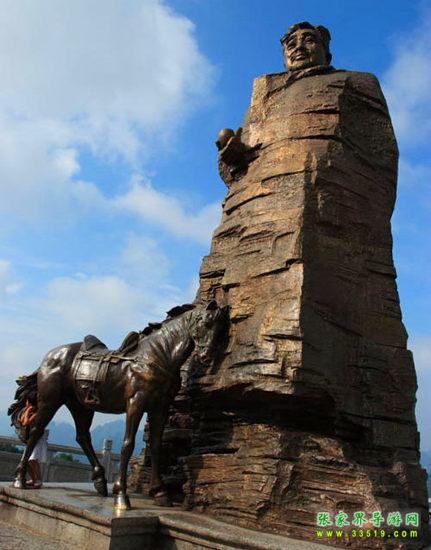
The park is located on the east side of Shijiayan in the Tianzi Mountain Scenic Area, and within the park stands a bronze statue of Marshal He Long. The park covers an area of about 3 hectares. The park's name was inscribed successively by Hu Yaobang and Jiang Zemin, and the park also contains inscriptions by Hu Yaobang, Peng Zhen, Liao Hansheng, and others. The head of the He Long bronze statue is lifelike, while below the shoulders it is sculpted in the shape of rock, like the wondrous peaks of Wuling, standing majestically atop a stone platform. His posture is resolute, chest out and gazing into the distance, holding a tobacco pipe, with a calm expression and an air of righteousness, while a warhorse nestles closely at its master's right side. The statue as a whole symbolizes Marshal He Long's glorious military career, enduring forever alongside the peerless scenery of Wulingyuan. The inscription "He Long" was written by the calligrapher and seal-carving artist Qin Esheng, carved onto a slanted rock slab whose shape resembles an open hardcover book. The park also features rows of reeds gifted by Honghu City in Hubei Province, where He Long once established a revolutionary base in his early years. The park also serves as a national defense education base for Wulingyuan District, displaying light and heavy weaponry. There is a domestically produced F—J-6 fighter jet and a T—34 tank that Stalin rode in command during World War II.
Yongsheng Pavilion, commemorating Martyr He Mangu
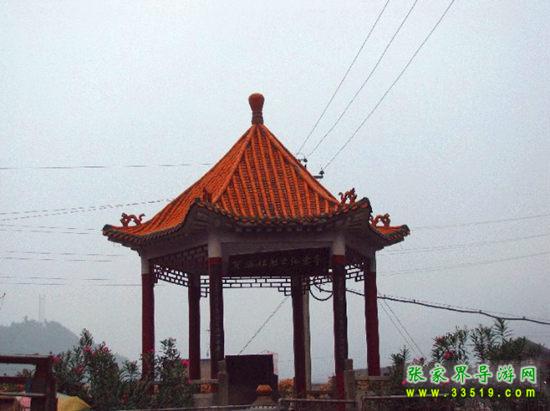
Located on the northern edge of Jiaochangping at the Heping Street intersection in Sangzhi County seat. It is the place where He Long's younger sister, Martyr He Mangu, was martyred. On the 6th day of the 8th lunar month in 1928, the "suppression" militia commanders Chen Cexun and Zhang Hengru bound and executed guerrilla captain He Mangu, and left her body exposed for several days. Afterwards, people often came here to pay their respects and commemorate this heroic woman martyr. In 1975, Sangzhi County built a hexagonal wooden pavilion with a small green-tiled roof here, named "Yongsheng Pavilion." It covers 80 square meters. The lane was also named "Yongsheng Lane" because of it. It later collapsed for some reason. In the autumn of 1986, the county cultural relics management office rebuilt it in its original style as a reinforced concrete pavilion with red columns and through-tenon "fang" beams, glazed tile roofing, and a terrazzo surface. Facing south, the upper part bears a plaque inscribed in regular script with "Yongsheng Pavilion." On the two front columns is a couplet of praise: "Seeking truth, leaving her son and parting from her husband, bravely fighting the demons of the world; for the revolution, shattering jade and sinking pearls, truly a heroine among women." In the center of the pavilion stands a marble stele inscribed with the martyr's life story.
Sangzhi County Revolutionary Martyrs Cemetery
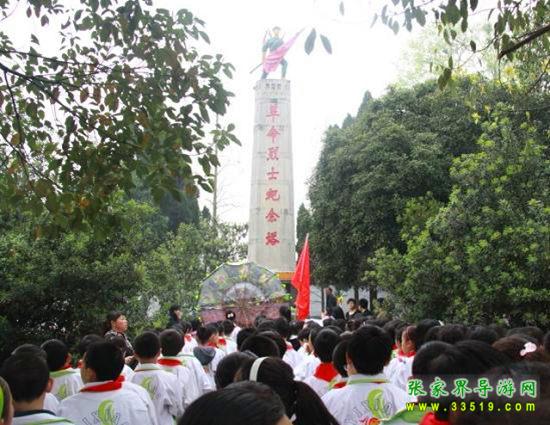
Also known as the Sangzhi County Revolutionary Martyrs Memorial Tower, it is located at the northern end of Changzheng Road in Zhujiatai, the new urban area of Sangzhi County. It was built in 1952 and restored in 1987. The cemetery is rectangular, covering more than 6,000 square meters. A nearly 20-meter-tall, three-tiered marble memorial tower stands majestically in the center of the cemetery, with a statue of a Red Army soldier carrying a gun and holding aloft a flag perched atop the tower, spirited and imposing. The front of the octagonal base is engraved with an inscription, and the four sides are inscribed with the names of 2,100 revolutionary martyrs. Outside the north wall of the cemetery is a 700-square-meter burial ground, the resting place of some deceased veteran Red Army soldiers and veteran cadres. Sangzhi County Revolutionary Martyrs Cemetery is one of the eight county-level revolutionary martyrs cemeteries in the province.
Meijiashan Park
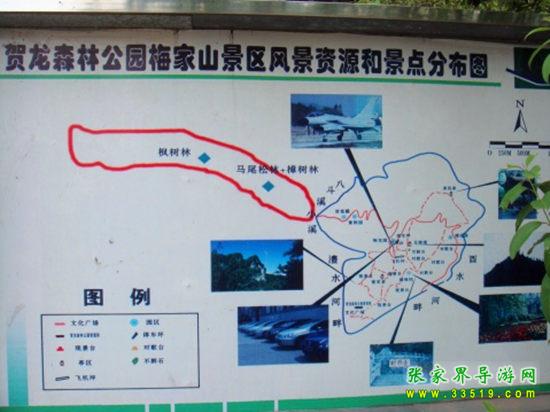
Located by the Lishui River at the Beimen Bridge in Sangzhi County seat. In July 1929, He Long, commander of the Fourth Red Army, set up a command post on the mountainside here and cleverly laid an empty-city stratagem, luring and annihilating more than 2,000 troops of the "encirclement and suppression" commander Xiang Zirong in the Chixi River, known in history as the "Great Victory at Chixi." Since then, Meijiashan has become even more famous, and people often climb it to gaze at the magnificent mountains and rivers in the distance and commemorate the great deeds of the revolutionary martyrs. After the 1950s, the county's military sports department successively built shooting ranges below the old command post site to train militia athletes. In the spring of 1984, the relevant county departments set aside 29 hectares of mountain land to establish a landscape park.
Yongding Huilongguan Revolutionary Martyrs Cemetery
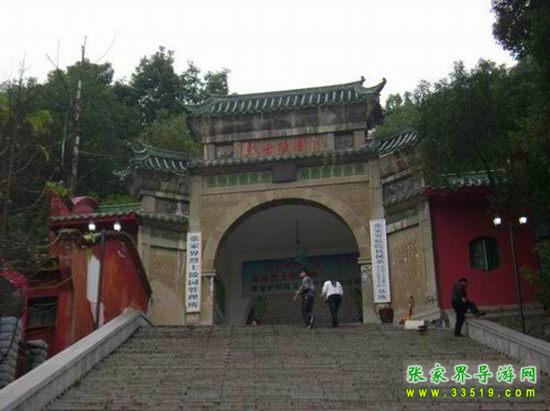
Located on Huilongguan Mountain east of the city urban area. Completed in July 1985, it is a memorial site for revolutionary tradition education and for paying respects to revolutionary martyrs in Yongding District.