This attraction introduction is compiled from historical materials in the "Zhangjiajie Tour Guide Network" (33519.com · Scenic Spots section). Ticket prices, opening hours, transportation, and contact information mentioned in the text may be outdated. Please refer to the latest official announcements from the scenic area before traveling; some content consists of historical background/cultural introductions and is for reference only.
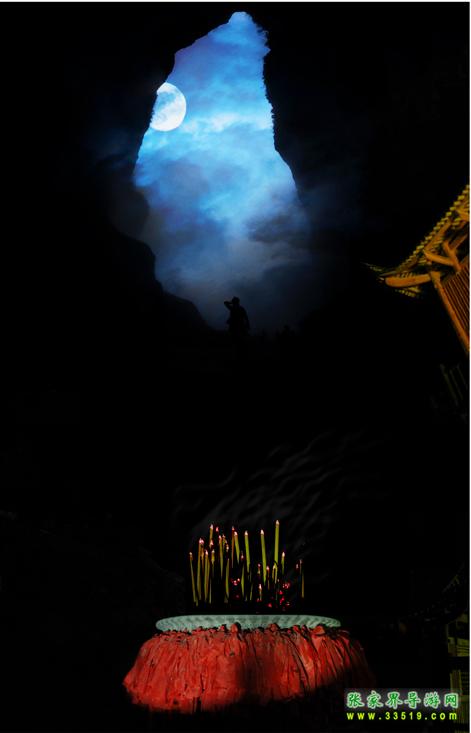
Tianmen Mountain was called Songliang Mountain in ancient times. In the sixth year of Yong'an of the Wu Kingdom during the Three Kingdoms period (263 AD), a cliff on the mountain suddenly opened into a cave, bright and clear like a gate, forming the rare world wonder—Tianmen Cave. Emperor Sun Xiu of Wu considered this an auspicious sign and renamed Songliang Mountain as Tianmen Mountain.
Tianmen Cave is the most representative scenic spot of Tianmen Mountain. It is located in the middle-upper part of the Tianmen Mountain massif, at an altitude of 1,300 meters. The gate is 131.5 meters high, 57 meters wide, and 60 meters deep, making it the world's highest-altitude natural mountain-piercing cave.
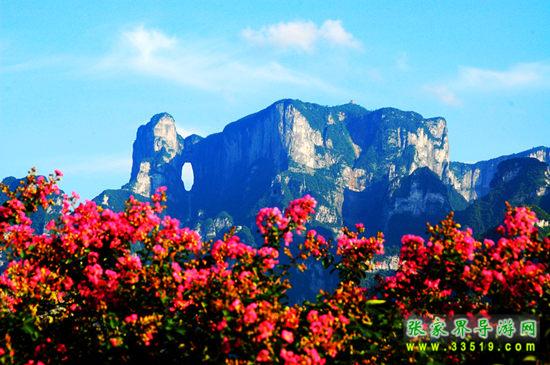
Tianmen Cave opens north and south on a sheer cliff thousands of feet high, soaring upward to the heavens, with ever-changing atmospheric conditions. Like a bright mirror or a heavenly gate inlaid on the vast sky, it swallows white clouds and exhales purple mist year-round, rendering an atmosphere of unfathomable mystery and appearing even more transcendent and ethereal. As the saying goes, it captures all the creative power of heaven and earth and conceals all the mysteries of the universe, becoming an unsolvable enigma through the ages—searched for and sought after, yet ultimately elusive. Standing within it is like entering the celestial palace and imperial pavilion, evoking the feeling of 'I wish to ride the clouds and fly away as an immortal, straight into the ninth heaven to grasp the universe.' 'Tianmen Cave opens and clouds flow through; even the Emei of Jiangdong is inferior.' The famous Yuan Dynasty poet Zhang Dui once praised it thus, and from this the majestic momentum is evident.
Tianmen Cave Scenery
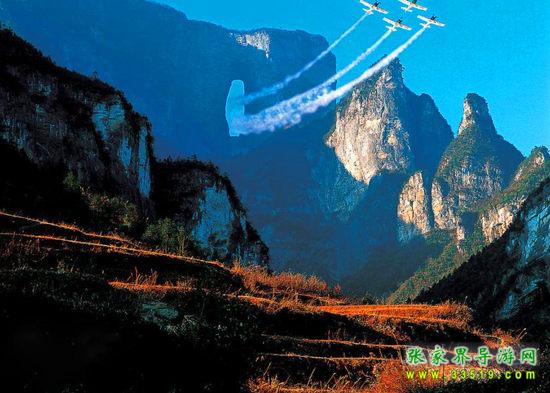
For over 1,700 years, this spectacular wonder of the world has attracted countless visitors. Especially in 1999, when world aerobatic masters flew aircraft through Tianmen Cave, it caused a global sensation, with as many as 800 million viewers watching the live broadcast.
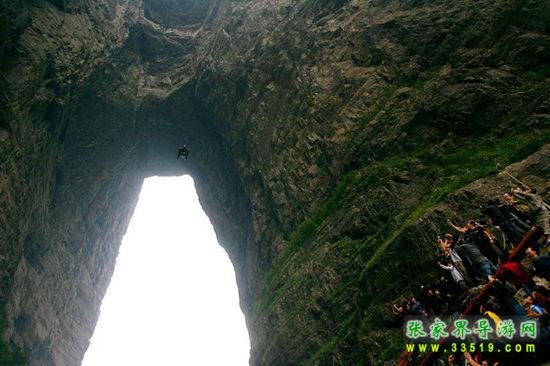
On September 24, 2002, famous American extreme skydiver Jeb Corliss successfully flew through Zhangjiajie's Tianmen Cave. It is reported that wingsuit flying, also called proximity sky gliding, has a history of less than 20 years. Flyers wear wingsuits and jump from tall buildings, towers, bridges, and cliffs, flying close to buildings or natural landscapes at high altitude. Because the athlete's takeoff altitude is low, the time available for adjusting posture and opening the parachute is extremely short, making it extremely dangerous and difficult—the most extreme of extreme sports in the world.
On a bright sunny early morning or evening, standing at the place outside Tianmen Cave where clouds and sky meet, occasionally a celestial spectacle appears: seven-colored rays of light shoot through the cave, purple qi surges skyward, encircling the peaks and mist, like Buddha's light illuminating the earth and auspiciousness descending upon the world. 'In ancient times, a local saw rosy light emerging from Yunmeng, with purple qi swirling and filling the opened cave, overflowing to the sky, and considered it auspicious, bowing reverently to the ground in worship.' This is a specific description of the Tianmen rosy light. There is even a legend recorded that seventy or eighty years ago, standing at the South Pier by the river in Zhangjiajie city proper, one could clearly see the majestic and spectacular Tianmen Cave, but today, from the same spot, one can only see the mountain without the cave. To view this magnificent scene, one must go to Dayong Bridge four kilometers away. This is one of the Six Mysteries of Tianmen—the 'Tianmen Turning' mystery, which has cast a layer of mysterious halo and color over Tianmen Cave.
There is yet another wonder: inside Tianmen Cave, raindrops drift through the air throughout the year. This is the legendary Tianmen Cave 'Plum Blossom Rain.' The raindrops are cool and sweet, a symbol of good fortune. Legend has it that whoever catches forty-eight drops of Plum Blossom Rain with their mouth can become an immortal.
The origins of Tianmen Cave are mysterious and profound, and its path to discovery was full of twists and turns. Legend has it that long, long ago, an explosion rang out in the sky, colorful auspicious clouds spread in splendor, and the mountain suddenly opened into a cave. The voice of the Jade Emperor rang out like a great bell, asking: "What do you want?" All who witnessed it could kneel on the ground and ask for whatever they needed. There is a local folk song: "A thousand keys and ten thousand locks, open the Heavenly Gate, and a hundred fruits will bear."
Exactly when Tianmen Cave opened remains a matter of much historical record and differing opinion. In Zhangjiajie there was a scholar named Chen Ziwen, highly accomplished in local historical and cultural research, who believed that by 48 AD, Tianmen had already taken shape. After nearly 2,000 years of change, it has formed the majestic and spectacular scene we see today.
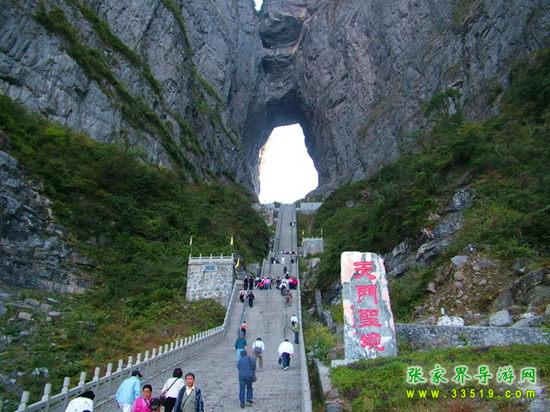
The Five Wonders of Tianmen Cave
First Wonder
Majestic and towering. The Qing dynasty poet Wang Zirui wrote: "Push open the stone gate, and only five feet remain to heaven." Tianmen Cave is 131.1 meters high, 30 meters wide, and 37 meters deep. It can hold 300 people and could accommodate a 16-story building. In the Qing dynasty, a county magistrate named Li Jin stood in Yongding Guard City and looked out, seeing only that "the rock cave half swallows the clear moon of night, the mountain's bend forever harbors clouds beyond the sky." At that moment, Tianmen Cave had swallowed half the moon.
Second Wonder
Open and bright. The peaks before and behind the cave entrance are all quite low, and only this mountain stands supreme. The cave is open and clear; apart from drifting white clouds, there is only the melting blue sky, unstained by a speck of dust. This provided an excellent condition for the aircraft that flew through the cave in 1999.
Third Wonder
Plum-blossom rain falls every day. Who would believe, without having been to Tianmen Cave, that on the stone wall at the top of the cave, day and night, all year round, there drips and patters a "plum-blossom rain"? It is said that if you open your mouth and catch forty-eight drops, you can become an immortal. Where does this plum-blossom rain come from? This is a riddle. It has drawn many literati and scientists to investigate.
Fourth Wonder
Green bamboo hangs upside down from the cave ceiling. On the southern eaves of the cave ceiling grow lush but not tall green bamboos, with roots like coiled dragons and leaves like clusters of willow, hanging down in rows like curtains and whistling with the wind, commonly known as dragon bamboo. The Ming dynasty poet Zhang Yanghao praised it in verse: "The mountain spreads its wild screen far down to the ground, the wind wields heaven's broom to sweep the clouds empty."
Fifth Wonder
Wind and clouds shift and change. At the mouth of Tianmen Cave, on clear days thin clouds lightly veil it and mist idly coils around, and all is calm; but on cloudy and rainy days, the clouds rage and the mist seethes, overturning rivers and seas, striking the stone walls with a rustling sound, while cold wind blows toward the sky with eerie howls, as if dragons were soaring and serpents dancing, making one's hair stand on end. At the first clearing of rain, when clouds and mist seal it tight, Tianmen hides itself and conceals its form, so that even its direction cannot be determined. In the Qing dynasty, a local prodigy named Qin Jin'ou paired it with the spectacle of the red sun at Tankou and wrote a couplet: "At Tankou there is a gap that the red sun fills; Tianmen has no lock, but white clouds seal it."
Tianmen Cave, with its five wonders, endows Tianmen Mountain with vigorous vitality. If Tianmen Mountain is the soul of Wuling, then Tianmen Cave is the soul of Tianmen Mountain.
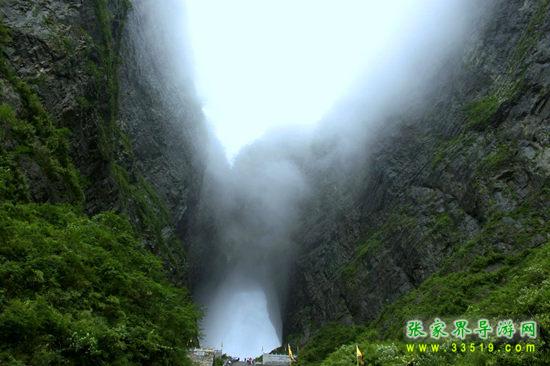
Related Legends
Legend One
On the ancient land of China, there is a great mountain leading from the human world to the fairyland of Peach Blossom Spring, the soul of the Wuling Range — Tianmen Mountain. You need only climb the 999 stone steps from the foot of Tianmen Mountain to reach the gate to the fairy realm — Tianmen Cave. The huge cave opening is large enough for modern aircraft to fly through, and it is the highest natural karst cave in the world. The formation of Tianmen Cave predates by more than 500 years the stone-born eldest disciple Sun Wukong, whom Tang Sanzang took on when he went to fetch the scriptures (the cave formed in 263 AD). It was formed when a great rock in Tianmen Mountain, having gathered the spiritual essence of heaven and earth, burst open into a cave. From then on, whenever a great figure of the human world passed away, on Tianmen Mountain, whether under a clear sky or a sky full of stars, there would instantly be lightning and thunder, wind and rain, as if Tianmen Cave were shedding tears that poured down in torrents... The tears cascaded down the cliff faces like a waterfall, and seen from afar, it was like the Milky Way of heaven descending upon the nine provinces. This phenomenon remains unexplained to this day!
Legend Two
In the middle of Tianmen Cave lies a threshold, and at each end of the threshold stands a spirit beast — the qilin (one of the four celestial spirits) — guarding it. The qilin (which may also be called the celestial mouse-deer or celestial qilin) has a single auspicious horn and a body covered in scales, resplendent in gold and jade. The qilin is the embodiment of justice and righteousness, and at the same time a symbol of wealth and good fortune. After you have climbed the 999 stone steps, the qilin will smile kindly in welcome. When you step across the threshold, it is as if your life has passed through layer upon layer of hardship and entered the land of humanity's dreams — that is, the fairyland of heaven, the Peach Blossom Spring beyond the world — and you may enjoy for a while the immortal life in which one day in heaven equals one year on earth. When you look down, you see the vast human world, with farming and weaving, and you feel carefree and joyous. Thus the ancients also said:
On Tianmen Mountain is Tianmen Cave, and across Tianmen Cave lies the Tianmen Threshold.
The human world and heaven are separated by the threshold; to go to the fairy realm, cross over it.
A life without worry and full of happiness, joyful as an immortal.