This attraction introduction is compiled from historical materials in the "Zhangjiajie Tour Guide Network" (33519.com · Scenic Spots section). Ticket prices, opening hours, transportation, and contact information mentioned in the text may be outdated. Please refer to the latest official announcements from the scenic area before traveling; some content consists of historical background/cultural introductions and is for reference only.
Introduction
Shentang Bay, according to the Cili County Annals compiled during the Wanli period of the Ming Dynasty, was originally called "Shentang Fort." It is located in the western part of Suoxiyu and is a semicircular deep valley depression full of mystery.
Shentang Bay is surrounded by sheer cliffs on three sides, with only a gap on one side of the mountain from which one can look down into the bottom of the bay. According to local mountain dwellers, from the gap to the bottom of Shentang Bay, one must descend nine levels of rock ledges. Most people dare not go down; even the boldest can only reach the second ledge before having to turn back. In 1968, a medicinal herb collection team from a PLA unit, in order to gather valuable herbs such as lingzhi, tied ropes around their waists, pulled each other along, and clung to vines and creepers, but could only descend to the sixth ledge before being unable to go further. This was because when they looked down from the sixth ledge, it was still bottomless, and they could only hear a tremendous roaring sound, which was extremely terrifying, forcing them to retreat.
Shentang Bay in Wulingyuan is like a giant "bucket" placed on top of a massive cauldron, with the surrounding "bucket"-shaped rock walls about 300 meters high. On the southeast side of the bucket wall, there is a small opening through which the waterfall in the bay pours out, flowing from Zhiye Bay into Ganxi. During the "Cultural Revolution," the Suoxiyu "May 7th" Cadre School once organized an expedition, attempting to climb up from the Ten-Mile Gallery below along Zhiye Bay to the bottom of the waterfall. Along the way, they had to pass 24 levels of "Heavenly Ladders," which are 24 levels of knife-edged rock walls. Among them, there are 9 levels of rock walls over 10 meters high, and some rock ledges even overhang like duck sheds, requiring people to crawl like geckos to get over them. The last "Heavenly Ladder" is fifty to sixty meters high, and all previous explorers could only sigh at the cliff, inscribe a few words, and turn back.
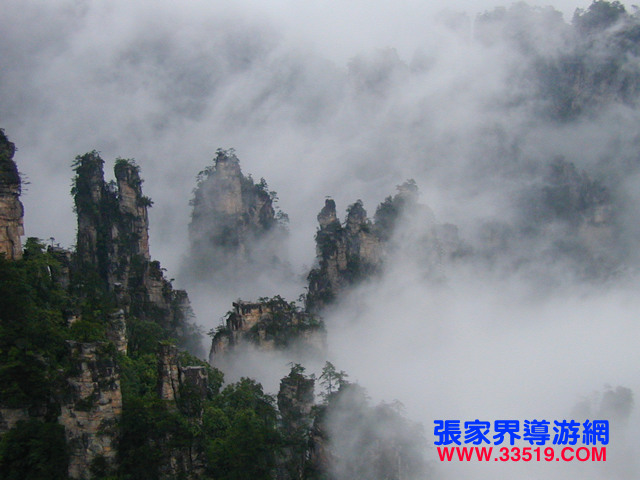
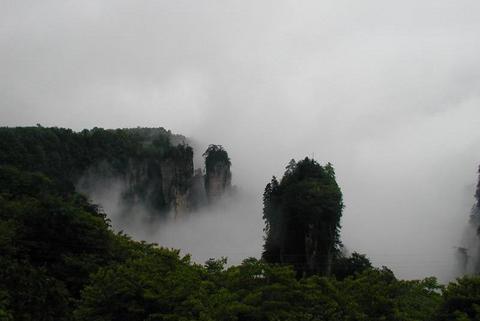
Shentang Bay is shaded by dense trees. In scorching summer, while grass dies and trees wither elsewhere, mist often rises here; after a long drought, when rain suddenly falls, one can often hear sounds like drumbeats and charging troops.
How deep and how far Shentang Bay really is remains a mystery to this day. According to folk legend, Shentang Bay was the place where the Tujia peasant uprising leader Xiang Dakun retreated and set up camp after his defeat. Unwilling to accept defeat, he continued to drill his troops inside, preparing to make a comeback. Therefore, on gloomy days, one can still hear the sounds of people shouting and horses neighing from within the bay.
Attraction Introductions
Shentang Bay Tourist Attractions:
Wolong Ridge
The Wolong Ridge trail winds like a coiled dragon lying on the mountain ridge, meandering and appearing and disappearing intermittently. It sometimes passes through forests, sometimes climbs perilous paths, alternating between steep and gentle. Along the way, one can also see several scenic spots such as the vigorous and upright "Five Old Pines."
Pagoda Peak
Pagoda Peak is not far from the "Heavenly Gate Ladder" scenic spot. One can see a towering peak piercing the clouds—this is Pagoda Peak, named for its pagoda-like shape. The peak is about 300 meters high, with rugged rocks in distinct layers, each layer growing Huangshan pines, some standing upright, some hanging upside down, some twisting, some slanting, each with a different posture.
Heavenly Gate Ladder
Heavenly Gate Ladder (also known as "Heavenly Ladder"). It is the first pass entering Shentang Bay from Xihai. Arriving here, one has a strong sense of "one man guarding the pass, ten thousand men cannot open it." The ladder here is different from the one at Tiantai; the ladder at Tiantai is welded from steel pipes, while this one is carved from natural cracks in the rock wall. It is only about 0.33 meters wide and the ladder is only 10 meters high, but climbing it is quite thrilling.
Anecdotes: The Mystery of Shentang Bay
In the summer of 1990, on a sunny afternoon, more than ten tourists from Shanghai and other places saw a group of young girls in fluttering dresses dancing on the cliff in front of Shentang Bay from the Point General Platform. They gradually faded away after half an hour.
A photographer once encountered the sounds of people shouting and horses neighing that appeared after a sudden change in weather at Shentang Bay. Afterwards, he compared Shentang Bay to a geomagnetic tape recorder, which might have recorded the actual sounds of some ancient battle between two armies. Because when it rains, the vibration frequency of that time reappears, and thus this "tape recorder" "plays" the sounds of that time. Others say: this is a mixed sound of wind, rain, waterfall, and echoes, combined with the fear of those present, creating a psychological perception. The debate continues to this day without a definitive conclusion.
According to local mountain dwellers, there are 9 levels of rock ledges on the cliff of Shentang Bay. Some people have attempted to descend the cliff to explore, but when they had only reached the fourth level, about forty to fifty zhang deep, everything around was already pitch black, and various shrill cries came from beside their ears, making their hair stand on end, and they dared not climb down any further. In 1968, officers and soldiers of a PLA unit, in order to collect valuable herbs such as lingzhi, brought guns and used ropes and other tools, but could only descend to the sixth level before being unable to continue. Looking down with binoculars, they even saw huge pythons and various wild beasts.
Legend of King Xiang the Heavenly Son
In Hunan, there is a magical valley called "Shentang Bay." When thunder and lightning strike, strange sounds sometimes emanate from the valley—sometimes the clanging of gongs and drums, sometimes the shouts of soldiers, and occasionally the neighing of warhorses, which is very strange. Books say that scientists have not yet given a clear answer to this phenomenon, but at the time two explanations were more widely circulated. One explanation is: the valley of Shentang Bay is very deep, and surrounded by high mountains on all sides. When wind passes through the peculiar caves and dense forests in the valley, it makes loud noises and swirls in the valley, lingering for a long time. Mixed with the sounds of wind, rain, and thunder from the sky, it forms the strange sounds. The other explanation is more interesting: during the 18th year of the Hongwu period of the Ming Dynasty, also on a thunderstorm day, a tragic battle took place here. The unique terrain and rock formations of the valley, under the action of thunder and lightning, formed an instantaneous natural recorder that recorded some of the sounds of that time. In subsequent times, when external conditions are met, the valley will automatically "play" these sounds.
That year, Xiang Dakun was 20 years old. Early in the morning, he came alone to Qingyan Mountain. These past days, one matter had been circling in his mind, and he needed to be alone here to think quietly. Dakun had been the leader of the Tujia people for over four years. In recent years, the Yuan Dynasty's fortunes had run out, rebellions were breaking out everywhere, and years of war had severely affected their normal production. The court's conscription and the rebels' harassment made it impossible for the Tujia people to live in peace. As the leader of the Tujia people, he had the responsibility to protect his people. He knew that with the Tujia's current strength, they could not confront the court or the rebels. But if they could find a place that was easy to defend and hard to attack, settle down, and then build an army, it should be feasible to avoid this war. He had a bold idea: to establish a Tujia kingdom in the Wulingyuan area. For this purpose, he had made a special trip to Huanglong Cave, where there was a reclusive scholar named Li Boru, an old friend of his father. Scholar Li was a remarkable man who knew astronomy above and geography below, and his divinations were very accurate. Scholar Li not only strongly agreed with his idea but also promised to come out of seclusion to assist him. As for the Tujia people, they would certainly support him. Now he only needed to make the final decision. Dakun sat on the mountain until evening. Under the glow of rosy clouds, Qingyan Mountain was as beautiful as a poem or painting. Dakun thought, tomorrow, this place should be renamed Tianzi Mountain.
Xiang Dakun, now over forty, climbed Tianzi Mountain alone. It had been more than twenty years since he established the Tujia kingdom. In these years, the Tujia people had multiplied and prospered here, growing stronger and stronger. His people deeply respected him, calling him King Xiang. The wars had long ended; the Han Chinese Zhu Yuanzhang had defeated the Yuan army and established the Ming Dynasty. Everything had been developing in a good direction, but just three years ago, the Ming government suddenly sent a state letter inviting him to discuss important matters. His military advisor Li Boru did not let him go, but instead sent his younger brother Dahu in his place. But once he went, there was no news at all. Three years had passed, and his brother had not returned. Dakun's heart ached! He had only this one blood brother, and he was determined to find him. But the Ming Dynasty was too powerful, and he could not act rashly. Military advisor Li Boru understood his thoughts. He set up an altar, performed rituals, and sought heaven's revelation. After receiving the decree, the advisor told Dakun that after thirty-six days, a heavenly gate would open on Tianzi Mountain. As long as three divine arrows were shot eastward through the heavenly gate, the Ming emperor could be killed. Once the emperor died, the realm would surely fall into chaos, and then they could take the opportunity to lead troops into the imperial city and rescue Dahu. But Dakun was anxious. It had already been thirty-five days, and he did not want to wait any longer. He wanted to go up the mountain to see if the heavenly gate had opened. Just as he reached the mountainside, Dakun saw from afar that a new stone gate had opened on the mountain. Dakun was overjoyed—the advisor had not deceived him after all. He thought of Dahu, whom he had not seen for years; it seemed Dahu was right ahead, waving to him. Dakun planted his feet firmly in front of the heavenly gate, took a deep breath, and drew his bow.
One day in the 13th year of the Hongwu period of the Ming Dynasty, Emperor Hongwu Zhu Yuanzhang was discussing state affairs with his ministers when suddenly there was a commotion outside the door. A guard came to report that a divine arrow had flown from the west and shot down the stone lion in front of the palace gate. Zhu Yuanzhang was about to go check when he heard a "whoosh"—a dragon head on the dragon throne suddenly disappeared. Zhu Yuanzhang was so frightened that he sat down on the ground. Before he could recover, he heard another sharp whistle and felt a chill on his head. Turning to look, his crown had been nailed to the wall behind him. Guards rushed forward and surrounded the ashen-faced Zhu Yuanzhang. A guard pulled out the arrow and saw three characters written on it: "Xiang Dakun." Xiang Dakun? Zhu Yuanzhang thought, hadn't this fellow been eliminated by my scheme three years ago? No matter who he is, since this person has such supernatural powers, he must be eliminated with all effort.
In the 18th year of the Hongwu period of the Ming Dynasty, on this day, a thunderstorm struck and a fierce wind arose. King Xiang, Xiang Dakun, once again ascended Tianzi Mountain. Unlike previous times, this time he was not alone; following him were over a hundred brothers who had just fought their way out of encirclement. More than forty days earlier, the Ming general Tang He, who was sent to conquer the south, had led over 100,000 elite troops in a five-pronged attack on Tianzi Mountain. Although Tianzi Mountain was easy to defend and hard to attack, King Xiang had only a few thousand soldiers, and they had never experienced battle. After more than 40 days of bloody fighting, Dakun was finally overwhelmed by superior numbers and suffered defeat after defeat, retreating all the way up Tianzi Mountain. Tianzi Mountain in the rain and mist was desolate as iron. Xiang Dakun, now over fifty, no longer had the divine bravery of his younger days. He knew the situation was hopeless, but his heart became calm instead. Arriving at Shentang Bay, he looked up and saw peaks arrayed before him, vaguely resembling thousands of horses and soldiers. Suddenly, a halo appeared in the mist ahead, growing brighter and brighter. In the middle of the halo there seemed to be something, like people yet like Buddhas. Dakun was transfixed. He seemed to see his wife and children who had died in battle, and Dahu whom he had not seen for years. They seemed to be speaking to him. Dakun hurried forward, and the halo gradually faded, replaced by the rain and mist covering Shentang Bay. Dakun turned around and looked at the distant mountain stronghold. He raised his head, opened his mouth and shouted something, then turned and leaped down.
As for Xiang Dakun, there are also historical records: "In the 18th year of the Hongwu period of the Ming Dynasty, after King Xiang, Xiang Dakun, felt the situation was hopeless, he shouted three times at Shentang Bay and leaped down together with over a hundred soldiers..."
Other Legends
Legend says that King Xiang the Heavenly Son threw himself into Shentang Bay and died a heroic death, but his spirit did not disperse. They set up camp in the bay, accompanied by pythons, fierce beasts, and poisonous insects, drilling troops day and night, always ready for revenge.
Regarding this legend, later works such as the Yongding County Annals and the Xiang Clan Genealogy all recorded it. The beautiful and tragic legend adds even more mystery to Shentang Bay and has attracted bold and knowledgeable warriors through the ages to risk their lives venturing deep into it, exploring and seeking the truth.
As early as the late [Yuan] Dynasty, plagues were rampant in Yongding Guard, Jiuxi Guard, and other areas. In the Tusi region of northwestern Hunan, nine out of ten households were empty, and corpses lay in the wilderness. It was commonly said that Shentang Bay had medicine that could cure the plague. A young doctor, in order to collect this medicine, under the protection of two highly skilled Tujia warriors, was lowered by rope into Shentang Bay. In the end, the brave men went and never returned; the three mysteriously disappeared into the depths of the clouds and mist...
During the Tongzhi period of the Qing Dynasty, two hunters with exceptional skills, carrying bows and arrows on their backs and holding precious sabers, went together to Shentang Bay to hunt rare and exotic animals. The two tied ropes and descended the ledges. When they reached the mountainside, they were frightened by the eerie and terrifying scene inside: intertwined trees and vines, swirling poisonous mist, chilling winds, and strange sounds. A giant python with cold, gleaming scales was coiled around a thousand-year-old tree. The two dropped their sabers and bows and arrows and fled for their lives. Later, the two became dazed and confused, babbling nonsense, and soon both fell ill with serious diseases.
In the mid-1950s, several hunters from outside the mountains chased a wild boar. The boar, wounded, fled for its life and accidentally tumbled down into Shentang Bay. One hunter volunteered to descend into the bay to retrieve the prey. He tied a rope around his waist and was lowered to the fifth ledge (legend says there are nine ledges). Exhausted, he sat on a moss-covered dead tree to smoke a pipe and rest. After finishing a pipe, he prepared to get up. He casually tapped his bamboo pipe holder against the tree trunk, but unexpectedly the trunk slowly moved. The hunter was shocked. Looking closely, he realized he had been sitting on a python as thick as a barrel! The hunter was immediately struck dumb with fear. Three days after returning home, he died suddenly. Before dying, he had a high fever, talked nonsense, and screamed hysterically: "Python! Python!" His face was extremely terrifying. In the late 1970s, a PLA expedition team, carrying submachine guns and leading military dogs, entered Shentang Bay. When they descended to the third ledge, they saw deep moss with animal tracks, slippery water congealed with dragon saliva, dead leaves three feet thick, and centipedes crawling everywhere. Suddenly, a white monster flew out from the ancient forest. The frightened soldiers fired their weapons in panic, and by sheer luck hit and killed the white creature. It turned out to be a large white rat weighing over 20 jin! At this time, the military dogs whimpered and howled, restless and agitated. Several soldiers, still shaken, had to beat a hasty retreat. In the summer of 1982, a local writer, in order to collect folk literature materials, invited four colleagues to venture into Shentang Bay. They went upstream along the Ten-Mile Gallery, took the route through Zhier Bay, and entered Shentang Bay from the southern canyon. Just as the group approached the valley entrance, a thunderstorm suddenly broke out. Poisonous insects scattered from the dead leaves. [After being drenched] a month later, they again took the same route to explore, and also encountered thunderstorms and failed. This matter still puzzles them to this day: it was clearly scorching hot just moments ago, why did torrential rain suddenly pour down? In the summer of 1986, a photojournalist from Beijing, under the guidance of a guide, wanted to photograph the inner mysteries of Shentang Bay. He was lowered by rope. Just a few meters down, he suddenly heard sounds of horses neighing and people roaring from the bay. Immediately after, dark clouds gathered and torrential rain poured down. The journalist was scared out of his wits and swore never to photograph Shentang Bay again. To this day, among the thousands of wind and rain photographs of Zhangjiajie, not a single one reveals the inner secrets of Shentang Bay.
In the late 1980s, a professor led several students into the mountains from Zhier Bay. When they were near the Shentang Bay canyon entrance, a chilling wind suddenly struck. The professor collapsed unconscious. The students hurriedly supported the professor and fled down the mountain in a panic, scrambling and tumbling...
In the same year, the agricultural reclamation department sent a well-equipped survey team in an attempt to uncover the mystery of Shentang Bay. They endured countless hardships but still could not approach the bottom of the bay, and had to turn back midway.
Shentang Bay is both gracefully charming and coldly merciless; terror is filled with strange and mysterious allure, and hidden within the mist are deadly intent and hatred. One scientist said that Shentang Bay is a large magnetic field that recorded the cries of the bloody battle between King Xiang and the imperial army back then, releasing them whenever the climate is right. Others say that the reason the ever-lingering mist in Shentang Bay is so soul-stealing is that it is caused by miasma, so much so that for thousands of years no one has visited, and who knows how many fierce beasts, venomous snakes, and poisonous insects are there.
The code of Shentang Bay awaits fearless heroes to decipher it!