This attraction introduction is compiled from historical materials in the "Zhangjiajie Tour Guide Network" (33519.com · Scenic Spots section). Ticket prices, opening hours, transportation, and contact information mentioned in the text may be outdated. Please refer to the latest official announcements from the scenic area before traveling; some content consists of historical background/cultural introductions and is for reference only.
[Ticket Price Information Update · 2026-09-14] The prices/times contained on this page are historical source materials and may be outdated. Before traveling, please refer to the latest official announcements of the scenic area.
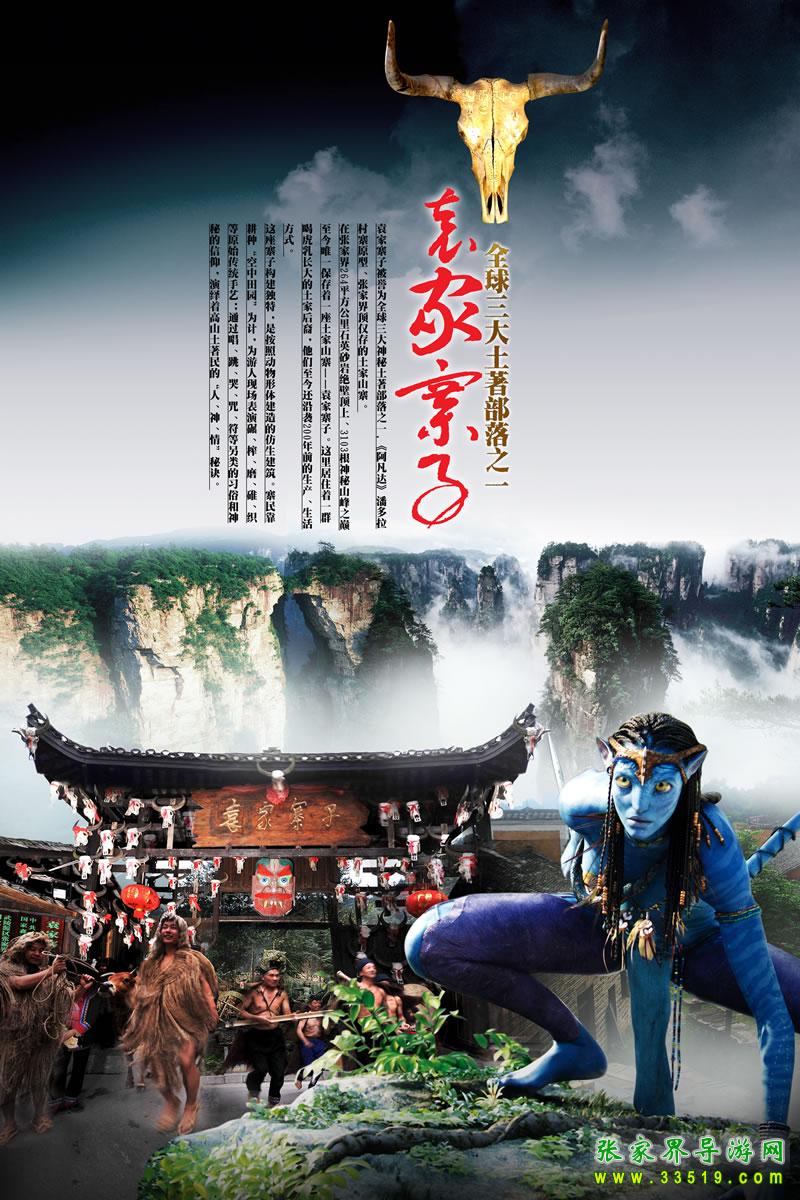
Yuanjia Zhaizi is located in the core scenic area of Zhangjiajie Wulingyuan. It is the only private building within the Yuanjiajie Scenic Area—the village of a local landlord—and has been preserved intact, becoming a major tourist attraction. It retains the architectural features of the Tujia ethnic group, with eaves curving upward at the corners, strings of corn and chili peppers hanging under the eaves. The local people are warm and hospitable, fond of entertaining honored guests with home-brewed wine, and before drinking they must sing a toast song. After the young woman finished the toast song, each tourist tasted a cup. The alcohol content was not high—seemed like only a few percent—not hard to drink, and I didn't feel much... I had long heard of the three great specialties of the Tujia people: "driving corpses, crying marriage, and placing curses," which remain unsolved mysteries to this day. This is the curse worm used by the young woman for placing curses. Xilankapu—a major specialty of the Tujia ethnic group—is woven thread by thread with colorful silk threads by women before marriage. The craftsmanship is exquisite and takes a very long time.
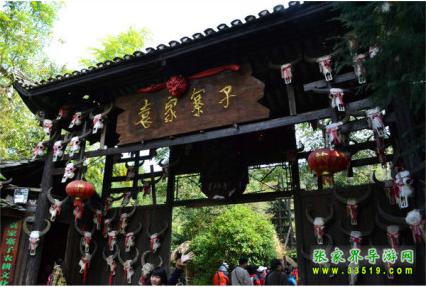
Distinctive Architecture
Yuanjia Zhaizi follows the architectural characteristics of the Tujia ethnic group. The eaves at the corners of the village gate curve upward, with a plaque reading "Yuanjia Zhaizi" hung horizontally in the center, large red lanterns hanging on both sides, and golden old corn cobs hanging all over the gate. As soon as we arrived, the villagers began playing suona horns and beating drums—it was very lively.
After entering, a fierce tiger lies across the front, with a child and a giant ape sitting beside it. This is the totem of the Tujia ethnic group, who since ancient times have believed in "taking the tiger as father and the ape as mother." Inside the village, displays show the Tujia people's history of reproduction, living habits, and the items they use—such as the different self-defense weapons used by Tujia men and women. Some are quite oddly shaped; if you handed one to me, I really wouldn't know how to use it.
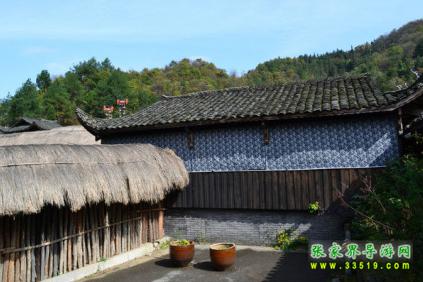
Carefully Constructed Scenery
The chaos at the Zhongping resettlement site became unbearable even to the people of Yuanjiajie themselves. In 2006, inspired by "building a world-class tourism masterpiece," the village party branch and village committee organized indigenous residents to go out for study tours and learning, helping them understand that development is for today's benefit while protection is for leaving wealth to future generations. After a village representative meeting, it was decided to use 15 indigenous households at Zhongping as a pilot, exploring a new path through self-rescue and self-governance. That is: without changing the building area of the houses, remodel the exterior into the shape of a Tujia mountain village; without changing the property attributes of the houses, implement unified operations; without affecting income, change the service content, replacing family inns and restaurants with farming culture demonstrations and folk custom performances.
In February 2007, led by the village committee, 15 households with 80 indigenous residents contributed their houses as shares and, through mutual cooperation, legally obtained the business license for Yuanjia Zhaizi, along with the enterprise code certificate and tax registration certificate. In March of that year, they hired a professional team to move in and began comprehensive renovation. Subsequently, the village obtained the filing certificate for cultural performance venue operations and a health permit; fire safety rectification was carried out; and the pricing department incorporated the village into the performance industry for standardized management.
Thus, a new production model was born—Yuanjia Zhaizi—where people voluntarily cooperate and indigenous residents of the scenic area find their own way to make a living. In a residential room of Yuanjia Zhaizi bustling with streams of visitors, village party secretary Zhang Yuhui did some calculations for this writer: 20 years ago, when Zhangjiajie was first established as a city, the per capita net income of Yuanjiajie Village was only just over 300 yuan. Ten years ago, every household in the village ran inns and restaurants, but per capita net income was still only 2,000 yuan. This year, despite government demolition and resettlement reducing both the scale and scope of operations, villagers' income has risen substantially—by conservative estimate, no less than 16,000 yuan per capita. Zhang Yuhui said: "We used to earn money by selling hard labor; now we earn money as bosses collecting dividends." The 15 households receive a total annual dividend of 753,000 yuan from their shares, and the village also pays each household 5,000 to 8,000 yuan annually in rent subsidies. The money earned by the village collective can be redistributed as well. In this way, villagers earn more than 11,000 yuan per capita annually from the village.
In June 2007, Heilongjiang Provincial Governor Zhang Zuoyi visited the village for inspection, accompanied by city and district leaders. When he heard that Yuanjia Zhaizi had removed 388 beds and eliminated 1,650 dining seats, reducing sewage discharge by more than 5 million tons annually, he commented that the village model was an effective attempt to protect the scenic area environment, enrich tourism content, and provide a way out for indigenous residents. In August 2008, renowned CCTV journalist Wang Zhi came to the village for a reporting visit. When he heard that Tujia history is long and profound, ethnic culture is vast and deep, and especially that folk culture and arts are deeply loved by tourists, he repeatedly said that the village is a heritage platform for reviving Tujia farming culture through live demonstrations for visitors, and commented that Zhangjiajie had explored a new path for protection and development.
Anyone who has been to Yuanjiajie knows that there are many rainy and foggy days on the mountain. With the village there, visitors won't feel regretful even if they can't see the mountains, because there is such a wonderful place to visit on the mountain.
Atop the 264 square kilometers of quartz sandstone cliffs in Zhangjiajie, on the summits of 3,103 mysterious peaks, there remains to this day the only preserved Tujia mountain village—Yuanjia Zhaizi. Here lives a group of Tujia descendants who grew up drinking tiger's milk, and they still follow the production and lifestyle of 200 years ago. This village is uniquely constructed—it is a biomimetic building shaped after an animal's form. Villagers make their living by cultivating "fields in the sky" and perform traditional handicrafts on-site for visitors, such as husking, pressing, grinding, pounding, and weaving. Through singing, dancing, crying, chanting, and talismans—alternative customs and mysterious beliefs—they enact the "people, gods, and emotions" secrets of these high-mountain indigenous people.
Three important reasons why the village has been preserved: First, the village's buildings are constructed in the shape of an animal atop a sheer precipice, making it a rare biomimetic building among China's ethnic minorities. Second, the indigenous residents' way of life is extremely primitive, still remaining in the state of over 200 years ago, possessing tremendous tourism value. Third, the indigenous residents' ethnic culture is itself an object worthy of protection—it cannot be allowed to break off and needs to be continued. It is precisely for these reasons that, with the special permission of Premier Zhu Rongji, it was reported to UNESCO for approval.
Take the world's No. 1 elevator (the Wings of Zhangjiajie · Bailong Elevator) into the Heart of Zhangjiajie · Yuanjiajie Scenic Area; then arrive at the Pillar of Zhangjiajie · Qiankun Pillar to feel the awe of the "floating mountain" Hallelujah from Avatar; then cross the naturally formed No. 1 Bridge Under Heaven; and reach one of the world's three great mysterious indigenous tribes, the prototype of Pandora Village in Avatar, and the only remaining Tujia mountain village at the top of Zhangjiajie (the Root of Zhangjiajie · Yuanjia Zhaizi), to experience the primitive and mysterious farming culture.
Take the world's No. 1 elevator for a vertical ascent, experiencing aerial sightseeing; enter the core Yuanjiajie Scenic Area of Zhangjiajie, feeling the mystery of Mihun Terrace and the awe of the Qiankun Pillar, the "floating mountain" Hallelujah from Avatar; cross the naturally formed No. 1 Bridge Under Heaven; arrive at one of the world's three great mysterious indigenous tribes, the prototype of Pandora Village in Avatar, and the only remaining Tujia mountain village at the top of Zhangjiajie—Yuanjia Zhaizi—to experience the primitive and mysterious indigenous culture and farming culture [cost self-arranged 166 yuan per person (includes one-way Bailong Elevator)]