This attraction introduction is compiled from historical materials in the "Zhangjiajie Tour Guide Network" (33519.com · Scenic Spots section). Ticket prices, opening hours, transportation, and contact information mentioned in the text may be outdated. Please refer to the latest official announcements from the scenic area before traveling; some content consists of historical background/cultural introductions and is for reference only.
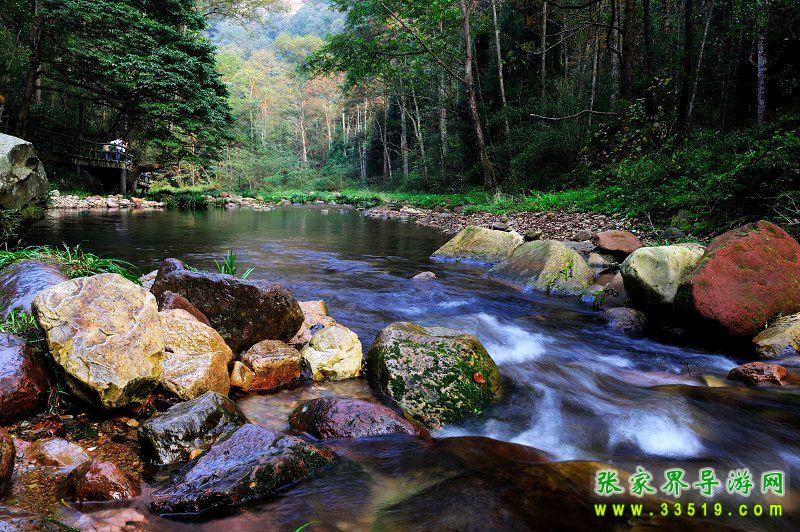
Golden Whip Stream is a naturally formed beautiful stream, named after the Golden Whip Rock. The stream winds its way from west to east, and even in long droughts, it never runs dry. Approaching Golden Whip Stream, everything is verdant green, even your clothes take on a faint green tint. The murmuring water accompanies the songs of birds. As you walk, you suddenly feel a coolness and realize a gentle breeze is blowing. Waves of fragrance make you stop involuntarily to savor it. In the crystal-clear, spotless emerald water, fish swim joyfully, and pebbles of red, green, and white glisten in the water. Sunlight filters through the forest gaps, casting dappled shadows on the water surface, giving one the enjoyment of nature's tranquility and serene beauty.
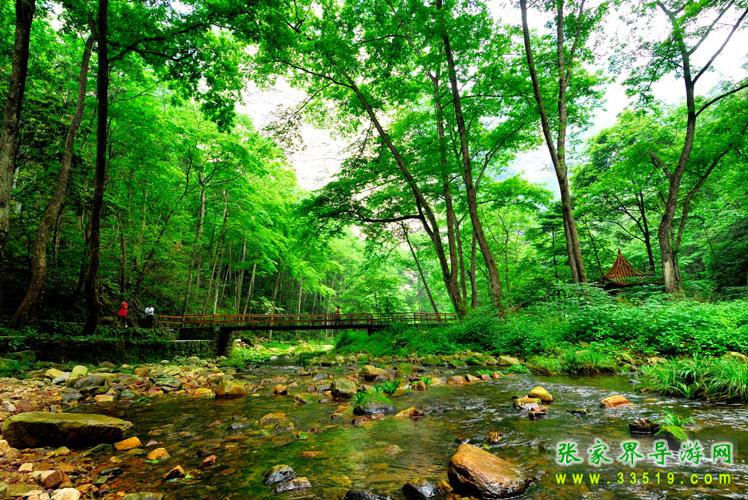
Golden Whip Stream is named after the Golden Whip Rock it flows past. With a total length of 5,700 meters, it winds through sheer cliffs and fantastic peaks. The stream valley has lush vegetation, and the stream water is clear in all four seasons. It is called a 'landscape gallery' and 'fairyland on earth.' A poem praises it: 'Clear clear waters, green green mountains, mountains like painted screens, people like immortals; if immortals walked within the painting, each step a gaze, each gaze a new heaven.' Along the way you will see a song request platform, where Tujia girls are always ready to sing folk songs for visitors. For just ten yuan they will sing heartily for you. Of course, if you don't want to spend the money, you can also listen to others' requested songs and leave after enjoying them.
The area along Golden Whip Stream is the most beautiful section of Wulingyuan Scenic Area. After entering from the gate of Zhangjiajie Forest Park, walk forward about 300 meters to reach the entrance of Golden Whip Stream. The entire stream is 5.7 kilometers long, winding through peaks, valleys, and clouds. The stream water is clear and pristine, with varied cascades, small fish swimming within, fresh flowers and grasses along the banks, and birds singing and orioles calling. Walking along the clear stream is better than traveling through a painting.
Golden Whip Stream winds through deep ravines and secluded valleys. On both sides of the stream, thousands of peaks tower into the clouds, with dense forests blocking the sun. Here, the stream murmurs, glass-like waterfalls cascade, and rare flowers and exotic herbs coexist with rare birds and animals, forming an extremely beautiful, serene, and natural ecological environment. It is called 'the most beautiful canyon in the world' and 'the most poetic stream.'
The main scenic sights include Drunken Arhat, Divine Eagle Guarding the Whip, Golden Whip Rock, Huaguo Mountain (Flower and Fruit Mountain), Water Curtain Cave, Cleaving the Mountain to Save the Mother, Meeting After a Thousand Miles, Nanmu Flat, and Water Winding Around Four Gates. Among them, Golden Whip Rock rises abruptly over 380 meters from the ground; the entire rock is composed of quartz sandstone, and under the sunlight it reflects a dazzling golden glow, which earned this "stone whip" the modifier "golden." Beside Golden Whip Rock stands a peak shaped like an eagle protecting its young, awe-inspiring and majestic, guarding the "Golden Whip" day and night, and thus it is called the Divine Eagle; this scenic spot is named "Divine Eagle Guarding the Whip." A huge rock is split open down the middle and is named "Chenxiang Saves His Mother." This comes from an ancient legend: a boy named Chenxiang, whose mother was crushed at the foot of the mountain for violating heavenly law. To save his mother, little Chenxiang trained hard in his skills and ultimately cleaved the mountain peak with a sharp axe, rescuing his mother. "Huaguo Mountain" and "Water Curtain Cave" are the domain of the Monkey King, Sun Wukong, long familiar to people from Journey to the West. In short, this stretch of scenery is like a land of peach blossoms beyond the world, and one cannot help but linger and forget to return. Water Winding Around Four Gates is where Golden Whip Stream converges with Kuangdong Stream and Longwei Stream; the stream valley is broad, Yuyan Peak is exquisitely beautiful and enchanting, and the legend of Wansui Tablet is mysterious.
Deep Mother-Child Affection
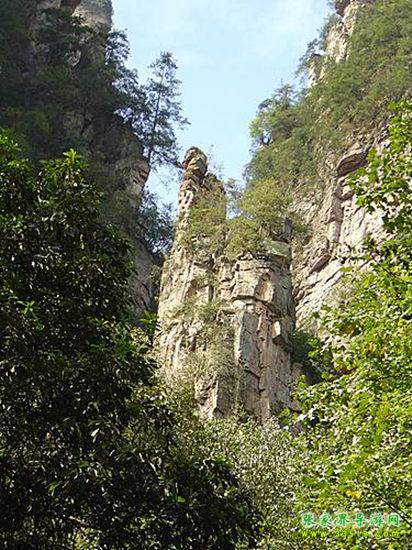
In this deep and secluded valley, there is a medium-sized peak that looks very much like a mother affectionately cradling a sleeping child in her arms, her kind face brimming with a happy smile. "Who says the heart of a blade of grass can repay the spring sunshine?" Who says stone is cold and heartless? Does not this mother's tender appearance resemble our own mothers? "Of all virtues, filial piety comes first"—we must never "forget our mother after taking a wife."
Pigsy Carrying His Wife on His Back
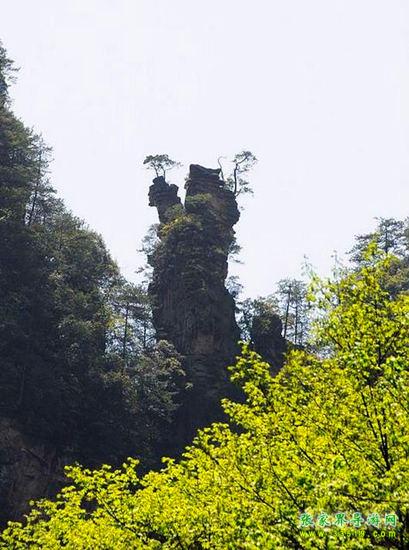
When it comes to pleasing one's wife, Zhu Bajie can be called an expert in this regard. Look back and you will see, not far away, a stone peak with some small trees growing on it, forked at the top like the English letter "Y," very much like Zhu Bajie wearing a little green hat carrying his petite wife on his back (some joke that he is wearing a "green hat" and carrying a "little wife"). The little wife holds a small parasol and is still wriggling on his back! Bajie's mouth is the most vivid—pouting out long, as if he has been carrying her for a long time, exhausted beyond endurance, and is panting heavily—you must not look down on Mr. Zhu Bajie; his charm is considerable. He can not only eat and play, cheerful and generous, but also gentle and affectionate. Though his looks are a bit "safe," he is especially good at making girls happy, and many a slender fair maiden likes this kind of "gentleman who is a good match."
Golden Whip Rock, Divine Eagle Guarding the Whip, Drunken Arhat
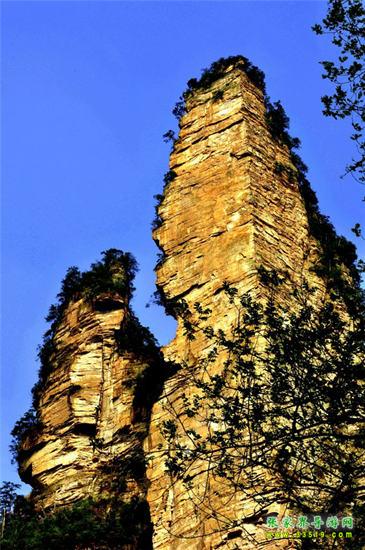
"Even if Yangshuo has a thousand elegant bamboo shoots, they cannot match a single golden whip here." This stone peak, with a relative height of over 300 meters, has sharp edges and layered joints, rising abruptly and piercing straight into the clouds, very much like a long whip thrust into the earth—truly "piercing the blue sky without blunting its edge." Whenever the sun sets in the west, the afterglow shines on the rock with a glittering golden color, so people call it Golden Whip Rock.
It also has a magical story: in the early years of the Qin Dynasty, when Qin Shi Huang was building the Great Wall, tens of thousands of laborers were forced to take part in this massive project, and many died or were injured from exhaustion. Then Guanyin Bodhisattva, in great compassion, pulled a strand of hair from her head and gave it to each laborer; as long as a laborer placed the hair on a rock and pulled gently, even a rock weighing a thousand catties could be rolled with ease. When Qin Shi Huang learned of this, he was overjoyed and gathered the hairs together to make a divine whip. He picked up the divine whip and tried lashing it a few times, and immediately the earth shook and the mountains swayed. So, in order to expand his territory, he began to drive mountains to fill the seas. When the Dragon King in the sea learned of this, he could not help but panic, and having no other way, he resorted to a beauty trap, sending the Dragon Shrimp Girl, transformed into a beauty of stunning looks, to intoxicate Qin Shi Huang and secretly swap the divine whip with a golden whip from the dragon palace. When Qin Shi Huang woke up, he could no longer drive the mountains and cried out that he had been tricked. In a rage born of shame, he seized the Dragon Shrimp Girl, cruelly cut her to pieces, and threw down the golden whip; a thick smoke rose from the flat ground, and this golden whip from the dragon palace turned into Golden Whip Rock, while after death the Dragon Shrimp Girl also turned into the lobster flowers beside Golden Whip Stream. A poet once wrote: "Lobster flowers bloom year after year, yet driving mountains to fill the seas was all in vain. A tyrant cannot seize the will of the common people; above the stream hangs the overlord's whip in vain."
From a geological perspective, this golden whip is even more miraculous. According to research, Golden Whip Rock is currently the world's tallest isolated stone peak in relative height and the most regular in peak-pillar shape. During the Devonian period 380 million years ago, the crust in this area subsided, seawater invaded and became a vast ocean, and flowing water continuously washed large amounts of loose fine debris from the nearby land; together with silicates in the seawater, these settled, cemented, and compacted into shape, forming quartz sandstone layers. By the Permian period 285 million years ago, the quartz sandstone was exposed on the surface due to crustal uplift and formed swamps, and plants multiplied, forming argillaceous limestone coal-bearing strata that covered the sandstone layers. By the end of the Triassic period 200 million years ago, strong crustal movement occurred again in this area, causing the flat strata to fold and fracture, forming mountain ranges that continued to rise and become exposed on the surface. After millions of years of water erosion, cutting, and the development of vertical joints in the rock, the present peculiar natural scenery of countless peaks rising and myriad rocks towering has been formed. Golden Whip Rock is undoubtedly a masterpiece among masterpieces created by nature's miraculous movements.
Gazing at Golden Whip Rock, one end thrust deep into the crust and the other piercing straight to the end of the blue sky, gazing at layer upon layer of marine sedimentary lines and one after another wave-erosion ripple marks on the rock, we seem able to see the vicissitudes of time piling up layer by layer, layer by layer, building the heights of the future, and then collapsing layer by layer, layer by layer, falling into the abyss of history; we seem able to hear the sound of tides rising and falling, the rumbling roar when the crust rose and sank, and the deathly silence after these movements! Zhuangzi said: "All things are born from being, and being is born from non-being." Perhaps all things are produced and perish precisely in this splitting and merging. Astronomy and geology have always filled me with awe. These two sciences can most broaden one's vision and expand one's mind, giving one's thinking depth and producing the joy of gazing at the starry sky, overlooking the Earth, and transcending history. The Earth, with a mere volume of 1,080 billion cubic kilometers, is no more than a speck of dust, a drop in the ocean, in the eyes of astronomers who measure spatial distances in light-years; and the human individual, whose "life span is less than a hundred years," and the succession of dynasties from Qin, Han, Sui, Tang, Song, Yuan, Ming, and Qing are, in the eyes of geologists who date history by rock strata and life by fossils, merely a wisp of blue smoke, a trace of cloud and mist. At this very moment, Golden Whip Rock seems to stand beyond the green mountains and clear waters, beyond time and space, beyond all things. "Vast and boundless, it joins the great breath of the universe, and none can find its edge; ample and overflowing, it roams with the Creator, and none can know its end." In all and everything, beyond all and everything, only change and eternity abide together.
The mountains of Zhangjiajie are truly created by heaven and earth, with workmanship surpassing that of ghosts and gods!
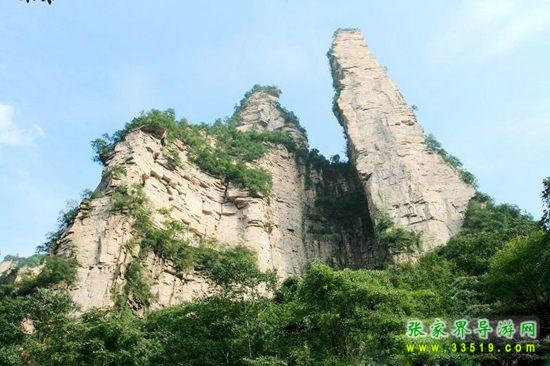
Just close to the left side of Golden Whip Rock, there is a peak that looks very much like a giant eagle; the sharp, protruding part is the eagle's beak. The eagle's head is held high, its wings half spread, carefully guarding this golden whip day and night, and people call this scene Divine Eagle Guarding the Whip. Why does this divine eagle protect this golden whip? Just opposite Golden Whip Rock, there is a rock peak over 200 meters high, rounded in form, leaning toward Golden Whip Rock and forming an 80-degree angle with the ground, like a drunken arhat, seeming drunk yet not drunk; the locals call him Drunken Arhat. His "intention is not in the wine"; his aim is to steal this golden whip, but because the divine eagle guards the whip, he has never succeeded. One really does not know where this arhat learned the Buddhist theories of "greed, anger, and ignorance" and "precepts, concentration, and wisdom." Why insist on what cannot be obtained?
Master and Disciples Seeking the Scriptures
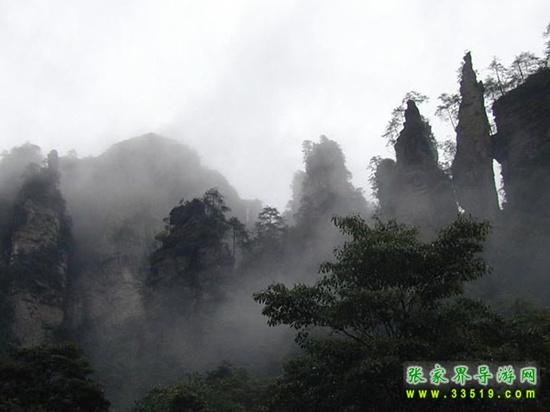
The three peaks standing side by side in the valley are quite distinctive; some call them "Master and Disciples Seeking the Scriptures," saying that they are the "group photo" of Tang Monk, Sun Wukong, and Sha Wujing. Friends who have seen Journey to the West may find this scenery somewhat familiar; this place was once an exterior shooting location for CCTV's Journey to the West. Some guests often ask, why did the important character Mr. Zhu Bajie not make it into this "group photo"? He snatched a moment of leisure and went behind to carry his wife (did we not just see the scenic spot "Pigsy Carrying His Wife on His Back"?). He accidentally missed the time. From this we can see that love and career can sometimes inevitably conflict a little.
Cleaving the Mountain to Save the Mother
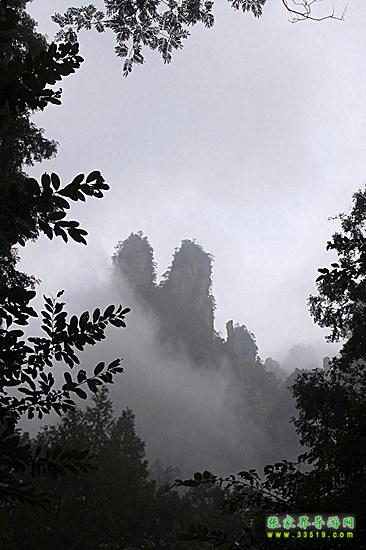
Ahead is a peak whose bottom is joined as one body and whose top is split into two halves, as if cleaved apart by something; coincidentally, beside it there is a small peak that looks very much like a huge axe. People call this scene "Cleaving the Mountain to Save the Mother," saying it was split by Chenxiang when he saved his mother. From a geological perspective, it was mainly formed by alternating hard and soft rock layers undergoing gravitational collapse and water cutting, split by nature's ghostly axe.
Candle Peak
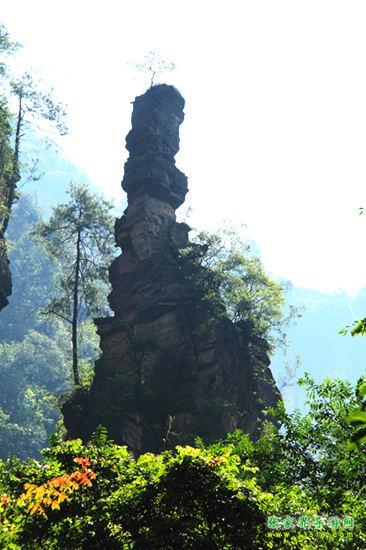
An ancient poem says: "The candle has a heart and still grieves at parting, shedding tears for others until dawn"; "When shall we trim the candle together by the west window, and talk of the night rain in Bashan?" A popular song now sings: "Your smile in the candlelight, so warm it moves me..."; "Please light another candle for me, because I have long lost my way..." Whether in the eyes of the ancients or modern people, candles are always so full of feeling, and candlelight can always ignite so many memories! This slender peak at the foot of the mountain looks very much like a candle; a small tree grows on top, very much like the candle's wick, and the leaves on the small tree seem like the flame given off when the candle burns. If these strange peaks and rocks, flowers, grasses, trees, birds, beasts, insects, and fish... all things in the world are sentient, then this candlelight must surely have been lit for their sweet trysts and romantic love, or for deep longing and sorrowful parting, right?
Wenxing Rock
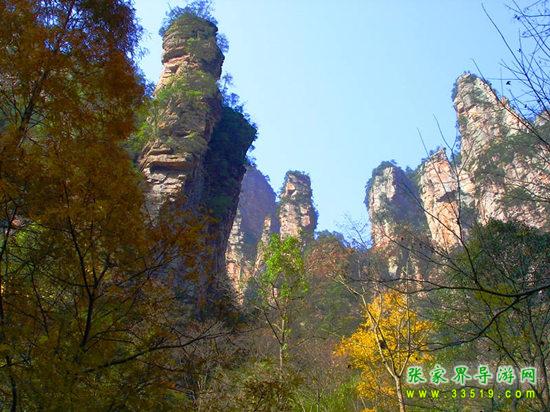
In the past, people who could write essays were said to be the incarnation of the "Wenqu Star" descended to earth. This peak before us—does it not look very much like a person? In particular, the top of the peak resembles a person's head; the forehead, nose, mouth, and eyes can all be seen clearly, and especially the short hair on top of the head and the beard on the chin look just like the real thing! Who is that? Some say it is Lu Xun. When President Jiang visited this scene on March 27, 1995, he said it also looked like Gorky. Lu Xun once translated Gorky's works and greatly respected Gorky, and Gorky also admired Lu Xun. Unfortunately, they had no chance to meet in their lifetimes. Unexpectedly, at Golden Whip Stream, the two masters have become one, merged into a single whole. How understanding the mountains of Zhangjiajie are! It turns out that the reason Zhangjiajie is so full of poetic and pictorial charm is precisely because such world literary masters are here.
Two Turtles Exploring the Stream
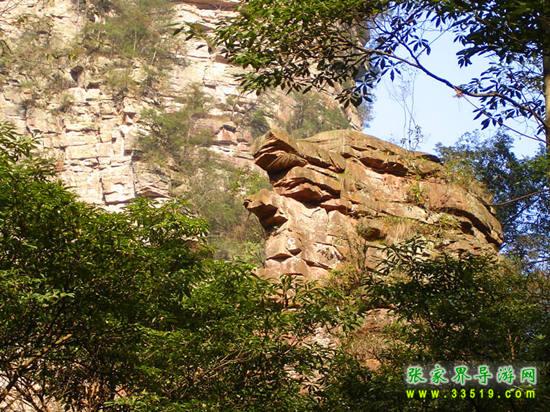
In the dense forest there are two stones that look very much like two turtles stacked together, craning their heads and peering about, crawling toward Golden Whip Stream. Some say this is "husband and wife returning home together." There is an absurd story here: one night billions of years ago, the Dragon King of the Sea notified the shrimp soldiers, crab generals, and all his subordinates living in this area that at dawn the next day the seawater would recede, and they must all withdraw in time. These two amorous turtles, caring only for romance under the flowers and moon, treated the Dragon King's words as wind past their ears. When they got up the next morning and saw that the seawater had already receded far away, it was too late for regret. They crawled and crawled, hoping only that one day this stream water could carry them back to the sea. Some people have a different "version": what are these two turtles doing hiding in this deep mountain forest? To evade "family planning." Zhangjiajie has many peaks shaped like turtles... that is all their doing!
Zicao Pool
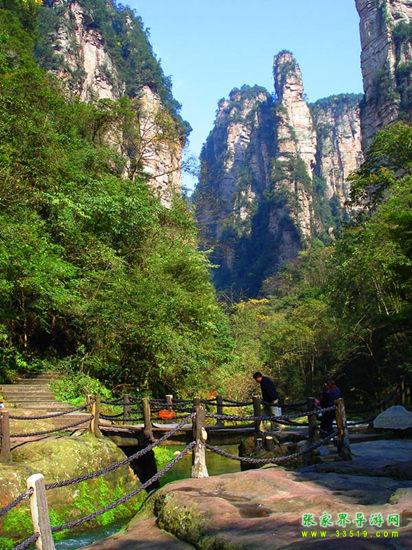
Originally named Zhicao Pool, it was named because mountain people in the Qing Dynasty washed handmade paper here. The pool water is so clear that the bottom can be seen; the bottom of the pool is entirely purplish-red rock. The pool is about 5 meters long, about 4 meters wide, and about 2 meters deep. "One pool of glassy water, two jade-green streams." Upstream from the pool, the water of Shadao Gully flows into Golden Whip Stream; the current is very swift, and strings of spray fall like pearls onto a jade plate. Around the pool, mountains encircle and waters wind, green trees form shade—what a cool, quiet, and secluded place! This pool of water, clear and green as jade, calm as a mirror, seems to hold tender feelings and yet also a touch of shyness, involuntarily reminding one of those widely recited lines: "That pool beneath the elm shade is not a clear spring, but a rainbow in the sky, crumpled among floating weeds, settling a rainbow-like dream." "There are perhaps a hundred fish in the pool, all seeming to swim in empty space with nothing to rely on. Sunlight shines straight down, their shadows spread on the bottom; suddenly they are still, then suddenly they dart far away, coming and going swiftly, as if sharing joy with the visitors." The ancients once debated the "joy of fish." One ancient said: "The fish swim back and forth so freely—how happy they are!" Another said: "You are not a fish; how do you know the fish are necessarily happy?" The first retorted: "You are not me; how can you say I do not know the fish are happy?" Tell me, then, is it the fish that are happy, or are we?
The small bridge over Zicao Pool is a complete natural giant stone, more than 3 meters long, more than 1 meter wide, about 30 centimeters thick, and weighing several tons. When the bridge was built, there was no mechanical equipment at all. How was such a heavy stone put in place? A short poem carved on the bridge surface answers: "Ten giant spirits descended from heaven, each holding a golden whip. At a single cry of heave-ho, the bridge spans Zicao Pool." The signature is unexpectedly "Ten Stonemasons"! You might as well read this poem again—do you catch any flavor in it? This little poem overflows with strong romantic coloring! "At a single cry of heave-ho, the bridge spans Zicao Pool." This romantic spirit almost catches up with Qu Yuan and yields nothing to Li Bai!
Meeting After a Thousand Miles
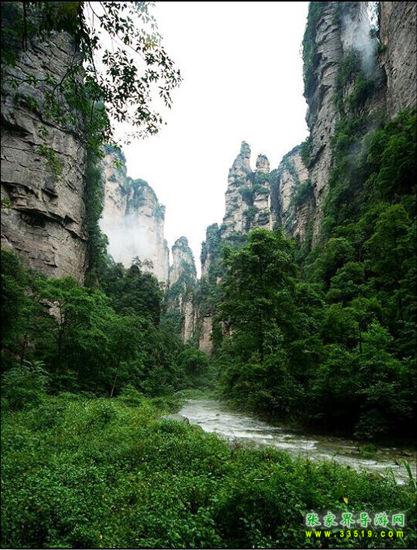
If destined, people meet though a thousand miles apart; through countless rivers and mountains, love endures. "Having seen the vast ocean, no other water seems worthy; having known the clouds of Mount Wu, no other clouds compare." The stone peak ahead, over 300 meters tall, doesn't it look like a pair of lovers? The man is tall and sturdy, wearing a helmet on his head and armor on his body, his right hand around the woman's waist, his left hand on her shoulder. The woman is full-figured with delicate features, gazing deeply at her beloved. The two, brimming with tender affection, seem to have a thousand words to say that even three days and nights could not exhaust. Can you guess whether they are pouring out the pain of parting, or expressing the joy of reunion? A poet once wrote: "Half pity, half sorrow, he joined the army young and returned old. His wife sobs, the general's tears, turning into spring wind that fills the valley." Legend has it that the man was a Tujia general during the Ming Dynasty's resistance against Japanese pirates. As soon as the battle ended, he rushed back over a thousand miles, dusty and travel-worn, to reunite with his beloved. He didn't even have time to change out of his helmet and armor! Since parting from her beloved, the woman thought of him day and night, losing all appetite for food and drink. "For him my belt grows looser, yet I regret not; for him I grow haggard." Her delicate face still shows a trace of weariness, yet she appears all the more lovely and touching! This scene, this feeling—do you see it? Do you see stone, or do you see love? The sound of the mountain wind on the stone cliffs, mingled with the flowing water of Golden Whip Stream, seems to offer blessing after blessing: May your love be perfect! May all lovers in the world be united in marriage!
Reunion Tree
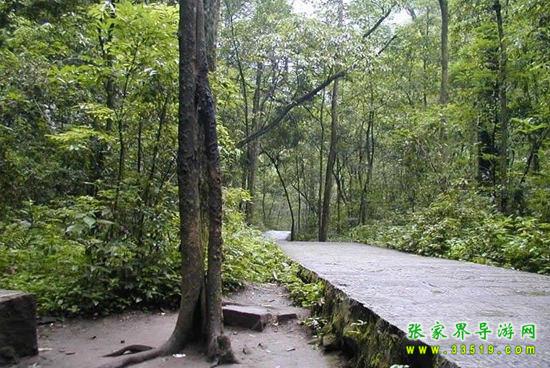
There are at least eight thousand, if not ten thousand, nanmu trees like this in Zhangjiajie, yet this one stands out and has become a scenic spot. Its uniqueness lies in the fact that the trunk splits into two at 50 centimeters above the ground, but for some unknown reason, after growing upward for over a meter, the two parts merge back into one, seamlessly. People often say that through all rivers and mountains, love endures. Golden Whip Stream can be said to embody affection in every blade of grass and every tree. Could it be that the tree, too, has gained human nature, unable to bear the pain of separation and longing for a joyful reunion? The opening line of Romance of the Three Kingdoms is: "The general trend under heaven is that after long division, there must be union; after long union, there must be division." This tree, uniting then dividing, dividing then uniting, seems to expound a profound philosophy for us.
Leaping Fish Pool
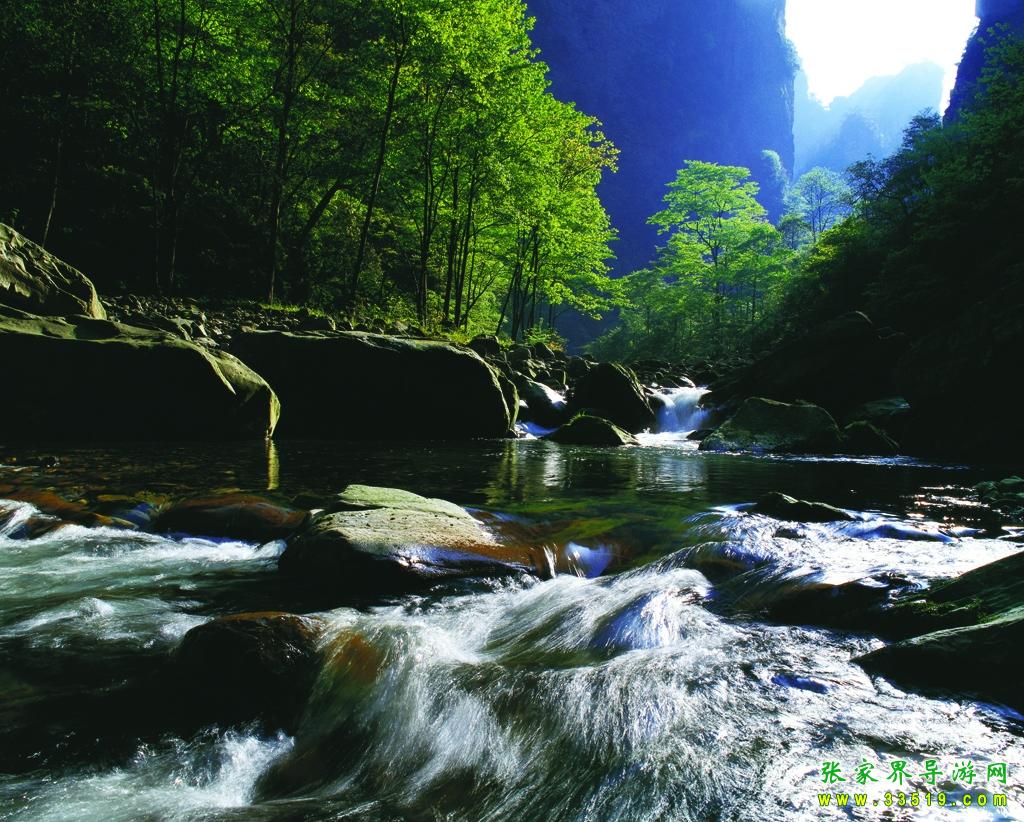
Below this waterfall with a drop of over one meter is a small stone pool called Leaping Fish Pool. In the pool live many small white fish that swim upstream year-round. They are lively and active. When the peach blossoms bloom, their temperament seems to become especially restless, and they constantly leap and compete in the pool, trying to swim upstream, often jumping nearly one meter high, as if competing in a high-jump contest. At this time, clever mountain folk would take their scoop nets (a type of woven fishing tool) and wait by the pool for the fish. As soon as a fish jumped up, they would quickly thrust out the net and catch it in midair, then put it into their fish basket. In this way, sometimes they could catch five or six jin of fish in a day. You may have netted fish, angled fish, or speared fish... but such delightful "catching fish" is something you rarely encounter in this world!
Camel Peak
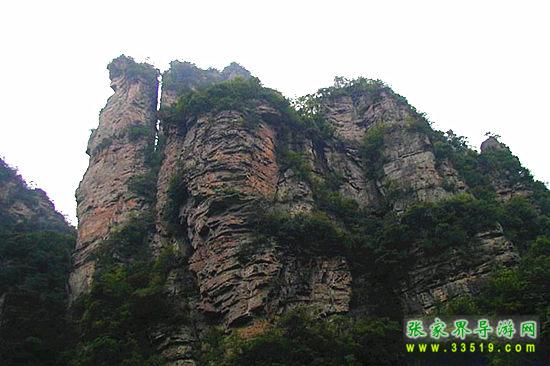
Among the peaks lined up before you, the one in front is the camel's head, and the two behind are the camel's humps. Taken together, they look like a camel strolling along. How did the camel, famed as the "ship of the desert," come to this place of green mountains and clear waters? Someone joked that it originally wanted a change of scenery, to come out and relax, but never expected the scenery here to be so beautiful, so it lingered and stayed at Golden Whip Stream.
Water Surrounding Four Gates
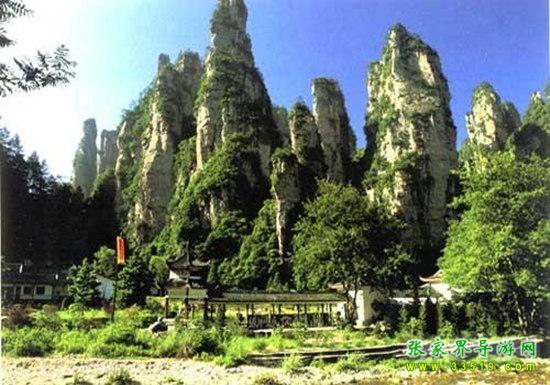
To the south is Dragon Tail Stream, to the north is Mandarin Duck Stream, and to the west is Golden Whip Stream. The three waters flow east and converge into Suo Stream. Four streams, four mountain gates—hence this place is called Water Surrounding Four Gates. Water Surrounding Four Gates is also known as Zhima Pagoda. Legend has it that Zhang Liang of the Han Dynasty, who retired to the mountains and forests, once came here. His horse, enchanted by the picturesque scenery of mountains encircling waters, simply refused to go any further. It is said that below Incense Burner Rock in the northwest corner is Zhang Liang's tomb (yet to be verified). Someone wrote a poem in response: "Treading through green mountains seeking the ancients, at Four Gates surrounded by water lies a fine burial site. Below Incense Burner Rock an old earthen tomb, the grave of Han Dynasty Marquis Zhang Liang." It is also said that this was the place where Xiang Dakun, the Tusi King of the early Ming Dynasty (who proclaimed himself Son of Heaven, known as King Tianzi Xiang), raised his uprising. Therefore, one peak there was named Ten-Thousand-Year Tablet, and another large group of peaks was called the Forty-Eight Great General Rocks—truly, "Wuling has many wondrous scenes; who arranged them so cleverly? Left for thousands of years for people to freely shape!"
Transportation
At the long-distance bus station (to the left as you exit the train station), take a bus to Zhangjiajie National Forest Park. After entering through the gate of Zhangjiajie National Forest Park, walk forward about 300 meters and you will reach the entrance of Golden Whip Stream.