This attraction introduction is compiled from historical materials in the "Zhangjiajie Tour Guide Network" (33519.com · Scenic Spots section). Ticket prices, opening hours, transportation, and contact information mentioned in the text may be outdated. Please refer to the latest official announcements from the scenic area before traveling; some content consists of historical background/cultural introductions and is for reference only.
[Ticket Price Information Update · 2026-09-14]
- Tianzi Mountain Cable Car: one-way 72 yuan, round-trip 144 yuan; discounted one-way 36 yuan
If old ticket prices/opening hours appear in the main text, they are historical materials and may be outdated, for reference only.
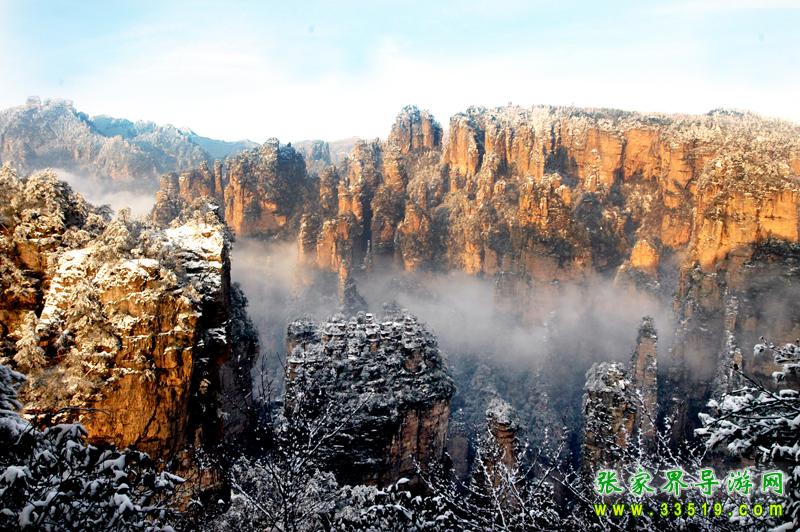
Tianzi Mountain is located in the northwest part of Wulingyuan, with a total area of 5,400 hectares, forming a tripartite balance with Zhangjiajie National Forest Park and Suoxiyu. It starts from Shenzhen Pavilion in the east and ends at General Rock in the west, stretching nearly 40 kilometers.
Tianzi Mountain has an elevation of 1262.5 meters and stands out among all for its towering height. Legend has it that it was named after Xiang Dakun, a Tujia leader in the Song Dynasty, who led an uprising here and called himself "Heavenly King." When viewing the scenery at Tianzi Mountain, the field of vision is wide, the momentum is majestic, and the layers are rich. It is especially renowned for viewing peaks, watching the sun, enjoying the mist, and appreciating the snow. Hence the saying goes, "After seeing Tianzi Mountain, no other mountains are worth seeing." There are also vast stretches of primitive secondary forests here, with exotic flowers and rare trees everywhere, and rare birds and animals seen everywhere.
I. Excellent Viewing Spots
Due to its high terrain, it offers views from the southeast, east, and west, with long sightlines, broad panoramas, and multiple layers of scenery. From the top of Tianzi Peak or Seven-Star Mountain, looking down, one can feel the thousands below. The central part of Tianzi Mountain is high, with low surroundings, like a giant pagoda rising from the ground. Various newly developed landforms of peculiar shapes are mostly concentrated on the mountainside, such as majestic waterfalls, perilous Immortal Bridge, rock gates, karst caves, and dense, steep peak forest stone pillars, greatly satisfying visitors' curiosity.
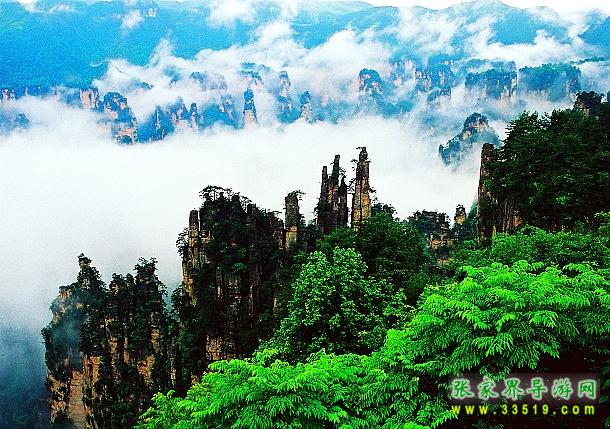
II. Magical Peaks and Rocks
The magic of Tianzi Mountain lies in its mist-shrouded strange rocks and perilous peaks, like pillars, towers, or bamboo shoots, ranging from tens of meters to hundreds of meters, carved in myriad forms. There are natural group images such as Qu Yuan Reciting, Sisters Whispering, Deep Love of Husband and Wife, Immortals Gathering, Fairies Dancing, and Heavenly Soldiers Marching. Local people call the stone pillars shaped like military generals "Forty-Eight Great Generals, Forty-Eight Small Generals," arranged in eight gates, with the Heavenly Son sitting in court reviewing troops. Legend says the name Tianzi Mountain comes from the Tujia uprising leader Xiang Dakun. He led 30,000 troops, called himself the Heavenly Son of the Xiang Family, and vowed to resist the court. After fierce battles for days, he was defeated and surrounded, shouted three times, and jumped from the rock mouth of Shentang Bay on the right side of Yuanjiajie with his horse, transforming into strange peaks and rocks like the Heavenly Son holding court. To this day, Shentang Bay remains mysterious, with sheer cliffs thousands of feet around its depths; overlooking from the cliff, one feels an eerie chill and unfathomable depth. From ancient times to now, few have ventured there, and no one has revealed its secrets, leaving only imagination in myths and legends, adding a layer of mysterious splendor to Tianzi Mountain.
III. Natural Rock Walls
The magic of Tianzi Mountain also lies in a massive rock wall over 20 kilometers long and up to a thousand meters high, embracing all the scenery. The rock wall facing the stone forest folds into ridges, with rock mouths and bays extending and retracting like the teeth of a folding fan. On the rock eaves at an elevation of over 900 meters on the mountainside, there is a winding yet flat touring path. The path is over 20 kilometers long, with 69 rock bays and 84 viewing platforms along the way; each bend offers a new scene, each platform a different view. This is a natural touring route, truly making one marvel at nature's craftsmanship.
IV. Diverse Water Scenery
The karst seepage water of Tianzi Mountain flows out from the sandstone surface at about 900 meters elevation to all sides, forming countless springs and streams, and waterfalls and water curtains beyond count. Some plunge down, some trickle slowly. The colorful waterfalls flowing from the red sandstone are especially superb scenery.
V. Four Great Wonders
Tianzi Mountain also has four great wonders: clouds and mist, moonlit nights, rosy sunrises, and winter snow. Clouds and mist are the most common celestial wonders of Tianzi Mountain, including scenes like cloud fog, cloud seas, cloud waves, cloud waterfalls, and cloud colors. After long rain clears or in fine drizzle, first comes hazy fog, then white clouds form, floating around. The peaks appear and disappear in the boundless sea of clouds, making one feel as if in the fairyland of Penglai. Sometimes clouds surge from stream mouths, climb over peaks, then pour down overwhelmingly, forming cloud waterfalls, extremely spectacular. On moonlit nights, when the moon is bright and stars sparse, and all is silent, the peak forests here are draped in a "magic veil" by the hazy moonlight, like groups of demon shadows standing in the secluded valley. Hearing the chirps of birds and animals creates a sense of mystery. On rosy sunrises, on clear mornings, a red sun rises slowly from the strange mountains and peaks against red clouds. Thousands of stone towers stand gracefully, draped in red glow, very enchanting. In winter snow, as winter arrives, Tianzi Mountain is wrapped in silver, with green pines and peaks covered by heavy snow. At this time, Tianzi Mountain has icicles hanging upside down, ice flowers scattered, and only some mountain deer and wild boars are not conquered by the silver-white world.
Tianzi Mountain has five main scenic areas—Huanglong Spring, Fengqi Mountain, Laowu Chang, Chapanta, and Shijiayan—along with dozens of important scenic spots.
He Long Park
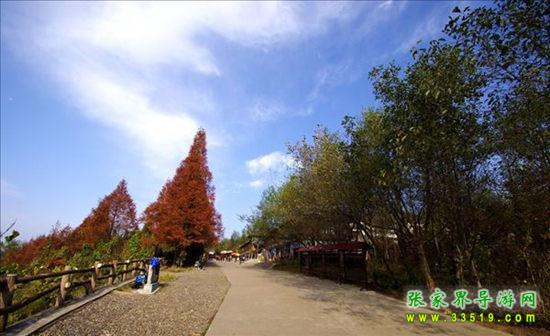
To commemorate Marshal He Long, He Long Park was built here in 1985. He Long Park is a cultural landscape on Tianzi Mountain and also a patriotism education base. It displays a Soviet-made T-34 tank that Marshal He Long once rode in, as well as a J-6 fighter jet independently developed by our country. The landmark scenic spot in He Long Park is the bronze statue of Marshal He Long.
He Long Bronze Statue
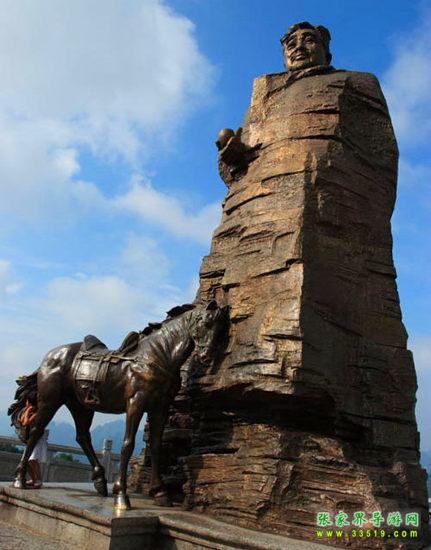
The tall bronze statue standing before us is Marshal He Long. Designed by the famous sculptor Professor Pan He, it is one of the largest single-figure bronze statues since the founding of the People's Republic of China, standing 6.5 meters tall and weighing 9.3 tons. It was decided to cast this statue to commemorate Marshal He Long's 90th birthday (Marshal He Long was born on March 22, 1896, and passed away on June 9, 1969). On October 25, 1986—the 50th anniversary of the victory of the Long March of the Second and Sixth Army Corps—it was formally installed here.
Marshal He Long gazes into the distance, his weathered eyes holding endless emotion. In his hand he holds a pipe worn smooth by years of use, and his warhorse affectionately nestles at his knees. We can almost see that young man who once walked out from the foot of Tianzi Mountain, stepped onto battlefields of blood and fire, endured the vicissitudes of life, and has now finally returned as a bronze statue to this native land he once longed for day and night. "Marshal He Long, may your soul return home!"
Why was He Long's bronze statue placed here? At the time, there were many different opinions about where to install the statue. After several heated discussions, a consensus was finally reached—because Marshal He Long had once organized and led numerous guerrilla battles among these towering mountains, and because the terrain here is higher, which better sets off the dignity of the bronze statue, it was ultimately decided to let Marshal He Long return to Tianzi Mountain. In fact, this bronze statue itself is an eternal landscape. While touring the mountains and waters, visitors can also pay tribute to Marshal He Long's great achievements and reflect on how hard-won today's happy life is. However, some elders in Hongjiaguan were quite unable to accept this. They said: "Marshal He Long fought for the country his whole life, climbed snow-capped mountains and crossed grasslands—it was too hard. After death, he still has to 'watch the mountains' for Zhangjiajie. Marshal He Long truly had a bitter fate."
Why does Marshal He Long face this direction? Directly ahead is his hometown, Hongjiaguan. After leaving his hometown in 1935 to begin the Long March, Marshal He Long never returned to his native place again. Although he only attended two years of private school, he once wrote a line of poetry: "How many times in my dreams I return to my hometown, my arms wrapped tightly around Tianzi Mountain." As the saying goes, no water is as beautiful as the water of one's hometown; no one is as dear as the people of one's hometown. During his military career—through hails of bullets, narrow escapes from death, and a life of constant wandering—how deeply Marshal He Long must have missed his hometown! Now Marshal He Long has finally returned, to stay forever with the people of his hometown and to 'watch the mountains' for them for all time.
Isn't Marshal He Long's towering figure just like the quartz sandstone peaks of Zhangjiajie? Yes—Zhangjiajie is said to have 'three thousand peaks and eight hundred waters,' and all the peculiar peaks together number only two thousand nine hundred and ninety-nine. Add Marshal He Long's figure, and there are exactly three thousand peaks. This symbolizes that Marshal He Long shares eternity with the green mountains and clear waters of Zhangjiajie, and shines together with its sun and moon.
In his hand he holds a pipe worn somewhat smooth—a 'treasure' he cherished throughout his life. To emphasize his tall and dignified image, the warhorse beside him appears somewhat smaller (the ratio of the statue to the horse is 4:1), but it was precisely this warhorse that accompanied him through hails of bullets and led him to victory after victory. When Marshal He Long was pondering a problem, he always loved to pick up his pipe and take a few puffs of tobacco; when charging into battle, he always loved to pat his warhorse and offer a few words of praise. Thus some say the pipe symbolizes Marshal He Long's wisdom, and the warhorse his bravery. The ancients said: "Devise strategies within a command tent to win victory a thousand miles away." Marshal He Long was indeed a military strategist both brave and resourceful. Under the long-term condition of the enemy being strong and we being weak, he did suffer quite a few defeats, but he remained full of confidence. With his pipe and warhorse, and with the great wisdom and courage of an outstanding military strategist, he turned defeat into victory time and again, ultimately winning the final victory. Without this pipe and warhorse, without this great wisdom and courage, how could he have risen from a poor peasant to become a marshal of the Republic with outstanding military achievements?!
"One pipe, two blades, from western Hunan heroes are made. Visitors come here to see the bronze statue, as if beholding the blood-stained battle robe of old." Let us pay tribute to Marshal He Long! Take a photo with Marshal He Long!
Viewing the West Sea from Yunqing Rock Scenic Platform
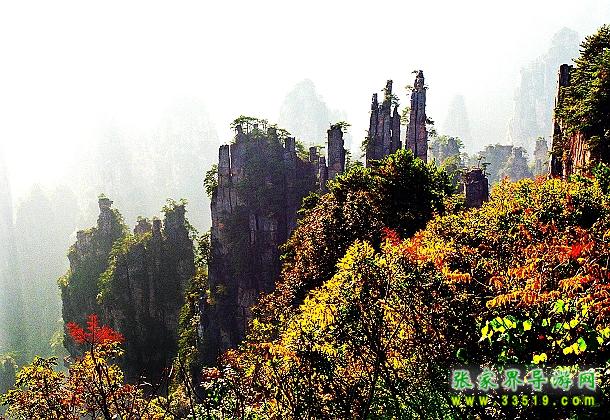
This is one of the best viewing platforms in Zhangjiajie. It is named after Marshal He Long's courtesy name, Yunqing. The canyon below is the West Sea. On top of one of the stone peaks in the West Sea closer to us, there is a rock that looks very much like a boat, and a pine tree on it that looks very much like a sail. This scene is known as 'Stone Boat Setting Out to Sea.'
Looking out, you see this enormous canyon filled with fantastic peaks and strange rocks, green pines and emerald cypresses, in a thousand forms of breathtaking beauty. The ancients said: "Climb a mountain and emotion fills the mountain; gaze at the sea and feeling overflows the sea." Facing this sea-like mountain and mountain-like sea, an indescribable joy rises spontaneously. At this moment, if you hold your breath, clear your mind of all distractions, and gaze at these peaks—row after row, layer upon layer—for 30 seconds, you will surely feel as though you yourself have become a peak. Li Bai once wrote a poem titled 'Sitting Alone on Jingting Mountain': "All birds have flown high and away; a lone cloud drifts idly on. Gazing at each other without weariness, only Jingting Mountain and I." Today, let us compose 'Sitting Alone on Tianzi Mountain': "All birds have flown high and away; a lone cloud drifts idly on. Gazing at each other without weariness, only 'Tianzi Mountain' and I." We are watching the mountains, and the mountains are watching us, aren't they? This feeling of gazing at the mountains, sitting with the mountains, and conversing with the mountains is truly wonderful beyond words!
If it happens to be just after rain, the canyon becomes a sea of mist and clouds, with the peaks surging within the mist, appearing and disappearing. "A thousand peaks and ten thousand valleys rise and fall at will, deep and shallow all shrouded in mist." How could these unpredictable yet vibrantly alive clouds and mist not set one's thoughts racing!
Three hundred and eighty million years ago, surging waves here once cradled the ancient sun. At that time the entire Earth was desolate, and life had just completed the evolution of single cells, algae, and fish. Three hundred and eighty million years drifted by, and the sea with its towering waves became a mountain of fantastic peaks and strange rocks. The mountain was then named a sea by a form of life no longer single-celled but capable of thought and creation—humanity. This truly is a sea: a sea of peaks, a sea of geography, a sea of history, a sea of philosophy, a sea of aesthetics, a sea of life! Facing this great sea, I think of our ancient ancestors—were they squeezed into some rock layer? If another three hundred and eighty million years pass, will the mountains here once again flood into a vast ocean? Will one of our bones become a fossil embedded in the rock layers? In the vastness of time and space, what is true change? What is true eternity?—West Sea, perhaps your essence is a boundless sea of thought.
Imperial Brush Peak
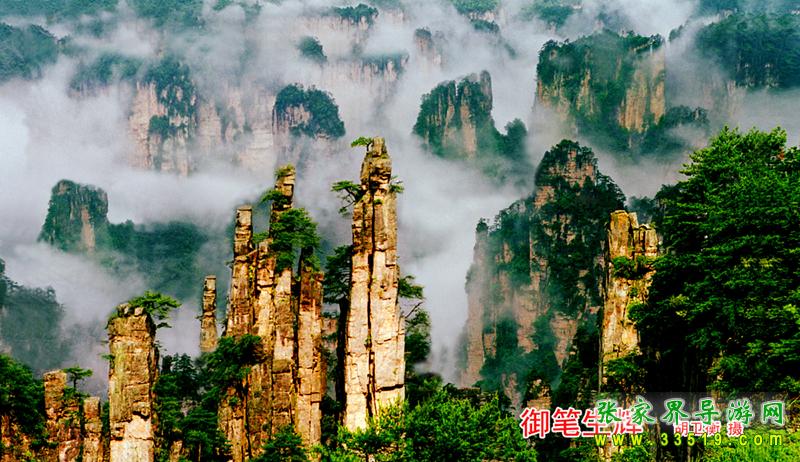
These few slender, thin peaks before us seem to have grown out of this canyon one by one, section by section, and their shape closely resembles a row of writing brushes placed upside down in a brush holder. The tips and shafts of the brushes can be clearly distinguished, and the medium-sized pine trees at the top look exactly like the bristles of writing brushes! This is simply the work of master craftsmen! How difficult it is for mountains to grow into such a shape—they were finally formed after hundreds of millions of years of complex geological processes including water erosion, wind and rain weathering, and gravitational collapse. Apart from nature, who else has such craftsmanship and patience to carve and refine quartz sandstone as hard as iron in this way? Some say that Zhangjiajie's picturesque scenery was painted by these brushes, using green mountains and clear waters as lines, wind, flowers, snow, and moonlight as colors, and time and space as the canvas.
Legend has it that these were the brushes once used by King Xiang, the Son of Heaven, so they are called Imperial Brush Peak. In the past, the imperial brush could be said to be a symbol of supreme imperial power. Linking several peaks with the imperial brush that held the power of life and death shows that even the local people who lived here every day were amazed by them. With the development of Zhangjiajie's tourism industry, Imperial Brush Peak has become a landmark scenic spot of Zhangjiajie, frequently appearing in various books and DVDs. People therefore affectionately call it the 'image ambassador' of Zhangjiajie's wondrous peak forest.
Fairy Scattering Flowers
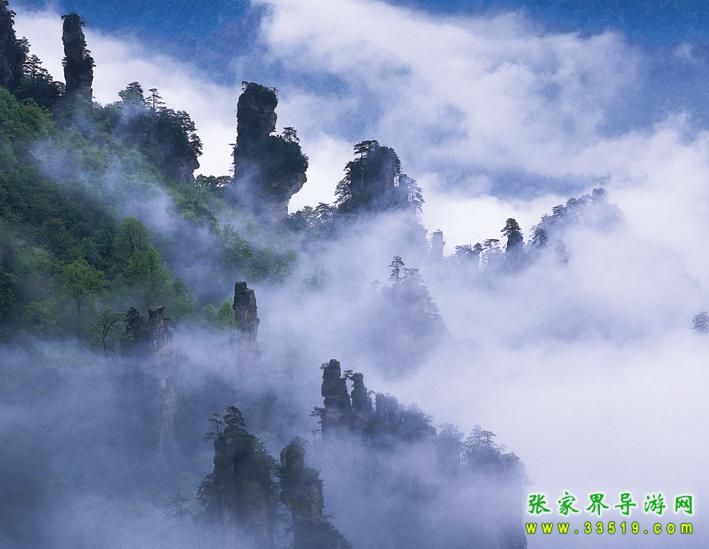
"One may love the realm, but loves beauty even more." Some say that over by Imperial Brush Peak is King Xiang's OFFICE, and here at Fairy Scattering Flowers is his harem. "Since ancient times, all heroes have loved beauty; if one does not love beauty, one is no hero." Whether King Xiang was that kind of beauty-loving hero can no longer be verified, but if this young maiden carrying a flower basket before us really was his consort or his sister, then it can be said with certainty that King Xiang was truly blessed with romantic fortune! Surely this woman—beautiful enough to outshine the moon and shame the flowers—also enjoyed 'three thousand favors bestowed upon one person'!
This beauty needs almost no description from me—that figure, that face, that expression—what a naturally beautiful, peerless woman! You can tell at a glance! You can even see her double eyelids! I notice some gentlemen seem to be staring wide-eyed, motionless—could they be having improper thoughts? "The love of beauty is common to all." Even if you really are having improper thoughts, that is entirely normal. Gentlemen may freely express their admiration, and ladies may compare themselves with her to see who is more beautiful!
In fact, she is not only beautiful as a fairy but also clever and skilled at dressing up. Take her hairstyle, for example—even a world-class stylist would probably fall short. Zhangjiajie is suitable for tourism in all four seasons, and the scenery differs in each. In spring, the gentle willow wind that does not chill the face cuts her a lively, lovely boyish bob; in summer, the branches of flowers, grass, and trees braid her a long, beautiful braid; in autumn, she simply dyes her hair golden, looking for all the world like a fashionable blonde; in winter, with snow blanketing everything, her face is delicate and her hair all white, transcendent and refined, like a fairy who does not eat the food of mortals.
Look—she carries a flower basket in her hand, and the flowers and plants in it differ with each season. Sometimes they are colorful and richly clustered; sometimes green leaves and red flowers stand out alone. "Year after year the flowers are alike, but year after year the people are different." Flowers bloom and fade—why is it that this beauty alone can remain forever young? Could it really be that one day on Tianzi Mountain equals a hundred years in the mortal world? This inevitably gives rise to endless associations and emotions! Some say it is because Zhangjiajie's climate is pleasant and the air fresh, with a natural beauty-enhancing effect, so she never ages. Others say it is because she has always befriended flowers, grass, and trees and kept company with green mountains and clear waters, living happily every day without a trace of worldly worry, and therefore remains forever young.
Tianzi Pavilion
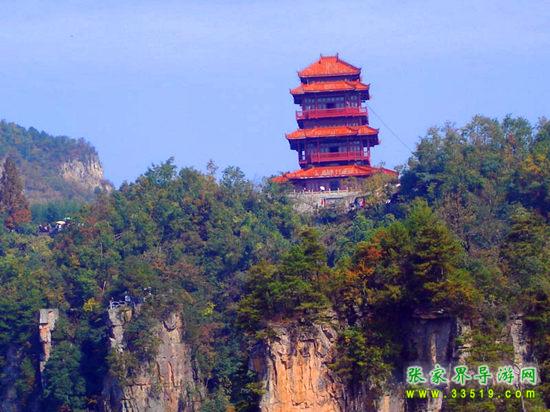
This is a six-story, four-tiered, double-eaved antique-style building with a pierced-top structure, 30 meters tall, donated and built by the Shenzhen Municipal Government. At the beginning, it was intended to be named 'Shenzhen Pavilion,' but many people (including Shenzhen residents) opposed this, believing it would not harmonize well with the overall scenery of Tianzi Mountain. From another perspective, however, the Shenzhen people's awareness of 'managing a city' is very much worth learning for the people of Zhangjiajie. "To see a thousand miles farther, ascend one more story." Climbing the pavilion and gazing into the distance, the peaks of Tianzi Mountain unfold before your eyes, offering a scenery all its own.
Pointing-General Terrace
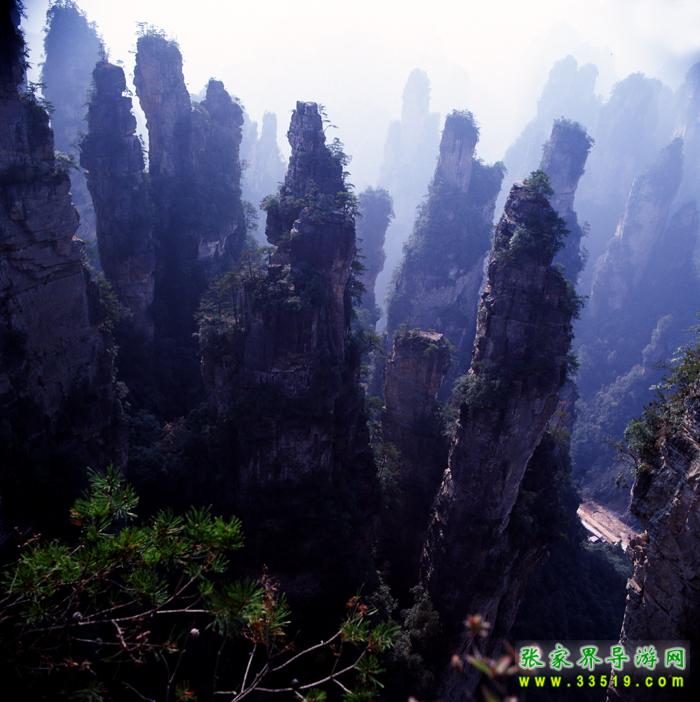
If taken literally, this inevitably brings to mind ancient battlefields of golden spears and iron horses, such as "reviewing troops in autumn on the battlefield" or "at night in snow by the tower ships at Guazhou Ferry, iron horses in autumn wind at Dasan Pass." In fact, Pointing-General Terrace is just a viewing platform, and the so-called "generals" are simply the peaks before our eyes.
Legend says King Xiang once reviewed his generals here—hardly credible. Yet today we are here enjoying the view—absolutely true. Looking out, peak after peak rises rugged and towering in a thousand forms—the momentum really does resemble an army about to march to the battlefield—who knows whether it is that we humans inherently have a warlike side, or whether these towering mountains truly once witnessed bloody battles? If that is so, may this Pointing-General Terrace forever remain a viewing platform!
Shentang Bay
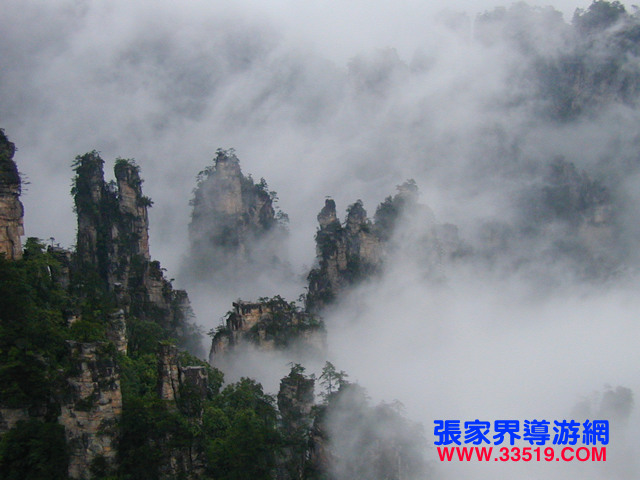
"If you don't reach Shentang Bay, you've wasted your trip to Tianzi Mountain." Shentang Bay is surrounded by cliffs on all sides, so deep that the bottom cannot be seen. Legend has it that after his defeat, King Xiang rode his white horse and leapt off the cliff to his death here. If the weather turns rainy, especially when a violent storm is approaching, strange sounds such as horses neighing, people shouting, and war drums thundering emerge from the bottom of Shentang Bay. Local people say this is King Xiang's restless spirit, still drilling his troops and preparing to make a comeback.
General Rock
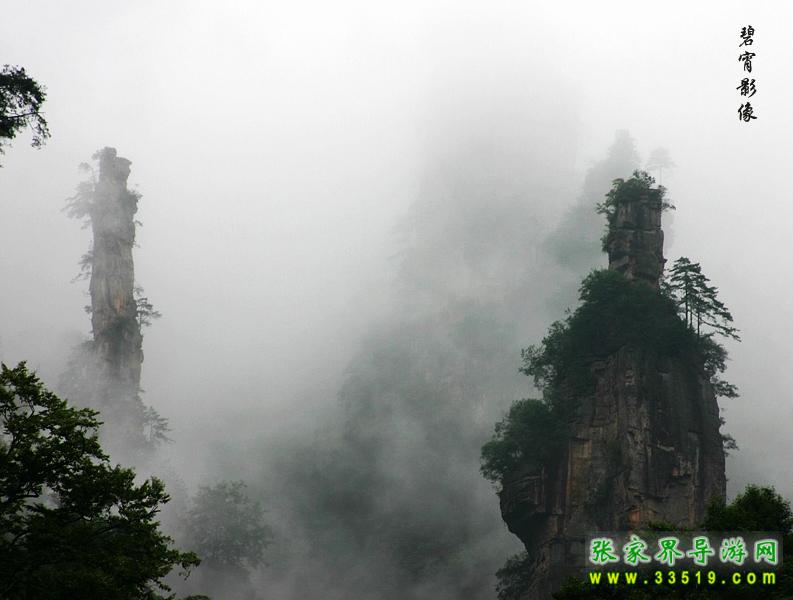
General Rock is said in folk legend to be the incarnation of King Xiang. See him clad in golden armor, with a slightly protruding belly, standing with hands behind his back—that bearing, that elegance, exactly like a general commanding thousands of troops. The late famous writer Mo Yingfeng wrote a poem in praise: "Lonely deep mountains, ancient and secluded through the ages; nature's craftsmanship shames the artisan. The Son of Heaven in the mountains follows the clouds away; the general on the rock stays with the years." The vicissitudes of time are silent, the years boundless; what remains forever between heaven and earth is the general's bearing!
Heavenly Terrace
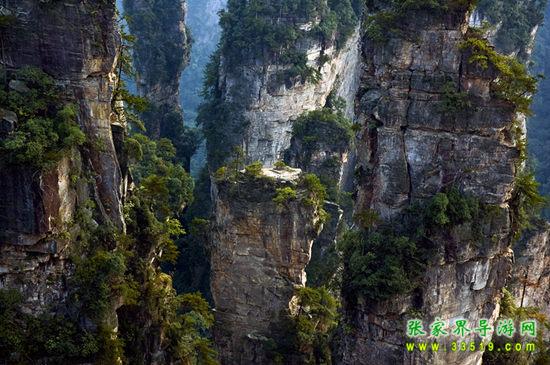
"I wish to ride the wind and return home, yet I fear the jade towers and jeweled palaces, so high and cold beyond bearing." Heavenly Terrace is a very high viewing platform, high enough to make one want to "ride the wind and return home." Below Heavenly Terrace lies the West Sea of incomparable beauty. The famous contemporary Zhangjiajie poet Qin Dayu once wrote a well-known ci poem, 'Climbing Tianzi Mountain': "In late autumn I alone ascend the Heavenly Terrace; mist surges and peaks hide, wind rolls and clouds part. Green pines atop the mountain, the vast sea before my eyes, Penglai beneath my feet. I paint red maples to add crimson color, toss my robe on the stone and lie on the green moss. With wine by the clear stream, singing long before the view, washing away all dust." The scenery here is so beautiful it sets one's imagination wandering—just shout aloud, and it seems you can converse with the immortals—friends who believe there are immortals in heaven may as well give it a try!
South Heavenly Gate
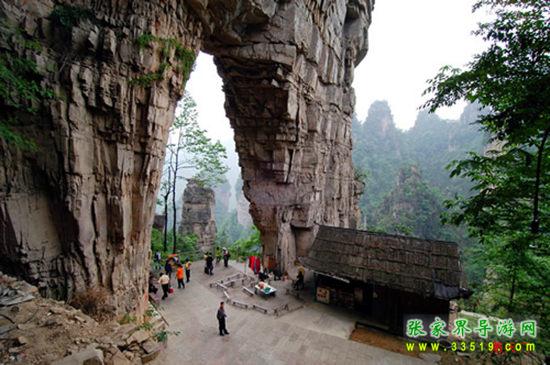
This naturally formed mountain gate is more than 10 meters wide at the base and 15 meters tall. Walking through this heaven-made gate, one cannot help but marvel at nature's wonder. The gate itself can be said to be rare in the world, but its name, "South Heavenly Gate," is found in countless places across our country—Mount Tai in Shandong, Mount Heng in Hunan, Mount Putuo in Zhejiang, Mount Huaguo in Jiangsu, and many others all have a "South Heavenly Gate." If you like going online, typing the three characters "South Heavenly Gate" into search engines on sites like Sohu and Sina will turn up hundreds or even thousands of related websites. This shows on one hand that people rather like the name "South Heavenly Gate," and on the other hand that there is a phenomenon of mutual imitation in our tourism development process. Zhangjiajie alone has two "South Heavenly Gates." If you like pursuing individuality and happen to be especially inspired right now, why not give this mountain gate a more moving and distinctive name? If your naming is truly excellent, the government will surely reward you generously.
Transportation
1. External Transportation
At the city's long-distance bus station (next to the railway station), there are many shuttle buses to the Tianzi Mountain ticket station, with frequent departures and a fare of 15 yuan. They go directly to the top of the mountain, saving you the cable car fee. You can also take a shuttle bus to Wulingyuan Town, then transfer to a motorcycle taxi (about 3 yuan) or a regular taxi to reach the Wulingyuan ticket station. Once inside the scenic area, take the free eco-friendly shuttle bus to the Tianzi Mountain cable car station, where you can ride the cable car directly to the top of Tianzi Mountain.
2. Internal Transportation
Tianzi Mountain cable car one-way: 52 yuan; Tianzi Mountain cable car round-trip: 104 yuan. Departs every 10 minutes (provided there is no queue). In case of severe weather or power outages, the cable car cannot operate.