This attraction introduction is compiled from historical materials in the "Zhangjiajie Tour Guide Network" (33519.com · Scenic Spots section). Ticket prices, opening hours, transportation, and contact information mentioned in the text may be outdated. Please refer to the latest official announcements from the scenic area before traveling; some content consists of historical background/cultural introductions and is for reference only.
Maoyan River is located in a section of the upper Lishui River within Yongding District. It is another new tourist scenic area opened after the Zhangjiajie National Forest Park, situated 35 kilometers west of Zhangjiajie city proper. In 1986, Maoyan River pioneered the rubber raft drifting tourism project in China. Tourists ride rubber boats drifting downstream, enjoying both the beautiful canyon scenery and the thrill and excitement of rushing rapids and dangerous shoals. Maoyan River has been the territory of the Maogang Tusi since ancient times. Six hundred years ago, Qin Hou, the leader of the Tujia people, fought against government troops in this area, opposing Zhu Yuanzhang's ethnic oppression. The mountains, waters, caves, and villages here, along with their place names and anecdotes, are all attached to the moving stories and beautiful legends of King Qin Hou. All of this has draped Maoyan River in a layer of mystery. Maoyan River is one of Zhangjiajie's five premium tourist routes.
The drifting section of Maoyan River is a stretch starting from Qingyu Pool, 20 kilometers west of Dayong City, heading north. Although Maoyan River has dangerous shoals and swift currents, the riverbed gradient is small and the water level drop is not great; the dangerous shoals are relatively short (generally only about 20 meters long), while the distance between shoals is quite long (generally over a thousand meters), so the waves are moderate, and the drift is thrilling but safe. The main scenic spots of Maoyan River include: Xuemen Gorge, Dongzi Fang, Maoyan Shoal, Jia'er Gorge, Wentang Hot Springs, Mayang Ancient Ferry, Maoyan River Gorge, Shuidongzi Waterfall, and more. The green mountains and clear waters along both banks make it picturesque, hence it is also called the 'Hundred-Mile Gallery.'
Maoyan River extends from Kuzhu Village upstream to Huayan Power Station downstream, a total length of 50 kilometers. Due to the construction of the Yutan Power Station in the 1990s, Maoyan River was divided into two parts: above the dam is the calm lake tour, 20 kilometers; below is the drifting tour, 25 kilometers. The main scenic spots to be enjoyed during the drift include Wentang Ancient Ferry, Suoying Pool, Congdou Shoal, Yanban Shoal, Lianhuan Shoal, Shuidongzi Waterfall, Yuanyang Islet, Jima Village, Heishe, Xingzi Shoal, Mao'er Shoal, Yanhe Gorge, Huoshao Rong, Xinlan Shoal, Raolan Shoal, Yinyang Shoal, Huangtu City, Zuzhou River, Xiangbizi Shoal, Magu Shoal, Dalanzi Shoal, Xiaolanzi Shoal, Chengjia Rock, and more.
Overview of the Calm Lake Tour Route
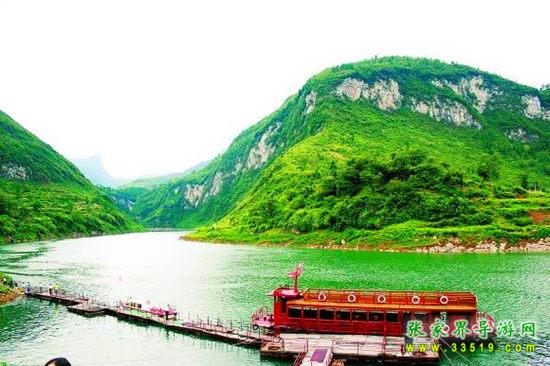
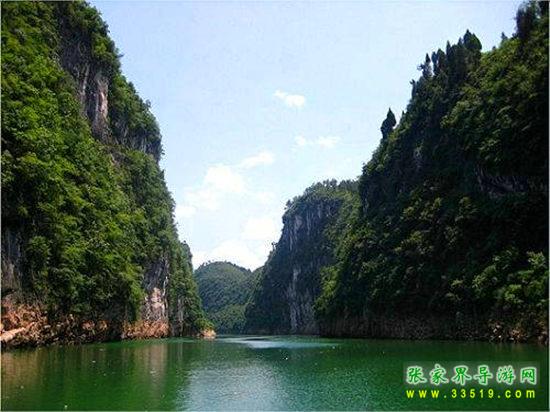
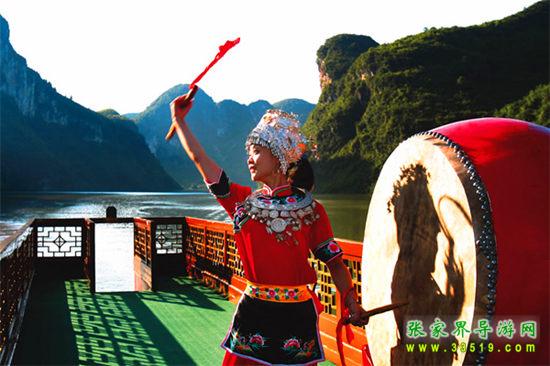
From Kuzhu River upstream to Yutan downstream, a total length of 20 kilometers. The main scenic spots along the way include: Xuemen Gorge, Qin Hou Cave, Seven-Year Village, Fishing Terrace, and the Mystery of the Spear Pole. Due to the impoundment of the Yutan Dam, the water level in the upper reaches of Maoyan River has risen, and some scenic spots have changed somewhat.
Xuemen Gorge
As soon as one reaches the mouth of the gorge, one immediately feels a chilling wind and piercing cold. The desire for adventure and the hesitation of fear make one at the gorge mouth 'not dare to enter, yet unwilling to retreat; looking up, one sees only a sliver of blue sky,' making one think 'this is a crack in the earth.' Xuemen Gorge flows down from Zhushitou Mountain at an elevation of 1,363 meters, with its outlet level with Maoyan River. Legend has it that during the Ming Dynasty, the Sangzhi Tusi launched a night attack on the Maogang Tusi and was disastrously defeated here, with blood flowing like a river, hence the name Xuemen Gorge (Blood Gate Gorge). The gorge is 3 kilometers long, 150 to 200 meters high, and less than 3 meters wide, with the narrowest part allowing only one person to pass through.
Qin Hou Cave
On the cliff about 40 meters above the water, three cave openings are arranged horizontally, collectively known as Qin Hou Cave. The upstream cave has a slightly lower opening, with spring water flowing out, commonly called 'White Python Emerging from the Cave.' The middle cave has an ancient fort built in it, and the entire waterway is within crossbow range. Defending this strategic point truly makes it 'one man guarding the pass, ten thousand men unable to break through.' The downstream cave has its opening shaded by miscellaneous trees, with a stone-built checkpoint; one must enter the cave from here. The distance between the three cave openings is about 50 meters, and they are interconnected inside. These caves are very deep, and to this day, no one has thoroughly explored them. Some locals say there are pythons as thick as water buckets inside, and some even say there were once 'wild men' in there. If a local child cries and cannot be comforted, the adults say to the child, 'Stop crying, or the wild man from Qin Hou Cave will carry you off and eat you.' The child really does stop crying.
Seven-Year Village
This village was originally called Maogang Village. Because Maogang Tusi Qin Hou rose up in rebellion with Chen Youliang and fought against the Ming army until his defeat, lasting seven years, later generations renamed it 'Seven-Year Village.' In this area, there are more than 20 places related to Qin Hou's name, such as 'Qin Hou's Stove,' 'Qin Hou's Spear,' 'Qin Hou's Fishing Terrace,' and so on. Among these legends and historical sites, some are historical facts, some are fabrications, and some are imagination. But regardless of authenticity, the Tujia people's feelings of remembrance for their leader are genuine.
Fishing Terrace
On this cliff there is a natural stone cave, with a spring flowing out from it, cascading down along the stalactites and stone curtains hanging outside the cave opening. Its shape resembles strands of silk thread, hence it is called Fishing Terrace. On the stone wall inside the water curtain, there grows a thick layer of moss and plants, very beautiful, making the Fishing Terrace even more full of imaginative color. No wonder some say: this is where Qin Hou once fished.
The Mystery of the Spear Pole
Inside a stone niche on the cliff, there is a pole-like object, about one zhang long, about a handful in thickness, purplish-brown in color, visible but out of reach. Some say this is Qin Hou's long spear, and others say it is Qin Hou's clothes-drying pole. But if we think carefully, neither explanation holds up to scrutiny. It has stood there for thousands of years; if it were iron, it should have rusted; if it were wood, it should have rotted. Is it a tree? But it has no branches or leaves, and it never grows. So what exactly is it? Someone once offered money to hire villagers from Seven-Year Village to descend on ropes from the cliff top to investigate, but none of the villagers were willing to do it, considering it an offense to the former king. Out of respect for the Tujia ethnic group, we are willing to let it remain a mystery forever. Perhaps we can find greater joy and experience deeper meaning in our imagination and speculation.
Overview of the Drifting Tour Route
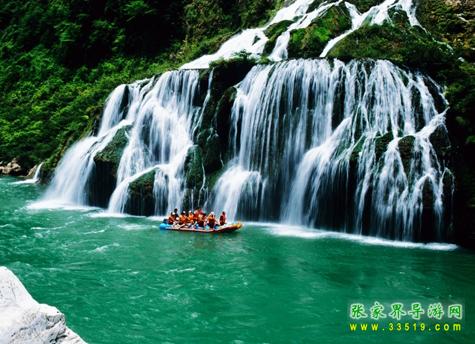
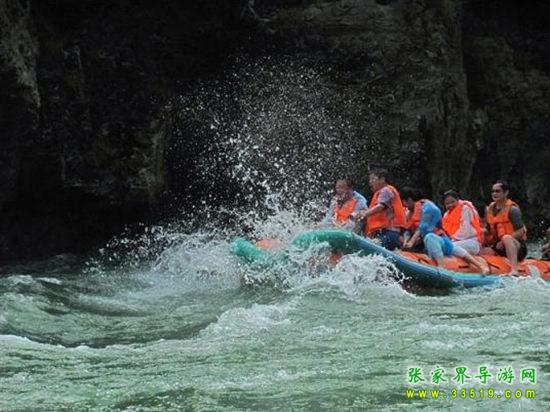
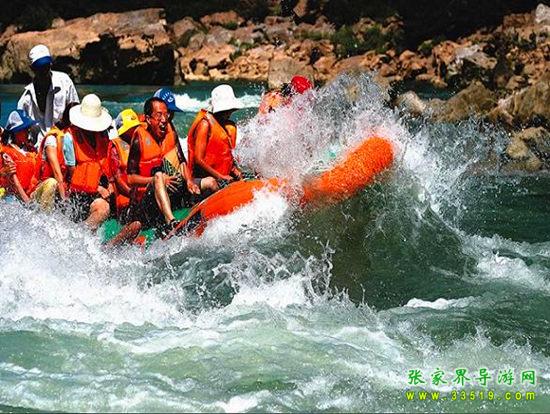
From Wentang to Huayan, the total water route is 25 kilometers. The main scenic spots include: the Ancient Ferry, Suoying Pool Gorge, Yuanyang Islet, Jima Village, Yanhe Gorge, Shuidongzi Waterfall, and Nandu River. While 'striking the water mid-stream, waves dashing against the flying boat,' don't forget to fully enjoy the flowing springs, flying waterfalls, and canyon scenery on both banks.
Mayang Ancient Ferry
How ancient is this old ferry crossing? Just look at the smooth, worn flagstone path and you will know. Probably, as soon as there were people here, there was this ferry. The ferry scenery is picturesque: the winding bluestone path, the emerald green bamboo groves, the silvery-white sandbars, plus the wild mountains and waters all around, instantly make our hearts—somewhat dusted by city life—become extraordinarily fresh and transparent! One of the representative works of the famous writer Shen Congwen, 'Border Town,' was made into a film right here.
Suoying Pool Gorge
Look, on the left bank's stone wall, several cave openings are built up with stones and have gun ports. In the larger cave with an underground stream, there were once water-powered rice huskers and mills. Some say these were the lairs of bandits from years past.
Speaking of bandits, one can't help but think of fighting. Drifting on Maoyan River, naturally, 'fighting' is indispensable. The ancients said: 'To do good work, one must first sharpen one's tools.' When small boats come around selling 'weapons' (water guns and ladles for water fights), you might as well strengthen your 'weapons and equipment,' so that if a band of 'fierce bandits' ('battle-hungry' tourists) suddenly appears along the way, you won't be caught completely off guard. I suggest you adopt a 'positive defense strategy'—don't strike first—but excel at 'striking only after the enemy strikes.' How about that?
Yuanyang Islet
This is a great place for camping and spending the night outdoors! Spending the night by Maoyan River is truly a rare pleasure; listening to the waves at midnight is an unforgettable experience. Someone in the Qing Dynasty wrote a poem titled 'Sounds of the Shoal on a Quiet Night': 'Suddenly I hear the shoal's sound rise from the corner of the house, / I suspect the Milky Way is surging from the Jade Capital. / Pine valleys have waves that toss the moon's shadow, / Green peaks and sky rain startle like thunder. / The rushing river pours straight down, the heart cannot compete, / Melting stones race in the current, anger not yet calmed. / Only at dawn does the sound gradually cease, / In the mountains, woodcutting begins again with a ding-ding.'
Jima Village
'Green waters wind away, green mountains open facing each other.' Jima Village is a small mountain village nestled by the mountains and water. Legend has it that in ancient times someone left five warhorses here. The villagers released the horses on Yuanyang Islet. A long time passed, and the owner still had not returned. The warhorses neighed day and night, refusing to eat or drink, and eventually turned into five mountain peaks. The name Jima Village (Horse-Boarding Village) comes from this. The village has about a dozen households, and seven or eight small wooden boats quietly moor at the bank; they rely mostly on these small boats to communicate with the outside world. Look, naked children are playing in the water on the riverbank, and beautiful, simple village girls are washing clothes by the river. Such a harmonious, tranquil, and exquisitely beautiful mountain-and-water village makes one sigh: 'There is no lack of fine lines here, only a poet to come and go.'
Shuidongzi Waterfall
We rush between mountains and waters, but actually we are conversing with nature, and the topic is about life. On June 23, 1994, Li Menghua, then Director of the National Sports Commission, accompanied by Vice Mayor Xiang Wanlong, inspected the Maoyan River drift and wrote a poem in front of Shuidongzi Waterfall: 'A light boat tours Maoyan, joy amidst the waves. Life is like drifting, constantly passing dangerous shoals.' Indeed, life is like drifting; one must constantly rush through one dangerous shoal after another. Only the truly brave can enjoy the pleasure of 'joy amidst the waves.'
Shuidongzi Waterfall is spectacular, like shattered jade covering the mountain! Like an iceberg sliding down! It has not only the elegance of high mountain flowing water but also the majesty of plunging straight down. The waterfall is formed by groundwater flowing out from a large hole in the stone wall, about 70 meters high and 45 meters wide. What is wonderful is that it neither falls straight along the bank nor pours down as a single cascade, but flows along the crevices of the cliff slope, sometimes opening and sometimes closing, like a stunning beauty with rich expressions, always making one unable to see clearly and never tire of watching. As you leave her, you will involuntarily turn back again and again.
Nandu River
From Nandu River to Huayan is 10 kilometers of mirror-calm water; rushing rapids and dangerous shoals no longer exist. This inevitably brings to mind what the Englishman Russell said: 'Each person's life is like a river—beginning small, confined within narrow banks. Then it rushes passionately over boulders, plunges down waterfalls. Gradually, the riverbed widens, the banks expand, and the water flows more smoothly. Finally, the river flows into the sea, without any obvious breaks or pauses.'
Nandu River has been a ferry crossing from Yongding District to Yongshun County since ancient times. In 1949, a squad of PLA soldiers escorting supplies upstream to the bandit-suppression troops in Sangzhi was ambushed by the bandit Tian Manman, and all died heroically. As the saying goes: 'In ten years a shoal becomes a pool, in ten years a pool becomes a shoal.' Today, this is no longer a major transportation route; the winding mountain road down to the river has been overgrown with wild grass. Only the story of the PLA soldiers is passed down from generation to generation, and the Tujia mountain song 'The mountain is high, so there is a winding road; the water is deep, so there is a ferryman' occasionally echoes through this hundred-mile canyon.
Transportation
1. Maoyan River drift connects to the Zhang-Luo Highway in the south and the Zhang-Sang 1835 Line in the west. The Xiao-Wen (Xiaohekan to Wentang) Highway runs through the entire area, linking up with the main routes of Zhang-Luo, Zhang-Qing, and Chang-Zhang, forming a network that is very convenient.
2. Take a bus from the station to Wentang, passing through Maoyan River, and take a bus back to Zhangjiajie city from Huayan.
3. Buy tickets in the city; the scenic area has dedicated shuttle buses for pickup and drop-off.