This attraction introduction is compiled from historical materials in the "Zhangjiajie Tour Guide Network" (33519.com · Scenic Spots section). Ticket prices, opening hours, transportation, and contact information mentioned in the text may be outdated. Please refer to the latest official announcements from the scenic area before traveling; some content consists of historical background/cultural introductions and is for reference only.
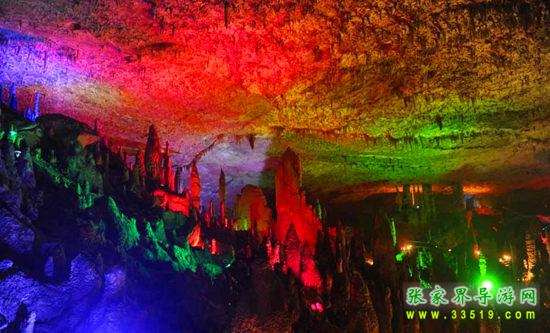
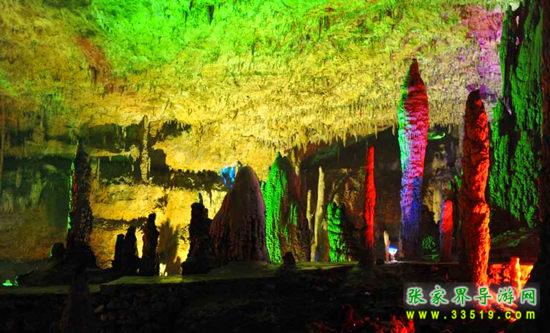
Jiutian Cave is located in Lifuta Township, 17 kilometers from Sangzhi County seat in Zhangjiajie City, Hunan. It is 70 kilometers from the city proper and 62 kilometers from Wulingyuan. It is named Jiutian Cave because there are nine natural skylights (jiutian) inside the cave. The total area is 250 hectares, making it the largest karst cave discovered in China to date — three times larger than the Lichuan karst cave, which claims to be the world's largest. The air inside Jiutian Cave is fresh, warm in winter and cool in summer. The entire cave is divided into upper, middle, and lower levels, with five spiral viewing platforms at different heights, the lowest level being more than 400 meters below the surface. Preliminary surveys have confirmed that the cave contains 40 large halls, 3 subterranean rivers with dramatic drops, 12 waterfalls, 5 natural bridges, and more than 10 underground mountains. In addition, there are countless colorful stalactite formations. Among the many fascinating sights, the five great wonders — Nine Star Mountain, Jade Palace, Crystal Palace, Jiutian Xuannü Palace, and Longevity Star Palace — are the most famous.
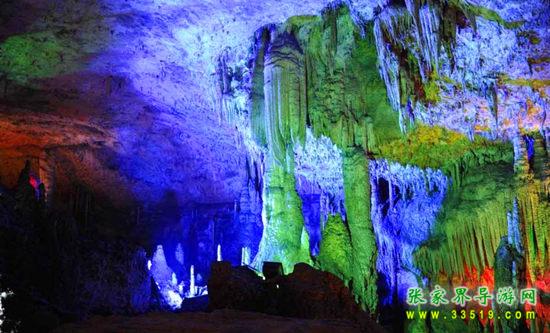
In 1995, it was designated an "International Cave Association Exploration Base" (only two in the country), and was accepted as a member of the International Cave Association (only three in the country). It was discovered in 1987 by cave exploration hero Wang Hairan, and officially opened to visitors in 1988. It was listed as a provincial-level scenic area. In the same year, after investigation and verification by experts from international cave organizations, it was determined that Jiutian Cave is massive in scale, unique in landscape, and still has a number of undeveloped cave clusters suitable for exploration and investigation. Thus, Jiutian Cave was formally accepted as a member unit of the International Cave Organization, and simultaneously designated as an International Cave Exploration Base. From then on, Jiutian Cave entered the international cave world and its status rose greatly. Jiutian Cave is an extra-large karst cave of karst topography, complex in structure, developed in the southern section of the third uplift of the Neocathaysian tectonic system, belonging to the stratigraphic Upper Permian series. The area currently confirmed as available for touring is 250 hectares, earning it the title of "Asia's Largest Cave." The year-round temperature is 20–22 degrees Celsius. At 2.5 kilometers south of the cave entrance, the Fengluan Stream Natural Forest Park, combining natural scenery and rich ethnic customs, stands alongside it; 2 kilometers southeast of the cave entrance, the Lishui River winds past like a silver ribbon.
Jiutian Cave is extraordinarily secluded. Whether it is the murmuring streams, the winding paths, the silent mountain breeze, or the still stone pillars, all give one a sense of returning to simplicity and authenticity.
In late September 1989, cave exploration experts from the United States, Britain, and Belgium visited Jiutian Cave for investigation, and unanimously agreed that Jiutian Cave has high scientific research value and tourism value.
In 1988, more than 20 cave experts from 17 countries conducted three investigations of Jiutian Cave, and determined that the area available for touring inside the cave is over 2.5 million square meters, divided into three main levels: upper, middle, and lower (we are now on the first level; the second and third levels are still below). The lowest level is 470 meters below the surface. Inside the cave there are three subterranean rivers, twelve waterfalls, fifteen pools, two dragon wells, five natural bridges, six thousand-field terraces, three natural lakes, five ponds, more than ten underground mountains, thirty-six large halls, and so on. Currently, only one-tenth of the cave's total area has been developed, meaning the touring area is about 250,000 square meters. Of this, we can see four skylights and six large halls (the other five skylights and halls are in undeveloped areas). The entire tour route is 8 li (4 kilometers) long and takes about two hours.
The First Skylight
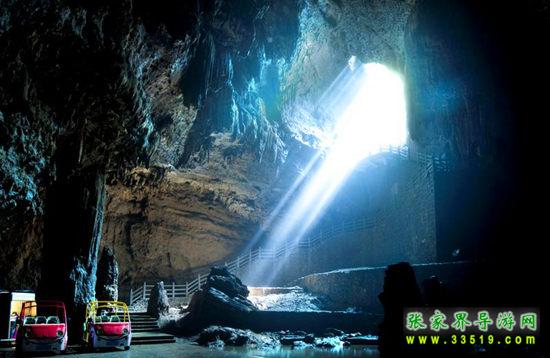
This is the largest skylight in Jiutian Cave and also the one closest to the surface (so we generally choose to enter or exit through this skylight). The distance from its opening to the surface, as measured by experts, is 54 meters. The vertical drop from the opening to the ground where we stand is 18 meters. This relatively open area is the first large hall inside the cave, with an area of about 250 square meters.
Huabiao (Ornamental Column)
The landscapes inside karst caves are mainly composed of stalagmites, stalactites, and stone pillars. Formations growing from below are stalagmites; the particularly thick ones are called stone pillars; those hanging down from above are stalactites (also called dripstones); and the wider ones flowing down along walls are called stone curtains. On the right there is a stalagmite of peculiar shape. Looking at it as a whole, it closely resembles the huabiao (ornamental column) in front of Tiananmen in Beijing (friends who have been to Beijing will recognize it more clearly) — a symbol of our Chinese nation. In ancient times there was a saying: it expressed the hope that the emperor would return victorious after a military campaign. In this way, this huabiao appears at the very beginning of our journey, which is also to wish everyone a safe return.
Lotus Hall, Guanyin Sitting on the Lotus Platform
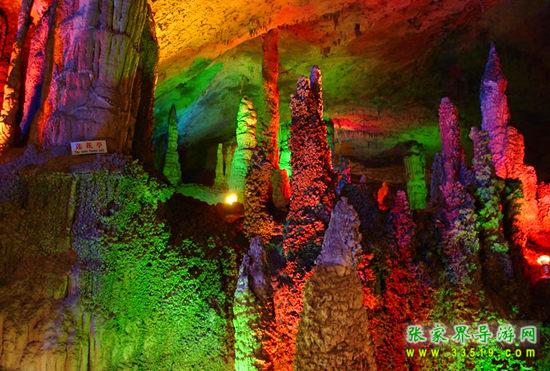
The second large hall inside the cave is called Lotus Hall. Above our heads hangs an inverted lotus bud about to bloom. Water drips from its stamens, forming a pool below. If you look to the upper left, you can also find the Guanyin Bodhisattva inside the cave. With hands pressed together in prayer, she is seated in meditation, chanting sutras.
Tujia Mountain Village
Directly ahead is a scene of twinkling stars and brilliant lights, just like the Queen Mother of the West holding a peach banquet. This is one of the three great wonders inside the cave: the Tujia Mountain Village. Some say it looks like a rural area that has prospered, with electric lights shining there too. Whenever mist swirls around, it resembles a city of towering buildings, known as one of the 'Three Foggy Capitals'—the mountain city of Chongqing!
Lucky Stone
To the lower right is a red stone that looks like an 'agate stone.' This is mainly because directly above it is a red stalactite whose main component is iron oxide; the water dripping down has dyed this stone red. Many friends who have touched this stone say it is also the only 'Lucky Stone' in the cave. If this is your first visit, you might as well touch it and try your luck. Legend has it that if you touch this Lucky Stone for the first time, you will surely have good fortune.
Underground Zhangjiajie
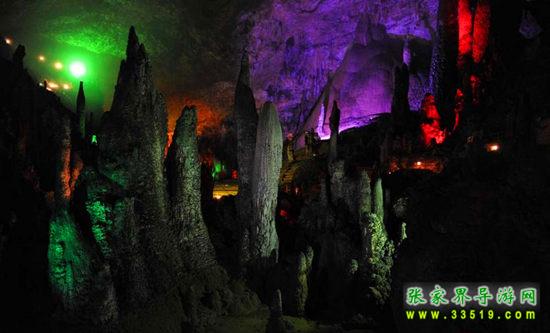
From the viewing platform on the left, you can see the 'second of the three great wonders of Jiutian Cave—the underground forest wonder,' which we also call the small underground Zhangjiajie. Below is a forest of stone pillars in all kinds of shapes. The stone pillars here are also very majestic and spectacular. It feels just like looking at the West Sea Peak Forest from the foot of Tianzi Mountain—absolutely wonderful.
Life-and-Death Love, Huashan Dangerous Path
To the lower left of the underground forest, you can also see a pair of modern lovers. We call this place 'Life-and-Death Love.' Below us there is a tour path, and we will return along the path on this side in a moment. Next, we will go up the Huashan Dangerous Path. 'Since ancient times, there has been only one path up Huashan.' Please be sure to pay attention to safety.
Crystal Palace, Crystal Mountain
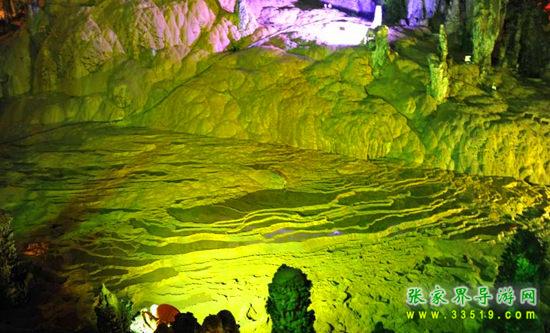
This small hill you see now is called 'Crystal Mountain,' which is how the Crystal Palace got its name. Its scientific name is 'flowstone,' and it was formed 150,000 years ago. Because the cave ceiling is a high mountain, its surface water gathers into streams and seeps down through cracks in the cave roof. During the water flow, calcite and secondary calcium carbonate were deposited to form it. After heavy rain, water flows down like this, forming a waterfall. We also call this underground area the 'Stone Waterfall Group.' You must have already noticed the glittering things above. According to scientific identification, these are calcite crystals containing a certain phosphorus element. They look sparkling and bright. Their special characteristic is that when the cave is dry in winter, they are especially bright, while in summer when the cave is damp, they become especially dim. If water flows down like this, they cannot be seen at all.
Transportation
There are tourist buses to and from Jiutian Cave every day, or you can take a minibus from Zhangjiajie Bus Station to Sangzhi County and then transfer to a bus heading for Jiutian Cave; there are relatively many such departures.