This attraction introduction is compiled from historical materials in the "Zhangjiajie Tour Guide Network" (33519.com · Scenic Spots section). Ticket prices, opening hours, transportation, and contact information mentioned in the text may be outdated. Please refer to the latest official announcements from the scenic area before traveling; some content consists of historical background/cultural introductions and is for reference only.
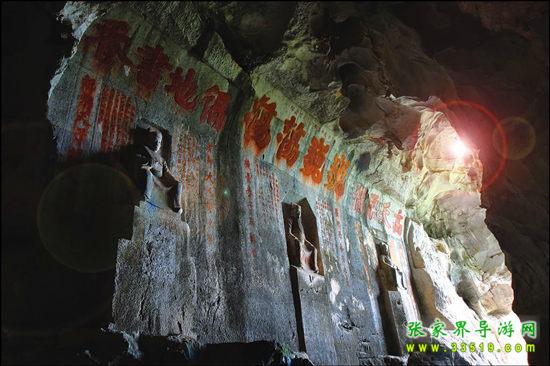
The Yuhuang Cave Grottoes are located on the southern cliff of Makong Mountain, about 7 kilometers west of Zhangjiajie city. They were funded and built solely by the local gentry Li Jingkai in the Qing Dynasty. Li Jingkai was also called Li Wurui, with the alias Jiudong Le and the literary name Shipo Sheng. He was born in the seventh year of Qianlong (1742 AD) and died in the Yiyou year of Daoguang (1825), at the age of 83. Mr. Li's family was well-off and among the richest in the area. In his youth he studied diligently and was quite talented. For decades he pursued an official career, but repeatedly failed the examinations and had no hope in officialdom. So he saw through the vanity of the world and sought consolation elsewhere. He hired craftsmen and spent huge sums, using the natural caves of Makong Mountain and arranging them according to upper, middle, and lower positions. With ingenious planning, he had them carved into three levels—'Heaven,' 'Human World,' and 'Underworld'—with eight caves in total. In addition, about 3 kilometers away at Fengquan Cave he had another cave carved, hence the alias 'Jiudong Le' (Joy of Nine Caves). The upper level of the Yuhuang Cave Grottoes is Yuhuang Cave; the Human World level has Yujin Cave, Haobi Cave, Mochi Cave, Hulong Cave, Xiongshi Cave, and Kongsheng Cave; and the Underworld level is Yinguo Cave. The eight caves form a complete chaotic world. At the head of the eight caves is Yuhuang Cave, carved with a statue of the Jade Emperor, meaning the supreme being of 'Heaven,' commanding the middle-level 'Human World' and the lower-level 'Underworld.' Therefore the eight caves are collectively called Yuhuang Cave. Construction began in 1799 and was completed in 1807, lasting eight years. Inside the caves are carvings of deities of historical figures and a large number of poems, couplets, and plaques. Not only are the stone carvings exquisite and unique, with vivid spiritual charm in the statues and powerful, grand calligraphy, but in the thematic conception of the grotto art, they also express the feelings of the sponsor Li Jingkai—his unrecognized talent, his cynicism toward the world, and his longing for a peaceful and prosperous age—and criticize the corrupt imperial examination system. They have certain historical value for studying Qing Dynasty society and the imperial examination system, as well as the thoughts and feelings of ordinary scholars of that time. The entire cave complex is more than 300 meters long from east to west, with 19 extant stone statues and more than 50 stone inscriptions. It is the only well-preserved grotto art group in Hunan Province. In 1959, Yuhuang Cave was listed as a key cultural relic protection unit of Hunan Province.
Yujin Cave
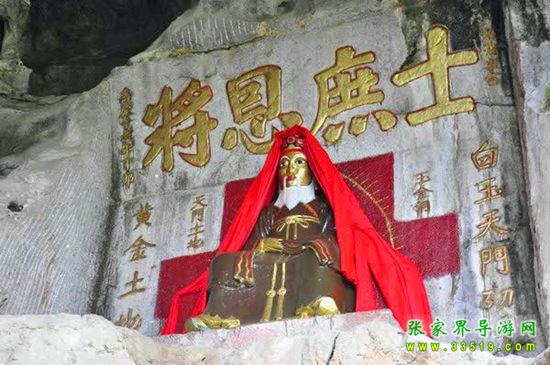
When touring Yuhuang Cave, starting from Yanggao Spring at the foot of Makong Mountain and climbing the stone steps, the first thing that comes into view is Yujin Cave. Yujin Cave, also known as Tianmen Tudi Cave, was completed in the twelfth year of Jiaqing in the Qing Dynasty (1807 AD). The cave is 10 meters high, 7.8 meters wide, and 9.6 meters deep. Inside is carved a statue of the Earth God. For some unknown reason, Li Jingkai broke convention and made only a single image, without an Earth Goddess. According to Taoist rules and folk deity positions, all Earth God temples have statues of both the Earth God and the Earth Goddess, because the Earth God is a very low-ranking deity who governs the land and protects the peace of a locality, and is close to the people. Therefore the people also felt very close to him, and so they gave the Earth God a spouse. Above Yujin Cave is a plaque inscribed with four large characters: 'Shishu Enjiang.' On both sides are couplets. The upper couplet reads 'White jade heaven gate penetrates,' and the lower couplet reads 'Golden earth god adorned.' The Earth God is also called the 'She God.' Because the land is vast and cannot all be sacrificed to, earth was mounded into an altar for the god 'to repay merits.'
Haobi Cave
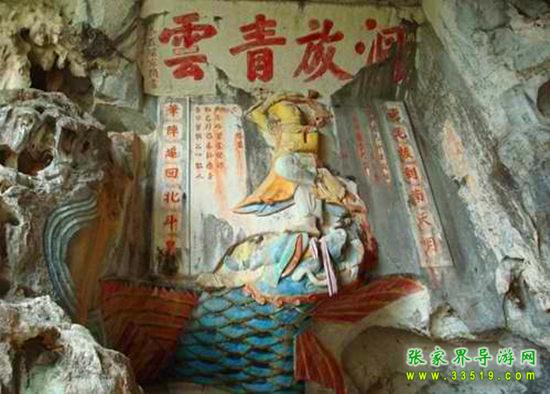
While sightseeing in the caves of the Human World level, after walking west 108 meters you arrive at Haobi Cave. Haobi Cave, also known as Kuixing Cave, was completed in the fourth year of Jiaqing in the Qing Dynasty (1799 AD). The cave is 11.5 meters high, 6.5 meters wide, and 33.3 meters deep. Inside are carved a statue of Kuixing and a giant sea turtle. Above the cave is a plaque inscribed with four large characters: 'Dong Fang Qingyun.' There is also a couplet. The upper line reads 'A hair tip sweeps to the southern sky moon,' and the lower line reads 'A brush formation pursues back the Northern Dipper star.' The signature is 'Inscribed by Shipo Sheng (Li Jingkai's nickname).' Judging from the statue, what Li Jingkai carved is Kuixing riding on the sea turtle. According to historical records, Kuixing is one of the Twenty-Eight Mansions, named 'Kui Mansion.' It is the great deity worshipped by Taoism as governing the rise and decline of literature. Gu Yanwu, who once raised the famous slogan 'Every man is responsible for the rise and fall of the nation,' explained in Record of Daily Knowledge: 'The divine image could not resemble Kui, so Kui was changed to Kuixing; and since it could not resemble Kuixing either, the form of the character was used, with the ghost radical, one foot kicked up to the right like the big curved hook in the character kui, one hand holding a dou measure, like the dou character in kui; and one hand holding a brush, meaning to mark with the brush the names of those who pass the examinations.' The plaque 'Dong Fang Qingyun' is an outward expression of Li Jingkai's bold words 'rising straight to the blue clouds.' The upper couplet 'A hair tip sweeps to the southern sky moon' and the lower couplet 'A brush formation pursues back the Northern Dipper star,' signed 'Inscribed by Shipo Sheng (Li Jingkai's nickname).' The carving of Kuixing riding the turtle head is ingeniously conceived: the turtle's head is in the upper cave, while the turtle's tail is in the lower cave. The proportions are appropriate and the figure is vividly modeled. Kuixing is bare-chested and barefoot, with one foot on the sea turtle, truly giving the impression of 'standing first on the turtle head'; the other foot is hooked upward, making the sitting posture dignified and majestic. One hand raises a brush high, while the other is clenched in a fist, implying both literary and martial accomplishment. In addition, Lu Ban is also carved in Kuixing Cave, which is also worth viewing and pondering. The Lu Ban statue has a plaque inscribed with four large characters: 'Fangyuan Zhiye.' The couplet reads 'Not a hair's breadth beyond compass and square, brush and ink deeply hide the plumb line.'
Mochi Cave
After leaving Kuixing Cave and walking west 20 meters, you reach Mochi Cave. This cave was completed in the fifth year of Jiaqing in the Qing Dynasty (1800 AD). The cave is 9.2 meters high, 7.9 meters wide, and 18.5 meters deep. Inside there are 3 statues, 15 stone inscriptions, 3 places with merit records written in ink on gray walls, and quite a few poems. The statue in the cave is Wenchang. The plaque reads 'Wenguang Chidan,' and there is also a couplet. The upper line reads 'Light ink inscribes the name, truly literature unsurpassed in the world,' and the lower line reads 'The cinnabar pool transforms, nothing but ancestral virtue shaking heaven.' There are also many poems in the cave. According to research, except for one poem, 'Sixteen Peaks of Tianmen,' composed by the Yuan Dynasty Hanlin scholar Yang Zhou, the rest were inscribed by Li Jingkai. Several of the poems represent Li Jingkai's thinking very well.
Yuhuang Cave
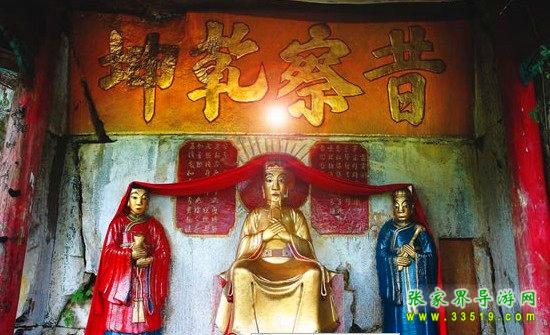
Yuhuang Cave, also known as Leidian Cave, sits above the seven caves and is the divine cave representing the upper heavenly level, honored as 'Heaven.' The cave is 4 meters high, 5 meters wide, and 3 meters deep. Inside is carved a statue of the Jade Emperor, flanked by statues of the Golden Boy and Jade Girl. Look: this Jade Emperor wears a golden crown, a dragon robe, and holds a Qiankun bag, sitting upright in the center with a majestic and composed expression. He is 1.9 meters tall. The Golden Boy holds a elixir bottle, and the Jade Girl holds a lute handle, standing on either side of the Jade Emperor. Above the cave is a plaque with four large characters: 'Xicha Qiankun.' The couplet has been destroyed.
Hulong Cave
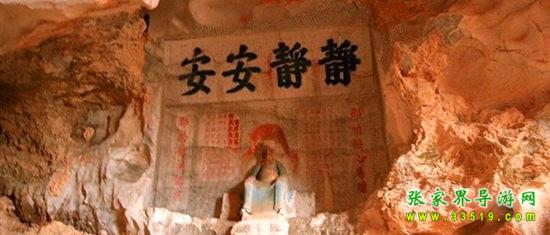
Hulong Cave was completed in the seventh year of the Jiaqing reign (1802). Inside the cave are statues of the four oldest historical figures in ancient China: Tang Yao, Yu Shun, Hou Ji, and Gao Yao. Under the plaque "Majestic and Vast" is Tang Yao. Legend has it that he was a tribal alliance leader in the late patrilineal clan society, historically known as Tang Yao. He appointed officials to manage the seasons and established the calendar. Tang Yao was virtuous and kind. Because his son Dan Zhu was unworthy, he was unwilling to let his son succeed him, so he widely solicited opinions from the people and selected Shun as his successor. After a three-year assessment of Shun, Yao handed over his position and authority to Shun. When Tang Yao passed away, the people mourned deeply, as if they had lost their parents. Under the plaque "Fragrance of Books Everywhere" is Yu Shun, surnamed Yao, of the Youyu clan, named Chonghua, historically known as Yu Shun. When Shun succeeded to the throne, he also followed Yao's example, widely listening to the people's opinions, selecting virtuous people to govern civil affairs, and choosing Yu, who had merit in flood control, as his successor. It is said that he was later exiled by Yu and died in Cangwu in the south. Under the plaque "Grain Abundant in the High Heavens" is the statue of Hou Ji. He was the ancestor of the ancient Zhou clan. Regarding the cultivation of various grain crops, he served as an agricultural official during the time of Yao and Shun, teaching the people to farm. He invented the planting of wheat and millet. His achievement lies in transitioning China from ancient nomadic life to settled agricultural life, which was of epoch-making significance. Under the plaque "Quiet and Peaceful" is the stone carving of Gao Yao, who was also a minister of Shun. After Yu the Great inherited the throne from Emperor Shun, Gao Yao was chosen as Yu's successor. When Gao Yao died, Yu recommended Gao Yao's son Bo Yi as his successor. Later, Yu's son seized Bo Yi's position and established himself, and the abdication system came to an end. Legend has it that Gao Yao was in charge of criminal law and prisons during Shun's time, equivalent to today's Minister of Justice. What was the meaning of Mr. Li Jingkai carving these four great sages of ancient China in the cave? Researchers have verified and analyzed that, in addition to expressing reverence and remembrance for them, it was also meant to express Mr. Li's own yearning for a peaceful and prosperous era. He hoped for a virtuous ruler like Tang Yao to manage state affairs, and that the throne would not be passed to unworthy descendants but given to virtuous people, bringing vast grace to the nation and the people; that a general atmosphere of reading would be formed, with the fragrance of books everywhere, enlightening people's minds and helping them understand reason, so that people of noble character and outstanding talent like Yu Shun could be selected and put in important positions, establishing merits for the people; that there would be a creative and highly capable person like Hou Ji in charge of agriculture, so that "grain is abundant in the high heavens" and there would be bumper harvests every year; and that there would be an upright and selfless person like Gao Yao, strict in law enforcement, managing public order and criminal law, so that people would abide by the law and live and work in peace. In this way, a "quiet and peaceful" social order and ideal world would emerge.
Lion Cave
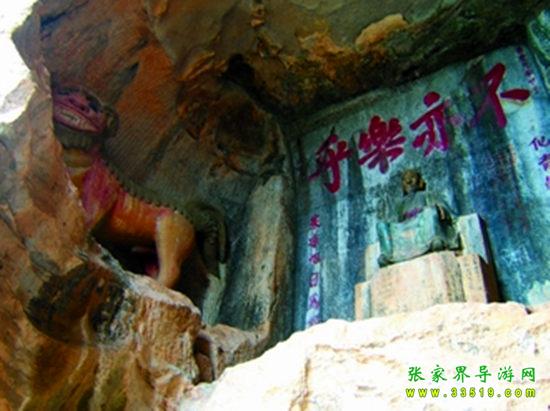
Lion Cave is close to and connected with the "Tiger-Dragon Cave"; one could say they are separate outside but linked within. The two caves are extremely close, only 14 meters apart (walking outside); if you go through the inside, you only need to crawl through an earthen hole (opening) to reach the other. Lion Cave was formed in the ninth year of the Jiaqing reign (1804 AD). The cave is 11.5 meters high, 4.5 meters wide, and 8 meters deep. Inside the cave are a self-carved statue of Li Jingkai and a mighty lion. The plaque above Li Jingkai's seated statue reads: "What joy!" The couplet is: "Transform and nurture the towering rock into a house; cold and cool, the rising sun as a furnace." Li Jingkai's self-carved seated statue is dignified and serene, dressed in cloth garments, gazing straight ahead with both hands resting flat on his knees—entirely a picture of leisurely contentment, knowing how to be happy, and keeping aloof from worldly strife. This demeanor, paired with the couplet "Transform and nurture the towering rock into a house; cold and cool, the rising sun as a furnace," makes his intention obvious: since one keeps aloof from worldly strife and peacefully enjoys nature, of course one would feel "What joy!" What he makes clear is his life's aspiration and his way of dealing with the world! Beside the seated statue is a mighty lion, head raised and tail swinging, displaying great majesty, with a lifelike and vivid form. Standing to Li Jingkai's right, it is most imposing. Unfortunately, today's lion is a man-made restoration; the original lion was blown up by a superstitious countryman named Que Changcheng. It happened that Que Changcheng's fiancée, Qin Zhengying, fell ill and could not be cured by doctors, so a sorcerer was consulted for divination, who said the illness was caused by the lion of Yuhuang Cave. In a fit of anger, he blew off the lion's head. Although the blown-up lion has been restored, it is greatly inferior to before in beauty and naturalness. Because the ancient mighty lion was carved with vivid imagery and lifelike expression, many people came to see it, and many years ago myths spread about it. One says the mighty lion had cultivated itself into an immortal, entering the cave by day and coming down to the flat ground at night to eat grain, and also granting children to women who had been married for a long time without conceiving, and so on. Therefore, people often came to Lion Cave at night to burn incense and worship. Especially those women who had been married for years without conceiving would prostrate themselves in worship, and after burning incense and worshipping, they would touch the lion's sensitive parts with their hands. Those sensitive parts have been rubbed smooth……
Confucius Cave
This is the last scenic spot on the "human world" level. The cave was formed in the eighth year of the Jiaqing reign of the Qing Dynasty (1803 AD). The cave is 6.3 meters high, 7.6 meters wide, and 10 meters deep. Although this cave is named "Confucius Cave," the statue of Confucius no longer exists; now only a memorial tablet and couplets remain. The tablet reads "Spirit Tablet of the Great Achiever, Supreme Sage and Teacher Confucius." On both sides of the tablet are written "The Four Assessors and Ten Philosophers, ever attending the worthies." There is also a couplet: "Flying up from the golden peach tree; who among the leopard-transformed leaves the jade cassia branch?" This uses the eagle as a metaphor for people and the peach tree as a metaphor for teachers. "Leopard transformation" can be understood as a qualitative leap, while "cassia branch" is a metaphor for "plucking the cassia"—that is, winning first place in the imperial examination. Li Jingkai carefully built Confucius Cave and established a spirit tablet for Confucius, which shows that he revered Confucius and esteemed culture. The statue of Confucius was originally also vivid, lifelike, and spiritually expressive, but unfortunately it has been destroyed.
Netherworld Karma Cave
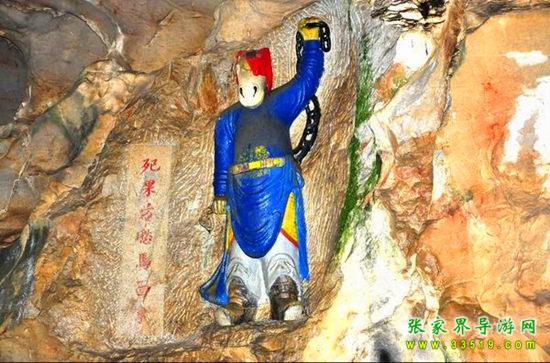
After touring the last cave on the "human world" level—Confucius Cave—you can wind your way down along the mountain path all the way to Karma Cave by the Lamb Spring. This is a cave that expounds the Buddhist doctrine of karmic retribution. The date of the cave's formation is unknown, roughly contemporaneous with the other seven caves. The cave is 3.1 meters high (up to 9 meters at its highest point), about 10 meters wide (13 meters at its widest), and 10–50 meters deep (legend says it connects to an underground river, and inside there are still dugout canoes, said to lead all the way to Maogang Xianchai River a hundred li away). Above the entrance of Karma Cave are three large characters: "Karma Cave." After entering, in the first section you can see statues of Ox-Head and Horse-Face with human bodies; in the second section, King Yama is enshrined. At the entrance there is a plaque reading: "Good and Evil Come Now." A couplet reads: "Because of good, because of evil, all is recorded in life; karma brings auspiciousness, karma brings calamity, repaid separately after death." After entering the cave, the light is dim and the atmosphere eerie and terrifying—truly a veritable "netherworld." The first things you see upon entering are the carved statues of Ox-Head and Horse-Face. Both Ox-Head and Horse-Face have human bodies and human hands, with only their heads being those of an ox and a horse. These two carvings are quite vivid in form and lifelike in expression, presenting the fierce, demonic, and hideous faces of Ox-Head and Horse-Face. Both hold instruments of torture: one holds a cangue, the other an iron chain. Together with the couplet: "In life, because you did not believe in Ox-Head's image; in death, you will fret as Horse-Face seizes you." Entering the second section of the cave, below on the rock chamber hall we can see King Yama. He holds a brush in one hand and the "Register of Life and Death in the Wheel of Reincarnation" in the other.
Fengquan Cave
Fengquan Cave is named for its peak spring. It is located west of Yuhuang, about 3.5 kilometers from Yuhuang Cave. It is also one of the nine caves built by Li Jingkai, and was the earliest to be constructed. The cave is divided into three sections and is relatively large in scale. Inside the cave there was originally a plaque inscribed "Mingming Spring," with a couplet: "South Sea island mountain, high fire and smoke; West Heaven white water, golden-locked rosy clouds." Going deeper along the cave, in the second section you can see carvings of the "Eight Immortals" and a statue of Guanyin seated on a lotus platform. You can also see the plaque "Ancient and Modern Merciful Ferry" and nine inscribed wall poems. Inside the cave there are also the monstrous mounts of the Eight Immortals, such as the Azure Dragon, White Tiger, Green Lion, and White Elephant. The human and animal figures in the cave each have their own bizarre postures, vivid and lifelike, with high artistic appreciation value.
Entering the third level of the karst cave, the interior is spacious, and there are also the "Thousand-Plot Field," "Kneeling Worship Hall," and more. Inside the cave, water flows with a murmuring sound, sand piles up like beaches, and from time to time spring fish swim playfully. What a wonderful cave-heaven blessed land!