This attraction introduction is compiled from historical materials in the "Zhangjiajie Tour Guide Network" (33519.com · Scenic Spots section). Ticket prices, opening hours, transportation, and contact information mentioned in the text may be outdated. Please refer to the latest official announcements from the scenic area before traveling; some content consists of historical background/cultural introductions and is for reference only.
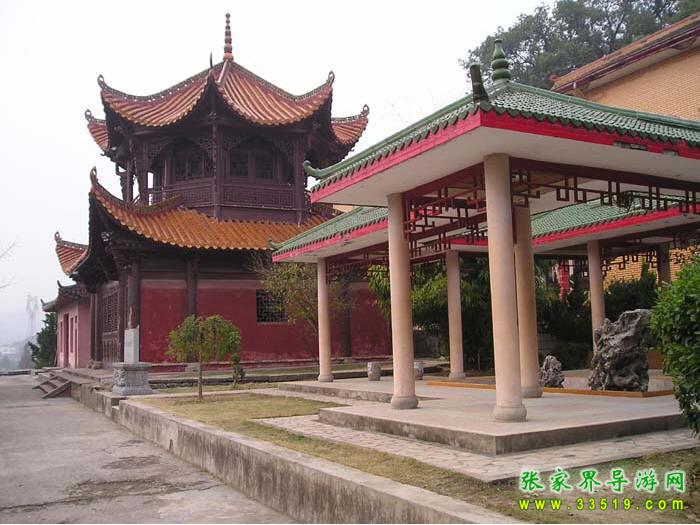
Plum Blossom Hall is located in Jiuxi Village, Jiangya Town, Cili County, Zhangjiajie, on the campus of Cili County No. 2 Middle School. Originally named Bagua Tower, it got the name Plum Blossom Hall because a black stone slab is embedded in the central lighting beam, with a plum blossom made from shell material on it, crystal bright and luminous. According to old chronicles: Xingguo Temple was founded in the Tang Dynasty, and the whole temple was divided into five halls: the Archway, Vajra Hall, Mahavira Hall, Plum Blossom Hall, and Abbot's Room. Plum Blossom Hall is one of the main buildings of the temple. It faces north from the south, has two layers of eaves, and walls on three sides. The hall's plan is square, with a side length of 12.6 meters and three bays. The building is 14 meters high, with a wooden frame structure, octagonal projecting eaves, 65-degree upturned corners, and glazed tiles on top—seven parts antique, three parts divine splendor—long known as a jade-like pavilion. Supported by eight bracket sets, the entire structure is rigorous, beautifully shaped, and possesses traditional national style. Behind the hall are three thousand-year-old ancient camphor trees, further adding to the Plum Blossom Hall's atmosphere of antiquity and solemn tranquility. In October 1983, Plum Blossom Hall was designated a key cultural relic protection unit of Hunan Province.
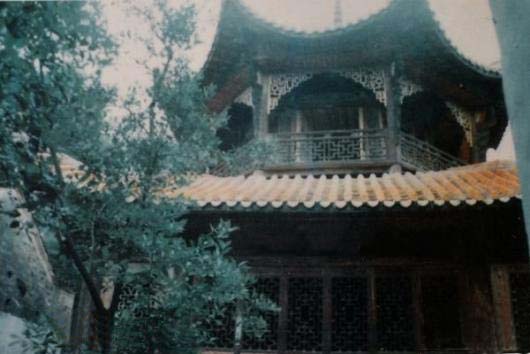
In the mid-Republican period, to develop education, Xingguo Temple was used as Loushui Middle School. Because of the outstanding people and auspicious land, after liberation it was changed to Cili No. 2 Middle School, and from then on the sound of reading aloud replaced the former evening bell. But the ancient camphor trees in the temple and one core building, Plum Blossom Hall, were preserved. In the 1970s it was listed by the province as a provincial-level key cultural relic protection unit. In 1984 the provincial cultural relic authorities allocated 80,000 yuan to restore it to its original condition.
Plum Blossom Hall has both certain historical and cultural value and high ornamental value. In front of the hall are more than a hundred stone blocks; climbing the steps, beneath your feet comes the mournful croaking of frogs, astonishing visitors, and to this day the mystery remains unsolved. In front of the hall are two great bells (one called the Song Bell, one called the Ming Bell); when struck, they boom like spring thunder. And thirty li away on Maohua Ridge there is a Neng Stone Tablet that echoes the great bells from afar, with a sound like a gong. People call it "Copper Gong Copper." Passersby who see it are all amazed.
According to the unofficial history of Jiuxi, Plum Blossom Hall and the Tang Bell in front of it were both built by two master craftsmen from Sichuan (that is, one carpenter and one caster). To build Plum Blossom Hall, Yuchi Gong posted a notice to recruit extraordinary craftsmen from all under heaven, and more than 30 were selected. Among them, two craftsmen from Wuhan and Sichuan were chosen, and each created a wondrous carving: the Wuhan craftsman made a wooden birdcage, with two lifelike wooden birds carved inside; the Sichuan craftsman made a wooden abacus, whose frame and beads were from the same piece of wood, moving flexibly and freely. Each had its own merits. Finally, by drawing lots, Sichuan won, and the caster hired by the carpenter was also an extraordinary man from Sichuan. On the day of testing the bell, the caster had said in advance that after he had traveled back toward Shu for one day, the bell should be struck as a signal. Unexpectedly, Yuchi Gong was so eager to test the bell that less than two shichen after he left, he struck the bell early. At that time, the bell caster had only reached the Copper Gong Tablet on Maohua Ridge. The caster then asked the locals how many li it was, and they replied: 30 li. The caster said regretfully: "This bell has only this much fortune; otherwise it would carry to a hundred li away!" This story may carry some mythological color and cannot be wholly believed, but on clear days, the bell sound truly reaches the Copper Gong Tablet, and its clarity is rarely seen in the world.
Afterward, several incidents related to the bell sound of Plum Blossom Hall occurred in succession, leaving people mystified.
In March 1928, He Long, following the instructions of the Party Central Committee, returned to his hometown to make revolution. At night he broke through the Jiuxi Guanmen Rock and lodged at the home of his old friend Xu Xiaotong, then county director of national defense, and was warmly received by Xu Xiaotong.
Jiuxi was He Long's second hometown. His ancestor He Gui had settled here with the Ming army and was buried on North Mountain. The next day he made a special trip to the ancestral grave to pay respects to his forebears, and then visited Plum Blossom Hall, where he had once come years before. He climbed up the Plum Blossom Hall tower, ascended high to gaze afar, and leaning on the railing looked into the distance, taking in a vast view: to the east stood Brush Peak; to the west stretched Mafu; north and south were layered peaks and overlapping ridges, verdant and towering, like dragons moving in hiding, like beasts at play. In front of the hall, the Suo River was like a ribbon, the ? River like white silk; on the river a hundred boats raced, white sails dotted here and there. Blue sky, white clouds, green mountains reflected in the water, beautiful scenery merged into one, and poetic feeling and pictorial imagery arose spontaneously in his mind. At this moment He Long sighed and said, what a pity that such beautiful rivers and mountains have yet to return to the hands of the people. Seeing such scenes, he felt all the more the weight of the burden on his shoulders. He returned to the Xu residence and poured out his complex feelings to Xu Xiaotong. Xu praised him, saying this showed the general's deep attachment to his hometown!
On the third day, He Long bade farewell to the Xu residence and prepared to cross Maohua Ridge from Sanjiadian back to Hongjiaguan. Unexpectedly, Xu Xiaotong's battalion commander Zhang Guopan had long colluded with Zhu Bazi and wanted to take He Long's head to Chiang Kai-shek to claim 200,000 silver dollars. So he sent assassins to lie in ambush at the Copper Gong Tablet. Just as He Long was about to go up the mountain, the bell suddenly rang out, and the Copper Gong Tablet immediately produced an echo. He Long knew there must be trouble, immediately changed route, and escaped disaster. Later He Long sent people to investigate who had struck the bell, but no one ever knew.
On the eve of the liberation of Cili, the underground organization of the Chinese Communist Party in ? River planned to hold a secret meeting at a household on Maohua Ridge to prepare for the liberation of Cili. Unexpectedly, this matter was discovered by a secret agent surnamed Tang, who reported it to his superiors and organized remnant Nationalist troops overnight for a surprise attack. Just at this moment, the bell rang, and disaster was avoided. When asked afterward for the reason, no cause could be found, so it could only be attributed to the divine bell of Plum Blossom Hall manifesting its power again.
In the summer of 1984, the famous writer Ye Weilin, known for his novels, essays, and poetry, after touring Wulingyuan, was invited by the author to come specially to Jiuxi and joyfully viewed Plum Blossom Hall, saying: "The rivers and mountains leave behind scenic traces; we of this generation climb again." As he boarded the boat to return to Changsha, he left a poem saying:
Where can cultural relic wonders be seen? At Plum Blossom Hall in Jiuxi, Cili.
Hiding beauty, hiding wonders, hiding the years; overflowing with light, overflowing with color, overflowing with yesterday.
Life is fortunate to enjoy fine scenery; the temple, unfeeling, leaves regret behind.
Laden with spiritual essence, gazing at the returning boat, the heart like river waters rolls up waves.