This attraction introduction is compiled from historical materials in the "Zhangjiajie Tour Guide Network" (33519.com · Scenic Spots section). Ticket prices, opening hours, transportation, and contact information mentioned in the text may be outdated. Please refer to the latest official announcements from the scenic area before traveling; some content consists of historical background/cultural introductions and is for reference only.
Baizhang Gorge is located in the Suoxiyu Scenic Area. Legend says this was an ancient battlefield. Scenic spots such as Tethering Horse Post, Flag-Planting Peak, and Imperial Seal Rock are all associated with the ancient battlefield, so Baizhang Gorge is also called "Baizhang Gorge" (Hundred-Battle Gorge). Among the scenic areas of Wulingyuan, few have historical records, but because of its strategic terrain, this place appeared in writing as early as the early Ming Dynasty. According to the Cili County Annals: "The gorge is a hundred zhang high, towering and elegant into the clouds, with reddish-brown stone screens and prominent pass eyes, its wonders unsurpassed under heaven."
Baizhang Gorge is where the highway from Wulingyuan Scenic and Historic Interest Area to Zhangjiajie City runs through the entire gorge. It gets its name because there is a stone wall nearly a hundred zhang high, piercing the clouds, too tall to look up at. According to the Cili County Annals, to the right of Suoxiyu is Baizhang Gorge, and the gorge is thirty kilometers long... It is also said that the rebel army of King Tianzi fought a hundred battles here with government troops, hence the name Baizhang Gorge (Hundred-Battle Gorge). Hu Guifang, the Ming Dynasty military defense official of Jiuyong, loved traveling through mountains and rivers all his life. After coming to Baizhang Gorge, he inscribed a seven-character poem: "The gorge is a hundred zhang high, cave clouds deep; if you seek the Peach Blossom Spring, look here. The troops march slowly as wind and snow press hard; who will exhaust their joy like one from Shanyin?" It is carved on the stone wall beside the path in the gorge.
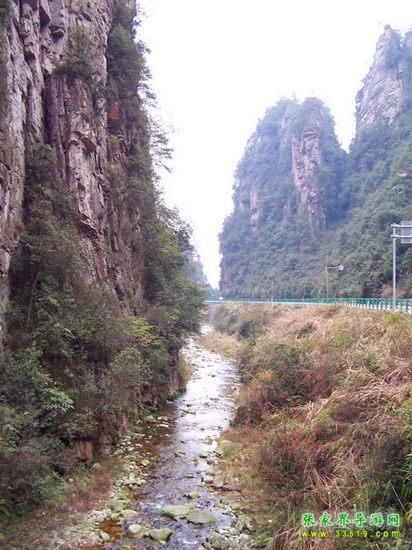
Baizhang Gorge is located in the southern part of the Suoxiyu Scenic Area and consists of three gorges: Baizhang Gorge, Dongjia Valley, and Wangjia Valley.
Among them, Baizhang Gorge is located in the middle of Chaqi Valley. In ancient times, this gorge had many apes. With sheer cliffs and strange gorges, the terrain was strategically important and it was an ancient pass. The Daoguang-era Yongding County Annals of the Qing Dynasty records: "On the sheer cliff of Baizhang Gorge there is a 'Silver Arrow Rock,' suspended high on the cliff, silver in color, with characters on it, visible but unreachable." This rock no longer exists. It is said that in the early Ming Dynasty, Qin Chu rebelled, and the court established a pass here. It is also said that when King Xiang raised his banner in rebellion, he fought government troops a hundred times at the mouth of Baizhang Gorge, hence it is also called Baizhang Gorge. The gorge is deep, steep, and majestic, with a stream flowing through the middle. On the right side there was originally a stone path, the official road between Cili and Yongding during the Ming and Qing dynasties. Among its features, Shaping Pastoral Fields, Baizhang Gorge Wall, and Bazhu Pool are the most wondrous and beautiful.
Baizhang Gorge Wall
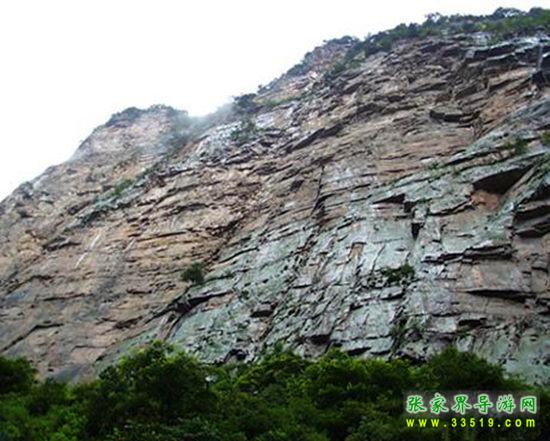
Located on the right side in the very middle of Chaqi Valley. A stone wall rises abruptly from beside the stream, towering to the sky and standing on the earth, about 300 meters high and about 800 meters long. Looking up, the cliff seems about to fall; the entire wall has no vegetation, with clear texture and distinct edges and corners, strong and powerful, irresistible. In front of the wall, a valley blocks the view, ethereal and serene. On the other side, several peaks face each other, bowing their heads in salute. Standing on the summit of Banli Mountain and gazing into the distance, this wall is like a crouching beast, head raised and tail tucked, overwhelming in spirit.
Shaping Pastoral Fields
Pausing at Jundiping and gazing at the south bank of Suoxi, the area of Shaping and Chenjiagang has rolling hills, terraced fields arranged in layers, streams winding around, scattered village houses, shaded by green trees, with sparse Chinese tallow trees and curling cooking smoke. In late spring and early summer, rapeseed flowers turn yellow, spreading across mountains and slopes, making it even more clear, beautiful, and elegant. Behind it, "ten thousand stone bamboo shoots stand, tall and elegant into the sky," layer upon layer of green peaks and patches of yellow flowers setting each other off in great harmony. If clouds and mist wrap around the mountain waists and summits, it becomes even more richly expressive, forming a magical and spectacular ink-wash mountain scene.
Flag-Planting Peak
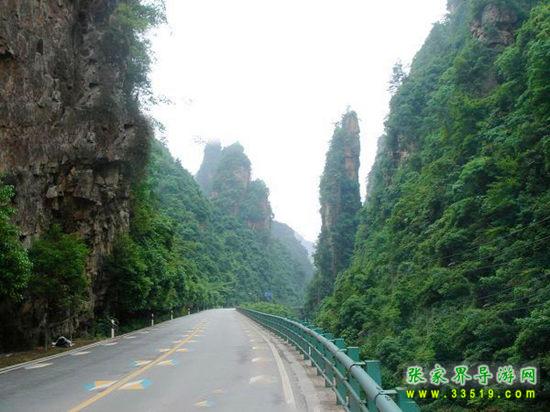
From Jundiping, going 200 meters into Baizhang Gorge, a peak on the right rises clearly from beside the stream, about a hundred meters high. Seen horizontally it looks like a flag, seen from the side it looks like a sword, so people call it Flag-Planting Peak. It is said to be the place where King Xiang's rebel army planted their military banner. On the summit, two green pines stand vigorously, their green crowns covering the cliff, while the stream gurgles past the foot of the peak. Two kilometers into Baizhang Gorge, on the right, there is a huge cliff like a cut wall, rising about 300 meters into the air. On the stone wall 10 meters above the cliff base are carved the three double-outlined characters "Baizhang Gorge," each about 1 meter in diameter, signed "Written by Li [name unclear], Damen Shanren of Yuyue, Ming Dynasty jinshi." To its left is carved the Ming Wanli-era poem by Hu Guifang, then Right Participating Administrator of Shangjingnan Circuit and Jiuyong Military Defense: "The gorge is a hundred zhang high, cave clouds deep; if you seek the Peach Blossom Spring, look here. The troops march slowly as wind and snow press hard; who will exhaust their joy like one from Shanyin?" There are also Ming Dynasty virtue inscriptions recording the names of household heads who supervised the cutting of the stone path and donated silver. On the stone wall opposite Flag-Planting Peak are carved the three characters "Baizhang Gorge" written by the painter Huang Yongyu in the 1980s.
Bazhu Pool
Located in the stream valley in front of the Baizhang Gorge Wall. The stream channel is S-shaped, winding from the foot of Banli Mountain all the way to the cliff with the Baizhang Gorge inscriptions, then turning back and flowing away. Along nearly 150 meters of the stream channel, because the stream bed varies in height, multiple drops are formed and water rushes into pools; there are also many stones blocking the stream water, causing it to collect into pools. The eight pools are all as green as pearls and jade, each displaying its own beauty. The first pool is round, the second long, the third swirling, the fourth wondrous, the fifth square, the sixth and seventh shallow, and the eighth quiet. The water of the third pool gushes out from a stone lip and is immediately blocked by a stone tongue. The flow turns once and then again, then spreads out along a stone ledge into an umbrella-shaped waterfall, plunging down, leaping and flashing, as bright and dazzling as jade silk, falling into the pool with a loud roar and rolling white foam. The fourth pool is especially wondrous and beautiful. On both sides by the pool, slab stones resemble sprouts, interlocking and extending. The pool water swirls as if boiling, green as jade. The pool is 4 meters wide, about 10 meters long, and about 5 meters deep. On both banks, wild grass and vines grow thickly, enclosed by peak walls.
Legends
Legend says that after Xiang Dakun obtained four treasures—the heavenly book (unfortunately stolen), a bow and arrows, a precious sword, and a divine horse—he formally raised the banner of rebellion at Shuirao Simen and proclaimed himself king. He first enfeoffed Zhidao, Zhide, Zhishan, and Zhici as the four great generals of dragon, tiger, leopard, and phoenix; he appointed five tribal leaders—the Great God of the Eight Tribes, Huanglong Zhenren, Chen Xiang, Xia Dezhong, and Yang Si—as chief commanders (in Shandao Valley there still remains the scenic spot "Five Generals Worship the Master"), and ordered them to guard respectively the front three passes of Yamen, Jiangya, and Sanguansi, and the rear three passes of Wenyang, Jiaozhiya, and Cangguan Valley; he arranged the eight formation gates of "Rest, Life, Injury, Obstruction, Death, Scenery, Shock, and Opening" on Qingya Mountain; he also built eighteen stockades including Huangshi, Yaozi, Jiazhai, Qingya, Yangzhai, Yangzi, Biantong, Sugu, Qingshi, and Denglong; he also opened wasteland and garrisoned troops at Yuanjiajie to store grain and fodder; and mined iron in Kuangdong Valley to forge weapons. The Tujia and Miao people of the eighteen caves of northwestern Hunan responded one after another, like stars surrounding the moon or a hundred birds paying homage to the phoenix.
When the imperial court learned of this, it was greatly alarmed and successively sent Zhongshan Marquis Tang He, Jiangxia Marquis Zhou Dexing, Yingchuan Marquis Fu Youde, and the great generals against the barbarians Hu Hai and Deng Yu, among others, leading 150,000 government troops to suppress them. This was historically called the "Five Marquises' Southern Campaign." One day, King Tianzi was drilling troops at Zhima Ta when scouts suddenly reported that the emperor's hundred-thousand government troops had arrived at Baizhang Gorge! King Xiang immediately put on full armor and led native soldiers from Longwei Stream through Kangjin Rock straight to the western valley mouth of the gorge, where he planted the commander's banner and prepared to meet the enemy (now called "Chaqi Valley"). The great general against the barbarians, Deng Yu, personally came out to battle, and on this side General Long Xiang Zhidao raised his spear to meet him. The two armies began fighting at "Jiehuo Bridge." King Xiang gave a shout: "Beat the chun and play the music!" Instantly, the bronze tiger-knobbed chunyu (an ancient military instrument of the Tujia people) rang out with clanging sounds. When the native troops heard this military music, their morale was greatly boosted. On the other side, General Deng's spear technique was skillful, his divine spear like a meteor chasing the moon; on this side, Xiang Zhidao was highly skilled in martial arts, his iron spear like wind sweeping away residual clouds. They fought until heaven and earth darkened, sand and stones flew, and neither could gain the upper hand. But the native troops, after all, had long suffered from the fatigue of campaigning and could hardly hold out, so they had to beat the gong and withdraw.
Relying on his numerical superiority, Deng Yu gave the native troops no chance to catch their breath and again personally came to the front to challenge them. King Xiang did not reply, but secretly ordered his soldiers to carry out about a hundred wooden cages and line them up in front of the formation. Deng Yu sat on his horse, pointed at Dakun, and said: "Rebel leader! You have defied authority and stirred up rebellion, and deserve death. Dismount and be bound, and you may be spared!" King Xiang waved his Green Snake Sword and roared: "Release!" The native soldiers hurriedly opened the cage doors, and one fierce beast after another shot out like arrows from a bowstring, howling as they charged at the government troops. Before Deng Yu understood what was happening, a fierce tiger with a striped forehead had already rushed in front of his horse. The horse gave a startled cry and turned to flee! Those starving beasts bit everyone they saw. In an instant, the government troops fell into chaos, trampling and pushing one another, crying for their fathers and mothers, with countless dead from bites and trampling.
Originally, King Xiang thought he could not match the government troops, so he devised the special tactic of "beast warfare." Early in the uprising, he had sent hunters into the mountains to capture fierce animals and shut them in wooden cages, giving them neither water nor food for several days, waiting only for the right moment to unleash a "starving beasts pouncing on food" attack.
Deng Yu suffered this silent loss and had to retreat to "Jundiping" (present-day Suoxiyu Town, Wulingyuan), shutting his gates and not coming out. Just as he was feeling deeply depressed, five extremely beautiful women floated into his tent. These five women were the five daughters of Yang Jing, the Pingzhang of Huguang, named Chunfeng, Qiufeng, Lafeng, Jinfeng, and Yinfeng. Each possessed unique skills and extraordinary martial arts. Because their father Yang Jing had been demoted after failing to suppress Qin, this time they came to campaign in the south on their father's behalf, so Zhangjiajie has anciently had the legend of the "Five Women's Southern Campaign."
The eldest sister, Chunfeng, volunteered for battle.
This Yang Chunfeng was skilled in swordsmanship and full of strategy, and had followed her father in campaigns against the barbarians, repeatedly achieving merit. However, this time, seeing that the native barbarians were incomparably brave, each carrying swords and knives in their mouths, strong bows at their sides, and long spears in their hands, switching as needed, she could not help feeling somewhat timid. She did not rush to challenge them. Instead, on a stone platform halfway up the mountain, she set up a "stage in the clouds," and selected a hundred extremely beautiful female soldiers from the women's camp. One by one they took off their military attire and, completely naked, danced nude on the stage. As they danced, they scattered flowers toward the native troops. For a time, dancing shadows were faint and distant, songs lingered continuously, and fragrant flowers fell in specks, truly like heavenly maidens stepping down from the clouds!
King Xiang saw through their trick and ordered General Long: "Set up a stage and answer with songs and dances!" General Long stood on horseback, raised his head toward Yang Chunfeng, and sang:
"A ho ye——"
Before the final note faded, thousands of native officers and soldiers sang in chorus:
"A ye a ye ho! A ye ho ye a ye ho!"
Songs mixed with gongs and drums, footsteps responded to copper bells. They sang, they jumped, they danced. After the "flying dance" they danced the "spear dance"; after the "spear dance" they danced the "crossbow dance." They sang of Huandou and Chongshan, sang of the ancestors of the Ba Kingdom, sang of King Wu's conquest of Zhou. They sang for three days and three nights and danced for three days and three nights. The five Yang women had originally wanted to use sexual allure to defeat the barbarians, but they had not expected that these people could all sing and every one of them was good at dancing! Yang Chunfeng, having failed in one scheme, devised another. She called out to Zhidao: "I have long heard of General Long's tiger-like might, and only today do I meet you. It seems you and I still have a seven-tenths destiny as husband and wife!" Before her voice faded, a clamor arose on the stage: "Dragon matches phoenix! Phoenix matches dragon! Phoenix matches dragon! Dragon matches phoenix!" Zhidao looked up, and suddenly heard a "swoosh"—a poisoned arrow struck him right in the right side of the neck! It turned out that Zhidao had a body of hard martial training: spears could not pierce him and arrows could not enter him, except for the white birthmark on the right side of his neck. It is unknown which traitor had leaked this secret, bringing about his fatal disaster. The one who had just shot the cold arrow was Chunfeng's younger sister, Qiufeng.
With a shrill scream, he fell from his horse. King Xiang was greatly shocked. Seizing the moment when the five sisters were reveling, he drew his bow and shot two arrows in quick succession toward the stage (today the "Silver Arrow Rock" still remains at Baizhang Gorge). What fine arrows! They struck true, hitting Qiufeng squarely in both breasts. Alas, this lovely young lady of the Yang family tumbled headlong down the hundred-zhang cliff, and in an instant her body was shattered and her fragrance extinguished! When the Xiang army saw their commander slain, they pounced on the government troops like enraged lions. On the other side, Deng Yu personally held the rear, and what a bloody battle it was! As night fell, pine-torch fires lit up the entire gorge. Nothing was heard but the wails of gods and the weeping of ghosts; nothing was seen but flesh and blood flying and bones piled into mountains (today called "Bone Collapse").
Prince Xiangwang was grief-stricken over the loss of his eldest son. The eight generals admonished: 'Rather than lose soldiers and generals fighting for every inch of land, it would be better to avoid their sharp edge and lure the enemy in deep.' Prince Xiangwang nodded in agreement, then secretly ordered the camp to be broken, thus ending the Battle of Baizhang Gorge. Later, people also called Baizhang Gorge 'Baizhang Gorge' (Gorge of a Hundred Battles).
Transportation
At the city bus station (next to the railway station), take a shuttle bus to Wulingyuan, and along the way you can enjoy the scenery of Baizhang Gorge.