This attraction introduction is compiled from historical materials in the "Zhangjiajie Tour Guide Network" (33519.com · Scenic Spots section). Ticket prices, opening hours, transportation, and contact information mentioned in the text may be outdated. Please refer to the latest official announcements from the scenic area before traveling; some content consists of historical background/cultural introductions and is for reference only.
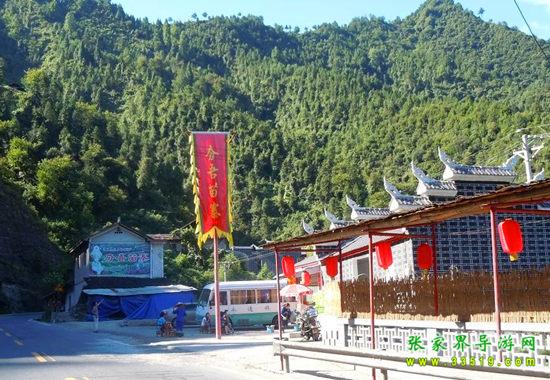
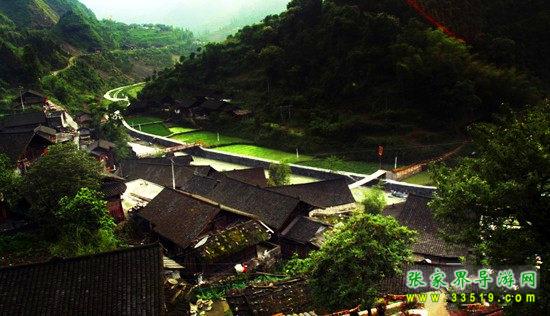
Hangwu Miao Village is located in Maoping Village, south of Guzhang County town, and is a must-pass spot on the classic tourist route from Zhangjiajie to Fenghuang. "Hangwu Miao Village" is in the Miao language, and its Chinese translation is: "a beautiful Miao village by a canyon stream." This Miao village lies on the way from Guzhang County town to Jishou; it is only an eight-minute drive from Guzhang County town, and three minutes from Jishou through the Niutoushan Tunnel. The visit takes about 1.5 to 2 hours. The entire village has 292 households, 1,204 people in total, and preserves the wooden stilt-house style unique to the ethnic minorities of the Wuling Mountains.
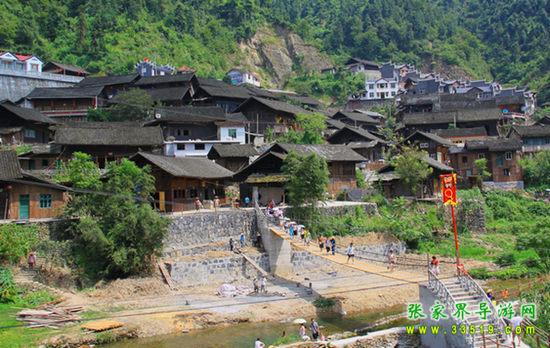
All the Miao people in Hangwu Miao Village are Sheng Miao (raw Miao), and few can speak Chinese. Their highest governing body is the clan system, and their highest leader is the Miao King! Hangwu Miao Village consists entirely of the "Long" clan branch, and the Miao King is named Long Xianwen. Ever since the Ming Dynasty built the Miao frontier wall in Xiangxi, splitting the entire Miao people into two parts, namely the "Sheng Miao" (raw Miao) and the "Shu Miao" (cooked Miao). Those inside the wall were Shu Miao, almost entirely sinicized! But Guzhang's Hangwu lies outside the wall, and all are Sheng Miao. They have completely preserved a series of Miao clan systems!
Hangwu Miao Village is divided into three major villages (the upper and lower villages are temporarily not open; currently only the middle village is open). The Sheng Miao of Hangwu can make a living by singing! At the Ganqiu Festival on August 5, 2010, I personally witnessed more than a thousand Miao people sitting in a large bamboo grove from morning till night without eating or drinking! The famous singer He Jiguang often took part in the antiphonal singing gatherings of the Ganqiu Festival at Hangwu Miao Village when he was young. The old Miao song queen, Granny Long, is already over 73 years old. Since the Miao village opened to tourists, no one has been found who can match her in three songs. On August 4, 2010, Song Zuying's husband Luo Hao personally visited Hangwu Miao Village to guide its work, and also met Granny Long!
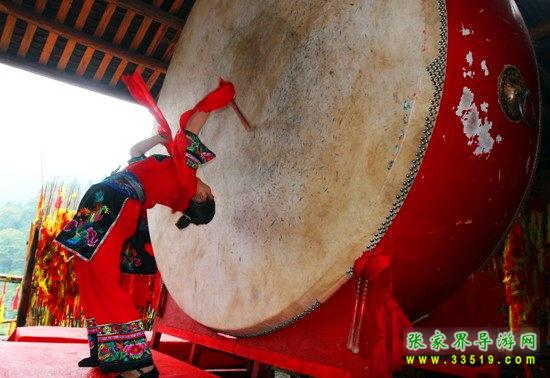
At present, the largest Miao drum in all of China is in Hangwu Miao Village. Some time ago it was transported to Shanghai for exhibition at the World Expo. The Miao drum is the soul of the Miao people's life. In the eyes of the Miao people: the Miao drum symbolizes a woman's belly, while the drumstick symbolizes a man's reproductive organ; when the drumstick beats, it brings prosperity and flourishing!
The highest elevation in Guzhang is Niujiao Mountain, at over 1,200 meters. The summit of Niujiao Mountain is shrouded in mist and clouds year-round, and nearly 6,000 mu of Maojian tea gardens lie at the top of the mountain, free of any pollution. Every time Song Zuying returns to her hometown and brings tea back to Beijing as gifts, it is always the golden tea of Niujiao Mountain. The vast majority of the Miao people in Hangwu Miao Village are hired tea farmers for Niujiao Mountain's golden tea.
The Miao people of Hangwu are currently devout followers of Xiangxi's Wu-Nuo culture! Traces of witchcraft and Nuo rituals can be seen everywhere in the Miao village. Immortals joining bamboo, bone-shrinking techniques, immobilizing chickens, drawing water from an empty cup, lifting a rice sack with a steelyard rod, and so on, are common occurrences in Hangwu. Last year an old Gu-po (sorceress) of Hangwu Miao Village passed away. The house she had lived in was filled with all kinds of jars and pots, and as soon as night fell, faint sounds of ghostly spirits would drift out from inside.
Hangwu means a small stream. A Miao village is where the Miao people have lived for generations. When heaven and earth were first separated, wherever there were Han there were Miao; when the Huaxia became a people, without Chiyou there would have been no Xuanyuan. Apes and humans evolved in turn, and all under heaven share one great unity; yet as clan lineages passed down, each upheld its own special gifts. The Miao emerged from "Mei Liu Mei Bang," which can no longer be verified. Through five great migrations, the present distribution of the Miao stands as proof. Hangwu traces its origins to Chiyou, and this is said to be a fact; the Miao village of Song Zuying's hometown is truly an authentic transmission.
In 2180 BC, a branch of the Miao called "Huandou" moved here and settled, naming themselves "Hangwu." Later, when the Manchu Qing entered the pass, ruling over the many with the few, they turned pale at the mention of the Miao, and so carried out the policy of replacing hereditary local rulers with appointed officials, governing through unification, and changed the name to "Maoping," which has lasted several hundred years since. After Liberation, with ethnic equality and autonomy, all rejoiced, and the Xiangxi Tujia and Miao Autonomous Prefecture was thus established. Yet the Miao remained impoverished, and the Party and the state showed them compassion and care, all the more so.
On July 21, 2009, a sudden great fire broke out, destroying 24 houses. Miao King Long Xianwen led the people in a valiant rescue, and his whole family relieved the hardships; Party and government bodies at all levels and all sectors of society joined forces to help, and with the strength of the whole village, the task was completed in one effort. By the end of that year, the reconstruction of the disaster victims' housing was fully completed, altogether 27 buildings for 31 households. The people were secure and able to work in peace.
At that time, Xiang Dingtian, then newly appointed Secretary of the Guzhang County Party Committee, went deep into Hangwu Miao Village to inquire into the people's hardships one by one, showing deep care and protection, and fully recognized that relief for the people was only temporary security, while the Miao village's lack of industry led to generations of poverty. He ordered that people's livelihood come first and industry be the key, and accordingly supported them with a plan for Miao cultural tourism; in this way, the Miao cultural tourism industry flourished, and the name "Hangwu Miao Village" was restored.
Today the village has 292 households, 1,204 people, all Miao. The folk customs are simple and honest, the temperament straightforward and sincere. The cultural heritage is broad and deep, the customs distinctive. The Miao language, Miao clothing, and Miao ornaments form a style of their own, with absolutely no admixture. Nuo opera, witchcraft, Miao songs, and various other arts and amusements are mysterious and strange, beyond imagination. In the past they were taught hand to hand and passed on by word of mouth, not known to outsiders. Now the nation prospers, folk customs have opened up, and so the Miao family's secret traditions are revealed one by one, to feast the eyes of all under heaven. And to share joy and amusement with brother ethnic groups—is that not delightful!
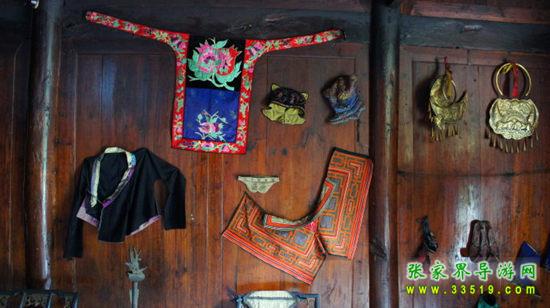
The Miao village is purely Miao, by no means a barbaric land; its mountains and waters are perilously beautiful, and it has many stones of Bian He. "China's Outstanding Civil Servant" Long Qingxiu, the great calligrapher Long Qinglian, Xiangxi Prefecture CPPCC Chairman Long Dezhong, Vice Chairman and Prefecture Ethnic Affairs Commission Director Long Jinbi, and others all came from this Miao village. When Song Zuying was little, she often came to learn to sing Miao songs. The wonder of a national voice has its origin; the meaning of heavenly music—how could it be without cause? These are all outstanding figures of the Miao village. As for those among the common folk who cherish jade and embrace excellence, who hide beauty and contain brilliance, they are as numerous as can be counted in cartloads and measured in bushels. The concentration of heaven and earth, the gathering of spiritual energy. When you come here, will you not feel something in your heart?
On August 5, 2010 AD, Hangwu Miao Village grandly opened for tourism, and was incorporated into the ethnic tourism industry poverty alleviation project, bringing double happiness. To speak for the guests, to offer congratulations, to commemorate, this record could not but be made. And so it is written.
The Miao people across the country are divided into many different clan branches: Red Miao, Black Miao, Flower Miao, Shu Miao, Sheng Miao, and so on. The Miao of Xiangxi are mainly Sheng Miao and Shu Miao. Analyzing the historical and cultural habitat of the Xiangxi Miao, Sheng Miao can be understood as the original-ecology Miao. And Shu Miao can be understood as the sinicized Miao. Therefore, to truly understand the mysterious culture of the Xiangxi Miao, one should start with the Sheng Miao. The Shu Miao of Xiangxi mainly refers to the Miao people within the Southern Great Wall centered on Fenghuang and Jishou. The Sheng Miao mainly live in Guzhang, Baojing, Huayuan, Mayang, and other places, outside the Southern Great Wall.
If the Great Wall expresses a mentality of the Central Plains farming people on the defensive against the attacks of northern nomadic peoples, then the frontier wall built by the Ming and Qing Central Plains dynasties in the Miao regions of Xiangxi by no means indicates that they were on the defensive, but rather that they wanted to place those Miao people full of rebellious spirit who were unwilling to submit (the Sheng Miao) outside the realm of governance. In this way, a peculiar cultural landscape emerged in Xiangxi, namely multiple layers of survival circles and cultural circles pervaded by a spirit of shamanism. That is, the "Shu Miao" survival culture circle and the "Sheng Miao" survival culture circle, as clearly distinct as the four seasons in a year in the mountains of Xiangxi.
Because of war, the Miao were forced to migrate constantly, causing their living environment to change unceasingly, especially the Sheng Miao living in the Guzhang, Baojing, and Huayuan areas of Xiangxi, whose historical development characteristics kept their beliefs for a long time at the primitive, lowest level of animism.
The beliefs of the Xiangxi Sheng Miao are not an individual act. The beliefs of any member must be consistent with those of the entire clan. Because Xiangxi is located at the end of the Guizhou Plateau, amid the great Wuling Mountains, with high mountains and steep slopes. Transportation is inconvenient. Coupled with historical and cultural factors, the basic cell of social organization in the Xiangxi region to this day remains the clan. A clan is a social group united on the basis of blood ties, also called a blood-lineage group. In the Xiangxi region, a clan is often manifested as a natural village. Close to nature, concerned always with issues related to survival, this determines the strongly secular nature of Miao beliefs and their unique view of ghosts and gods.
To adapt to their turbulent life, the Miao people had no choice but to band together as clan relatives. Whether in the course of migration or in resisting foreign invasion, the clan became the supreme concept in the hearts of the Miao people. The Miao everywhere live in clans according to clan branch and surname, and each clan branch has its own ancestors. The Xiangxi Miao are divided into 12 clan branches in total, and the largest surname is "Long." Guzhang's Hangwu Miao Village has 292 households, 1,204 people, all surnamed Long, without a single mixed surname—a pure Long-surnamed clan. The beliefs of the Xiangxi Miao are not an individual act; the beliefs of any member must be consistent with those of the entire clan. Because Xiangxi is located at the end of the Yunnan-Guizhou Plateau, amid the great Wuling Mountains, with high mountains and steep slopes, inconvenient transportation, and coupled with historical and cultural factors, the basic cell of social organization in the Xiangxi region to this day remains the clan. A clan is a social group united on the basis of blood ties, also called a blood-lineage group. In the Xiangxi region, a clan is often manifested as a natural village.
The Xiangxi Sheng Miao believe in "animism," and the objects of their belief are diverse spirits and ghosts. All the Sheng Miao people of Guzhang's Hangwu Miao Village believe that their souls are something visible and tangible—"Biya" (in the Miao language, spider). For example, when a child falls ill, it is mostly believed to be caused by a "lost soul," and so a "soul-calling" must be performed, with a "Lai Biya" ritual (in Miao: bring the spider back). A granny holds the child and sits in the central hall, while the child's mother takes incense, rice, meat, and wine to the village's Earth God shrine to offer sacrifice, imploring the ancestors to escort the child's soul back. Then she returns to the house, and at a place five meters from home she must ask loudly: "Has it come back?" The granny holding the grandchild immediately answers loudly: "It's back, it's back!" Then she takes from her bosom a spider wrapped in red cloth prepared in advance and places it in the central hall, pointing at the spider and saying: "Look, look, it (the soul) is here!" Then the sick child's mother says: "Really, it's good that it's back." Finally she scatters a handful of rice inside the house, and the "soul-calling" is complete.
The reason the beliefs of the Xiangxi Miao have endured and never declined, possessing endless vitality, also lies in the drive of various secular desires. This differs from Christianity's starting point of purifying the soul and elevating the emotions; the beliefs of the Miao people lie in getting the gods to "do something for themselves," that is, to obtain something from the gods, and their wishes are often of the lowest, material kind. How to have many children and grandchildren, how to dispel calamity and avoid misfortune, how to have favorable weather... These wishes cling closely to people's secular life and are strongly secular in nature. It is precisely this secular nature of their wishes that determines the secular character of Miao beliefs and becomes the powerful inner vitality of Miao belief.
Wherever Miao people live, there is sure to be a Miao drum! The largest Miao drum in the world is in Song Zuying's hometown—Guzhang's Hangwu Miao Village!
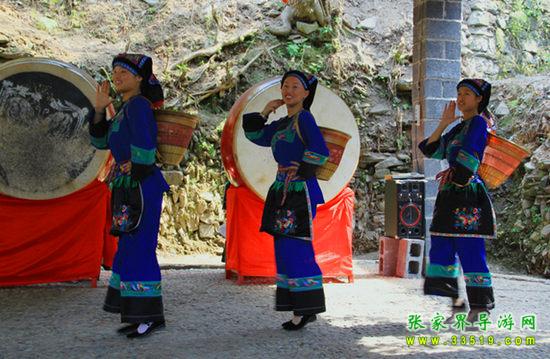
At the entrance of Hangwu Miao Village stands a great drum over three meters in diameter. This great drum is, to date, the largest Miao drum in the world, and not long ago it took part in the exhibition at the Shanghai World Expo!
The Miao people were the first people on earth to create the drum! It is said that the Miao ancestor Chiyou, when fighting the Yan and Yellow Emperors in the Central Plains, used drums to rouse the troops' morale and direct battle. Later, after the Miao were defeated, in the course of their westward migration they threw away everything, and only the cumbersome drum was not discarded!
The drum is the soul of the Miao people; whenever the Miao drum sounds, they are filled with passion and hope for life! The drum is like the belly of a Miao pregnant woman, and so the Miao drum enables this people to live on endlessly! The Miao drum is like the sun in the sky, giving the Miao people inexhaustible strength!
When the Miao people migrated, each clan branch group carried a wooden drum, beating it as they advanced to keep in contact and avoid falling behind. After moving to a new place, they re-established their social organization according to clan branch, and thus it was called a "drum society," or "establishing a drum as a society." One clan is one great "drum society." Several Miao villages and communities form one drum, and "establishing a drum as leader" means electing a drum head to manage the society's affairs. After the drum head is elected, the whole society respects him as a "leader." They obey his restraint—this is what we today call the Miao King. The current Miao King of Guzhang's Hangwu Miao Village is named Long Xianwen, and he has already served as Miao King for nearly ten years!
Today's Xiangxi has nearly ten thousand Miao villages and nearly two million people, and every three to five years a Miao Drum King is publicly elected! After Liberation, the first generation Miao Drum King elected in Xiangxi was Long Yingtang, the second generation Drum King was Shi Shunmin, and the third generation Drum King was Long Julan. From this it can be seen that the largest Miao clan branch in Xiangxi is the surname "Long," and that women have mostly become Drum Kings!
At the Third Hunan Provincial Ethnic Minorities Games, the Xiangxi Miao drum won the gold medal for Miao drum, and at the Fourth and Fifth National Ethnic Minorities Games it also won gold medals. The Miao drum entered the 1995 China Tourism Products Exhibition and the Shanghai Osmanthus Art Festival. The third generation Drum King Long Julan visited Singapore with the Chinese Folk Art Troupe, and a news reporter wrote a special feature titled "Drumming All the Way to the Lion City." The first generation Xiangxi Miao Drum King Long Yingtang performed in Beijing with the Hunan Provincial Song and Dance Troupe in 1957; at the Huairen Hall in Zhongnanhai, Long Yingtang gave a special performance for Chairman Mao and other central leaders, receiving high praise from Chairman Mao, who even took the initiative to pull her over for a group photo.
Gu poisoning, one of the three great ancient mysteries of Xiangxi, is a common topic in Shen Congwen's books, yet young people today have mostly only heard of it. Gu-po (sorceresses who practice gu) generally do not live very long; the longest-lived do not exceed 65 years. The only old Gu-po in Guzhang County, Xiangxi, is in Hangwu Miao Village! Last year, at the age of 64, after collecting the last batch of poisonous insects and just as she was about to prepare gu poison, she quietly died.
Strangely enough, not long after the old Gu-po died, a great fire broke out in the village. It burned down more than 20 houses in one go. Just as the fire was about to reach the old Gu-po's house, it suddenly went out. More than two hundred households in the whole village were spared from disaster! Could it be that the old Gu-po's spirit had manifested?
Now, whenever the weather changes, as night falls, as long as you pass by the door of the old Gu-po's house, you will surely hear eerie, strange cries from inside!
Hangwu Miao Village recreates the legendary scenes of Xiangxi's three great ancient mysteries
The three great ancient mysteries of Xiangxi are generally recognized as: corpse-driving, gu-poisoning, and Chenzhou talismans! In the eyes of the world, Xiangxi is known for being "mysterious." In fact, Xiangxi's mysteries are far more than just three great ancient ones! Strictly speaking, it would not be excessive to say there are over a thousand!
Hangwu Miao Village has inherited the essence of Xiangxi's Wu-Nuo culture. There are still several corpse-drivers and Chenzhou talisman masters in the village. Once tourists enter the village, they can ask those masters to show a few of their skills!
The witchcraft currently performed for tourists includes:
① Immortals Joining Bamboo: A man and a woman are chosen from among the tourists, and the two stand facing each other about 10 meters apart, then each grasps a bamboo pole with both hands, clamping it at the waist. After the sorcerer chants a spell, the two bamboo poles slowly come together. For this witchcraft to succeed, the selection of the female partner is very particular: it cannot be done during menstruation. Immortals Joining Bamboo was a magic used by the people of Xiangxi in the past to judge whether a husband and wife could grow old together.
② Immobilizing a Chicken: The sorcerer sets up an altar and performs the ritual. A live, lively rooster is fixed onto an iron ring; tell it to walk and it walks, tell it to stand still and it does not move at all, and even the sound of gongs and drums beating has no effect.
③ Lifting Rice with a Steelyard Rod: Rice is put into a jar, then a steelyard rod is inserted into it; when the rod is pulled out with force, the entire jar can be lifted along with it.
④ Bone-Shrinking Skill: The sorcerer takes an iron ring half his own size, then slowly squeezes his body through it...
There are dozens of sorcery performances for tourists on site, but due to time constraints, only two sorcery performances can be shown to each tour group at a time!
Ox Horns — Reproduction and Sacrifice of the Huanwu Raw Miao
The Raw Miao people of Huanwu Miao Village often include a pair of ox horns in their paper-cutting art. Whether it is an ox, a dog, a snake, a silkworm, or a shrimp, they frequently cut out a pair of ox horns.
The ox, as the earliest wild animal domesticated by human ancestors, was the first to participate in human activities as a source of productive power. Its strength and physique became an unsurpassable greatness in the hearts of the Miao ancestors living in an agrarian age. The image of the ox and that of man often merged in the fields and mountains, and over time, the ox became man and was endowed with reverence. The ox was also often associated with tenacious fighting power — the Miao ancestors once tied sharp knives to the horns of bulls, letting the herd charge and throw the enemy ranks into disarray to defeat them. Thus, ox horns were endowed with sacred meaning — separated from the whole to become a fixed symbol or emblem. Its shape, its hardness, its solidity give it a sharp offensiveness; it symbolizes the potency of male reproductive power, and enshrining ox horns implies flourishing offspring, so it also became a symbol of fatherhood.
Butterfly Mother
The people of Huanwu Miao Village regard the butterfly as the grandmother of humankind! That is why the Miao people like to paint butterfly patterns on drumheads, and frequently use butterflies as motifs in embroidery and paper-cutting.
Among the many heroes of the Miao people, Jiang Yang is the most fully rounded figure with the most striking personality. Jiang Yang was hatched from one of the twelve eggs laid by Butterfly Mother in the foam on the water, and was a brother to Thunder God, the dragon, the tiger, insects, and other natural beings.
The true background of the "Butterfly Mother" myth is the belief in animism. The ancient Chu people worshipped birds as totems. Legend has it that King Huai of Chu "transformed into a bird named Chu Soul." The Chu people believed that the soul could become a bird, and that a bird could guide or accompany the soul in flight. The butterfly totem was born from the bird. Thus, Butterfly Mother has endured the vicissitudes of time in folk legend, surviving all tribulations, reflecting the profound influence of animistic worship on folk art and demonstrating the eternal charm of ancient myths.
Fish Worship
Fish worship exists widely among the Miao people of Xiangxi. It is regarded as a metaphorical form of early human worship of the female genitalia.
The reason fish became a symbol of the female genitalia is that, in terms of external appearance, its shape — especially the shape formed by two fish combined — closely resembles the female genitalia; in terms of inner meaning, a fish's belly holds many eggs, and its reproductive capacity is extremely strong. This similarity in appearance and uniqueness in meaning coincided with humanity's inner desire for reproduction and development. This naturally aroused admiration and imitation, hoping that through fish-worship rituals, some transformation of reproductive function could be achieved — that is, the reproductive function of fish could be transferred to humans themselves.
For this very reason, in many Miao villages in Xiangxi, when people gut a fish, they often require that the tail be cut off with a single stroke and stuck beside the household shrine, with the aim of beseeching the gods for protection or the granting of reproductive power.
Three Great Reasons to Visit Huanwu Miao Village in Guzhang County
Reason 1: Guzhang County is renowned for its tea. Guzhang Maojian tea and Guzhang American ginseng are celebrated at home and abroad. At the mention of Guzhang, one immediately senses the atmosphere and charm of "mysterious Xiangxi, tea-rich Guzhang."
Reason 2: Guzhang is a place of outstanding people and land, long known as the "Home of Song and Dance" and "Home of Weightlifting." Contemporary singers famous at home and abroad include He Jiguang (whose representative work is "Carrying Tea on a Shoulder Pole to Beijing") and Song Zuying (whose works about her hometown include "Little Back Basket" and "Guzhang Tea Song").
Reason 3: Huanwu Miao Village in Guzhang County is in China's smallest county, giving rise to the saying: "One family fries chili peppers, and the whole county sneezes."