This attraction introduction is compiled from historical materials in the "Zhangjiajie Tour Guide Network" (33519.com · Scenic Spots section). Ticket prices, opening hours, transportation, and contact information mentioned in the text may be outdated. Please refer to the latest official announcements from the scenic area before traveling; some content consists of historical background/cultural introductions and is for reference only.
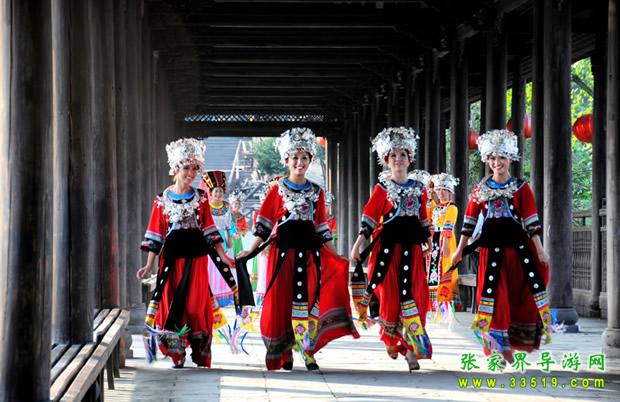
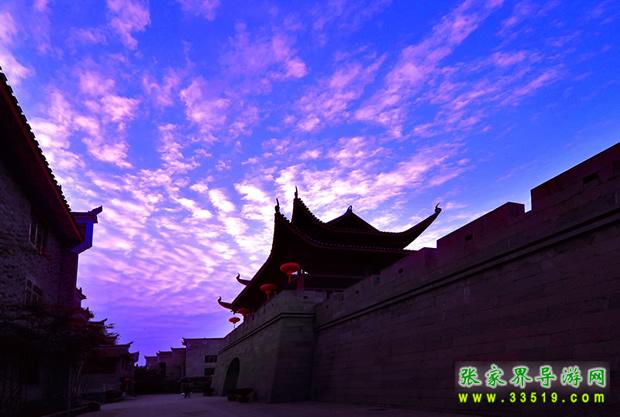
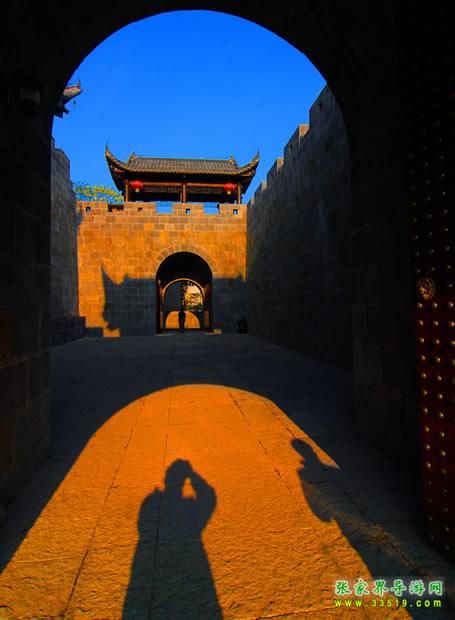
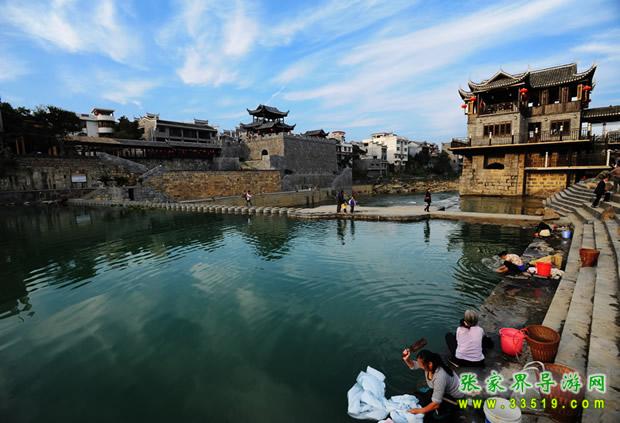
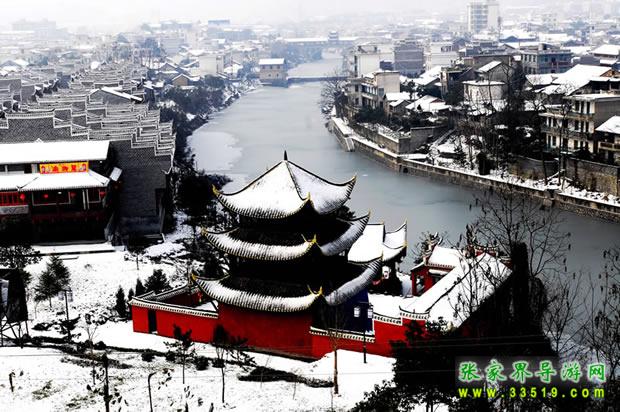
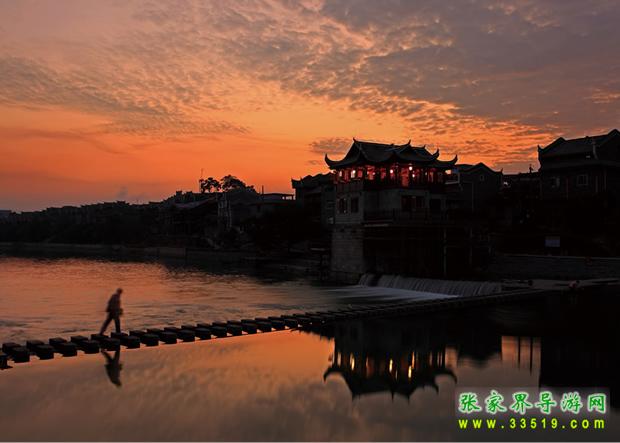
Qianzhou Ancient City is small and exquisite, with stone walls winding 1,980 meters long and 5 meters high. The Wanrong River flows through the city, and the bluestone slabs along the ancient riverside street, polished smooth by the feet of generations of passersby, are naturally and exquisitely laid. Along the street stand the Miao people's distinctive stilted houses (diaojiaolou), rich in ethnic style.
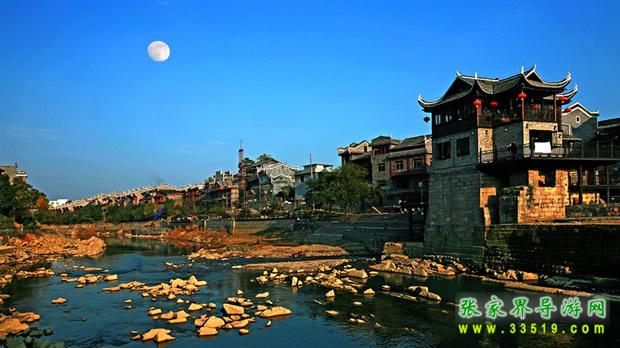
One ancient city's advertising slogan reads: "For you, this ancient city has waited a thousand years." But Qianzhou City, located in the Jishou urban area, the capital of Xiangxi, has waited over 4,200 years. Today's Qianzhou City presents a new appearance with a tourism layout of "one city, one garden, one workshop," while what remains unchanged is the ancientness and profundity accumulated over thousands of years. Strolling through it, what you see, hear, and feel will let you truly experience "Greater Xiangxi."
Now, let us walk together into Qianzhou and feel the charm emanating from this thousand-year-old ancient city.
First, there is the "one city," namely Qianzhou Ancient City.
As the folk saying goes: "Qianzhou's city, Fenghuang's soldiers." Since ancient times, Qianzhou has been the twin city on the Southern Great Wall, equally famous as Fenghuang Ancient City. It has a ten-li basin, two rivers encircling the islet, three land routes stretching across, shaped like the Qian hexagram. Inside the city are ten li of ancient streets, within the city are ten li of river channels, outside the city are ten li of walls. It was an important commercial port and wharf during the Qin and Han dynasties, and a key military command center on the Southern Great Wall defense line during the Ming and Qing dynasties.
Inside the ancient city, there is the Hu Family Pond, known as "small bridge, flowing water, and households," covering 2,800 square meters. The "Anlan Well" in the pond is the water source of the pond. The families living around the pond have well-preserved Ming and Qing ancient buildings with whitewashed walls, dark tiles, and upturned eaves—unique in style. In summer, when frogs croak and cicadas sing, lotus flowers in the pond bloom in competition, and strolling by the pond is leisurely and comfortable.
Inside the ancient city is the unmatched Three-Gate Opening in the history of Chinese ancient architecture, composed of the South Gate of the ancient city, Tongji Gate, and the Moon City (also called the Ear City). It is a landmark building integrating transportation, defense, water access, and fire prevention, and an important military defense facility of the cold-weapon era.
There are also many precious cultural relic buildings here, including the North Gate built during the Jiaqing reign of the Qing Dynasty; Qianzhou Confucian Temple, built during the Yongzheng period of the Qing Dynasty and one of the best-preserved Confucian temples in Hunan Province; and so on.
Greater Xiangxi is a land of outstanding people and spiritual vitality, and Qianzhou Ancient City has produced many talents. During the Guangxu reign, Yang Yuebin, governor-general of Shaanxi and Gansu, disregarded his advanced age and recruited soldiers in his hometown to fight the French in Fujian and Taiwan; Luo Rongguang, Tianjin garrison commander, led troops against the Eight-Nation Alliance, defended Dagu Fort, and died in the line of duty; Zhang Yizun, one of the four great contemporary Chinese painters of horses, and a group of ethnic talents too numerous to list. The former residences of Luo Rongguang and Yang Yuebin are also hidden here.
In addition, inside the city there is also the old site of the National No. 8 Middle School, where during the War of Resistance Against Japan, then-Premier of the State Council Zhu Rongji, his wife Lao An, and other people of insight studied, as well as ancient dwellings where historian Jian Bozan, children's literature writer Zhang Tianyi, and General He Jiesheng, daughter of Marshal He Long, once stayed. Their existence lets us feel a rich humanistic atmosphere.
Beyond the weighty legacy of the ancient city, the scenery of the Wanrong River—hailed as "Songhua River in the north, Wanrong River in the south"—adds even more charm to the ancient city. Strolling through the ancient alleys, by the stepping stones and the Wanrong River, along the city towers and walls, you will be deeply touched by a transcendent tranquility.
This "one city" is worth savoring.
After touring the ancient city, let us focus on the Xiangxi Intangible Cultural Heritage Park. Xiangxi Prefecture is a treasure trove of intangible cultural heritage. To date, the prefecture has over 3,200 intangible cultural heritage items of various categories, of which 24 are listed on the national protection list. The Baigong Workshop inside Qianzhou Ancient City is a grand exhibition garden showcasing Xiangxi's intangible cultural heritage in a concentrated way. Among the masters settled here are Ye Shuiyun, a Chinese outstanding Tujia brocade inheritor; Shi Shunmin, a Chinese Xiangxi Miao Drum King; Zhang Guangming, a national-level Tujia Hand-Waving Dance inheritor; and Peng Lin, a Xiangxi paste painting arts and crafts master—17 in total. Here we can see the masters' live demonstrations. The Baigong Workshop can also be seen as a silhouette of the real life of the people of Xiangxi.
In addition, at the Baigong Workshop you can also see a truly original ecological ethnic cultural program of Xiangxi—"Gelangdu." It takes sacrificial culture as its main thread and is divided into three major sections: "Heaven," "Earth," and "Harmony." It is the primitive totem of the indigenous peoples of Xiangxi. All performers are intangible cultural heritage inheritors or transmitters from the folk of greater Xiangxi. Many instruments and props are unique to Xiangxi and are presented for the first time.
After touring the ancient city and experiencing Xiangxi's intangible cultural heritage, before leaving you might visit our "one workshop," namely the Xiangxi Workshop, to taste the most authentic and distinctive Xiangxi cuisine and purchase one or two gifts with the most Xiangxi characteristics. As a Hunan Provincial Ethnic Tourism Commodity Demonstration Site and Hunan Provincial Tourism Shopping Demonstration Site awarded by the Hunan Provincial Tourism Bureau, it brings together various specialty commodities, local cuisine, and leisure culture of Xiangxi. Among the displayed famous, high-quality, and specialty tourism commodities of Xiangxi, Qianzhou Pressed Duck, Jiugui Liquor, Xiangxi Mushroom Oil, palm weaving crafts, and Xiangxi Fragrant Vinegar are all excellent choices for gifting to relatives and friends.
The veil of mysterious Xiangxi awaits you to lift, the unique Tujia and Miao customs await you to experience, and the profound frontier heterogeneous culture awaits you to perceive. Release the passion in your heart and come together to feel this ancientness and profundity.
1. By the banks of the Wanrong River stands a thousand-year-old ancient city, with bluestone slab streets, winding ancient alleys, and dwellings nestled closely together. In one corner of the city is a place called Hu Family Pond. Every early summer, the scenery around the pond is full of vitality.
2. Lotus leaves stretch to the horizon in endless green, while lotus flowers reflecting the sun glow especially red.
3. If it is late summer, with frogs croaking and crickets chirping, a gentle breeze brushing your face, and fireflies lighting the way, enjoying by the pond the fine melody composed by nature and the lotus pond is infinitely leisurely. Every year on the 24th day of the sixth lunar month is the best season for viewing lotus flowers. The lotus flowers are tender and pink, facing the blazing sun, competing in beauty. Under the cover of lotus leaves one after another, they are like graceful young maidens, and the half-open buds are even more shy and maidenly. After the sky-blue misty rain passes, dewdrops on the lotus leaves are crystal clear, dripping into the pond with a "drip-drop" sound, like heavenly music. Lotus flowers in the rain, emerging from mud unstained, facing the rain unyielding, surpass even the Goddess of the Luo River emerging from water. When clouds part and the sun is round, under the bright sun, with lotus fragrance lingering, one feels relaxed and joyful. Countless bees come in succession, crowding around the lotus, gently gathering, as if afraid to disturb the beautiful dream of the lotus fairy. Whether in clear skies or sudden rain, the lotus pond has its own scenery; the misty rain lotus pond is like a poem and a painting, with thin mist hazy, as pleasant as Jiangnan. Under the bright red sun, blue sky and green leaves, the lotus emerging from water attracts bees and butterflies, like a heavenly paradise.
4. Like jasper adorning a tall tree, ten thousand branches hang down like green silk ribbons. Residents by the pond live alongside it, and the wooden-tiled houses are reflected in the water like a bright mirror, mirroring each other. The plants by the pond are lush and verdant. The stone-paved path splits in two. An arched small bridge stands beneath the willow tree, whose long dense branches, when a gentle breeze slips by, sway with the wind like a maiden's long hair. Such beautiful scenery quite evokes the feeling of "small bridge, flowing water, and households." Sitting by the pond is infinitely spring-like; viewing such a fine scene and fishing by the pond is a blessing in life.
5. Above the riverbank, spanning both shores, with people coming and going ceaselessly, sheltering them from wind and rain, it is thus named: the Wind and Rain Bridge. As the sun sets in the west, the heartbroken one is at the edge of the world. From afar, the bridge lies resting over the river, with a pavilion in the middle, three upturned eaves, and a spire piercing straight into the clouds. Beneath the bridge are stone piers, solid and firm, and on both sides the bridge arches, large and small, are neatly arranged. Under the setting sun, all is quiet and leisurely; on the river, a small boat pushes upstream against the current. The boatman plies his pole and sings a little tune of homesickness. In the distance, a small house has a straight chimney, where a lovely wife cooks rice and waits for her husband's return. Such a scene fills one's heart with profound melancholy, and feelings of longing for home and family arise spontaneously. How I wish to have thousands upon thousands of broad mansions, to shelter all the poor scholars of the world and bring them joy, unshaken by wind and rain, steady as a mountain. The afterglow of the setting sun spills onto the bridge, as if gilding it with a layer of gold. People at leisure come to the bridge, either to rest or to admire the evening clouds. Whether the wind blows or the rain falls, pedestrians come and go on the bridge without cease; now someone sits on a wooden bench waiting for the rain to stop, now a peddler sets up a stall and cries his wares, now a few serene and composed old men gather and chat, or a few children read poetry and books on the bridge, doing their lessons, and there are even Wu Nuo masters telling fortunes and casting divinations. Outside, thunder and rain rage together, but inside the bridge all is safe and sound, still a scene of peace and harmony, without the slightest wild wind or wave. The bridge body shelters and protects, shielding from wind and rain, benefiting the people on both shores.
6. Picking chrysanthemums by the eastern hedge, I carelessly catch sight of the southern mountain. The residents of the small town live a comfortable life, working at sunrise and returning at sunset. Several sisters-in-law and old men move chairs and sit down. Gathered together, they chat freely. Life flows on like a gentle stream; the women weave clothes and spin thread, children run through the streets, and all who come and go know one another, while the old dog lying on the ground rests with its eyes closed. Neighbors often drop by each other's homes, and at mealtimes they often call out to one another; whenever there is a good dish, they always invite three or five people to share it. If a wedding or funeral occurs, everyone around helps one another, truly proving that a near neighbor is better than a distant relative! Such a life is just like: Picking chrysanthemums by the eastern hedge, I carelessly catch sight of the southern mountain. In the evening, the gongs and drums of the small town still sound, and the Wu Nuo Hall beats and clangs, becoming an after-dinner entertainment!
7. Spectators swarm in, and the lingering melody circles the beams for three days without end. At night, the Wu Nuo Hall is packed with people. Listening to opera after dinner has already become a custom. Old people follow the opera, shaking their heads and humming softly, while children below the stage imitate the moves. The performers on stage sing loudly and resoundingly, like thunder piercing the ears. Their movements flow like drifting clouds and running water, completed in one breath, and their performances are exquisite and lifelike. The several accompanists playing erhu and beating gongs and drums are also quite absorbed. Whether it is Miao opera, Wu opera, Yang opera, or Nuo opera, each has its own characteristics, drawing the audience below to clap and cheer from time to time, all praising it as superb! At this moment the Wu Nuo Hall is brightly lit, and most people in the ancient city gather here to enjoy the opera, with no trace of sleepiness at all. If one cannot listen to opera after a meal, it is hard to fall asleep. The opera continues until it stops two hours later, and the crowd disperses one after another; some, still not fully satisfied, hum loudly from time to time and, on the bluestone street, imitate the actors and dance. The people leave and the building empties, the lights go out little by little, and the ancient city returns to its peaceful and serene appearance, as if it too has fallen into deep sleep.
8. At dawn, as day breaks and the silver light has not yet faded, the diligent people have already begun to rise and work. The red glow of sunrise covers the ancient city as if it has gained new vitality. People also begin to busy themselves, and the small town gradually becomes prosperous; on the streets, workshops, general goods stores, gold, silver, and jade shops, snack bars and restaurants, batik and carving workshops…… many shops open one after another. The crowds coming and going hurry along the official roads. A new day has begun again, and the ancient city has also welcomed a new day!
Qianzhou——two clerical-script characters towering into the blue sky, hung in the plaque at the top of the Gongji Gate of Qianzhou Ancient City, solemn and vigorous. They linger in my heart like a dream. On the day I first came to visit this ancient city, more than ten colored banners hung in the Gongji Gate, and the banners told me that this ancient city was carrying out all kinds of activities, the most eye-catching of which were the “Qianzhou Ancient City People's Life Prize-Winning Fun Sports Meet” and the Xiangxi regional selection trial of the Eighth National Youth Art Exhibition and Evaluation Activity. Curious, I took a small slip of paper from the volunteers, followed their instructions, filled in my mobile phone number, and dropped it into the cardboard box they held. A young woman said that the lottery would be drawn in a little while. My wife, showing an envious look, modestly said that she should fill one out too. It seems that everyone will strive for a chance at a prize. Could there be a possibility of both husband and wife winning? It was still early, and with more than a hundred li of travel, it was better to fill our stomachs first. On the temporary performance stage beside the Gongji Gate, a fashionably dressed Qianzhou local, with the help of staff, was joyfully performing the “back-of-the-head ball” activity. The large characters “Travel Xiangxi, rush to Qiancheng, all the people participate, suitable for young and old” implicitly conveyed the Qianzhou people's happiness in life. I had only a half-day plan to tour Qiancheng, and could not wait for the prize draw, so I entered the Gongji Gate. The neat ancient city, the quiet and beautiful stone slabs, the small blue bricks and small blue tiles, everywhere were signs reading “Guyun Jishou, travel Xiangxi and rush to Qiancheng,” along with notices of various activities for the elderly, making the cold winter of this ancient city feel warm. After only a few steps, a song with a childlike voice came from a wooden courtyard, elegant and unrestrained; we followed the sound into this old house, and the courtyard turned out to be a performance venue, where a little girl held a microphone and sang while performing on stage. At the front of the audience seating, several middle-aged people with an artistic temperament sat gracefully, speaking softly, as if judging the girl's posture and singing. The audience seats were filled with men and women, old and young, and one could also see quite a few waiting performers painting their eyebrows and eyes and applying powder and makeup. I had seen an opera house in the ancient city of Nanjing, and its architectural design and effect were no more than this. Yet the ordinary people of Qianzhou could also live the life of the imperial palace in their daily days. On the plaque of the stage were written the several fluent cursive characters “Qianzhou Wu Nuo Hall.” Xiangxi produces talented people in abundance; this is a hall of art, and these singers are all outstanding in the arts.?? Coming out of the Wu Nuo Hall, I saw a door plaque inscribed “Renhe Residence.” On the door wall hung a small introduction: the first-generation master of Renhe Residence was He Chenxiang of Hengzhou (1755——1813), posthumously honored as Grand Master of Court Discussion, a descendant of the Tang dynasty poet He Zhizhang, who moved to Qianzhou during the Jiaqing reign of the Qing dynasty. A famous person of Qianzhou. I could not help but feel deep respect. The descendant of a poet could live in this remote borderland of Huxiang; Qianzhou had long since merged into the circle of Chinese civilization. There were also Yang Yuebin, Governor of Shaanxi, Grand Guardian of the Crown Prince, and a famous general of his generation who recovered Taiwan, and Luo Rongguang, a national hero who led three thousand soldiers, took the lead personally, and vowed to defend the Dagu Fort to the death. Qianzhou, a ten-li basin surrounded by mountains on all sides, its mountains like nine turtles seeking their mother, with the Wanrong River and Tianxing River winding around the islet, forming three stretches of land lying across, shaped like Qian and Kun. Paying homage to the houses where one famous person after another once stayed, I seemed once again to be savoring Mr. Shen Congwen's description of Qianzhou Ancient City in his work Xiangxi: “Although the place is not large, the small stone city is neat and clean, and it has produced people with names in history over the past thirty years……” Another 500 meters east, the majestic great city gate——Sanmenkai——stands towering. Passing through the gate opening, one almost loses oneself in a large well, with a gate opening on each side, north and south; it turns out that Sanmenkai stands right on the bank of the Wanrong River. Outside the gate is the common Xiangxi stepping-stone weir. The river water is clear and quiet, and a small fishing boat carrying a man is busily using cormorants to catch fish. A few plum blossoms attract two women, whose cameras keep capturing the graceful postures of the wintersweet. At that time, the plum blossoms had just formed buds, and the cold snow had not yet arrived, so it was simply those two young women being sentimental. Sanmenkai, majestic and mighty; the cold plum blossoms delicate with hidden fragrance; the river water naturally flows murmuring day and night, a scene through the ages, showing not the slightest vicissitude. We followed the riverbank upstream and in the distance saw a stone arch bridge flying east-west across the riverbank. That must be the legendary Sanwangge Wind and Rain Bridge. Although it is hard for me to find those legendary stories, I know that this Wind and Rain Bridge has witnessed the vicissitudes of the ancient city. Once, this was a strategic pass on the Feng-Qian Highway; merchants, soldiers, and common people traveling north and south in sedan chairs would always be attracted by the river when they arrived here, and then sit by the bridge railing to rest a while. When the breeze blew, wave after wave of love songs stirred people's emotions. Below the bridge, carp leaped, and spring light was no more. But at night, from the stilted houses on both banks came the tender voices of women, naturally a soul-stirring and bone-shaking enchantment. So who among the idly chatting people would be willing to abandon this scenery of spring flowers and autumn moon and leave early? I read the couplets one after another on the Wind and Rain Bridge, feeling a burst of bewilderment, a whimsical fancy, and also a sense of loneliness. My wife kept urging me, hurry up, didn't we agree to tour for only half a day? I answered oh oh, while my soul still lingered in a sentiment called Hu Dekan: In gentle wind and waves, the hidden scales in the river leap to the water's surface; with timely rain, Qianzhou moistens the travelers crossing the bridge who speak of spring light.?? After seeing Luo Rongguang's former residence and paying respects at the temporary residence of Jian Bozan, a famous Chinese historian, renowned Marxist historian, and one of the important founders of Marxist historical science in China, we entered a small lane, and somehow could not at first see the long-awaited Hu Family Pond. Suddenly inspired, my wife and I once again turned back to the Gongji Gate, then south, and in less than two hundred meters, a uniquely characteristic scenic spot appeared before our eyes. The curved Qingfeng Bridge, the quiet Anlan Well, ancient dwellings of different eras, and the leisurely visitors by the lake, tranquil, elegant, and primitive, while the withered lotus flowers gave people the coolness of aged dignity. I was a little hungry, but fortunately a small stall displayed local mugwort glutinous rice cakes; when I asked the price, it was one and a half yuan for two. Peeling open the reed leaves, the sweet fragrance of mugwort rushed to my nose. I listened as the woman selling mugwort cakes and the residents sitting idly talked about their children's schooling while also being satisfied with their present lives. “Whether grades are good or not should not be forced; being healthy and strong is more important than anything.” I thought of how the martial spirit of Xiangxi people has always been valued more than literary pursuits; studying depends on talent, and being strong and vigorous can likewise bring honor to one's ancestors. Thus there emerged Yang Yuebin, Luo Rongguang, Wu Bayue, leader of the Qianjia Miao people's uprising, and Fu Liangzuo, Deputy Minister of the Army in the Republic of China, national talents from Qiancheng, and even General He Jiesheng, daughter of He Long, stayed in Qiancheng, adding new splendor to the ancient city.?? In front of the Confucian Temple, I met two old men, one named Tian Jingyou, who introduced the other as Xiang Yuanxiong. I heard them say that they were originally from Zhen'gan, one retired as a teacher and the other from the general supply and marketing department, and because they valued the cultural landscape of Qianzhou Ancient City, they moved into Qianzhou Ancient City after retirement. Both are now members of the Qianzhou Poetry Society, and after retirement they write poetry and paint in the ancient city, enjoying a happy old age. I saw that on the lintel of the old man's neighbor hung the plaque “Zhang Yizun Temporary Residence,” and the house had already been listed as a municipal-level cultural relic protection unit. So this was the temporary residence of Master Zhang Yizun, known as “Xu in the north, Zhang in the south.” “Three Steeds,” “Eight Steeds,” and “Ten Thousand Horses Galloping” were so vivid that in an instant they seemed to gallop before my eyes, raising the dust of iron-clad warhorses. With such a profound history, with the spiritual vitality of a ten-li basin, surrounded by mountains on four sides, two rivers winding around the islet, three stretches of land lying across, shaped like the Qian hexagram, I suddenly understood: literature carries the Way, literature unites, literature transmits; using commerce to support culture, and culture being able to enrich commerce, has been so since ancient times. At Old Man Tian Jingyou's place, he warmly received us and seated us, and gave me a collection of poems he had written himself. By the Wanrong River lies ancient Qianzhou, where the Wu River winds blue and flows gently. Before the Wind and Rain Bridge spring swallows dance, and in the green waves brocade-scaled fish swim. The sound of Buddhist bells curls up from Guanyin Pavilion, and sparse willows and sunset glow touch the stilted houses. At night, roaming both banks with friends, ten thousand household lights embrace a lone boat. I deeply admire these two old men's realm of life, far from the noise of the world, delighting in mountains and waters, spending their later years in peace. Opposite the Confucian Temple is Guanyin Pavilion, with blue water stretching to the sky, wisps of green smoke before the Buddhist hall, and outside the meditation room door, lush fine grass; as the sun sets in the west, it urges one to forget to return. In my heart there is a wish: in my later years, to rent a wooden house in the ancient city of Qianzhou, hold a cup of clear tea, look up at the red sun and watch flying birds, sit quietly in a mountain pavilion and listen to evening Zen. This life would be enough.