This attraction introduction is compiled from historical materials in the "Zhangjiajie Tour Guide Network" (33519.com · Scenic Spots section). Ticket prices, opening hours, transportation, and contact information mentioned in the text may be outdated. Please refer to the latest official announcements from the scenic area before traveling; some content consists of historical background/cultural introductions and is for reference only.
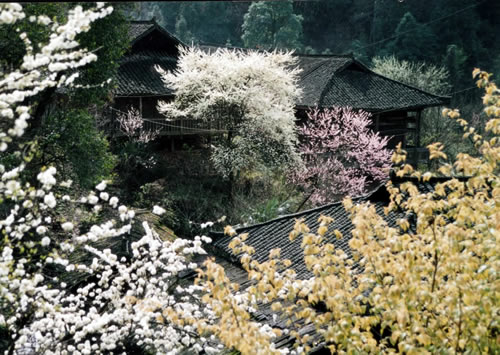
Hunan Xiaoxi Ecological Tourism Scenic Area is located within the Xiaoxi National Nature Reserve, in the southeastern part of Yongshun County, adjacent to Zhangjiajie National Forest Park and Mengdong River Scenic and Historic Area, with a total area of 24,800 hectares, of which the core area is 6,133 hectares. The Xiaoxi National Nature Reserve grows large areas of subtropical low-altitude evergreen broad-leaved primary secondary forest. Within the area there are many kinds of rare plants, including 43 species of national first- and second-class key protected plants such as dove tree, Chinese yew, emmenopterys, and silver magpie tree. In the primary secondary forest there also survive 68 species of nationally protected animals such as the golden leopard, clouded leopard, and white-necked long-tailed pheasant. The Xiaoxi National Nature Reserve has very high scientific research value and has been investigated and demonstrated by authoritative experts and scholars as the only natural resource treasure house of primary secondary forest among the thirteen provinces of central and southern China that escaped the invasion of Quaternary glaciers.
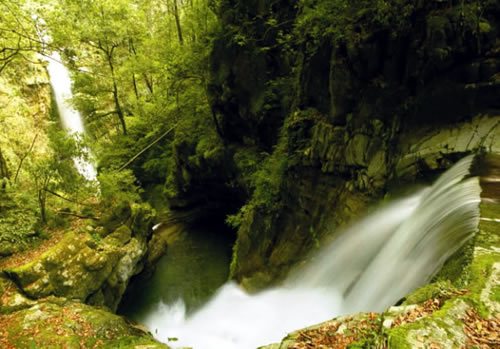
Hunan Xiaoxi Ecological Tourism Scenic Area is an ecological tourism area characterized by primary secondary forest, gorges, and peak-forest landform landscapes. Within the area, the forest sea is vast, the trees are lush, and the forest coverage rate reaches 92.5%. The concentration of negative oxygen ions is high, the air is fresh, and the environment is pleasant. In the gaps of the forest sea are dangerous gorges and deep ravines, flying waterfalls and flowing springs, towering strange peaks, and the calls of birds and apes, with occasionally one or two Tujia wooden buildings appearing, roosters crowing and dogs barking, and simple folk customs. The natural and humanistic scenery of Xiaoxi Ecological Tourism Scenic Area is primitive and simple, making it an ideal resort for leisure vacations and soft adventure tourism in central and southern China.
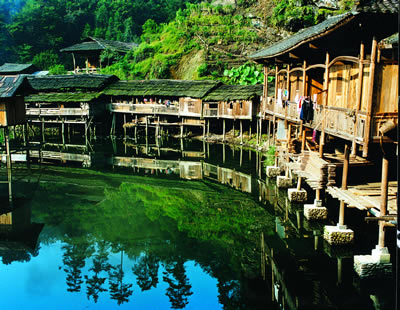
Within the area, normal landforms (erosion-fluvial landforms) and karst landforms develop simultaneously. River erosion and cutting are intense, the terrain is fragmented, and the relief is great, presenting multiple types such as mountains, mountain plateaus, hills, mound land, and synclinal valleys. In the horizontal direction, from the sandstone-shale erosion-tectonic mountain valleys in the northwest to the carbonate karst erosion-tectonic mountain plateaus and mountains in the center, and then to the metamorphic rock erosion-tectonic mid-mountain mountains in the southeast, there is an obvious pattern of horizontal regional differentiation with alternating ridges and valleys arranged in parallel; in the vertical direction, as the terrain rises, from modern riverbeds and stream-valley plains to mound land, hills, and then mountain mountains and plateaus, there is a pattern of multi-layering and layered distribution.
Within the territory are lofty mountains and steep ridges. Yonglong Mountain lies in an arc dominating the northwest of the county, and Rentou Mountain winds southeast. In between, mountain ranges such as Pu'an Mountain, Wanfu Mountain, Panlong Mountain, Sifangjie, Yangfeng Mountain, and Fangshiyan twist and connect, forming an oblique “S” shape. The terrain accordingly descends in steps toward the Lishui River in the northeast and the Youshui River in the south, forming an asymmetrical “saddle-shaped” geomorphic form. Within the territory, mountains and ridges overlap and streams and valleys crisscross. The highest Yangfeng Mountain has an elevation of 1,437.9 meters, and the lowest, Mingxi at Liyuping in Xiaoxi, has an elevation of 162.6 meters, a difference of 1,275.3 meters, with a terrain gradient of 44.6%.
The reserve is a deeply dissected mid-mountain area, with undulating ridges and complex orientations. The strata are mainly metamorphic rock. The climate has an annual average temperature of 11–12°C, with a frost-free period of 250 days at lower elevations and 200 days above 800 meters; annual precipitation is 1,300–1,400 mm, with high humidity and abundant clouds and mist. The soil parent material is sandstone and shale, and the soil is highly fertile, suitable for forest growth. The Yuquan Stream and Xiaocha Stream run through the entire area, and after converging they flow into the Youshui River. The total area is 26,347.6 hectares, of which the core area is 9,933 hectares, and the total forest stock is 2.2235 million cubic meters. It governs 19 administrative villages, 88 villager groups, 2,163 households, and 8,572 people. It is one of the 200 ecological zones of global priority protection, and is a low-elevation evergreen broad-leaved primary secondary forest that is rare in the world, unique in China, and the only surviving one in the 13 provinces of central and southern China that escaped the Quaternary glaciation. The reserve is rich in species and is a natural botanical garden, a gene bank of wild flora and fauna, and a natural oxygen bar.
The reserve has more than 1,500 species of plants, including 419 species of woody plants. Transportation in the area is inaccessible, and the native low-mountain broad-leaved forest is well protected, which is rare in the mid-subtropics. Evergreen broad-leaved forests are mostly distributed at elevations of 400–800 meters. In the valleys, Castanopsis tibetana, Machilus ichangensis, Sloanea sinensis, and Sloanea hemsleyana are dominant, while on the slopes, Castanopsis eyrei, Lithocarpus glaber, Castanopsis fordii, Schima superba, and Liquidambar formosana are dominant. There are many lianas in the forest, with thick vines entwined around large trees, forming a multi-layered, multi-species mixed forest. The forest stand is neat. On gentle terrain, there are coniferous and broad-leaved mixed forests with Masson pine and Chinese fir as the first canopy layer, among which there are many ancient Chinese firs of large girth. In addition to evergreen trees dominated by Lauraceae, Theaceae, Fagaceae, and Magnoliaceae, the plant composition also includes many deciduous tree species from Anacardiaceae, Aceraceae, Tiliaceae, Salicaceae, Ulmaceae, Eucommiaceae, Cercidiphyllaceae, Rubiaceae, Davidiaceae, Juglandaceae, and Betulaceae. It is the place of origin of the type specimens of 21 plants such as Cyclobalanopsis xiangxiensis and Lithocarpus xiangxiensis. There are 18 species of rare and endangered plants under national protection, including Davidia involucrata at the first level; Manglietia patungensis, Ginkgo biloba, Tetracentron sinense, Bretschneidera sinensis, Cercidiphyllum japonicum, Emmenopterys henryi, Eucommia ulmoides, and Liriodendron chinense at the second level; and Phoebe zhennan, Phoebe bournei, Pseudotsuga sinensis, Tapiscia sinensis, Euptelea pleiosperma, Pterostyrax psilophyllus, Corylus chinensis, and Tsuga longibracteata at the third level. In the area there are more than 150 species of fiber plants, more than 120 species of oil plants, 100 species of dried fruits, and more than 100 species of aromatic plants. Tsuga longibracteata is mostly distributed on steep slopes and cliffs above 900 meters in elevation, braving wind and snow, and extremely tolerant of drought and barren soil. Tapiscia sinensis is mostly distributed on slopes and in valleys below 800 meters in elevation, with a small crown and patchy distribution. In Zhuping Village there is a large ginkgo tree, 30 meters tall and 1.4 meters in diameter at breast height. The reserve has an especially large variety of Phoebe species, including 16 kinds such as Phoebe bournei, Phoebe hunanensis, Phoebe sheareri, Phoebe neurantha, and Machilus, hence it has the reputation of "Home of Phoebe." Sloanea sinensis: Elaeocarpaceae. Evergreen tree, up to 12 meters tall. Leaves clustered on the upper part of branchlets; flowers greenish white, several borne at the tips of branchlets or in the leaf axils on the upper part of branchlets. Capsule woody, ovoid-globose, densely covered with bristles, splitting into five or six valves. Seeds have a yellow aril. The wood is used for boards, utensils, and other materials.
There are 208 species of vertebrates, belonging to 23 orders and 70 families, and 738 species of insects in 19 orders and 144 families, including 159 species of natural enemy insects in 9 orders and 27 families. Among them are 36 species of national first- and second-class protected animals such as the leopard, clouded leopard, and white-necked long-tailed pheasant. Among the nationally key protected animals, the first-class protected species includes the black musk deer; the second-class protected species include the forest musk deer and tiger frog. The forest musk deer is the smallest species in the genus Moschus. Its body length is about 70 cm, shoulder height 47 cm, and body weight about 7 kg. Both males and females have no horns; the ears are long and upright, with slightly rounded tips. The upper canines of the male are well developed, curving backward and downward, extending beyond the lips; in front of the reproductive organ on the abdomen there is a musk gland, and the tail is thick and short with well-developed caudal glands. The limbs are slender, with the hind limbs longer than the forelimbs. The body hair is coarse and dark, olive-brown, tinged with orange-red. The lower jaw, throat, under the neck, and the front chest form a clearly demarcated white or orange-yellow area. The hair on the rump is nearly black, and adults have no spots. Some consider it a subspecies of the Siberian musk deer.
It lives in coniferous forests and mixed coniferous-broad-leaved forest areas. It is timid by nature. It lives a solitary life; it has a keen sense of smell and moves lightly and agilely. It migrates vertically with changes in climate and food. Its food consists mainly of tender branches and leaves of shrubs. Estrus and mating mostly occur in November–December, during which males and females gather together and fierce fights over mates occur among males. The gestation period is 6 months, with 1–3 young per litter. It has already been bred domestically in China, and the musk produced by the male is a precious traditional Chinese medicinal material and a high-grade spice.
The ecotourism scenic area within the reserve is an ecotourism area featuring primary secondary forest, gorges, and peak forest landforms. At present, 5 scenic areas have been opened to tourists, namely: the scenic area along the tourist route from Maoping Wharf to Xiaoxi Village, Longmen Stream Scenic Area, Yuquan Stream Scenic Area, Chayuan Stream Scenic Area, and Badong Magnolia Scenic Area. In the area, the forest sea is vast and the trees are lush, with a forest coverage rate of 81.59%, high negative oxygen ion concentration, fresh air, and a pleasant environment. In the gaps of the forest sea are dangerous gorges and deep ravines, flying waterfalls and flowing springs, towering peaks, and the calls of birds and monkeys, with occasionally one or two Tujia wooden houses appearing, roosters crowing and dogs barking, and simple folk customs. The scenic area integrates forest scenery, primitive river valleys, historical sites, and ethnic customs, and is an ideal resort for leisure vacations, scientific investigation, and soft adventure tourism in central and southern China.
The reserve adjoins Zhangjiajie National Forest Park and Mengdong River Scenic Area. It is an important tourism corridor connecting Xi'an and Chongqing to the Zhangjiajie scenic area and Guizhou Huangguoshu to the Zhangjiajie scenic area. It is 70 kilometers from Zhangjiajie Hehua Airport, 30 kilometers from Mengdong River Railway Station, 45 kilometers from Yuanling County Seat in Huaihua Prefecture, 120 kilometers from Fenghuang South Great Wall, and 42 kilometers from Wangcun Ancient Town in Yongshun County, with convenient land and water transportation. In the reserve, vegetation does not wither in all four seasons, and there are beautiful sights everywhere at all times. The vegetation is verdant and luxuriant, sunlight filters through the forest, the fish swim lively and nimble, and the cured meat, wild vegetables, and rice wine of the Tujia mountain villages intoxicate friends from all over the world. The beauty of the human world is hidden deep in Xiaoxi, and Xiaoxi is in your heart.
Transportation tip: Depart from Furong Town Wharf, board a motorboat, and after a journey of about three hours, the waterway becomes narrower and narrower, finally mooring at a small ferry crossing. Follow the steps up from the wharf, and before long you can board the shuttle bus bound for Xiaoxi.