This attraction introduction is compiled from historical materials in the "Zhangjiajie Tour Guide Network" (33519.com · Scenic Spots section). Ticket prices, opening hours, transportation, and contact information mentioned in the text may be outdated. Please refer to the latest official announcements from the scenic area before traveling; some content consists of historical background/cultural introductions and is for reference only.
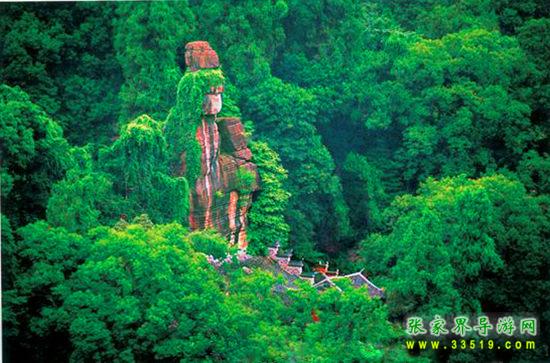
The Bu'ermen Scenic Area is a national-level forest park (on August 31, 2006, approved by the State Forestry Administration, it became one of the first national-level forest parks authorized to use the special logo of China National Forest Parks) and a famous scenic spot in Hunan Province. The scenic area is located in the northwest of Hunan Province (90 kilometers from Zhangjiajie City), on the banks of the Mengdong River 1.5 kilometers south of Yongshun County town, with a total area of 30 square kilometers. It is the north gate of the Mengdong River Scenic Area. It is characterized by strange rocks, hot springs, stone inscriptions, and Guanyin worship. The Bu'ermen Gate, Lotus Pond, and Eight Trigrams Formation formed by limestone dissolution are regarded as the uncanny workmanship of nature. The stone inscription in which the four characters "Shan Qing Hai An" (Green Mountains, Blue Sea Shore) are written in one continuous stroke and combined into the single character "An" (shore), and the Eight Trigrams Formation known as the "Bewildering Maze" leave people marveling endlessly. Here, it is verdant and lush all year round, with the sound of Buddhist chanting lingering — a good place for cultivating one's mind and character. "The Story of Suppressing Bandits in Wulong Mountain" and "The Story of Suppressing Bandits in Xiangxi" were both filmed here.
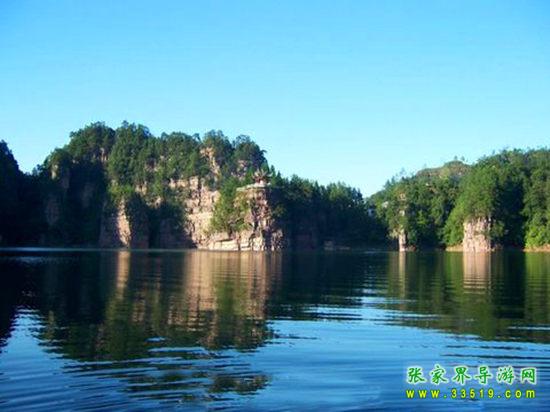
There are many wild fruit trees in the mountains — wild pear trees, wild chestnut trees, wild kiwi trees, and so on. In spring, wildflowers bloom everywhere, and it is very beautiful.
The Bu'ermen Nunnery sits among the green pines and cypresses in the mountains, with flourishing incense and a tranquil environment. Drawing lots at the nunnery is said to be very efficacious~
The name Bu'ermen is taken from the Buddhist term "Bu'er Famen" (the Gate of Non-Duality). On the right wall of the main gate are the four characters "Shi Men Tian Zao" (Stone Gate Hewn by Heaven) inscribed by Mr. Shen Congwen, written during his last return to his hometown before his death.
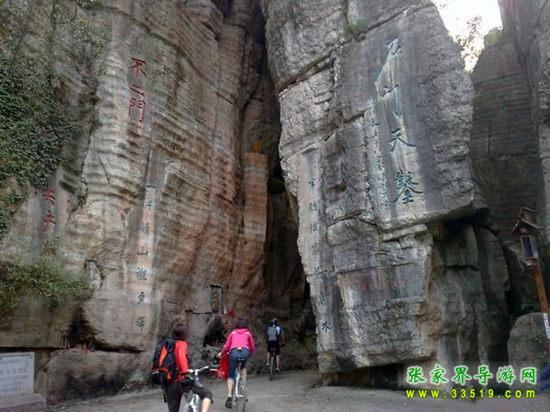
During the Jiaqing period of the Qing Dynasty, the Xixin Pond (Pool for Cleansing the Heart) was established. "Bu'ermen" looks as if hewn by axes and split by the gods, formed naturally from a stone forest, and the walls of the stone forest are covered with poems by literati of past dynasties. Here ancient cypresses tower to the sky, vines hang upside down, and the environment is serene and beautiful. There is the "Wanjuan Shu" (Ten Thousand Volumes of Books), a wall of rock resembling books, and the seven-tiered bluestone Peiying Pagoda with mist girdling its waist. The South Sea Guanyin sitting in concentrated meditation is a naturally shaped giant rock, remarkably true to life. Around Guanyin Rock are buildings in the Ming and Qing style, such as the Dizang Nunnery, Songshan Hall, and Shuifu Pavilion, cleverly and compactly laid out with clear themes, making use of the terrain to create scenery. Winding paths thread between the scenic spots, deep and intriguing in their maze-like interest, known as the Eight Trigrams Formation. On the riverbank within the scenic area there are two hot springs, wreathed in mist, with a suitable water temperature (41°C) and good water quality, capable of treating many diseases. County residents going through "Bu'ermen" to bathe in the hot springs come in an endless stream. Now a stone archway and a folk customs museum have also been added.
A corner of Bu'ermen: "The world has many forked roads, but Heaven has only the Gate of Non-Duality." These ten imposing characters form a couplet composed by the poet Mr. Gong Liu after traveling the Yuan River, touring Xiangxi, and visiting Bu'ermen.
Silently savoring the poet's profound sentiment, on a towering mountain top, gazing far into the world's one and only Bu'ermen, in the haze one can faintly see a thousand-fathom-deep valley, a single path opening in the middle, and stone split into two doors. Clusters of clouds surge forward like waves, and like bundles of snow-white wool blown and stirred by the heavenly wind; their overwhelming, mountain-toppling momentum does not allow you to observe them in detail — in the blink of an eye, they vanish as ethereally as a mirage, slipping away as swiftly as a meteor chasing the moon, disappearing without a trace — perhaps this is the unpredictable, wondrous scene of clouds surging at Bu'ermen.
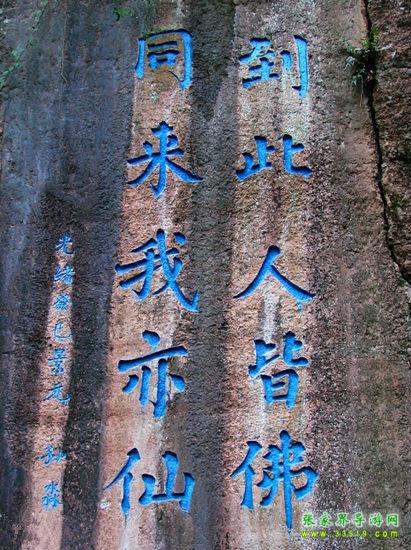
Inside Bu'ermen, a huge stone Buddha formed by the weathering of limestone stands towering amid the boundless greenery, six zhang tall, with a dark crown and white face, its head touching the white clouds and its feet treading the blue waters. Because of its form and spirit, people call it "Guanyin Rock." The "Yongshun County Annals" states that "Guanyin Rock has long been known as 'the Number One Rock among the famous peaks of Hunan scenery.'" Below Guanyin Rock stands a group of magnificent, colorful, and antique hall and pavilion buildings — this is "Songshan Hall," including the Sanguan Hall, Yuhuang Pavilion, and meditation rooms and guest quarters, exquisitely crafted and delicately unique. In particular, the Dizang Nunnery behind the main hall is similar in structure to the Zushi Hall, a Ming Dynasty building at the Old Tusi City. It backs onto a stone cliff, connects on the right to the Eight Trigrams Formation and on the left to the Reshui Pit, surrounded by rows of grotesque rocks and towering ancient trees. On the mountain north of Guanyin Rock is the heaven-made "Eight Trigrams Formation," some rocks like rows of halberds, some like spring bamboo shoots; some like ancient Buddhas, some like walking beasts. The wonder of the Eight Trigrams Formation lies not only in its forest of grotesque rocks, but most importantly in the winding paths paved with cracked stone slabs that rise and fall, now hidden and now visible — sometimes passing through deep underground stone caves, sometimes stretching through dense woods and thick grass, sometimes winding among strange peaks and rocks, connecting the east, south, west, and north gates of the Eight Trigrams Formation, with the complex and numerous stone paths interlinking to form a network, so that people sometimes find it hard to find a way out. Perhaps this is the reason for the name Eight Trigrams Formation. On both sides inside Bu'ermen, the stone walls open wide like screens, and literati and poets of past dynasties, praising the secluded beauty of the landscape or expressing the grandeur of their hearts, carved various cliff inscriptions. According to the "Yongshun County Annals," the Bu'ermen stone inscriptions include over 100 sites such as "Shenxiu Duzhong," "Wudao Nanlai," "Baiyun Menkai," "Dizhu Zhongliu," "Yanqian Nanhai," "Baibao Shengguang," "Biekai Shengmian," and "Bieyou Tiandi." After weathering the vicissitudes of time, only several dozen remain, such as "Guifu Shengong," "Shengjing Wushuang," "Dijin Chenfen," "Zhanqi Yangyi," and "Haishang Feilai." The poems on the eight scenes of Guanyin Rock written by the Qing Dynasty notable Bai Jie'an, such as "Pine Path Retaining Clouds," "Ancient Cave with Immortal Traces," "Layered Pavilions Rising in Green," "Jade Screen Encircling," and "Clear Pool with Moon Reflection," still stand out on the stone walls. Among them, the poem "Stone Gate Hewn by Heaven" is completely intact: "The Dharma gate towers high, nestled in five-colored clouds; uncanny workmanship wondrously fashioned it. Whipping stones leaves no trace yet still bears form; to rouse the mountain there is a bell, no hammer needed. The ground is touched by flower rain, a thousand forked paths lie level; the Way connects to the transmitted flame, opening a single thread. Say not that Zhongnan is called a shortcut; the giant spirit god opened this little Penglai." Jing Yuan, the tanhua (third-place laureate) of the Gengchen year of the Qing Dynasty, once inscribed on the stone wall: "All who arrive here are Buddhas; those who come together, I too am an immortal." He also had the overlapping characters "Shan Qing Hai An," written in one continuous stroke and combined like a picture into the single character "An," carved on the cliff — a work rarely seen in the world. In recent years, the stone walls have also been engraved with poems by the great man Mao Zedong and inscriptions by the scholar-general Xiao Ke, the painter Huang Yongyu, and other giants. Visitors here can fully enjoy the beautiful landscape, scenic spots and historical sites, and the edification of culture and art.
Legend has it that Bu'ermen was created when Guanyin Bodhisattva, descending to the mortal world, sent heavenly craftsmen and divine artisans to split the mountain and hew it open, so that through this gate countless footsteps — disappointed and content alike — could be led from the red dust of the world toward the heavenly realm. Therefore Bu'ermen is also called, in Buddhist terms, the "Gate of Non-Duality." Since there is a gate to enter through, there is also a path to come out by. In life, too, must one not pass through one or several gates — both narrow and perilous — before one can reach the inner sanctum?
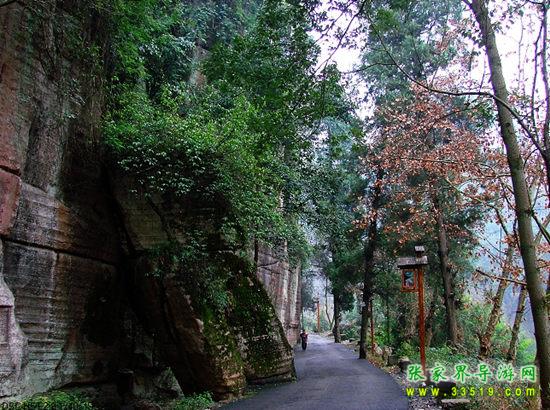
The main scenic spots include the eight scenes of Stone Gate Hewn by Heaven, Jade Screen Encircling, Clear Pool with Moon Reflection, Ancient Cave with Immortal Traces, Hot Spring Wreathed in Warm Mist, Layered Pavilions Rising in Green, Pine Path Retaining Clouds, and Pure Land Cleansing the Heart.
Transportation
Public transport: self-driving is recommended~ From Yongshun County, the total distance is about 2.5 kilometers.
1. Starting from the starting point, head due east along Fuzheng Street for 10 meters, then turn right ahead into Xizhou Road.
2. Drive along Xizhou Road for 190 meters, then turn right into Mengdong River Road.
3. Drive along Mengdong River Road for 210 meters, then turn left onto G209.
4. Drive along G209 for 1.4 kilometers, then bear slightly left and turn onto Yongshun Bridge.
5. Drive along Yongshun Bridge for 240 meters, then turn left ahead onto S230.
6. Drive along S230 for 290 meters, then turn right ahead.
7. Drive 170 meters to reach the destination: Bu'ermen National Forest Park.
Best time to visit: July and August.