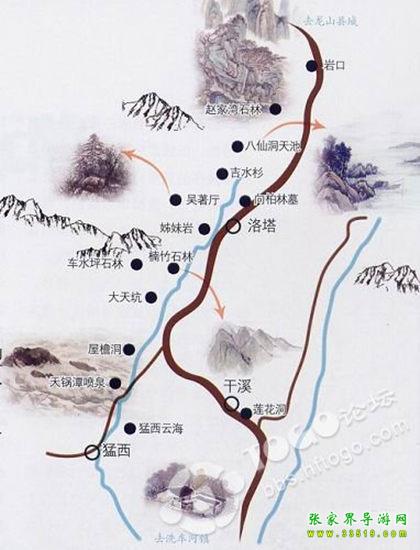
This attraction introduction is compiled from historical materials in the "Zhangjiajie Tour Guide Network" (33519.com · Scenic Spots section). Ticket prices, opening hours, transportation, and contact information mentioned in the text may be outdated. Please refer to the latest official announcements from the scenic area before traveling; some content consists of historical background/cultural introductions and is for reference only.
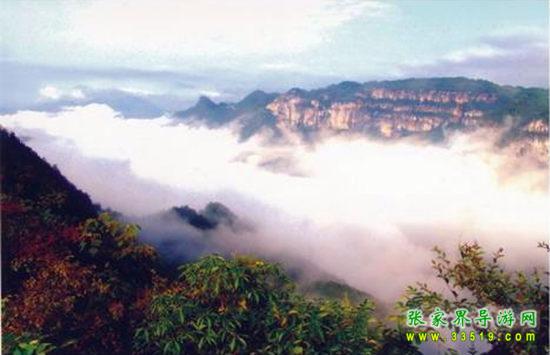
Luota Geological Park is located in Longshan, Hunan, with a total area of 142.66 square kilometers. It is extremely rich in geological relics, possessing 8 types of karst landform types, 11 kinds of karst morphological features, 340 large and small karst caves, and a stone forest area of 62 square kilometers. It is a natural karst geological park with great value for sightseeing and scientific research. As early as the 1970s, the Ministry of Geology of China designated this place as a scientific research base of the Institute of Karst Geology of the Chinese Academy of Geological Sciences and an internship base of the Graduate School of China University of Geosciences.
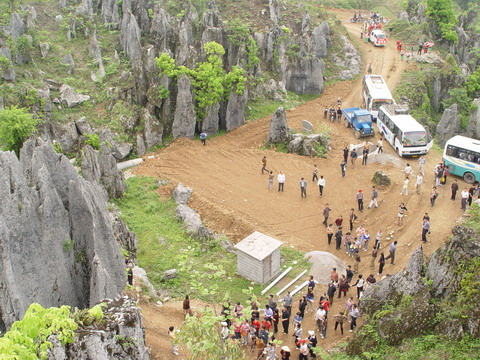
Luota Geological Park has a total area of 142.66 square kilometers. It is a karst rocky mountain area inhabited mainly by the Tujia and Miao ethnic minorities, 46 kilometers from Longshan County town, with a master plan of 14 scenic areas. The geological relics here are extremely rich, with 8 types of karst landform types, 340 large and small karst caves, and 106 karst depressions and funnels within its boundaries. The geological park is a typical representative of exposed karst geology in southern China, a masterpiece of nature's uncanny workmanship, a geological relic left by hundreds of millions of years of geological movement, and a rare karst landform geological wonder in China. Within the park, stone forests cluster, karst caves are densely distributed, underground rivers interlace, waterfalls and springs cascade, and ancient organisms survive as relics. It is hailed as an "encyclopedia" of karst geology and is a scientific research base of the Institute of Karst Geology of the Chinese Academy of Geological Sciences.
As a natural karst geological park, it has great value for sightseeing, exploration, and leisure. It not only possesses unique climate resources but also beautiful natural landscapes. At present, four scenic areas have been preliminarily developed: Nanzhu, Longwan, Badong Xianshan, and Jiupu Valley. The scenic areas integrate karst caves, beautiful waters, strange rocks, and cultural heritage into one, forming a magnificent and spectacular scene of a thousand postures, a typical karst ecosystem and the richest three-dimensional panorama, making people linger and forget to return.
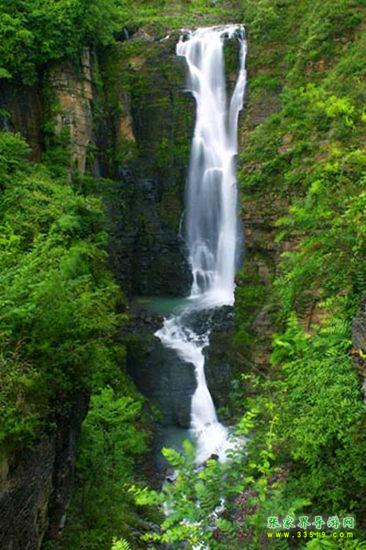
Stone pillars and stone forests formed by karst landforms can be found everywhere in Luota. Luota is a complete synclinal karst structural unit, developing karst structural landform landscapes rarely seen in China. It can be said to gather the great achievements of karst landscapes: platforms, peak clusters, isolated peaks, karst hills, stone forests, stone teeth, depressions, funnels, karst caves, underground rivers, gorges, precipices, waterfalls, and more — everything one could wish for, with complete stages of formation and development. It is a typical representative of exposed karst in southern China, with high ornamental and scientific research value. Within the area, karst caves are densely distributed, underground rivers interweave, and the groundwater system is vast. It is a karst scientific research base of the Chinese Geological Research Institute and was approved as a provincial-level geological park by the Hunan Provincial Department of Land and Resources on December 28, 2002.
Climbing up to Luota, one sees only connected mountains and stretching valleys, with tens of thousands of rocks like a forest. Blocks of blue-gray boulders vie in height and elegance, in beauty and strangeness, stretching in all directions, layered and interlaced, with peculiar shapes — pagoda-shaped, lotus-platform-shaped, arhat-shaped, cone-shaped, knife-shaped, arrowhead-shaped, curtain-shaped, and more standing in dense array, like wondrous mazes, composing the charming landscape of Luota Geological Park. Some are exquisitely carved, as if chiseled by a female embroiderer; some are jagged and grotesque, as if hewn by ghosts and gods; some are towering and precipitous, like ink-wash paintings; some stand ruggedly erect, wrapped in vines, more like tall ancient trees. Tall ones, short ones, large ones, slender ones. Thick, thin, wrinkled, smooth — each with its own character, like human faces that are all alike yet none the same, brightening one fascinating scene after another among the green trees and red flowers. The Luota Stone Forest spreads across the entire mountain area, with the more concentrated ones being the Nanzhu Cheshuiping Stone Forest, the Suoluo Zhaojiawan Stone Forest, the Baxian Cave Stone Forest, and the Yinhe Pagoda Stone Forest along the highway. The stone forest around Cheshuiping alone covers an area of more than 1,000 mu. In terms of scale, area, shape, and combination, the Luota Stone Forest can rival the Yunnan Stone Forest.
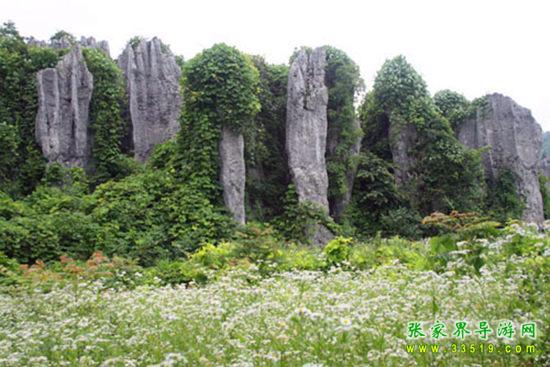
Longwan Stone Forest
As descendants of the dragon, the people of Longshan have a special affection for dragons. Many places are named after dragons. This stone forest is called Longwan Stone Forest, and legend says it was the place where the Dragon King drilled troops and reviewed his generals.
1. Conch Bestowing Blessings
This is the Conch King. The Dragon King sent it to stand guard, but it harbored evil thoughts and used its beautiful pearl to seduce the Dragon King's eldest princess. This angered the Dragon King, who gouged out its pearl and ordered the Conch King to repent here. Over time, the Conch King attained enlightenment and became immortal, slowly turning into this rock, dedicated to bestowing blessings on the mortal world. At the beginning of each year, locals come to pay homage to it, praying for favorable weather; whenever loved ones travel far, people come to pay homage to it, praying for their safety.
2. Sea Turtles Yearning for the Moon
These sea turtles were conscripted by the Dragon King to fight, long separated from their homes. They gaze at the moon and long for their loved ones: "May we all be blessed with longevity, though far apart, we still share the same bright moon."
Dragon Palace
Below here is the Dragon Palace, where the Dragon King hides treasure and takes refuge. The palace is deep and unfathomable, with underground rivers crisscrossing, connecting to the Lotus Platform and the Dragon's Rest Ravine.
1. Granny Cave and Grandpa Cave
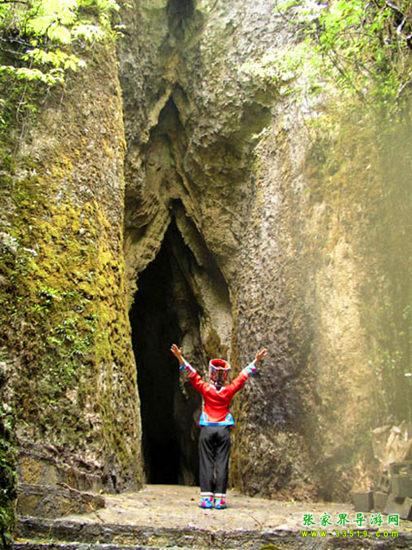
The Dragon King's little princess and the Tiger King's son fell in love, but both sets of parents opposed it. The two loved each other deeply and arranged to meet secretly outside the Dragon Palace, but they never managed to meet. As time went on, the Dragon King's little princess turned into Granny Cave, and the Tiger King's son turned into Grandpa Cave. They remain here forever, showing people the eternity of love and the true meaning of love.
2. Lotus Platform
The Lotus Platform is the Dragon King's back garden.
Longqi Ravine Stone Forest
Longqi Ravine is where the Dragon King dwelt.
1. Six Gates
To enter the place where the Dragon King dwells, one must pass through six gates: the Gate of Peace, the Gate of Wealth, the Gate of Fortune and Longevity, the Gate of Noble Offspring, the Gate of the Top Scholar, and the Gate of Wishes Fulfilled.
Having passed through these six gates, good people will enjoy peace throughout their lives, and all things will go smoothly on life's journey.
2. Crocodile Gnawing at Stone
Due to years of continuous warfare, the Dragon King's military pay ran into trouble, and the crocodiles were so hungry that they gnawed at stones. When the Heavenly Court discovered this, it immediately issued a decree, and stones grew up from the sea, with the crevices between them filled with Wulong dates and "relief grain," which solved the Dragon King's military pay problem. These Wulong dates are crisp and sweet, nourish yin and strengthen yang, and serve as both fruit and medicine; they have been passed down ever since and have become a local delicacy. Legend has it that in ancient times the Tujia hero Nuligaba grew tall and strong and gained immense strength only after eating these Wulong dates, becoming a peerless hero of his generation.
3. Tailwind Gate
Two ships caught in wind and waves were pushed by dolphins with their tails, enabling them to escape danger. The ships, the dolphins, and the rocks below formed a gate, which people later called Tailwind Gate, meaning escape from danger and smooth sailing. Passing through Tailwind Gate brings success in all things and boundless prospects. Legend has it that the Tujia hero Nuligaba walked out of the Tujia mountain village through this Tailwind Gate to establish his achievements.