
This attraction introduction is compiled from historical materials in the "Zhangjiajie Tour Guide Network" (33519.com · Scenic Spots section). Ticket prices, opening hours, transportation, and contact information mentioned in the text may be outdated. Please refer to the latest official announcements from the scenic area before traveling; some content consists of historical background/cultural introductions and is for reference only.
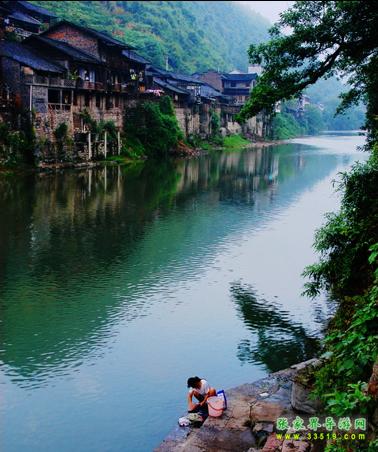
Xieche River is located by the Xieche River in Longshan County. The area has a mild climate, spring-like conditions all year round, green mountains and clear waters, and beautiful scenery. It is a famous town in Xiangxi. The Hongyanxi River and Mengxi River converge here to form the Xieche River, which flows through Laoche and Miao'ertan and empties into the Youshui River at Longtou. The lowest point is 237 meters above sea level. Before the Yonglong Highway opened to traffic in 1958, there was not a single highway for hundreds of li around. Through the ages, this Xieche River, which leads down to Chenyuan, became one of the main water transport routes in the border region of Hunan, Hubei, and Chongqing.
Several large bridges form the town's unique scenic line. Among them, the Xieche Bridge Pavilion Bridge was first built in the thirteenth year of the Guangxu reign of the Qing Dynasty (1887), the Xieche Small River Banlong Line Highway Bridge was built in 1976, and the Xieche Big River Xieta Line Highway Bridge was built in 1997. The exquisitely shaped Pavilion Bridge lies like twin dragons on the waves, while the majestic highway bridges span like twin rainbows, connecting the three banks along the river into one, forming several main streets: Dongping Street, Yanhe Avenue, Xiaohe Street, Wanzi Street, and Pozi Street.
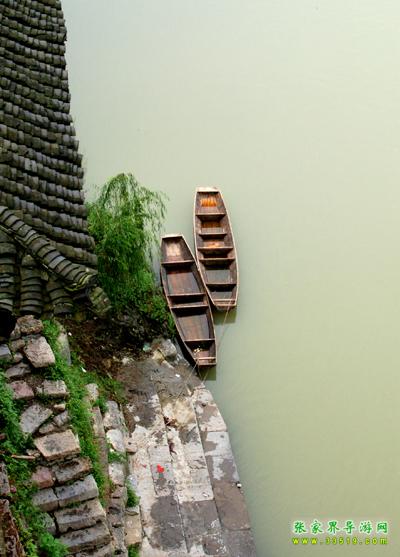
Most dwellings are stilted wooden buildings, built against the mountains and by the water. Those facing the river cast reflections in the clear pools like a waterborne market, while those against the mountains stand majestically on high cliffs like castles in the air. The two rivers are clean and transparent, and the small river is especially beautiful, with green mountains flanking its banks and green waters flowing endlessly. Along the riverbanks, smartweed blooms red and angelica is white, osmanthus is fragrant and orchids are aromatic, earning it the name "Fragrant Stream." Its water comes entirely from karst caves. Within three li of the street, there are several cave springs—Squid Cave, Rhinoceros Cave, Wangjia Cave, and Xiangjia Cave—and a hot spring called "Chicken Droppings Pool." "Chicken Droppings Pool" has a strong sulfur smell, with water temperature near boiling and extremely strong decontamination power. It can wash sweat stains completely clean without any soap and can treat sores and scabies and maintain skin health. The river abounds with squid, tender and plump. Before the Beginning of Winter, they all swim upstream into karst caves to spend the winter, and two or three days before the Beginning of Summer, they emerge in groups with the summer flood. Villagers set nets at the cave entrances and, simply by "waiting by a stump for a rabbit," can reap abundant harvests. Before the 1970s, sometimes several hundred jin could be caught per day. The small river has many rapids and swift currents, making it an excellent place for rafting.
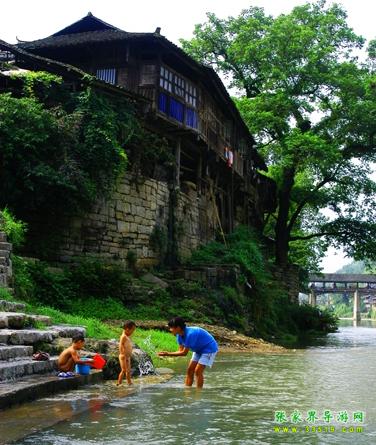
Xieche River is a Tujia ethnic settlement area, and the Tujia language is still widely used today. The Tujia people have a language but no script, and their ethnic culture has been passed down orally from generation to generation, so the Tujia culture here is uniquely distinctive. Eight li from the town, on the west bank of the Xieche Big River, is the renowned Tujia Grand Hand-Waving Hall—Sanyuetang. The Qing Dynasty Jiaqing-era "Longshan County Gazetteer" records: "The Tujia chieftains established the Hand-Waving Hall, said to be the underworld office of deceased chieftains, with memorial tablets offered. At dusk, gongs are struck and drums beaten, men and women gather for long songs, called hand-waving. Some set the period in the first month, some on the sixth day of the third month." The Qing Dynasty Hand-Waving Hall stele extant in Pendi Village, Xieche River Town, gives a detailed account of the grand hand-waving events of that time.
East of Xieche River, Tasha, Dianfang, and Pojiao are famous for their "Daliuzi" percussion music, and Dianfang Township was thus awarded the title "Hometown of National Folk Art" by the Ministry of Culture. Miao'ertan Town, connected by water to Xieche River, is rich in Tujia brocade, with "weaving looms in every household, quite retaining ancient customs." Its products sell well at home and abroad, and the hometown of Ye Yucui, awarded the title "National Master of Arts and Crafts" by the Ministry of Light Industry, is right here. In 1999, Miao'ertan was awarded the title "Hometown of Mass Culture and Art of Hunan Province" by the Provincial Department of Culture, thus forming a cultural landscape centered on Xieche River with rich Tujia customs.