This attraction introduction is compiled from historical materials in the "Zhangjiajie Tour Guide Network" (33519.com · Scenic Spots section). Ticket prices, opening hours, transportation, and contact information mentioned in the text may be outdated. Please refer to the latest official announcements from the scenic area before traveling; some content consists of historical background/cultural introductions and is for reference only.
[Ticket Price Information Update · 2026-09-14]
- ★Location correction: Miao King City is actually located in Songtao Miao Autonomous County, Tongren City, Guizhou Province, about 39 km from Fenghuang Ancient Town (cross-province)
- Adult ticket approximately 68–120 yuan (online platforms from about 70–78 yuan)
- Opening hours: summer approximately 8:00–18:00, winter approximately 8:30–17:30
If old ticket prices/opening hours appear in the main text, they are historical materials and may be outdated, for reference only.
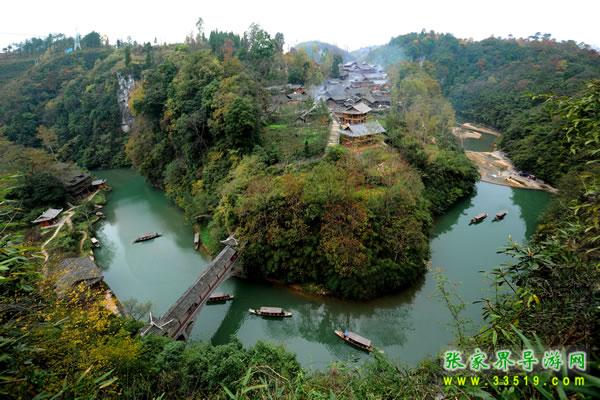
Miao King City, located in Songtao Miao Autonomous County, Guizhou Province, was first built in the early years of the Hongwu era of the Ming Dynasty, originally serving as the garrison of the Dayi Miao Civil Affairs Office. From the Xuande to Jiajing eras, through the long-term management of Miao kings Shi Geye, Long Dage, Wu Buer, Long Xibo, Wu Heimiao, and others, it gradually became the 'City of Kings' on the outer perimeter of the Southern Great Wall in the La'er Mountain region. The king's city covers an area of approximately 4 square kilometers, divided into an east city and a west city. The original city wall was over 2,000 meters long, 4 chi wide at the top, 6 chi wide at the base, and 9 chi high. There were 4 city gates, 11 lanes within the city, and 11 stockade gates within the lanes. It is a Miao frontier ancient city on the border of Hunan, Guizhou, and Chongqing that remains relatively well preserved, integrating politics, economy, culture, military, and architecture, with high historical research value and tourism development value.
Introduction to Miao King City
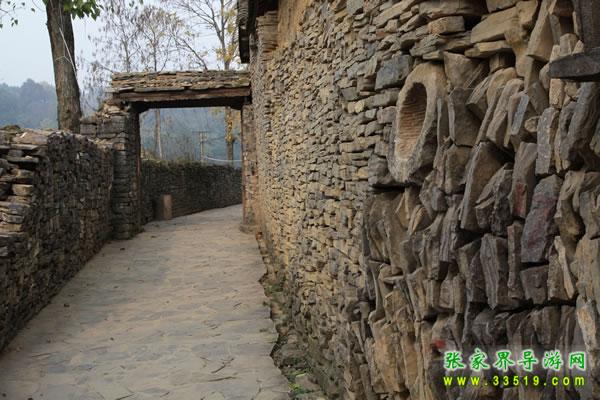
Miao King City is the only relatively well-preserved ancient Miao village in the southwestern region that integrates politics, economy, culture, military, and architecture. It covers an area of 10 square kilometers and, following the mountain terrain and water features, has six ancient military stockades built along its front and rear. Within the ancient stockade there are 11 lanes, and within the lanes there are 11 stockade gates. The lanes use stone walls as barriers that connect with each household's courtyard walls, and there are specially designed 'right-angle lanes' to confuse the enemy,
Guizhou Miao King City scenery (8 photos) that can lure enemies into dead ends and annihilate them. This formed an effective military defense system. The outer wall of the ancient stockade is 3 meters high and 80 centimeters wide, allowing soldiers to patrol back and forth on top. The stilted houses within the stockade are of typical Miao style, and the 'crooked doors and devious paths' are a unique architectural style of the ancient village. Through the management of dozens of generations of Miao kings, Miao King City had already reached a certain scale by the Ming Dynasty.
Miao King City was built in the early years of the Hongwu era of the Ming Dynasty, originally serving as the garrison of the Dayi Miao Civil Affairs Office. From the Xuande to Jiajing eras, through the long-term management of Miao kings Shi Geye, Long Dage, Wu Buer, Long Xibo, Wu Heimiao, and others, it gradually became the 'City of Kings' on the outer perimeter of the Southern Great Wall in the La'er Mountain region. Miao King City is located within Zhengda Township, Songtao Miao Autonomous County, Guizhou Province, 10 kilometers from Tongren Airport, 25 kilometers from Tongren Railway Station, and 39 kilometers from the main scenic area of Fenghuang Ancient Town. The king's city covers an area of approximately 4 square kilometers, divided into an east city and a west city. The original city wall was over 2,000 meters long, 4 chi wide at the top, 6 chi wide at the base, and 9 chi high. There were 4 city gates, 11 lanes within the city, and 11 stockade gates within the lanes. The row upon row of stilted houses, the 'crooked doors and devious paths' architectural style, and more not only possess a certain war defense capability but also reflect a high level of architectural skill. It is a Miao frontier ancient city on the border of Hunan, Guizhou, and Chongqing that remains relatively well preserved, integrating politics, economy, culture, military, and architecture, with high historical research value and tourism development value. Miao King City is a weighty historical and cultural tome, a vanished ancient battlefield. The bewildering 'Eight Trigrams Maze' terrain, the mysterious and eerie Miao King Grand Canyon, the fossilized underground arsenal of Miao King City, the sky-covering bamboo sea, the steep and hidden Miao King secret paths, the legendary General-Testing Bridge, the Life-and-Death Double-Pass Bridge—all allow you to appreciate the wonders of nature while traveling through a tunnel of time into the history of Miao King City... Moreover, there is also a rich Miao ethnic atmosphere here: love songs, leaf songs, toast songs; the mysterious and unfathomable feats of climbing a mountain of knives, walking through a sea of fire, fishing in boiling oil, threading steel needles through the throat, immortal bamboo joining, lifting rice with a steelyard rod, and more; the breathtaking high-altitude flying acrobatics, the passionate four-sided flower drum dance, and the peculiar marriage customs of 'painting flower cat,' 'ear pulling,' the eight-person spinning swing, and more. This is a magical land, a mysterious place; every lane, every gate, every tree is a page of the Miao people's profound history. Starting from here, you will come to understand Miao King City, and at the same time feel the simplicity, mystery, breadth, and depth of Miao culture...
Miao King City Itinerary
Route: Depart from Fenghuang Ancient Town——pass through a kiwifruit plantation——visit Yunpan Stone Village to admire the Southern Great Wall that has endured a thousand years, standing at a high point to experience the Great Wall 'Miao Border Wall'——Miao King Ten-Thousand-Mu Tea Garden——Pomegranate Base——dine at Miao King City's Miao King Restaurant——tour Miao King City scenic area——Miao King Mansion——Military Lanes——original spinning and weaving room——Miao King Reviewing Platform——boat ride on Miao King River——return to Fenghuang Ancient Town to end a pleasant day's journey.
Architectural History
Miao King City was built in the early years of the Hongwu era of the Ming Dynasty, originally serving as the garrison of the Dayi Miao Civil Affairs Office. Through the management of dozens of generations of Miao kings, it became the 'City of Kings' on the outer perimeter of the Southern Great Wall of the eastern Miao. From the Xuande to Jiajing eras, Miao uprisings led by five generations of Miao kings—Shi Geye, Long Dage, Wu Buer, Long Xibo, and Wu Heimiao—broke out, and Miao King City became the uprising's main base, prompting the Ming government to build the Southern Great Wall. Its architectural structure and military lanes can recreate the history of several hundred years ago. Miao King City is formed by ancient military stockades with similar architectural styles (namely Kongtong, Dushu, Longtang, Dirong, Manjia, Tianjia stockades, etc.) interconnected to form a complete Miao King City scenic area. The ancient stockade is called 'Degou Xian' in the Miao language, meaning 'new stockade'—it is where the Miao kings lived and also a remnant of an ancient battlefield. During the Ming Dynasty, it was the center of the Miao people in the La'er Mountain region. In the early Republic of China period, it still housed over 230 households. Within the lanes, each household had its own dragon (front) gate and back gate, all interconnected, allowing for step-by-step defense and layer-by-layer guarding, much like a Eight Trigrams maze. After investigation, cultural relics experts unanimously agreed that this city's design 'can attack, can defend, and can retreat,' making it a Miao King City with considerable military fortification standards. Its architectural structure and fortifications can recreate the history of several hundred years ago. At the Miao King's Reviewing Platform, if there was a battle in Miao territory back then, the Miao King would stand here. When the ox-horn trumpet sounded and the Miao drums were beaten, Miao soldiers would rush here from all the Miao villages. The Miao King would wave his command flag, review his troops here, and march to battle.
Introduction to Scenic Spots
Miao King City covers over 4 square kilometers, with 11 city gates and 11 alleys, each alley sharing one main gate; within each alley, every household has its own dragon gate and back gate, all interconnected, allowing for step-by-step defense and layer-by-layer guarding, much like a Eight Trigrams maze. The terrain there is steep and the scenery beautiful. The row upon row of stilted houses and the 'crooked doors and devious paths' architecture not only possess war defense capability but also reflect a high level of architectural skill. It is a Miao frontier ancient fortress on the border of Hunan, Guizhou, and Chongqing that remains relatively well preserved, integrating politics, economy, culture, military, and architecture. Experts believe that this city's design 'can attack, can defend, and can retreat,' making it an ancient fortress with considerable military fortification standards, with high ornamental, preservation, and tourism value.
Former Residence of the Miao King
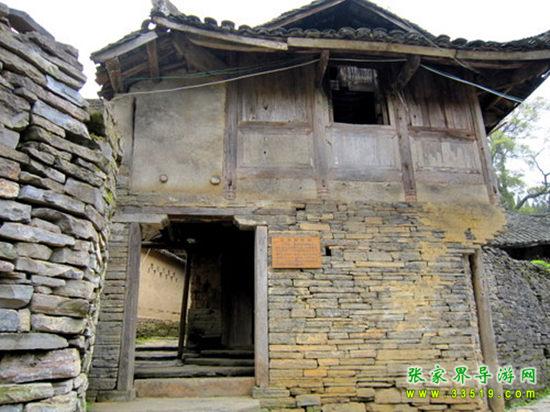
The landmark sight of Miao King City—the former residence of the Miao King, the 'Watchtower.' This was once the forward guard post of the Miao King Mansion and the place where Miao King Wu Heimiao once lived. This lane leads to the rear garden of the Miao King Mansion and is one of the most completely preserved and oldest lanes in the stockade.
Miao King Mansion
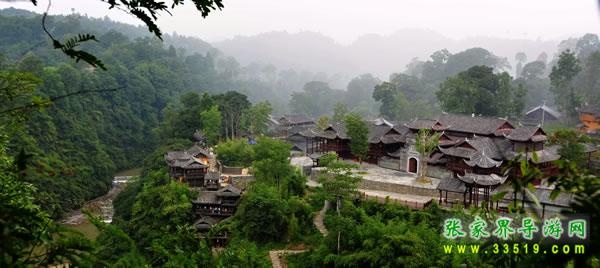
Most of the buildings within Miao King City were destroyed in 1929 during the early Republic of China period, when the two largest warlords in Guizhou, Zhou Xicheng and Li Xiaoyan, fought fiercely in Miao King City for three days and three nights. To save his life, Li Xiaoyan set fire to the houses. Of the 230-plus courtyard-style buildings—whether four-sided, three-sided, or two-sided compounds—only 6 survived; the rest were reduced to ashes. The Miao King Mansion's 'Watchtower' fortunately survived. The weaving and spinning machines placed here were the main tools used by Miao women to weave clothing and ornaments, and they are kept here for visitors to see. If you are interested, you can also try your hand at the joy of ancient Miao weaving.
Miao King City Wind-Rain Bridge
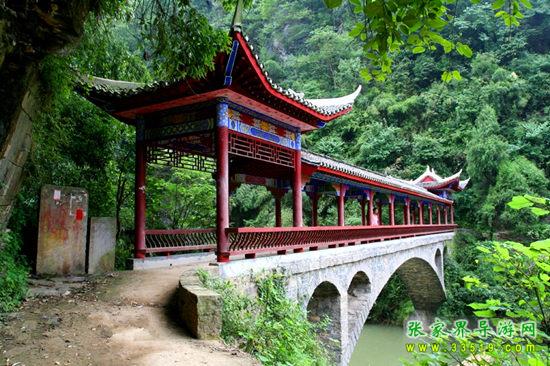
In ancient times, this was a wooden wind-rain bridge, with wooden pavilions on both sides and wooden planks laid in the middle. If enemy pursuers arrived here, the Wind-Rain Bridge
could have its planks removed to cut off the pursuers' path, serving a strategic defensive function. Now it is a place where young Miao men and women 'go to the edge market' (sing love songs and court). Look in the direction I'm pointing—the two natural cave openings on the mountainside by the Miao King River look like two big eyes, and there is also a long trunk; this is the legendary 'Divine Elephant Drinking Water.' Now let's go to the dock to take a tour boat and cruise on the Miao King River, enjoying the landscape of the Miao King Canyon.
Miao King City Stilted House Cluster
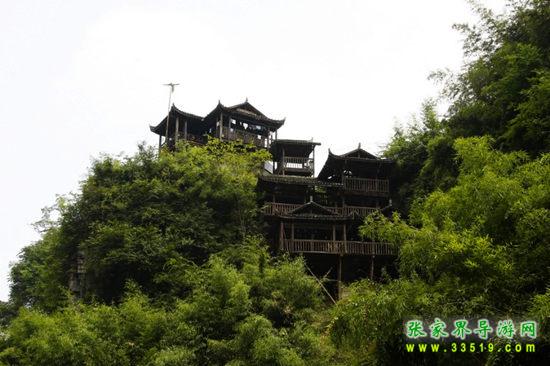
One of China's most distinctive stilted house clusters, composed of five stilted houses combined and embedded on a cliff face, extremely spectacular, fully embodying the essence of Miao architecture. Since they are built on a cliff, when going up to the stilted houses, try to walk on the inner side and do not lean against the outer railings.
Stilted Houses
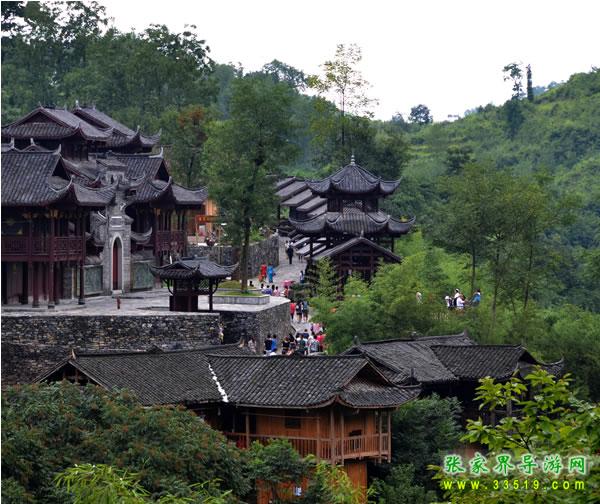
Miao King City! Miao women in full silver-adorned festive dress will warmly sing welcoming songs; the gate-blocking ceremony offers mellow Miao King rice wine; fragrant Miao dishes fill the blue-tiled wooden houses; by the spinning wheel, the old woman and the girl weaving flower belts speak in incomprehensible Miao language; the affectionate young women leave the mark of love—pot soot—on the faces of handsome young men; beneath the ancient trees, the imposing Miao shaman ecstatically entertains the gods; bare-chested young men perform powerful, unrestrained drum dances; at the bonfire party, people indulge in...
Local Customs
In Miao King City! Miao women in full silver-adorned festive dress will warmly sing welcoming songs; the gate-blocking ceremony offers mellow Miao King rice wine; fragrant Miao dishes fill the blue-tiled wooden houses; by the spinning wheel, the old woman and the girl weaving flower belts speak in incomprehensible Miao language; the affectionate young women leave the mark of love—pot soot—on the faces of handsome young men; beneath the ancient trees, the imposing Miao shaman ecstatically entertains the gods; bare-chested young men perform powerful, unrestrained drum dances; at the bonfire party, people indulge in joyful songs and laughter... Miao King City is a captivating place! Miao King City is an intoxicating place!!
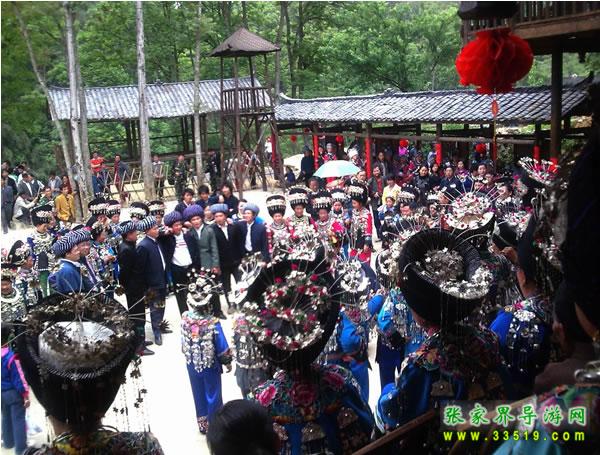
Ethnic Culture
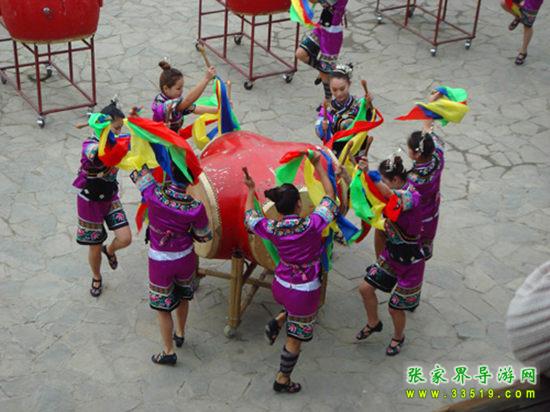
The rich Miao ethnic atmosphere of Miao King City: love songs, leaf songs, toast songs; the mysterious and unfathomable feats of climbing a mountain of knives, walking through a sea of fire, fishing in boiling oil, threading steel needles through the throat, immortal bamboo joining, lifting rice with a steelyard rod, and more; the breathtaking high-altitude flying acrobatics, the passionate four-sided flower drum dance, and the peculiar marriage customs of 'painting flower cat,' 'ear pulling,' the eight-person spinning swing, and more. This is a magical land, a mysterious place; every lane, every gate, every tree is a page of the Miao people's profound history. Starting from here, you will come to understand Miao King City, and at the same time feel the simplicity, mystery, breadth, and depth of Miao culture...
The 'King' of Miao King City
Historically, five famous Miao kings once proclaimed themselves "king" here at Miao King City. The first were Shi Geye and Long Dage in the fifth year of Xuande (1430 AD). Next was the ancestor of the Wu family here, "Wu Buer," who in the seventh year of Xuande (1432 AD), using Miao King City as his military command center, "fought against 120,000 Ming troops over successive campaigns." Later, in the nineteenth year of Jiajing of the Ming Dynasty (1540 AD), Long Xubao of Longtang (known among the people as Long Xibo) and Wu Heimiao of Miao King City again proclaimed themselves "king" here, raising the banner of uprising (named "Qizhang," which is still preserved intact today) and fighting bloody battles against the Ming army for 13 years. This was the famous "Jiajing Miao People's Great Uprising" in history. It was also because of this series of uprisings that the Ming Dynasty ultimately, in the thirty-third year of Jiajing (1554 AD), built a "Miao Frontier Wall" stretching over 380 li in the La'er Mountain area at the border of Hunan and Guizhou — the "China Southern Great Wall."
Honors
As a Miao historical and cultural preservation area, a rural tourism attraction, an ecological agriculture demonstration site, and a model of new countryside construction, Miao King City has received the nation's attention and support. It has been praised by leaders at all levels. Miao King City has been officially designated as the China Western Miao King City Film and Television Base, and six film and television productions have been shot here: "Soldier," "Border Town Men," "Rescuing Female Soldier Situ Hui," "Tell Me You Love Me," "Wind and Rain at Mount Fanjing," and "Where Are the Heroes."
Transportation
Miao King City Transportation Map
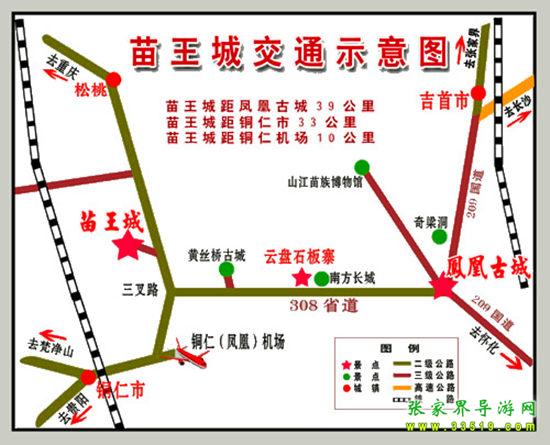
Miao King City is located within Zhengda Township, Songtao Miao Autonomous County, Guizhou Province. It is 9 kilometers from Tongren Fenghuang Airport, 32 kilometers from the Tongren city train station (the seat of the regional capital), and 39 kilometers from Fenghuang Ancient Town. Within its territory is the Yada Class II Highway, as well as the Songtao section of the Hangzhou–Ruili Expressway currently under construction. Transportation is very convenient.
Tickets
Ticket Type Price (Yuan) Notes
Adult Ticket 120 The actual ticket price and discounts are subject to what the scenic area announces.
Adult Ticket (including lunch and round-trip shuttle) 168
Booking standards for special groups: A. Free policy: Children (under 1.4 meters) and seniors over 70 years old are fully exempt with valid identification. B. Students with a student ID pay half price.
Scenic Area Opening Hours
AM8:00—PM16:30
Fenghuang Ancient Town Travel Routes:
A: Fenghuang Ancient Town Company Nine Scenic Spots: Former Residence of Shen Congwen, Former Residence of Xiong Xiling, Yang Family Ancestral Hall, East Gate Tower, Ancient Town Museum, Chongde Hall, Wanshou Palace, Tuojiang River Rafting. (Ticket 148 yuan)
B: Must-visit for independent travelers: North Gate Jumping Rock, Shawan Ten Thousand Names Pagoda, Dongzheng Street, Fenghuang Night Views
Zhangjiajie Travel Routes:
A: Zhangjiajie Scenic Area: Huangshizhai, Tianzi Mountain, Yuanjiajie, Golden Whip Stream
B: Combined scenic spots: Tianmen Mountain, Baofeng Lake, Yellow Dragon Cave, Tujia Folk Custom Park
Miao King City Travel Routes
I. Transportation from Fenghuang Ancient Town to Miao King City
Departing from within Fenghuang Ancient Town, take the Fengda Class II Highway near Tianxia Fenghuang Grand Hotel, passing the Kiwi Base (at 4 km), the Southern Great Wall (at 12 km), Huangsiqiao Ancient Town (at 21 km), the Guizhou Provincial Boundary Marker (at 28 km), the Three-Way Junction (at 29 km), the Vegetable Base and Lily Base (at 33 km), the China Miao King City Archway (at 36 km), the Miao King Tea Garden (at 36 km), the Miao King City Ecological Agriculture Sightseeing Spots (peach grove, golden fruit grove), and the Miao King City Parking Lot Ticket Office (at 39 km).
About 30 minutes by car, about 40 minutes by bus.
II. Transportation from Chongqing and Tongren Directions to Miao King City
1. From Chongqing: Exit the expressway at Yajia and follow the Yada Class II Highway for about 1 hour to reach Miao King City Gate No. 1 and the Miao King Tea Garden. Few vehicles, good road conditions.
2. From Tongren: From Tongren Train Station heading toward Hunan, passing near Tongren Fenghuang Airport (at 20 km), the Three-Way Junction (at 23 km), the Vegetable Base and Lily Base (at 26 km), the China Miao King City Archway (at 30 km), the Miao King Tea Garden (at 30 km), the Miao King City Ecological Agriculture Sightseeing Spots (peach grove, golden fruit grove), and the Miao King City Parking Lot Ticket Office (at 33 km).
About 25 minutes by car, about 35 minutes by bus.
III. Group Tour Itinerary Within Miao King City Scenic Area
Miao King City, where dozens of generations of Miao kings lived through the Ming and Qing dynasties, was the site of numerous Miao uprisings and served as their main base, prompting the Ming government to build the Southern Great Wall! The ancient Miao history, mysterious Miao religion, distinctive Miao customs, splendid Miao costumes, and exquisite Miao handicrafts are all fully reflected here.
Miao King City is the Home of Chinese Miao Songs, the Home of Miao Drums, the Home of Folk Stunts, the China Western Miao King City Film and Television Shooting Base, one of Guizhou Province's Top Ten Charming Scenic Areas, and an Outstanding Scenic Area of Tongren Prefecture.
1. Enter · Miao King City: Entering the Miao King City Scenic Area, the first thing you see is the majestic China Miao King City Archway. The scenic road is about 4 kilometers, along which you can view the Miao King Tea Garden and the Miao King City Ecological Agriculture Sightseeing Spots. After getting off at the large Miao King City parking lot, have your ticket checked at the scenic area ticket gate to enter, then pass through Yinglong Avenue to reach the Miao King Castle tower, where you will find the Miao gate-blocking wine, gate-blocking songs, and gate-blocking drums, fully demonstrating the Miao people's hospitality customs.
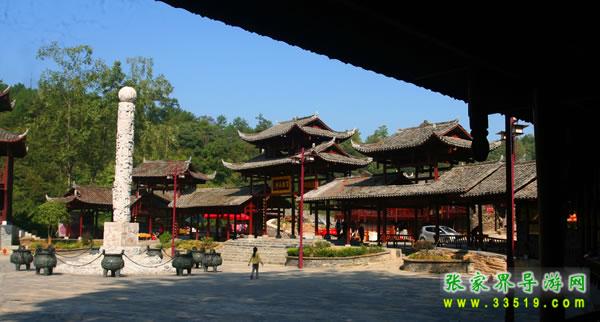
2. See · Yinglong Square: Passing through the Miao King Castle tower, you enter Miao King City's Yinglong Square, the place where the Miao people hold large-scale events. Here you will find the "Mama Tree" planted by Miao King Long Xibo, the divine judgment platform where gods are invoked to render verdicts, the small mountain god altar that protects the peace of the area, the sacred pillar commemorating Ma Sang shooting the sun, the Miao Embroidery Tower showcasing Miao embroidery craftsmanship, and the Hundred Miao Corridor currently applying for a Guinness World Record. The wood carvings in the corridor, "Picture of a Hundred Miao" and "Miao Migration Map," reflect Miao history and the image of the Miao people.
3. Walk · Ancient Village Military Alleys: Inside the ancient village of Miao King City there are eleven alleys, eleven village gates, and specially designed "right-angle alleys" to confuse enemies. Many battles were fought in these ancient military alleys, and one can almost still hear the battle cries. The various dwellings in the village can be called a museum of Miao architecture. The TV series "Soldier," "Border Town Men," "Rescuing Female Soldier Situ Hui," "Tell Me You Love Me," "Wind and Rain at Mount Fanjing," "Where Are the Heroes," as well as CCTV's "Village Sacred Banner," "Secret Nuo Techniques," "Happy China Tour – Miao King City," and "Traveling Across China – Miao King City" were all filmed in these dwellings and alleys.
4. Climb · Point-General Platform: Following the weathered old village wall to the steep and majestic Point-General Platform, you will feel the extraordinary martial bearing of the Miao king of that time. Here you can see the amazing natural bridge and also enjoy the magical Taiji landscape formation.
5. View · Former Residence of the Miao King: In the former residence of Miao King Wu Heimiao, who fought against 180,000 Ming troops, there is the Cattle-Sacrifice Sacred Pillar symbolizing power and wealth, as well as exquisitely carved stepping stones symbolizing happiness and good fortune.
6. Cross · Wind and Rain Bridge: The mountain songs of Miao maidens and the melodious sound of wooden leaves accompany you across the Miao Wind and Rain Bridge. This is the place where Miao young men and women go to the "border market" for courtship, where love is born and expressed, where hearts race!
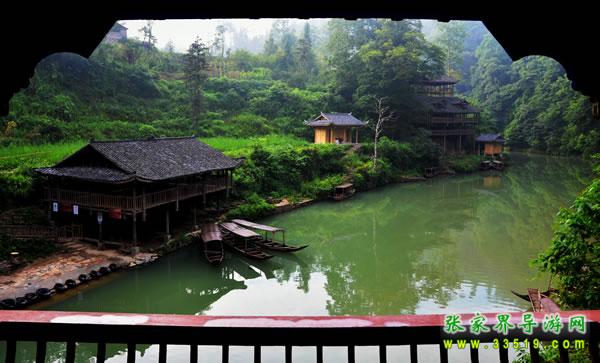
7. Sit · Boating on the Miao King River: Boating on the Miao King River, enjoying the beautiful mountain and water scenery on both banks of the Miao King Gorge is refreshing and delightful, as if in a paradise beyond the world.
8. Step · Flowing Waterfall: After disembarking, you come to the moving highlight of Miao King City's landscape — the flowing waterfall. Visitors love to take photos and play in the water here.
9. Admire · Stilted House Complex: On the swaying suspension bridge, you will feel at one with the stone peaks and cliffs on both banks and the stilted house complex. The stilted houses built on the cliff face, layer upon layer, are one of China's most distinctive stilted house complexes. Composed of five stilted houses combined together and embedded in the cliff face, they are truly spectacular and fully embody the essence of Miao architecture. ?
10. Watch · Folk Custom Performance: On the flat ground of the Miao King City Miao King Restaurant, the Miao King City's Daigou and Daipa present Miao folk customs, songs and dances, and Miao stunts for you, interacting with you and accompanying you with relaxation and joy.
11. Taste · Miao Family Meal: Be a guest in a Miao home and taste authentic Miao cuisine — free-range chicken, sour dishes, rice wine, farmhouse side dishes... your appetite will be greatly aroused and your spirits lifted.
12. Stroll · Miao King Mansion: View the Miao King Mansion's Miao King throne, Miao King bronze statue, Miao King Guest Reception Hall, Miao historical and cultural exhibition, and Miao handicrafts. (Note: Currently not open)
Notes:
1. A group's normal tour of Miao King City takes about 2-3 hours.
2. Please respect Miao taboos and living customs.
IV. Key Travel Routes to Miao King City
Fenghuang Ancient Town + Miao King City
Zhangjiajie + Fenghuang Ancient Town + Miao King City
Mount Fanjing + Fenghuang Ancient Town + Miao King City
V. Other Recommended Routes
Changsha + Shaoshan + Fenghuang Ancient Town + Miao King City
Guiyang + Zhenyuan + Mount Fanjing + Miao King City + Fenghuang Ancient Town
Fenghuang Ancient Town + Miao King City + Zhijiang + Hongjiang Ancient Commercial Town