
Zhangjiajie Huangshizhai (Yellow Stone Fortress) Tour Guide Commentary Featured
(At the park entrance) Hello, friends! Here we are at Zhangjiajie Forest Park. This is the park's main gate. Look at this gate—one side features a garden-style building with small blue-grey tiles in the local Tujia folk style, while the other side is accompanied by sandstone peaks, ingeniously blending the gate with nature. On May 28, 1992, two UNESCO officials sent to inspect and evaluate Wulingyuan's application for World Natural Heritage status were riding in a car that had just passed through the gate and gone about a hundred meters in when they suddenly shouted, "The gate! The gate!" They had the driver back up, and while lavishing praise on the gate's return-to-nature rustic charm, they kept snapping photos. So, everyone is welcome to take a glorious photo in front of this "Gate of Nature."
(Laomowan) Laomowan is the starting point for all the scenic spots in Zhangjiajie Forest Park. From here you can climb Yaozizhai, go up Huangshizhai (Yellow Stone Fortress), reach Chaotian Temple, descend to Golden Whip Stream, and also get to the Huangshizhai (Yellow Stone Fortress) cable car station.
(Huangshizhai [Yellow Stone Fortress] trail marker) "If you don't go up Huangshizhai (Yellow Stone Fortress), your trip to Zhangjiajie is in vain"—this shows the place Huangshizhai (Yellow Stone Fortress) holds in Zhangjiajie's scenery. Legend has it that Zhang Liang, the Marquis of Liu in the Han Dynasty, saw through the vanities of the world, resigned from office, followed Master Red Pine, and went into seclusion. He traveled to Zhangjiajie and was surrounded by government troops, but was later rescued by his master Huang Shigong, hence the name Huangshizhai (Yellow Stone Fortress). It is the place where Zhangjiajie's finest scenery is most concentrated, and also Zhangjiajie's largest cliff-top viewing platform. A famous poet once commented on Huangshizhai (Yellow Stone Fortress): "Every five steps is a wonder, every seven steps a marvel; ten steps away, you're left dumbstruck." So I suggest hiking up Huangshizhai (Yellow Stone Fortress) and taking the cable car down, or taking the cable car up first and descending via the front mountain—otherwise you really will have "wasted your trip to Zhangjiajie." The full Huangshizhai (Yellow Stone Fortress) route takes about 5 hours, with about 5 kilometers of walking uphill.
(Fir Forest Path) We are now walking along the Fir Forest Path. Since ancient times, there was only one route up Huangshizhai (Yellow Stone Fortress) via the back mountain. The path we're taking today was cut by hand more than ten years ago.

Earlier I mentioned that Zhangjiajie is China's first national forest park. This term actually came from abroad. As early as June 30, 1864, U.S. President Lincoln announced the establishment of the Yosemite protected area. On October 1, 1890, through the efforts of the famous conservationist John Muir, U.S. President Benjamin approved the establishment of Yosemite as a national park, and thus the world gained the new term "national park." Within less than a century, over 100 countries around the world had established more than 1,200 national parks, also called national forest parks. This was a major measure to protect the ecological environment on which humanity depends. Yet China, with its vast territory, huge population, and severely damaged vegetation, had still not responded by the late 1970s. That very year, a foreign guest asked the Premier of the State Council, "Does China have national parks?" The Premier answered diplomatically: "Yes, they are under construction. Please come back in a few years to see." After seeing the guest off, the head of the State Planning Commission was summoned to the Premier's office and tasked, together with the Ministry of Forestry, with finding a site for China's first national forest park. Just at that time, the magical land of Zhangjiajie was discovered in the Wuling Mountains of western Hunan, and so the first national forest park was born. According to statistics, from 1982 to the end of 1997, more than 870 forest parks at various levels were established nationwide, including 292 national-level forest parks, with an operating area of 7.48 million hectares. The establishment of national forest parks effectively curbed illegal destruction of forest resources, played an immeasurable role in protecting the ecological environment, and at the same time provided humanity with beautiful places for tourism and leisure. In 1997 alone, domestic forest parks attracted 50 million visitors, growing at 15%–20% annually. By the end of the 20th century, annual visitors to forest parks had surpassed 100 million. Experts therefore say that the establishment of Zhangjiajie National Forest Park was a major contribution to humanity, and its significance far exceeds its own value.
(Pill Gourd) This small stone peak looks just like a gourd! Legend has it that when Zhang Liang followed Master Red Pine roaming Tianmen Mountain and Zhangjiajie, he discovered traces of the immortal Master Red Pine at this great rock shelter and obtained Master Red Pine's elixir gourd. Unexpectedly, several hundred government troops tracked him there. Zhang Liang hurriedly led his disciples retreating toward Huangshizhai (Yellow Stone Fortress), and in his haste dropped the elixir gourd. The soldiers scrambled to grab it, when the gourd suddenly flew up into the sky, emitted an auspicious light, and slowly transformed into a stone peak that fell from the air, crushing the soldiers beneath it. Zhang Liang suddenly realized: "So it was Master Red Pine who saved me—otherwise my life would have been over!"
(Point-General Terrace) This is the first viewing platform on the way up Huangshizhai (Yellow Stone Fortress). According to historical records, in the early Ming Dynasty, Zhangjiajie produced a famous Tujia leader named Xiang Dakun. Dissatisfied with the court's oppression, he proclaimed himself King Xiang the Heavenly Son and raised his banner in rebellion at Shuiraosimen, shaking the court and the realm. Zhu Yuanzhang sent the southern campaign generals Yang Jing, Deng Yu, and others with 150,000 troops to suppress him. King Xiang the Heavenly Son, relying on Zhangjiajie's countless mountains and ravines, waged a bloody war against the government troops, but ultimately, overwhelmed by superior numbers, he threw himself into Shentang Bay and died a heroic death. After King Xiang the Heavenly Son's death, folk tradition attached his stories to the mountains and waters here, passing them down generation after generation. You will notice that in Zhangjiajie, the spirit of King Xiang the Heavenly Son is almost everywhere. This "Point-General Terrace" is said to be where King Xiang the Heavenly Son reviewed his troops and appointed his generals.

(Heavenly Book Treasure Box) Look at that rectangular stone block resting on the peak—doesn't it look like a box? And look more carefully: on the "box" there is a thin slab of stone half pulled out, just like the treasure box in mythology that once stored the heavenly book before it was stolen. Folk legend says that before King Xiang the Heavenly Son raised his rebellion, he obtained a copy of the "Heavenly Book" from the immortal master Zhang Liang. Unfortunately, King Xiang the Heavenly Son had only read a few pages when it was stolen by the turtle spirit, leaving only an empty box. With the "Heavenly Book" stolen and "heaven's secret" leaked, it was destined that King Xiang the Heavenly Son could not succeed—how could one not sigh with regret!
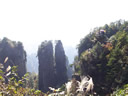
Throughout the entire Wulingyuan Scenic Area, landscapes as varied as the "Heavenly Book Treasure Box" can be found everywhere. So you are welcome to use your imagination and give them interesting names. Look, that tall stone peak ahead to the right—doesn't it look like a stone tablet hanging there? That is the heavenly book the turtle spirit dropped in its panic; folk tradition calls it "Heavenly Book Hanging High." And the middle peak among the three—doesn't it look like a crowing golden rooster? Legend says that when the turtle spirit stole the heavenly book, it happened to coincide with the golden rooster's crow at dawn, hence the name Golden Rooster Crows at Dawn.
(Sea-Stabilizing Divine Needle) Now ahead we can see an emerald valley. On rainy days, clouds surge in the valley like wild waves on the sea, and at the valley bottom a peak stands firm like a pillar in midstream above the mist, unshakable—hence the name Sea-Stabilizing Divine Needle. About a hundred meters to its southwest, another peak resembles a monkey's head, with neck drawn in and fists clenched, peering furtively, like Sun Wukong trying to seize this Sea-Stabilizing Divine Needle.

(South Heavenly Gate) (Walk forward 20 meters) Now please look up, and you will see a cave-like gate. This gate is about 30 meters high and about 4 meters wide, formed by two stone peaks on either side of the path leaning toward each other to form an arch. Not far to the right of the gate is a peak about 20 meters high whose top resembles a human head, with a face and features, like a gate-guarding general.

(South Heaven Pillar) Now ahead, amid the secluded valley and peaks, there is a solitary peak over 200 meters tall, just like a jade pillar holding up the sky. Its upper part is dotted with shrubs, its middle section bare rock, and its lower part masked by trees. The peak is round and majestic, named because it stands below the South Heavenly Gate.

(Wang Guangmei's Poem Inscription) On November 30, 1983, Wang Guangmei, wife of former President Liu Shaoqi, accompanied by Luo Qiuyue, deputy director of the Provincial People's Congress, and others, climbed Zhangjiajie. She was the earliest high-profile figure to visit Zhangjiajie. Back then, this place was still just a rough path freshly dug by hand. Wang Guangmei was overwhelmed by the scenery along the way, and it inevitably stirred up many memories of Liu Shaoqi. These four lines of poetry were not composed all at once; only after visiting four scenic spots did she recite them: "Strange peaks and exotic rocks, the finest under heaven; green pines and blue firs, too beautiful for words."
Some say this is a poem with double meaning. The word "strange" is a complete assessment of Comrade Liu Shaoqi; the word "beautiful" hints at another meaning deep in her heart that could not be spoken openly. Think about it: in those bitter days of "Down with China's Khrushchev, and trample him underfoot," for a woman dragging along a group of children to endure and miraculously survive—isn't that exactly the true portrayal of "green pines and blue firs"?
(Huangshizhai [Yellow Stone Fortress]) This is Huangshizhai (Yellow Stone Fortress)!
Huangshizhai (Yellow Stone Fortress) is more than 1,200 meters above sea level and covers over 250 mu. It is surrounded on all sides by sheer knife-cut cliffs. It is the best and largest viewing platform for looking down on the sandstone peak forest landscape, and also the best spot for watching the sunrise. If the weather is clear, we can even see Tianmen Mountain's cave from a hundred li away.

(Star-Plucking Terrace) Now let's go up to Star-Plucking Terrace to pluck stars, pluck clouds and mist, and pluck poetic charm! Please pay attention to safety—be careful not to make one false step and regret it forever. Speaking of Star-Plucking Terrace, it dates back to the early days of the park, when Comrade Zhang Jinfu, then State Councilor and Minister in charge of the State Economic Commission, early one morning, with a few stars still lingering at the edge of the sky, couldn't wait to climb this stone terrace. Facing hundreds of stone peaks beneath his feet, he recited a poem on the spot: "A thousand peaks vie in beauty, ten thousand trees lush and green; a dazzling array, too many beauties to count. Though not heaven, unlike the human world—to use this as a comparison is no exaggeration." It was he who gave Star-Plucking Terrace its name.
(Six Wonders Pavilion) Please guess—what are the "six wonders" referred to here? Most of you got it right. To be precise, they are: wonderful mountains, wonderful waters, wonderful clouds, wonderful rocks, wonderful animals, and wonderful plants. "The rivers and mountains leave behind scenic traces, and we ascend once more"; "To see a thousand miles, go up one more floor." Standing here, you can see Yuanjiajie, Yangjiajie, Tianzi Mountain, Chaotian Temple, and the Three Sisters Peak.
(Heavenly Pool) This pool is called "Heavenly Pool." Though it may not look like much, it has quite a few stories.
Long ago, Zhang Liang emulated Master Red Pine and roamed the famous mountains and great rivers of the world. Later, for some reason, he came to Tianmen Mountain and Qingya Mountain—Qingya Mountain being present-day Zhangjiajie—and even went up Huangshizhai (Yellow Stone Fortress). At that time, Empress Lü held sole power and was greatly alarmed by Zhang Liang's disappearance, so she ordered a nationwide manhunt: if he was alive, they wanted to see him; if dead, they wanted to see the body. When the governor of Wuling Commandery heard the news, he sent three thousand elite troops tracking him up the mountain, encircling Huangshizhai (Yellow Stone Fortress) so tightly that not even a drop of water could leak through. Zhang Liang had only about a dozen disciples with him, and they held out by relying on the natural defenses. The government troops could not attack, so they simply stopped attacking and settled in for a siege, planning to wait three to five months until the defenders starved to death. The food on the mountain ran out, and everyone grew so hungry they could barely stand. Zhang Liang was extremely anxious. One day, as he dozed off, he saw a white-bearded old man drifting down leisurely from the sky to stand before him. Zhang Liang saw at once that it was Huang Shigong, and hurriedly knelt and pleaded: "Your disciple is in trouble—I beg you, Master, to save us!" Huang Shigong smiled faintly, swept his horsetail whisk, and slowly vanished into the clouds. Just then, he heard someone shouting while running: "Master! Master! We're saved, we're saved!" Zhang Liang woke with a start and asked, "What is it, all this shouting?" The young disciple, panting, said: "Master, we found three big carp in the Heavenly Pool, each weighing about a hundred jin—enough to feed us for ten days or more!" Zhang Liang was startled. After a moment's thought, he immediately ordered: "Do not eat them! Throw the carp down the mountain at once!" The disciples could not understand at first—had their master gone crazy from hunger? But the order could not be disobeyed, so they threw every last delicacy that had been at their lips down the cliff. Then Zhang Liang instructed them to beat bamboo tubes, swords, and stones to make noise, while singing and dancing loudly. Singing what? Zhang Liang said: "Just sing: Huangshizhai (Yellow Stone Fortress), Huangshizhai (Yellow Stone Fortress), for a thousand years, ten thousand years, it cannot be breached!"
The next day, the government troops withdrew. It turned out they had discovered that there were still hundred-jin fish on the mountaintop, and that the defenders were singing and dancing for joy, which showed that they had plenty of provisions and that Zhang Liang was keeping his people secure and content—so what was the point of maintaining the siege?
Later, Zhang Liang told his disciples: this was my master Huang Shigong coming to save us.
From then on, the name "Huangshizhai (Yellow Stone Fortress)" was passed down generation after generation.

(Summit Loop Route: Five-Finger Peak, Front Garden, Heizongnao) Friends! Every rock peak here is an ancient work of art, and every rock peak hides an infinite mystery of nature. Facing such magnificent, majestic, and endlessly varied sandstone peak forest scenery, a few years ago a woman writer from Northeast China stood on Huangshizhai (Yellow Stone Fortress) and exclaimed: Having seen Zhangjiajie's scenery, I feel I could die content. Then she added: Having seen Zhangjiajie's scenery, I feel there is even more reason to live well. The two statements seem contradictory, but they are not: the first means that to have seen scenery as wondrous as Zhangjiajie's makes this life sufficient; the second means that life is so beautiful that one should cherish it even more. Wouldn't you all agree?
That year, facing the divinely crafted Front Garden, the poet Ding Mang was stirred to poetic inspiration and improvised:
"If in life you never visit Zhangjiajie, how can you at a hundred years call yourself an old man?"
(Heizongnao) Please look across—that is a patch of primeval forest, surrounded by sheer cliffs, with an absolute height of over 300 meters and a summit of about 60 mu. The vegetation is mainly ancient pines. The Tujia people call it Heizongnao, and it is a place where no one has set foot for millions of years. In the 1970s, an old worker from the forestry farm and two companions, using old climbing tools such as grappling hooks, ropes, and ancient copper coins, risked their lives and struggled for a whole day. By nightfall, they finally climbed to the summit. They saw ancient trees several arm-spans thick, a humus layer more than a meter deep, and the shed skin of a python hanging among the branches. The three thought that since they had managed to get up there, they might as well go in and explore. Unexpectedly, a violent storm suddenly broke out, frightening the three into hastily sliding back down the cliff. Not long after, unwilling to give up, the three prepared to venture again. It had been a cloudless, sunny day, but just as they climbed halfway up the rock face, suddenly thunder and lightning erupted and wind and rain raged. One of them slipped and nearly fell into the bottomless abyss. From then on, no one dared explore Heizongnao again, and to this day it remains a mysterious forbidden place.

(Abandoned Bridge Piers, Flying Cloud Cave) Ahead is a row of six peaks over 200 meters tall, like the piers left after a bridge collapsed. Look further ahead to the left: below the peaks there is a narrow, elongated stone cave called Flying Cloud Cave. At 8:30 a.m. on September 7, 1984, right in this space enclosed by stone peaks, a colored halo about 200 meters in diameter appeared. At that moment, the cheering, jumping figures of five eyewitnesses were clearly reflected in the center of the halo, and the surrounding strange peaks and rocks also appeared and disappeared within the halo. After more than twenty minutes, the halo gradually faded. This spectacle is commonly known as Buddha's Light. On May 15, 1996, the Buddha's Light spectacle also appeared at Shentang Bay on Tianzi Mountain. Science explains it as an optical phenomenon.
(Wuling Pines) Because Wulingyuan in Zhangjiajie was discovered very late, its primeval and ancient vegetation and landforms have been preserved intact. This is a huge biological treasure house, praised as a natural museum and a natural botanical garden. Botanists have determined that Zhangjiajie lies at the center of subtropical evergreen broad-leaved forest, preserving the original appearance of Paleozoic plant communities of the Yangtze River basin. The forest coverage rate here reaches 85%, with as many as 751 species of woody plants alone. It preserves a large number of the world's rare plants, such as the dove tree and ginkgo, known as "living fossils," as well as Bretschneidera sinensis, Emmenopterys henryi, Pseudotaxus chienii, and Torreya grandis. But the largest in area and strangest in form are the Wuling pines. Look—almost every stone peak in Zhangjiajie is covered with pines whose roots twist and interlock. "Gnarled and winding, they hang on sheer cliffs; pine branches sway over three thousand peaks." The great poet Hu Jia gave the most vivid assessment of Wuling's strange peaks: "Guilin intoxicates with the clear Li River; Emei's elegance lies in the clouds atop Golden Summit; Huashan's danger lies in gazing at the sky; Lushan's beauty lies in listening amid the springs—none compare to western Hunan's Wulingyuan, where thousands of strange peaks wrap green clouds, and forests grow on stone!" That forest on stone is the Wuling pine! The local chronicle expert Mr. Chen Ziwen wrote a poem about Wuling pines: "In Wulingyuan there are thousands of peaks, each with a clump of green pine at its summit. Biting the stone, roots free; upholding heaven, it refuses to bow." If one were to describe the character of the Wuling pine, this is the best personified footnote.

(Golden Turtle in the Sea of Mist) Look—nature's divine craftsmanship has sculpted this stone turtle so vividly. Among so many scenic spots, it is rare to find a landscape so alike both in spirit and in form. You all remember that when King Xiang the Heavenly Son's heavenly book was stolen, the culprit was this turtle spirit. Ridiculously, before it could even escape Huangshizhai (Yellow Stone Fortress), it was turned to stone by the immortal master Zhang Liang, condemned to serve as gatekeeper at the Back Gate for all generations.
(Back Gate) That is the Back Gate. It has the imposing position of "one man guarding the pass, ten thousand men unable to force it open." In the past, it was the only route up Huangshizhai (Yellow Stone Fortress). In March 1995, General Secretary Jiang Zemin went up and down Huangshizhai (Yellow Stone Fortress) from here. On the way up, while resting at the "Son of Heaven's Seat" scenic spot, the General Secretary cheerfully picked up an erhu and accompanied a local Tujia female singer; after reaching the summit, he could not resist singing the "Beating the Tiger Up the Mountain" aria from the Peking opera Taking Tiger Mountain by Strategy, sharing the joy with visitors.

(Cable Car Station) Now we are about to take the cable car down the mountain. The Huangshizhai (Yellow Stone Fortress) cable car was built from May 1995 to September 1997 as a joint venture between Taiwan's Zhengji Xingye Co., Ltd. and the Zhangjiajie Park Management Office—the first sightseeing cable car in our city. The cable line has a horizontal distance of 863 meters and a height difference of 431 meters, an operating speed of 8 meters per second, and a one-way hourly capacity of 948 people. All equipment was imported from France's Poma company, with a total investment of over 40 million RMB. The completion of the Huangshizhai (Yellow Stone Fortress) cable car opened an aerial sightseeing route for the park and filled the gap of Zhangjiajie having no sightseeing cable car. An old poem says: When you reach the absolute summit, all other mountains look small. Riding the cable car to view Zhangjiajie Park gives a very special feeling.
(Waiting-for-Husband Peak) Friends, although the construction of the cable car means we will miss the scenery along Pipa Stream, the spectacular sight of Waiting-for-Husband Peak is something you must not miss. Please look up: on that mountain ridge stands a solitary stone pillar, very much like a "village girl" with smooth curves gazing into the distance. Opposite the "village girl," a round hole pierces the sheer cliff, lying exactly in her line of sight, hence "Waiting-for-Husband Peak, gazing through the stone wall." Legend has it that a Tujia hunter from the mountains was seized by Qin Shi Huang to build the Great Wall and never returned. From then on, his wife stood on the mountaintop day and night gazing north, longing for her husband's return. Year after year passed, until she had even worn through the stone wall opposite with her gaze, yet her husband never came back. And the village girl slowly turned into a stone peak. A folk song goes: The farmer's good wife, the mountain village's good sister, stands on the high mountain watching for her husband's return. She watches through winter and spring, watches the northern wild geese fly south, gazes through the autumn waters, gazes through the stone wall, never knowing when her husband will come home.
(Husband-and-Wife Rocks) Friends, that concludes our tour of Huangshizhai (Yellow Stone Fortress). If you are interested, I sincerely recommend the famous scenic spot Husband-and-Wife Rocks. Look—in the distance opposite, there are two peaks leaning closely together, remarkably like a man and a woman, cheek to cheek, whispering intimately. Their faces, brows, eyes, mouths, noses, teeth, and flowing hair are all clearly visible. Folk tradition calls Husband-and-Wife Rocks the embodiment of the god of love. It is said that if you bow and make a wish before Husband-and-Wife Rocks, then for a loving couple it will bless them to grow old together and never part; for passionate lovers, it will bless them with loyal devotion and a happy marriage. So how about it? Those of you who are married couples or couples in love—why not bow too and seek good fortune?