
Zhangjiajie Golden Whip Stream Tour Guide Script Featured
(Golden Whip Stream Trail Marker) Friends! Now we begin our tour of Golden Whip Stream. It takes its name from the Golden Whip Rock by the stream. It runs 7.5 kilometers, and the tour takes about 3 hours. The main scenic spots along the way include Guanyin Presenting a Child, Golden Whip Rock, Wenxing Rock, Purple Grass Pool, Meeting After a Thousand Miles, Leaping Fish Pool, and Four Gates Flanked by Water.
Many tourists insist that Golden Whip Stream is the most beautiful canyon in the world, and this is by no means an exaggeration. As for how to evaluate Golden Whip Stream, let us quote the inscription written for Zhangjiajie by Nancy Dick, the female Lieutenant Governor of Colorado, USA: "Zhangjiajie is breathtakingly beautiful and incredibly wonderful. People say the Grand Canyon is miraculous (the Grand Canyon is the Colorado Grand Canyon in the United States, known as a wonder of the natural world), but I think Zhangjiajie is even more inconceivable." She considered Zhangjiajie to be "the most beautiful place in the world, and I will remember it forever."
(Lobster Flower) Everyone, pay attention to the little flowers by the roadside. These are the famous Lobster Flowers, known at home and abroad, and they are a specialty of Golden Whip Stream. When they bloom in autumn, each flower hangs from a green thread; when the wind blows, they sway from side to side, just like real lobsters bouncing about in the water. Even more interesting is that when the seeds ripen, a gentle touch will produce a snap, and the "shrimp seeds" will "jump" out of your hand. That is why many people wanted to collect the seeds to spread them, only to be greatly disappointed. Could it be that these flowers have a spirit and are unwilling to leave this earthly paradise?
(Guanyin Presenting a Child) Please look to the left. That inconspicuous little stone peak looks very much like a person holding a child and gazing into the distance. The local Tujia people call it "Guanyin Presenting a Child." It is said that couples who have been married for a long time without children may have their wish fulfilled if they sincerely make a wish here. But whether it is efficacious or not, you still have to find out for yourself. May I ask, which of you tourists would like to give it a try?

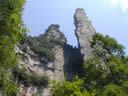
(Golden Whip Rock, Divine Eagle Guarding the Whip) If you ask what the signature scenic spot of Zhangjiajie National Forest Park is, the answer is ready-made: Golden Whip Rock. As early as the mid-Qing Dynasty, some literati included the peak forest of Zhangjiajie and Baizhang Gorge among the "Eight Scenes of Yongding." One was called "Gibbons Crying in the Steep Gorge"; another was called "Layered Cliffs Surging Like Pagodas": "Twenty li west of the county seat lies Qingya Mountain. In front of it, five mountains stand side by side, layered and towering like pagodas. Among them, one peak is even more towering and precipitous, piercing the Milky Way, with bright radiance and accumulated snow, most outstanding in wonder." The "one peak among them" mentioned here refers to Golden Whip Rock. Zhangjiajie accounts for two of the eight scenic spots, which shows that our forebears had good judgment. Golden Whip Rock has a relative height of more than 380 meters. It rises straight from the ground and pierces the clouds. Whether you look at it from afar or up close, from the front or the side, it is a long whip stabbing through the blue sky! As for the rock peak on the left side of Golden Whip Rock, look how much it resembles a fierce eagle, with hooked beak and glaring eyes, wings slightly spread, always alertly guarding the golden whip. People call it "Divine Eagle Guarding the Whip."
There are many beautiful legends about Golden Whip Rock and Divine Eagle Guarding the Whip. The most widely circulated one tells how Qin Shi Huang, on his way to drive mountains into the sea to fill it up, fell for the Lobster Girl's "beauty trap," and had his mountain-driving divine whip swapped for a fake one. From a scientific point of view, they were formed after multiple sets of joints and fissures cut through the rock strata, followed by weathering and collapse.
(Drunken Arhat) Now let us rest here for a while and listen to some Tujia folk songs. Look at this stone peak. Its base has collapsed into a dome, while the upper part of the mountain body leans forward at a downward angle, just like a monk drunk on wine, staggering and about to fall, ready to topple at any moment. Hence it is called "Drunken Arhat." Have you noticed? This large rock is the one that collapsed from the lower part of Drunken Arhat Peak on a summer night in 1983. This event, in one respect, confirms the cause of the formation of the sandstone peak forest.
(Flower and Fruit Mountain, Water Curtain Cave) We have arrived at Sun Wukong's Flower and Fruit Mountain and Water Curtain Cave. It is not that the people of Zhangjiajie are forcing connections and randomly dragging the events of Journey to the West over here; it is truly a coincidence. Yang Jie, the director of the Journey to the West production team, along with the actors playing Tang Seng, Zhu Bajie, Sun Wukong, and Sha Wujing, said with great certainty as soon as they saw this place: after scouting locations all over the country, only Zhangjiajie truly is the world of immortals, demons, and monsters depicted in Journey to the West. Everyone, follow where I am pointing and look ahead. To the front left is Tang Seng, wearing his monk's hat, draped in his kasaya, and muttering incantations. The dark stone peak closely following behind him is, of course, Sha Wujing. The enormously powerful Sun Wukong is half crouching behind Tang Seng, shading his eyes with his hand and observing the enemy situation. Where has Zhu Bajie gone? Needless to say, he is either greedily eating and sleeping, or secretly chatting up some young woman and chasing romance.

(Wenxing Rock) Everyone, please look to the front left. Does that stone peak look very much like the profile of Lu Xun? Mr. Lu Xun was a giant of the literary world, so people call it "Wenxing Rock." Lu Xun was the greatest modern Chinese writer and thinker, and an unprecedented national hero. The poet Zang Kejia wrote a poem in memory of Mr. Lu Xun called "Some People." Its opening lines are: Some people are alive, but they are already dead; some people are dead, but they are still alive. Mr. Lu Xun has always lived in the hearts of the Chinese people, and he also lives beside Golden Whip Stream in Zhangjiajie, Hunan, China. Some people say it looks very much like Gorky. Whether it is Lu Xun or Gorky, either way, both are giants of world literature.

(Purple Grass Pool) This is the famous Purple Grass Pool. Look, everyone: the pool water is crystal clear, completely transparent and bright, just like the little stone pool described by Liu Zongyuan in the Tang Dynasty: "In the pool there may be a hundred fish, all seeming to swim in emptiness with nothing to rely on," and "sunlight pierces straight down, shadows cast on the stones." Even the patterns on the stones at the bottom of the pool can be clearly distinguished!
Everyone, pay attention to this stone bridge. Is it a natural bridge or a man-made one? Look at the doggerel carved on the bridge: Ten giant spirits descended from heaven, each holding a golden whip; with a single cry of "yo-ho," a bridge spans Purple Grass Pool. This stone bridge is 2 meters wide, 4 meters long, and weighs 6 tons. It was built in 1983 by ten stonemasons from Sangzhi. Normally, a huge stone weighing 6 tons would have to be placed over a 4-meter-wide pool, and hoisting equipment would be absolutely necessary, but at that time there was simply no such possibility. So how did those ten laborers get it up there? It turned out to be very simple: the bridge-building equipment was just ten steel drills!
The stream on the left is called Shadao Gully. It is a desolate, uninhabited grand canyon. Along the way there are fine sights such as Slanting Shadow of the Stone Pagoda, Five Generals Paying Respect to Their Master, Little Tianmen, and Paradise of a Hundred Birds. From this gully one can go straight up to Yuanjiajie, then on to Tianzi Mountain, and also to Yangjiazhai.

(Meeting After a Thousand Miles) If fate brings people together, they will meet even from a thousand miles away; through all the vast waters and mountains, there is always affection. Look, the young man in armor and sword has hurried here through wind and dust, and the charming young woman has come with deep tenderness. There is no time to shake off the dewdrops hanging on their eyebrows, no time to brush away the mist and clouds lingering at their temples; just like this, full of tender feeling and urgent longing. The Creator is simply a master photographer, freezing the most moving instant into eternity. So it is with Wanglang Peak, so it is with Husband-and-Wife Rock, and so it is with Meeting After a Thousand Miles: love lets time slip away, but time has not let love slip away. When clouds come, they meet in the clouds; when rain comes, they meet in the rain. In a life of a hundred years, who does not long for a fated "waiting a thousand years for one encounter"?
(Rushing-About Slope) This slope on the left is said to be where, after the defeat of King Tianzi's troops, the main force retreated from here up to Yuanjiajie and into Tianzi Mountain. At that time, the government troops caught up. The soldiers lying in ambush cut the kudzu vines with one stroke, and rolling logs and stones came crashing down like a tide, sending the government troops scurrying in all directions. Later, this slope was called "Rushing-About Slope." From Rushing-About Slope, one can go up to the famous scenic route Yuanjiajie, where there are the Back Garden, Soul-Enchanting Terrace, Number One Bridge Under Heaven, and Heaven-Hanging White Silk Waterfall; one can also take the route to Tianzi Mountain and into Yangjiazhai. Everyone, look up. That isolated peak is called Yangzhai, and there is a stretch of primeval forest there.
(Fork Road to Upper Yaozi Village) Everyone, look across the stream. From that stone-paved path, you can go up to the Yaozi Village tour route. Yaozi Village is surrounded by sheer cliffs tens of thousands of feet high, and the stone plank road up the mountain is especially perilous. It is a super "viewing platform" second only to Huangshizhai (Yellow Stone Fortress). The main scenic spots include Eagle Beak, Rabbit Gazing at the Moon, Heavenly Bridge, Python Pine, and Dove Flower. If you are interested, you must come and see it next time you visit Zhangjiajie.
(Leaping Fish Pool) Every spring, when the "peach blossom waters" rise, fish of all colors in Leaping Fish Pool compete to leap and ride the waves upward from here, and the pool gets its name from this. According to folk custom, this is called "carp leaping over the dragon gate."
In Golden Whip Stream there is a kind of "baby fish," which is the largest amphibian in the world today and a Class II nationally protected animal. The scientific name of the baby fish is giant salamander. It is found only in China, Japan, and the United States. Because its cry sounds like a baby weeping, it is called "baby fish." Sangzhi County in Zhangjiajie City is the famous "hometown of the baby fish." The state has invested more than 10 million yuan in Baofeng Lake to build a giant salamander rescue center.
(Nanmu Flat) This place is called Nanmu Flat. The plants in Zhangjiajie Forest Park are distributed vertically. The area along Golden Whip Stream mainly has evergreen and deciduous broad-leaved forests, and the main tree species is nanmu. There are 16 kinds of nanmu in Zhangjiajie, such as fragrant nanmu, Lichuan machilus, red-leaf branch nanmu, glossy photinia, tiger-skin nanmu, downy photinia, red nanmu, large-leaf nanmu, butterfly nanmu, and bamboo-leaf nanmu, among which fragrant nanmu is the most precious. Zhangjiajie also has a peculiar kind of nanmu. One year, Liu Kailin, the director of the forest farm, cut down a nanmu tree and sawed it into boards to make boxes, only to unexpectedly discover very strange patterns on the boards: mountains, flowing water, small grasses, flowers, the sun, the moon, flying birds, and running beasts. Some people say these pictographic patterns were formed through the long-term influence of the surrounding environment, so it was called "reflection-pattern nanmu." As early as the Han Dynasty, the nanmu of Zhangjiajie began to be requisitioned by the imperial court; in the Ming Dynasty it was designated as tribute. During the Zhengde period of the Han Dynasty (1515-1520), the Mao gang Qin clan chieftains successively presented more than four hundred large nanmu logs to the court to build palaces that had been destroyed by fire. The chieftain king was therefore promoted by the emperor, and the Qin clan was granted a title, known in history as the "Qin Clan Imperial Grant."
Friends, the fifteen-li Golden Whip Stream is almost finished. Wulingyuan is known as "three thousand peaks, eight hundred waters," "three thousand emerald peaks, eight hundred glassy waters." Among the waters, Golden Whip Stream is the representative. Folk saying has it that in long droughts it never stops flowing, and in long rains its water stays green. Moreover, the water of Golden Whip Stream needs no soap for bathing, no shampoo for washing hair, and no washing powder for laundry. Nancy, the Lieutenant Governor of Colorado, said: if Golden Whip Stream sold air, it would absolutely be an income beyond valuation!

(Four Gates Flanked by Water) When Golden Whip Stream flows here, it joins Longwei Stream, Tianzi Stream, and Mine Cave Stream. The four waters weave through the four mountain gates in the east, south, west, and north, and together they hold up a beautiful sandbar. The sandbar is called Tianzi Bar, the place where King Tianzi proclaimed himself king and established the Tianzi Kingdom. Look, the row of three stone peaks opposite, together with the dozens of stone peaks standing all around, were anciently called "Document Tube, Brush Rack, Long Live Tablet, and Forty-Eight General Rocks." According to legend, they were all left behind by King Tianzi.
Four Gates Flanked by Water is a treasured geomantic site. According to legend, Zhang Liang, the Marquis of Liu in the Han Dynasty, was buried here. Everyone, look up to the left. It is said that on that mountain top is the site of Zhang Liang's ancient tomb. The ethnologist Long Bingwen wrote: "Treading all the green mountains seeking the ancients, at Four Gates Flanked by Water one finds a fine burial place; on Incense Burner Rock is the old earthen fort, the tomb of Zhang Liang, Marquis of Liu of the Han Dynasty."
In May 1992, two officials sent by UNESCO to conduct an inspection walked the whole length of Golden Whip Stream. Dr. Sancerre, who had spoken very little along the way, finally spoke. He said: clear stream water, intact vegetation, and such a long stretch with no human habitation—this is rarely seen in Asia!
Four Gates Flanked by Water radiates outward and connects with all the scenic areas and spots. To the right, one can take a vehicle through Longtail Village to Zhangjiajie Park or go down the mountain into the city; straight ahead, one can take a vehicle to Ten-Mile Gallery, to the Tianzi Mountain cableway station, and to Jundiping, Yellow Dragon Cave, and Baofeng Lake.