
Huanglong Cave, Baofeng Lake Featured
(Suoxi) The stretch of stream water from the point below Water Winding Around Four Gates to Yellow Dragon Cave is the famous Suoxi. According to the county annals, it was named "Suo" because government troops launched a campaign against the uprising of Xiang Wang Tianzi, and in ancient times it was called Suoshui. Suoxi gathers the waters of eight hundred streams and gullies in Wulingyuan, then flows into the Loushui River and joins the Lishui River. A contemporary woman writer named Su Ye, stirred by the beauty of Suoxi, actually declared, "In my next life I would gladly be a stone and marry the waters of Suoxi"—she wanted to be Suoxi's wife in her next life.
As for the landscape of Wulingyuan, one wonders how many people have praised and sung of it. Among this there is an aesthetic question, namely the artistic layout of landscape in a painter's brushwork. The ancient "On Painting" says: "Mountains are the body, rocks are the bones, forests are the clothing, grass is the hair, water is the blood vessels, clouds and mist are the spirit and shadow, mountain haze is the atmosphere, and temples, villages, and bridges are the ornaments." By this view, Wulingyuan has it all, so it is not without reason that people call Wulingyuan a super-sized Chinese painting scroll.
(Jundiping) We have now arrived at Jundiping, where the Wulingyuan District government is located. Like Suoxi, Jundiping was a place where imperial courts stationed troops to suppress peasant rebel armies through the ages, an ancient battlefield soaked in blood. In the early 1980s, this place was still a vast sandy beach. After more than twenty years of development and construction, especially after the State Council approved the formal establishment of the Wulingyuan District People's Government (county level) in 1988, it became the political, economic, cultural, and tourism center of Wulingyuan, and a prosperous new tourism city with a population of tens of thousands. In 1992, after strict inspection and acceptance, UNESCO formally inscribed Wulingyuan on the World Heritage List, making it one of the extremely rare purely natural heritage sites in the world. From then on, Wulingyuan strode onto the world stage. Standing on Wuling Avenue and gazing westward, we can see the skyline of rolling peaks, a giant landscape scroll hanging at the edge of the sky. To the southwest is Baofeng Lake Nature Park, and to the southeast is the world-famous Yellow Dragon Cave. Now we are heading to Yellow Dragon Cave and Baofeng Lake. The former is "China's best cave mansion," and the latter is praised as a "jade pool on earth." I believe everyone will gain a different experience from the sandstone peak forest scenery.
Yellow Dragon Cave
Bilingual Chinese-English AVI film introduction>>>> 4867 K More Yellow Dragon Cave pictures>>>>

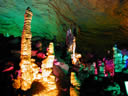
Yellow Dragon Cave is also known as Yellow Dragon Spring. Legend has it that during the Qianlong reign of the Qing Dynasty, a great drought lasted a hundred days. The famous master He Junru led his disciples into the cave to pray for rain, and all of them died. Before dying, Master He left behind a saying: "Let the field before the gate dry up, but do not strike Yellow Dragon Spring." From then on, no one paid attention to Yellow Dragon Cave. In early 1983, local villager Mao Jinchu organized nine militia members and, after enduring countless hardships and dangers, finally uncovered the truth of this world-class cave wonder. In February 1984, development began; in June of the same year, the Yellow Dragon Cave Management Office was established; and by the end of the year it was officially opened. In 1997, Yellow Dragon Cave was placed under the trusteeship of Beijing Datong Company. In November 1999, the World Aerobatic Grand Prix event of flying through Tianmen, initiated and operated by Yellow Dragon Cave Investment Co., Ltd., spread the name of Yellow Dragon Cave throughout the world.
Yellow Dragon Cave is one of the ace attractions of the Wulingyuan Scenic and Historic Interest Area. For its large scale, comprehensive contents, and beautiful scenery, it is hailed as the "all-around champion" of cave landscapes. As many visitors say: Yellow Dragon Cave is the crystallization of poetry, the condensation of philosophy, and the statue of beauty.
The explored floor area of Yellow Dragon Cave is about 100,000 square meters, with a total length of 7,640 meters and a vertical height of 140 meters. It is divided into two layers of dry caves and two layers of water caves, with one repository, two rivers, three pools, four waterfalls, thirteen halls, ninety-eight corridors, as well as thousands of white jade pools and tens of thousands of stalactite peaks. The entire great cave is like an ancient tree, gnarled and intertwined, spreading outward, with caves within caves, heavens beyond heavens, mountains upon mountains and waters winding back, and peaks turning around paths. The cave landscapes formed by the condensation of natural calcareous solutions are dazzling, beautiful beyond description, wondrous in every way, and possessed of everything. Now, please join me in a spiritual tour of Yellow Dragon Cave. Please be careful not to fall behind.
(Two Gates Welcoming Guests) Of the two gates, the one on the left is named the "Gate of Happiness" and the one on the right is named the "Gate of Longevity." Do you value love as you wish, a happy marriage, and success in career, and choose to walk through the "Gate of Happiness"? Or do you pray for long life and a hundred years of health, and choose to walk through the "Gate of Longevity"? Of course, everyone hopes to have both happiness and longevity. Then remember: choose one gate to enter now, and when the tour is over and you return, come out through the other gate—wouldn't that be having your cake and eating it too?
(Dragon Dance Hall) This is where the dragon clan is said to have held its dances. The dance has just ended, leaving only a pair of lovers in the box on the left wall still whispering to each other, completely unaware that the audience is gradually leaving!

(Plants in the Cave) In 1994, during the Third China Cave Landscape Conference held here, a local writer accidentally discovered that wild grass was actually growing in the cave! Previously, no plants at all could be seen in Yellow Dragon Cave, and experts believed that the dry, dark natural conditions over hundreds of millions of years made plant growth impossible. But incredibly, due to long-term exposure to fluorescent lamps, a scene of spring actually sprouted in the cave. Strangely, under ordinary incandescent light, this scenery could not be seen. Could it be that some power in fluorescent lamps awakened their dream of life? In 1996, in the "Zhangjiajie Special" produced by CCTV's "Zhengda Variety Show," a "Guess What" question was specially designed about grass growing in Yellow Dragon Cave. After that, some people came to Zhangjiajie for tourism just because of this wonder of "grass growing in the cave," saying they wanted to see for themselves whether it was true or false. So now I will pose a question for everyone to solve this age-old mystery of life: 1. Where did the seeds come from? Were they brought by birds and beasts? Blown in by the wind? Or were they remnants from prehistoric eras when the earth suffered repeated disasters? 2. Suppose the seeds were carried here when the earth's crust changed hundreds of millions of years ago. Then, after lying dormant for hundreds of millions of years, why did they neither die nor grow? Why did they revive under fluorescent lamps? What magical power do fluorescent lamps actually have? If anyone can solve this mystery, that person can become an honorary permanent guest of Yellow Dragon Cave. I am waiting for everyone's answers.
(Xiangshui River) Now we board a boat to tour the Xiangshui River. With a dreamlike mood, a mythological atmosphere, and the splashing sound of water, it is like hearing ethereal immortal music. Qilong Island, Longhua Reef, Dragon King's Golden Helmet, Treasure Pavilion, Stone Flower Pillar, Incense Insertion Platform—we seem to have arrived at the undersea palace in a Hans Christian Andersen fairy tale! No wonder the two UNESCO officials, while boating on the Xiangshui River, said that Yellow Dragon Cave was the most beautiful cave they had ever seen in the world, and that it was truly incredible for such a long underground river to exist inside the cave.
According to expert research, Yellow Dragon Cave developed in Triassic carbonate rock strata. The cave system is a three-dimensional spatial structure of three large layers far from shore and six small layers near shore, and the main passages extend along the strike of the rock layers. About 380 million years ago, the Yellow Dragon Cave area was a vast ocean, where highly soluble limestone and dolomite strata were deposited. After a long period of time, karst landforms began to form, until the earth's crust was uplifted 65 million years ago, creating dry caves. Then, through karst processes and water flow, today's underground wonder was formed.
(Heavenly Immortal Water) The Heavenly Immortal Water Hall has an area of 5,483 square meters. Look at those three streams of waterfall water, with a drop of 27.3 meters, pouring down from the high dome and falling into three jade pools. This is the "Heavenly Immortal Water" that the dragon clan is said to have drunk.
(Tianzhu Street) To express his longing for a beautiful life, the poet Guo Moruo wrote the poem "Street Market in Heaven": Imagine that in the dim and distant sky, there must be a beautiful street market; the goods displayed there are rare treasures not found in the world. It can be said that the artistic conception in the poem is most vividly displayed here. Look at those two stone pillars—call them "Hard to Meet" and "Joyful Reunion." How could such a humanized arrangement by nature not make people gasp in admiration? According to research, stalactites here grow only one meter in 270,000 years, and stalagmites grow only one centimeter per century. A hundred years from today, these two little flood dragons, one above and one below, so close yet seemingly worlds apart and doomed not to meet, will be able to achieve the "kiss of the century." At that time, everyone is welcome to come and celebrate!
Tianzhu Street is one kilometer long. The east and west streets, divided by the "Heavenly Street Market," are connected by Tianlong Bridge, which is 20 meters high, 3 meters wide, and 22 meters long. Tianlong Bridge is currently the largest stone arch bridge among tourist caves in China. Strolling on the bridge, will you perhaps think of that ancient legend of the Magpie Bridge across the Milky Way?

(Dragon Palace) The Dragon Palace is the largest of the thirteen halls of Yellow Dragon Cave and one of the most beautiful scenic spots. It has a floor area of 15,000 square meters and an average height of 40 meters. More than two thousand stalagmites rise from the ground in a thousand postures and a riot of colors, some like birds and beasts, some like court treasures, some like towering cedars, and some like rockets ascending into the sky. In the rear garden of the Dragon Palace are two flower pools, one of gold and one of silver, with clear water often overflowing and clusters of flowers in full bloom. From the palace ceiling hang stalactites like draped curtains, and the murals all around are lifelike. Water dissolved with various minerals seeps out from the rock layers and drips down. The minerals solidify and crystallize on the cave ceiling into hanging stalactites, and the water dripping from the stalactites again pours and piles minerals on the cave floor, growing into stalagmites rising section by section. Look at the formation of this Dragon Palace and appreciate its majestic momentum. The largest stalagmite in the cave, the 12-meter-high, 10-meter-diameter white marble natural stone chair known as the "Dragon King's Throne," commands from above, while numerous stone pillars and stalagmites resembling people or objects, vividly and true to life, surround the throne in worship and homage. Dozens of coral formations stand gracefully, just like a huge "court orchestra." The famous Hunan professor Yang Chunqiu wrote the lyric "Parasitic Grass" to depict this: "A thousand postures and ten thousand appearances, palaces and courtyards and chambers. The Dragon King holds a feast and offers fine wine, the Monkey King steals fruit and stirs up heaven, kings take favorites and embrace silk bed curtains. It has staged human strife and gathered the world's wonders."

(Sea-Calming Divine Needle) This is the landmark attraction of Yellow Dragon Cave. It is 19.2 meters tall and 40 centimeters in circumference, the tallest stalagmite in Yellow Dragon Cave. It is thick at both ends and thin in the middle, with the thinnest part only 10 centimeters in diameter. If, according to experts' determination that the average annual growth rate of stalagmites in Yellow Dragon Cave is only 0.1 millimeters, then by this calculation, the "Sea-Calming Divine Needle" has been growing for 200,000 years and is still continuing to grow. If it grows another six meters over another 60,000 years, it will reach the dome and truly "stand between heaven and earth"! In order to better protect this landmark attraction, the Yellow Dragon Cave scenic area management department specially bought 100 million yuan in huge insurance for the "Sea-Calming Divine Needle," creating a national precedent for insuring a world natural heritage site.

(Maze) The Maze is located on the lowest level of Yellow Dragon Cave. White and crystal-clear stalactites, stalagmites, stone pillars, stone curtains, stone flowers, stone tubes, curly stones, stone pearls, stone corals, and so on are exquisite and densely packed. The white, crimson, dark purple, and tender green calcareous crystals are untouched by dust and sparkle brilliantly. Cave landscapes of every kind are present, with endless mysteries. Compared with the rough and magnificent Dragon Palace, the Maze appears gentler and more delicate.
With its three-dimensional cave structure, enormous cave space, towering stone waterfalls, broad Dragon Palace hall, thousands of stalagmites, and tour routes both on water and on land, Yellow Dragon Cave constitutes a unique underground cave mansion at home and abroad. Such a charming palace of art as Yellow Dragon Cave slept underground for hundreds of millions of years, until that bright spring of 1983, when explorers led by local militia member Mao Jinchu opened the long-sealed cave door. From then on, Yellow Dragon Cave shone across the four seas.
Baofeng Lake
Bilingual Chinese-English AVI film introduction>>>> 3346 K More Baofeng Lake pictures>>>>
Friends, we have now arrived at Baofeng Lake Square.
Baofeng Lake is a masterpiece of scenic art created jointly by nature and human labor. In the 1970s, local villagers built a dam to generate electricity, unintentionally creating a beautiful lake. Because the lake backs onto Baofeng Mountain, it was named Baofeng Lake. In the mid-1980s, Baofeng Lake was introduced to the tourism market as a nature park; in the 1990s, the park was leased and operated by Malaysia Poly Industrial Development Co., Ltd., setting a precedent for the commercialized management model of tourism resources in Zhangjiajie City. The park consists of two major parts, Baofeng Lake and Yingwo Stockade, including seven major projects: the dynamic water scenery area, the water recreation area, the folk customs garden, the animal wonders area, the Poly Resort, the Poly Entertainment Center, and the exotic climbing route. The four major sights—Baofeng Lake, Baofeng Flying Waterfall, Yingwo Stockade, and One-Line Sky—are especially superb and are called the "Four Wonders" of Wulingyuan.
"Baofeng Flying Waterfall" Look, as soon as we enter the gate, the plunging waterfall occupies our field of vision, truly seizing attention at first sight. In the golden autumn of 1998, Hong Kong Chief Executive Tung Chee-hwa, after reporting to the State Council in Beijing, brought his wife Tung Chiu Hung-ping to inspect Zhangjiajie and joyfully toured Baofeng Lake. The couple sat in this very spot and had their photo taken, leaving behind deep affection for Baofeng Lake.
(Shanyue Pavilion) The Baofeng Lake Cloud Ladder is built against the cliff and can be called the most thrilling plank road in Wulingyuan. In May 1998, the famous master of Chinese painting Guan Shanyue, despite being eighty-eight years old, climbed the Cloud Ladder step by step and could not help being enchanted by the mountain scenery and water colors of Baofeng Lake. While resting at the mid-mountain pavilion on the Cloud Ladder, the famous painter Zhong Zengya, who accompanied him, noticed that the small pavilion had no name and proposed naming it "Shanyue Pavilion," which was immediately agreed to by those present. Unfortunately, Mr. Guan Shanyue has since passed away, but Shanyue Pavilion will forever remember this great people's artist.
(Baofeng Lake) The cloud ladder leads straight to the highest level, where suddenly one sees deep green rippling water. Indeed, a calm lake appears in the high gorge; the jade pool on earth is found right here. Baofeng Lake is 72 meters deep, about two li long, more than 150 meters wide at its widest, and just over 10 meters wide at its narrowest, with a water storage capacity of more than four million cubic meters. The dam site beneath your feet can be called a miracle in the history of dam site selection and lake building in our country: the dam is 80 meters high, 12 meters wide at its widest, and only 3 meters wide at its narrowest. This beautiful mountain lake was first built in 1974 and completed in 1979, mainly for small hydropower in mountainous areas and farmland irrigation. Its use as a tourism scenic resource began only in 1984. With the vigorous development of tourism in Wulingyuan District, this beautiful mountain lake has become increasingly cherished by Chinese and foreign tourists.
Around the lake, strange peaks encircle it, fine trees are lush, and the verdant, layered small islands are like green pearls, adding even more spiritual charm to the mountain lake. Someone wrote a poem in praise: "A deep mirror hides and locks in the green haze, bringing the Three Gorges all around. The tour boat speeds into the green mountains, startling pairs of mandarin ducks to fly." This is a vivid portrayal of the scenery of Baofeng Lake.
(Goddess Looking in the Mirror) Baofeng Lake not only has the overall beauty of mountains and water reflecting each other and movement and stillness complementing each other, but also, because of the many strange peaks and rocks in the lake, possesses the individual beauty of scenic forms. That stone peak standing alone by the lake, silently standing there, is called "Goddess Looking in the Mirror." See how gracefully she stands, with a slim figure, lowering her head in intoxication at her own beautiful reflection in the lake. If you look carefully, you will discover that this goddess wears a rare crown on her "head." On this crown, "gold hairpins and jade hairpins" scatter unevenly, with lush branches and leaves. This crown is actually a clump of rhododendrons. People really cannot believe that on such a bare stone peak, where not even a blade of grass can be seen around it, only a clump of rhododendrons grows. Whenever spring arrives, the rhododendrons bloom on this stone peak, attracting hundreds and thousands of butterflies to flutter around the clump of rhododendrons, and the shadows of the peak, flowers, and butterflies all fall together into the mirror-like lake, forming a mesmerizing wonder.
(Crocodile Rock) This stone stretching horizontally over the water is called "Crocodile Rock." It is said that Guanyin Bodhisattva specially sent it to protect the "Goddess." If anyone harbors evil intentions toward the Goddess or tries to steal the "crown" on her head, they will surely be eaten by this crocodile with its mouth wide open. Opposite Crocodile Rock is Shenyou Peak. This peak rises about one hundred meters above the lake surface, like a steel knife piercing straight into the clouds, giving people a sharp sense of wonder, majesty, and danger, as well as a sense of transcendent purity and aloofness. This peak can only be toured in the imagination and cannot be climbed.
(Golden Turtle Emerging from the Water) Look at this "golden turtle," lying quietly in the center of the lake. When the tour boat slowly approaches and stirs up ripples on the lake, the golden turtle suddenly comes to life, as if swimming gracefully toward you. It is welcoming guests from afar to visit Baofeng Lake!

(Antiphonal Singing on the Lake) Please listen carefully. This is Tujia young men and women singing antiphonally. The Tujia people are good at singing and dancing, and wherever there is a Tujia village, it is a hometown of mountain songs. When Tujia people go up the mountain to work, hunt, go to market, or hold weddings and funerals, they all sing mountain songs antiphonally. Especially when some young men and women court, they do not invite a matchmaker but use love songs to make connections. Through antiphonal singing, they test each other's culture, eloquence, and character and express their own feelings. Mountain songs are an art of poetry and also an art of musical rhythm. Structurally, they stress "comparison" and "association" and require rhyme. They are generally sung antiphonally, and there are also improvised songs, such as:
When cutting firewood, do not cut tung tree wood; tung seeds can be pressed for oil, which is worthwhile.
The lamp is hung on the wooden wall; the young man sharpens the fish knife, the young woman makes shoes.

(Cormorant Fishing) Look, everyone, those are cormorants fishing. In the past, people in Wulingyuan made a living by hunting and fishing. If a fisherman raised one or two cormorants, it was equivalent to opening half a slope of wasteland. Cormorants are the natural enemies of fish. When a cormorant sees a fish, it desperately chases and kills it. If it is a small fish, it swallows it in one bite. Unfortunately, the fisherman ties a small ring around their necks, so the fish cannot be swallowed and gets stuck in the throat, forcing them to spit it out on the boat. If they encounter a big fish, they first peck its eyes to make it lose its ability to resist, then hook its gill cover and drag it out of the water.
Well-trained cormorants are extremely loyal to their master. Once, those two cormorants suddenly disappeared, and the fisherman searched everywhere without finding a trace. Three days passed, and the fisherman was in despair. On the morning of the fourth day, the fisherman came sadly to the lakeside again and called to his cormorants. He seemed to hear a reply from a cormorant and hurried to the sandy shore. A tragic and stirring scene stunned him: a big fish more than three meters long, covered in wounds, lay dead by the shore; the two cormorants, their feathers plucked beyond recognition and their bodies covered with wounds, lay dying on either side of the big fish. The fisherman understood: the two cormorants had fought the big fish for three days and three nights!
The fisherman wept and carried the injured cormorants home for careful treatment. As for that big fish, how heavy do you all guess it was?
(Duguan Pass) This place is called "Duguan Pass." The two peaks closely flanking this pass, the one to the south is called "Duguan Stockade" and the one to the north is called "Bian Guan Stockade." According to local legend, during the Chongzhen reign of the Ming Dynasty, a minister surnamed Zhang in the imperial court lost confidence in the fatuous and corrupt Emperor Chongzhen and deeply hated the ugly behavior of the imperial relatives and civil and military officials who fought and intrigued against one another. Taking the opportunity of a visit to Yongding as provincial governor, he came to Wulingyuan. Seeing the extraordinary scenery and simple folk customs here, and thinking of the corrupt court and foul officialdom, he developed the idea of reclusion and fleeing the world. He immediately disbanded his attendants and was unwilling to return. Among the accompanying officers and soldiers, someone returned to the capital and reported to the emperor. The emperor was furious and sent an official to arrest him and bring him back to the capital for punishment. An old herb gatherer hid Mr. Zhang, the recluse, in a cave on this peak overnight. At intervals, he brought rice and vegetables to the recluse. The official sent to arrest him inquired everywhere but found no news, so he had to return empty-handed to report. When the emperor heard the report, he flew into a rage, dismissed him from office, and granted him gold to return home. Unexpectedly, this official, feeling ashamed to return home, also conceived the idea of reclusion. When he came here, the herb gatherer learned of it and sent him to live in seclusion in a cave on the peak opposite Mr. Zhang. From then on, local people called these two peaks "Duguan Stockade" and "Bian Guan Stockade." According to local people, someone once found a few lines of verse written in charcoal on the rock wall of "Bian Guan Stockade": "Duguan, Bian Guan, one body at leisure; heaven and earth are vast, all naturally so."
(Yingwo Stockade) Wulingyuan was originally a happy land on earth, but by the late Qing Dynasty and the Republican period, the world fell into chaos, and some peasants were forced into banditry. Some bandits from outside the mountains, to avoid government suppression, hid one after another among the isolated peaks and deep ridges of Wulingyuan, making themselves kings of the mountains. Banditry is an objectively existing social problem. In those years, there were bandits everywhere in China. The history of bandits in the American West has now become a world-famous tourism resource.
By rough count, more than twenty stockades, large and small, were built within Wulingyuan. The most famous include Huangshizhai (Yellow Stone Fortress), Yaozi Stockade, Yingwo Stockade, Wulong Stockade, Yang Stockade, Qingyan Stockade, Suguo Stockade, Biantong Stockade, Baoyue Stockade, and Yangjia Stockade.
Yingwo Stockade is 680.9 meters above sea level, with the highest peak at 720 meters and a vertical height of more than 300 meters. Whether going up to the stockade or down from it, there is only this one single path, a hundred-percent natural stronghold. This is Yingwo Stockade, built in the early period and once with flourishing incense, said to be efficacious as a oracle. Look, all four sides are sheer cliffs like walls, with only a narrow crack for passage. The folk name "Eagle's Nest" is an excellent portrayal. In the late Qing Dynasty and the Republican period, it was occupied by bandits and thus became a battlefield contested between government forces and bandits for this natural stronghold. Local people suffered deeply from the disasters caused by both officials and bandits and composed many doggerel poems. One of them goes:
Year after year of bandit disasters is truly lamentable; great and small alike are always bullied.
For five days no fire has been lit in the stove; in ten households, nine often weep.
And there is an even more sorrowful sight: the ground has no green grass, the trees no bark.
A dou of rice can buy an eight-year-old child; to pawn one's wife cannot even exchange for three sheng of rice.

(One-Line Sky) Just now everyone appreciated the grandeur of the natural stronghold of Yingwo Stockade. Now we are already in "One-Line Sky." "One-Line Sky" is more than 200 meters long, with a gorge height of about 100 meters and an average width of less than 4 meters. Such a deep, secluded, and narrow gorge is truly rare. At this moment, when you hear the gurgling mountain spring in the gorge and see the green trees, mountain flowers, and small grasses adorning the rock walls, what a serene and joyful feeling that must be. The ancients believed that climbing high and gazing far can broaden one's mind, while entering a gorge to seek seclusion can make one calm and contemplative. Therefore, Wei Yuan, a great scholar of the Qing Dynasty, believed that in tourism, besides touring mountains, one should also pay attention to touring gorges. He said: "If people tour mountains but do not travel through valleys, how is that different from entering a hall and neglecting the inner chambers? The inner chambers are all between two mountains; how can climbing high and gazing once be enough?"
(Waterfall Listening Pavilion) Friends, the Baofeng Lake tour has ended, and everyone has had a tiring journey. Now I suggest we go to the "Waterfall Listening Pavilion" to rest our feet, wash off our sweat, listen to music, and recover our energy before continuing. Look at this ethnic-style building, backed by sandstone peaks and facing the Baofeng Flying Waterfall. Ascending this pavilion, tasting fragrant Tujia tea and listening to the roar of the waterfall, in such a scene and mood, how could one not sigh at the ethereal realm of heartfelt conversation between humanity and nature?
[Appendix 1] About the Sandstone Great Peak Forest
The vast Wulingyuan, covering 264 square kilometers, has been shaped by nature's uncanny workmanship into the spectacular landform scenery of the sandstone great peak forest. In 1992, the two experts sent by UNESCO wrote in their technical evaluation report after inspecting and accepting Wulingyuan's application for World Natural Heritage: "Wulingyuan possesses undeniable natural beauty, because it has magnificent and jagged stone peaks, lush vegetation, clear lakes and streams, as well as incomparably beautiful karst caves and underground rivers." After comparing Wulingyuan's sandstone peak forest one by one with the Colorado peak forest, Danxia peak forest, karst peak forest, basalt peak forest, earth forest, and wind-eroded stone forest in the United States, the two experts held that the scale and number of red quartz sandstone are unique and possess undeniable and irreplaceable world geological value and status; the diversity of vertically distributed biological species and quantities also exceeds that of similar regions; the sandstone peak forest landform and limestone cave landform are completely combined; surface and underground are perfectly combined, and geology and biology are perfectly combined, and their integrity is incomparable.
This is the authoritative conclusion written by the two experts after field investigation, standing at the summit of world natural landscapes.
Professor Chen Guoda, chairman of the International Continental Rift Society, summarized the characteristics of Wulingyuan's sandstone peak forest in five aspects: first, the stone peaks and pillars combine form and spirit, magnificent and fantastical; second, the stone peaks are highly dense, numbering more than three thousand, making a true "peak forest"; third, the distribution range is broad, stretching in continuous sheets, spectacular; fourth, the ravines between the peak forest crisscross, combining with the peak forest to form a peerless and gorgeous picture; fifth, the forests are lush and the water abundant, verdant and continuous, which not only adds beauty to the sandstone peak forest but also provides good conditions for preserving soil and water and reducing damage from rainwater erosion.
The sandstone peak forest landform is unique in the world. About 380 million years ago, during the Devonian period, the earth's crust in the Wulingyuan area subsided, seawater invaded and became a vast ocean, and flowing water continuously washed large amounts of loose fine debris from the adjacent land. Together with silicates in seawater, they precipitated, cemented, and compacted into shape, forming quartz sandstone strata. By 285 million years ago, in the Permian period, the quartz sandstone was exposed above ground due to crustal uplift and formed swamps, and plants multiplied, forming argillaceous limestone coal-bearing strata that covered the sandstone layers. By the end of the Triassic, 200 million years ago, strong crustal movement (orogeny) occurred again in the Wulingyuan area, causing the flat strata to fold and fracture, forming mountain ranges that continued to rise and become exposed at the surface. After hundreds of millions of years of water erosion, cutting, and joint development, the present natural scenery of thousands of towering peaks and countless jagged rocks was formed. Some resemble the Golden Whip piercing the clouds, some resemble pagodas, some resemble natural stone bridges, some resemble figures and animals, and some resemble knife-cut and axe-hewn gorges. Zhangjiajie has the saying of "three thousand strange peaks." There are altogether 3,103 peaks with a relative height above 120 meters. The highest peaks are respectively Baofeng Mountain in Suoxiyu (1,260 meters), Kunlun Peak in Tianzi Mountain (1,262.5 meters), and Rabbit Watching the Moon in Zhangjiajie (1,264.5 meters). The lowest point is Hekou Village in Suoxiyu, 300 meters above sea level, and the relative height of the highest peak is about 900 meters.
As a whole, although Wulingyuan is all peak forest landform, Tianzi Mountain, Zhangjiajie, and Suoxiyu respectively belong to different stages of landform development. Tianzi Mountain belongs to the early stage of landform development, mainly platform landform. Above 800 meters is Permian argillaceous limestone, and below 800 meters is Devonian quartz sandstone. Zhangjiajie belongs to the middle stage of landform development. Under the effects of water cutting, weathering, and collapse, the original platform became numerous stone peaks; the density of the peak forest is relatively high, while the peak bases are relatively small. Suoxiyu belongs to the late stage of landform development, with relatively large peak bases, so the field of vision is also relatively open.
Some people may doubt that this place was once a sea. In the Laowuchang area of Tianzi Mountain, a kind of turtle-pattern stone is produced, one of Hunan's two famous stones (the other being chrysanthemum stone from Liuyang). When this stone is soaked in water, it displays patterns like a turtle shell. Turtle-pattern stone is actually a fossil of multivesicular coral, and coral is an organism that grows in shallow seas and warm-water zones. It truly records the historical fact that Zhangjiajie changed from sea to high mountains.
The mountains of Wulingyuan belong to fluvial landforms. How can fluvial landforms and glacial landforms be distinguished? Everyone can look at the shape of the valleys. Valleys in glacial landforms are formed by the "plucking" action of glaciers, and the valley bottoms are relatively gentle, appearing U-shaped, while valleys in fluvial landforms are formed by water cutting and scouring, and the valley bottoms are relatively narrow, appearing V-shaped.
The mountains of Wulingyuan belong to quartz sandstone peak forest. Quartz sandstone is a sedimentary rock layer. So-called sandstone refers to rock in which granular fragments with a diameter below 2 millimeters account for more than 50 percent. Sandstone contains iron, which oxidizes to form iron oxide and appears red, so it is also called red sandstone.
The red sandstone peak forest of Wulingyuan was named "Wulingyuan Peak Forest" by the famous geologist Professor Chen Guoda. As a world heritage, it is even more distinctive than the other six peak forests in the world:
1. Colorado Peak Forest. It developed in the Grand Canyon of Colorado in the United States. You may have seen it on television or video: sparse peak pillars, lonely and isolated, with a few Indian totem stone pillars standing upright, possessing a primitive and wild beauty. The Colorado Peak Forest is composed of Permian red sandstone. Its stone peaks have both the mystery of Wulingyuan's peak forest and the brilliant color of Danxia peak forest. But it is located on a plateau, more than 3,000 meters above sea level, dry and cold, with rare forests: "Though the wilderness has many strange rocks, it still lacks ornamentation and scenery."
2. Danxia Peak Forest. It is most similar to Wulingyuan Peak Forest. Composed of red sandstone, it not only has strange peaks
3. Karst Peak Forest Its name originates from the Karst region of Yugoslavia. It is formed by the "dissolution" of limestone by groundwater containing carbon dioxide. It differs from the Wulingyuan sandstone peak forest in origin, and each has its own distinctive form and charm. Since ancient times, there has been a saying: "Guilin's scenery is the best under heaven, and Yangshuo's scenery is the best in Guilin." The Stone Forest in Lunan, Yunnan, and the Seven Star Crags in Guangdong are both karst peak forests, often accompanied by caves formed by "dissolution." However, karst peak forests still lack the magnificent scenery of Wulingyuan's peak forest, which combines the divine, bizarre, secluded, wild, and beautiful in one, being rich in variation but insufficient in majesty and steepness.
4. Basalt Peak Forest Basalt is an igneous rock formed by the cooling and condensation of magma erupted onto the surface. When magma cools and condenses, its volume contracts, and the resulting vertical joints crack the rock into hexagonal shapes, creating uniquely shaped stone pillars. However, the resistance of various parts of basalt to weathering and water erosion is generally relatively uniform, so the stone pillars formed mostly appear monotonous, lacking the winding lines, peculiar shapes, and unpredictable morphological charm possessed by Wulingyuan's sandstone peaks.
5. Earth Forest It is a pillar-like landform left behind by the erosion and dissolution of water along their vertical joints, plus collapse due to gravity. It can be divided into loess forest and general earth forest: loess forest is found in Gansu, Shanxi, Hebei, and other provinces in China, mostly distributed on the Loess Plateau. General earth forest is more commonly seen in unconsolidated sediments, such as the earth forest formed by clay in the Taiyuan Basin of Shanxi. Although both have towering earth pillars with unique styles, due to the limitations of the soil, very few are rigid, majestic, and towering into the clouds; moreover, the earth pillars are fragile, mostly lacking the accompaniment of green shade and flowing water and the protection of plants, and have a relatively short lifespan.
6. Wind-eroded Stone Forest It is a landform formed by wind carrying sand grains abrading rocks. Found in arid zones, it mostly appears in square pillar, mushroom, tower, or castle shapes, appearing in groups as continuous belts, called wind cities, also known as devil cities. Although it has the beauty of "jade towers and jade mansions surpass the palace, unfolding whose scroll of paintings," in terms of momentum, it is far inferior to the rigidity and majesty of Wulingyuan's quartz sandstone peak forest, and in terms of environment, it lacks the elegance and beauty supported by green waters and blue mountains.
[Appendix 2] Index of Place Names
1. Zhangjiajie
As everyone knows, Jiangsu has Zhangjiagang, Hebei has Zhangjiakou, and Hunan has Zhangjiajie. Why is Zhangjiajie called "Zhangjiajie"?
Zhangjiajie was originally named Qingyan Mountain. Legend has it that in the third year of the Daoguang reign of the Qing Dynasty, a commandant from Yongding County named Zhang Wancong took a fancy to this auspicious land and wanted to claim it for himself. So he rode his horse around to mark the boundaries and carved on eight trees the words "Boundary of Commandant Zhang Wancong." But the very next day, the local people scraped off all eight characters he had carved and re-carved "Boundary of Zhang Liang, Marquis of Liu of Han." As we all know, Zhang Liang was a founding hero of the Han Dynasty. After helping Emperor Gaozu Liu Bang conquer the empire, he resigned from office and went into seclusion on Qingyan Mountain, where he studied Daoism under Master Chisongzi. After his death, he was buried beneath Xianglu Rock, northwest of Shuirao Simen. Folk legends represent the aspirations of the people. It can be said that the origin of the name Zhangjiajie is linked to Zhang Liang, the famous minister of the Han Dynasty. After Liberation, Zhangjiajie Township was established here. In 1959, the Zhangjiajie State-owned Forest Farm was founded. In 1982, with the approval of the State Council, China's first national forest park—Zhangjiajie Forest Park—was born, and the Zhangjiajie Administrative Office was established. In 1988, Zhangjiajie was placed under the jurisdiction of Wulingyuan District of Dayong City. In 1994, Dayong City was renamed Zhangjiajie City.
2. Wulingyuan
The core scenic area of Zhangjiajie is the Wulingyuan Scenic and Historic Interest Area (at the county level). In 1992, Wulingyuan was inscribed on the UNESCO World Heritage List. Why is this scenic area called "Wulingyuan"? There are roughly three reasons. Historically, Changde was formerly known as Wuling Prefecture. Before the Qin Dynasty, this area belonged to Qianzhong. From the Han Dynasty onward, for a long historical period, it was under the jurisdiction of Wuling Prefecture. Geographically, the Zhangjiajie scenic area is located in the remnant ranges of the Wuling Mountains (the Wuling Mountains originate in Tongren, Guizhou). In addition, in literature, many men of letters have mentioned "Wulingyuan" in their works. For example, Wang Wei wrote, "The residents all live together in Wulingyuan, and beyond worldly things they cultivate fields and gardens"; Li Bai also wrote, "When the task is accomplished, shake off your robes and depart, returning to Wulingyuan." They all compared Wulingyuan to an otherworldly paradise. Some even believe that the "Peach Blossom Spring" described by Tao Yuanming in his "Record of the Peach Blossom Spring" is not Taoyuan County in Changde, but Wulingyuan in Zhangjiajie. When Zhangjiajie was first developed, the core scenic area was under the jurisdiction of three counties: Dayong, Cili, and Sangzhi. In 1984, the famous painter of Xiangxi origin Huang Yongyu proposed unifying the management of three scenic areas—Tianzi Mountain, Suoxiyu, and Zhangjiajie Forest Park—and naming them "Wulingyuan." The Hunan Provincial Government specially established the "Wulingyuan Office" for this purpose. Hu Yaobang, then General Secretary of the CPC Central Committee, after inspecting the Xiangxi Autonomous Prefecture and hearing a report on Wulingyuan, personally inscribed "Wulingyuan District People's Government (County Level)." In October of the same year, it was officially named the "Wulingyuan Scenic and Historic Interest Area."