
Zhangjiajie Tianzi Mountain Tour Guide Script Featured
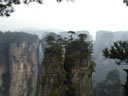
Now we're heading by bus to Tianzi Mountain Nature Reserve. Tianzi Mountain, 1,262.5 meters above sea level, gets its name because Xiang Dakun, a local Tujia leader, was proclaimed "King Tianzi" (Son of Heaven) by his troops. Tianzi Mountain has a mesa-like landform—high in the middle and low on all sides—which gives it a broad field of vision, long sightlines, distinct layers, and a magnificent momentum. The views here feel different from those at Yellow Stone Fortress (Huangshizhai) or Golden Whip Stream. At Yellow Stone Fortress, you sit facing the peaks and look at them eye to eye; at Golden Whip Stream, you are "inside a painting," gazing up at the peaks towering on both banks; but on Tianzi Mountain, you look down upon the vast world, and you'll feel the boundless pride of "no mountain above me—I alone reign supreme." Tianzi Mountain has four great wonders: peak forests, seas of clouds, sunrises, and winter snow. These majestic, spectacular, strange, and enchanting scenes, I believe, will feast your eyes and make you linger without thought of leaving.
(Songzi Ridge) This is Yuanjiajie. The plateau ahead is called Songzi Ridge. Legend has it that when King Tianzi established the Kingdom of Tianzi, the first capital site was right here. Only later was it moved to Shuiraosimen, and so this became King Tianzi's second capital.
(Enchanting Terrace) "Enchanting Terrace" takes its name from the extraordinarily bizarre scenery here, which dazes the mind and captivates the soul. Standing on the stone platform and gazing into the distance, Yellow Stone Fortress (Huangshizhai) and Yaozi Fortress merge into a semi-arc-shaped landscape painting; Golden Whip Stream and Shadao Gully loom in and out of view; in the valley below, among the clustered rock peaks, clouds and mist swirl—sometimes spreading into a mighty river, revealing the strange picture of "a few peaks green above the river." At such a moment, one naturally recalls the ancient lines: "Where is my hometown as dusk falls? The misty river fills one with sorrow." The sorrow is that the soul has lost its way among these wondrous mountains and waters and can find no road home.

(The Number One Bridge Under Heaven) [More photos of The Number One Bridge Under Heaven >>>>] That is "The Number One Bridge Under Heaven." Look—two peaks are linked by a long corridor, forming a natural bridge arch that normally swallows clouds and spits mist, a sight of magnificent grandeur. The bridge deck is about two meters wide and over twenty meters long, with an absolute height of 357 meters. On the bridge, ancient pines stand tall; along its edges, old vines hang down; below it, the depth is unfathomable. Walking on the bridge, you see mist rising and hear the roaring of pines, and the stone bridge seems to tremble and sway—a heart-stopping experience. This is a supreme marvel of Zhangjiajie's scenery and a miracle of nature.
(Rear Garden) Yellow Stone Fortress (Huangshizhai) has a Front Garden, and here there is a Rear Garden. Legend says both were hunting and leisure grounds of King Tianzi. This garden gate, with its rounded double arch, resembles the full-moon-shaped garden gates of ancient times. Add to that dozens of delicate, exquisite stone peaks dotted among the woods, birds singing, and streams murmuring—it feels much like the rear garden of a wealthy family in olden days. In many costume dramas, the story is about a rich young lady and a down-and-out scholar meeting secretly in the rear garden and pledging themselves to each other. I wonder if there's a down-and-out scholar among us—you might sign up and go to the Rear Garden to try your luck!
(Bird Paradise) Look ahead, everyone—that stream is Shadao Gully, and among its sights is one called "Bird Paradise." Every winter, while outside is a world of ice and snow with biting cold, here the water plants are lush and birds sing among the flowers. Birds from all around gather here and don't disperse until after the Start of Spring the following year. During this period, it becomes a grand festival for the bird tribe to mingle and revel. It's said they even hold "costume festivals," "model shows," and various "singer competitions" for different vocal styles and schools, sometimes on schedule and sometimes impromptu. If you visit Zhangjiajie in winter, I suggest you go to Bird Paradise and share the joy of the birds!
(General Rock) Look, that's General Rock! Folk legend says it is the incarnation of King Tianzi. See how he wears golden armor, his belly slightly protruding, standing with hands behind his back—that bearing, that elegance, is exactly like a general commanding thousands of troops. The late famous writer Mo Yingfeng wrote a poem in praise: "Lonely deep mountains, ancient and serene through the ages; Heaven's workmanship puts artists to shame. The King of the mountain has gone with the clouds; the General on the rock stays with the years." The vicissitudes of time are silent, yet the presence is boundless—what remains forever between heaven and earth is the General's gallant bearing!
(Qu Yuan Reciting) Among the historical figures circulating in Wulingyuan folklore, besides Master Red Pine, Emperor Qin Shi Huang, Zhang Liang, and King Tianzi, there is also Qu Yuan. Qu Yuan, full of patriotic fervor, was slandered and attacked by treacherous ministers and was successively exiled to the north of the Han River and to Jiangnan. During his exile in Jiangnan, it is said he once visited the Li River, which is reflected many times in his poems, such as "I cast my sleeve into the river; I leave my pendant by the Li Pu." Strangely enough, Qu Yuan's image was discovered on Tianzi Mountain. Look at that stone peak over 30 meters high, wearing a high cap and broad sash, thin as a human figure, his long blue gown fluttering in the wind. With hands behind his back, he paces into the distance, as if reciting by the waterside, as if singing a mournful song at the top of his voice—what a posture of anxiety for his country and his people. This is the famous scenic spot on Tianzi Mountain—Qu Yuan Reciting.
(Hanging Garden in the Air) Look, everyone—this hollow platform, surrounded by precipices on three sides, embraced by bizarre peaks, and lifted into the air, has dozens of mu of rice fields on it, hence the name Hanging Garden in the Air. A few Tujia families harvest spring, summer, autumn, and winter here, just like a land of peach blossoms beyond the world.
(Gathering of Divine Troops) From Immortal Bridge to Laowuchang, you see hundreds of stone peaks densely arrayed in the deep valley, exactly like a group of mighty and majestic officers and soldiers lined up awaiting orders. Legend says this is the gathering of King Tianzi's divine troops. Though myths are unreliable, such a concentrated and spectacular display of stone peaks is rare even in Wulingyuan. I'd like to quote a master of fine arts: "Absurd, inexplicable; told, you won't believe; arrive, and you'll understand." If you don't see the Gathering of Divine Troops, how can you know that stone peaks form a forest?
(Chapan Ta) It gets its name because a platform juts out into empty space by the cliff, shaped like a tea tray. Famous scenic spots in this area include Grand View Terrace, One Step Too Hard, Immortal Bridge, and Lovers' Tryst.
(Grand View Terrace) This is Grand View Terrace. Gazing as far as the eye can see, a thousand hundred strange peaks are all taken in at a glance. A poet said that the sandstone peak forest of Wulingyuan is a scene at every step, a thousand shapes in a thousand steps; one mountain has four seasons, ten steps have different skies. Experts have calculated that Wulingyuan has 3,103 stone peaks. Like a supremely skilled sculptor, they imitate all things in the universe, each shape lifelike, true to form, vivid as if about to move. Some are like conches emerging from water, some like golden turtles holding the sun, some like lotuses in full bloom, some like sky bridges spanning the void, some like long spears piercing the sky, some like pagodas standing tall, some like old men gathering herbs, some like jade maidens dressing, some like generals on campaign, some like warhorses neighing, some like lovers meeting secretly, some like husband and wife embracing, some like fairies scattering flowers, some like village girls keeping watch, some solitary peaks standing alone in beauty, some thrusting straight into the clouds, some graceful and slender, some mighty and fierce, some small and exquisite, some grand and majestic. Entering Wulingyuan, you see a forest of peaks, a world of peaks, an ocean of peaks. Upright, bizarre, beautiful, concentrated, rugged, ancient and wild—this is Wulingyuan. A master artist said: Wulingyuan's peaks have rewritten the concept of a mountain. The great photographer Chen Bo said: "The Three Mountains and Five Sacred Peaks may rival its beauty; every scenery in China is first-rate." Mr. Wang Jijie said: "A three-day tour of Wulingyuan surpasses reading a thousand poems of Li and Du." Mr. Xu Shijie said: "Elegant, secluded, perilous, steep—called extraordinary and superb; the Five Sacred Peaks and Huangshan bow in defeat." Mr. Li Chengrui protested indignantly on its behalf: "Who is the finest scenery in the Divine Land? We must ask Lord Xia to re-evaluate." It's a pity Xu Xiake never had the chance to come to Grand View Terrace and could not give any evaluation of Wulingyuan.
(One Step Too Hard) Look, everyone—this long, narrow platform extends to the east, and at its end the platform breaks into two peaks. The crack is about 100 meters deep, the two peaks are less than one meter apart, and the separated stone peak is about ten meters long and two meters wide—an excellent viewing platform. But this one step: the bold walk it as if on flat ground, a mere lift of the foot; the timid tremble and quake, never daring to cross the line by half a step. Between cliff and cliff, only one step apart—or rather, between life and death, only one step. I wonder if any of you dare to take this step!
(Immortal Bridge) Also called Self-Generated Bridge, it is 24 meters long, two meters wide at its widest and one meter at its narrowest, flying across the void with supernatural workmanship. After Lü Dongbin walked over the bridge, he attained immortality and rode the clouds away; after Chang'e walked over the bridge, she attained immortality and, with her cloak, flew to the moon. Now that it's our turn to stand by this bridge, don't we also feel a little ethereal, as if about to become immortals, reluctant to leave? We are not immortals—for the sake of travel safety, we'd better not walk across.

(Shentang Bay) If you don't see Shentang Bay, your trip to Tianzi Mountain is in vain. Wulingyuan has two mysterious forbidden places: one is Heicong Nao on Yellow Stone Fortress (Huangshizhai), and the other is Shentang Bay on Tianzi Mountain. Shentang Bay is a natural barrel-shaped depression with an area of more than ten hectares, surrounded by steep cliffs on all sides, and the bay is bottomless. On overcast and rainy days, one faintly hears what sounds like gongs and drums clashing and people shouting and horses neighing from within the bay. People connect this phenomenon with the story of King Tianzi, after his defeat, leaping with men and horses into Shentang Bay, saying that only because King Tianzi's soldiers' spirits linger does this sound of slaughter arise. Experts say it may be due to geomagnetic recording.

(Reviewing Stand) As mentioned earlier, many place names in Wulingyuan are related to King Tianzi's uprising. Names such as Shentang Bay, General Rock, Gathering of Divine Troops, Reviewing Stand, Imperial Brush Peak, Warriors Taming Horses, JunDi Ping, Zhakou Pass, Baizhang Gorge, Cha Qi Valley, Shu Qi Valley, Flower Stream, Zhima Ta, Brush Holder, Brush Rack, Long Live Tablet, Forty-Eight Great General Rocks, Gonggu Ta, Xiejia Valley, Luanchuan Slope, Luoma Valley, and so on, make one even more aware of the atmosphere of the ancient battlefield.
Legend says that when King Tianzi rose in rebellion at Shuiraosimen, after his defeat he led three thousand soldiers in retreat to Tianzi Mountain, where they relied on the barrier of the primeval forest to build Shentang Fort and wage an arduous guerrilla war against the government troops. This place is the site left by King Tianzi when he reviewed his troops and officers. At this moment, we cannot help but recall the scene of "reviewing troops in autumn on the battlefield" and the beacon-fire years of "golden spears and iron horses, swallowing ten thousand li like a tiger." We cannot help but loudly chant the tragic and heroic lines: "The wind sighs, the Yi River is cold; once the brave man departs, he never returns." It is said that King Tianzi's last battle was disastrously lost right here, and afterward he led his remnant soldiers in leaping down into Shentang Bay, dying heroically.
Here, I'll also tell you a strange phenomenon. One afternoon in April 1991, after rain cleared, a hazy mist spread over all of Tianzi Mountain. From West Sea to Shentang Bay, rock peaks appeared and disappeared in the fog. A group of Shanghai tourists came to the Reviewing Stand, and suddenly a bizarre scene stunned them all: in the center of Shentang Bay, seven young maidens floated down from the clouds and mist onto a platform atop a rock peak, where they drank tea, played the qin, and danced gracefully for as long as forty minutes. At first the tourists thought it was a hallucination; rubbing their eyes and looking again, they still saw three in green and four in red, with long hair over their shoulders, graceful figures, and light dance steps. Until the second before the "fairies" gradually vanished with a patch of cloud and mist, no one dared make the slightest sound; those with cameras desperately pressed the shutter. Unfortunately, the distance was too great, and when the film was developed that evening, nothing had been captured. After the news spread, some believed it, some did not. Actually, whether myth or fact, this strange phenomenon can be fully explained scientifically. "Mirage" is known to all; and don't oases, villages, and cities often appear in great deserts?

(Bronze Statue of He Long) Marshal He Long was a founding father of the People's Republic of China and one of the founders of the People's Liberation Army. He was born into a peasant family in Hongjiaguan, Sangzhi County, west of Tianzi Mountain. From his first uprising—chopping up the salt bureau with two kitchen knives—his life was full of legendary color, and countless stories and legends about him circulate in his hometown. The Tianzi Mountain area was once a place where He Long, Ren Bishi, Xiao Ke, Wang Zhen, and other generals waged guerrilla warfare. Once, He Long was surrounded by the militia at Gonggu Ta, and the local people, quick-witted, rolled He Long up in a straw mat and hid him, saving him from disaster. This story still circulates in this area today.
The bronze statue of He Long is 6.5 meters high and weighs 9.3 tons, the largest single-figure bronze statue in China to date. See him wearing a military greatcoat, that big pipe that once accompanied him as he commanded the winds and clouds held in his hand, and that big white horse that once neighed to the sky nestled at his knee. The heavenly wind blows his clothes, his gaze is like a torch, and the entire posture, color, and spirit—even the folds on the military coat—are in perfect harmony with the great sandstone peak forest, standing firm between heaven and earth with the three thousand strange peaks here, braving rain and wind.
(Fairy Scattering Flowers) This is a tragic and heroic legend from long ago. That year, the Tujia uprising leader King Tianzi was defeated by government troops and had to retreat with his remnant soldiers to Tianzi Mountain. A hundred thousand government troops pursued relentlessly, and eight hundred Tujia soldiers fought a bloody battle for seven days and seven nights until they ran out of ammunition and food. Unwilling to be captured and humiliated, King Tianzi and his officers and men, preferring death to surrender, leapt into Shentang Bay. Long afterward, a Tujia maiden who had deeply loved King Tianzi climbed over mountains and ridges to Tianzi Mountain, searching for the bones of King Tianzi and his soldiers, but she heard only the mournful mountains and the murmuring streams. The maiden swallowed her tears, took up a bamboo basket, and gathered mountain flowers all over the hills. Then, calling out King Tianzi's name, she scattered flowers everywhere. She wanted to dedicate her love and her heart to her beloved King. So she scattered and scattered, and in time the maiden was frozen by the years into a stone statue, still holding a flower basket, full of tender feeling.

(Imperial Brush Peak) Imperial Brush Peak is recognized as the landmark scenic spot of Wulingyuan's sandstone peak forest scenery, constantly appearing in domestic and overseas media and promotional materials—truly a wonder of the world. Originally, this was a divine stroke of nature's supernatural workmanship; scientifically speaking, it is the result of weathering, erosion, and cutting over the years. But folk tradition links it with King Tianzi, saying that after King Tianzi's martyrdom, his imperial brush turned into a stone peak, keeping watch by Shentang Bay, while the "brush holder" and "brush rack" that held the imperial brush remained at Shuiraosimen. Yet through the rise and fall of dynasties and the changes of the ages, "how many things past and present are all consigned to laughter and talk." Only this imperial brush remains! In the poet's eyes, it is good for writing the free and elegant mist, the varied and colorful clouds, the fiery glow of dawn, the dreamlike purity of moonlight, and the ice-and-snow world of "cold beyond bearing in high places." Of course, it can also write love poems for your passion for these mountains and waters, or for some confidante.
(Tianzi Pavilion) Friends, before climbing the tower, you may as well first read this "Ode to Tianzi Pavilion" at the entrance. Note that this plaque was inscribed by the master of Chinese painting Guan Shanyue. On May 20, 1998, after Mr. Guan Shanyue, then over ninety, climbed Tianzi Pavilion, his spirit soared and he laughed without cease, gladly inscribing characters for the pavilion. Later, he created a long scroll painting of Zhangjiajie, which was exhibited in Hong Kong and caused a sensation there. Some commented that Guan Shanyue's late-life artistic brilliance was achieved in Zhangjiajie.
(Wulingyuan Topographic Model) Now let us together appreciate the topographic and geomorphic model of the entire Wulingyuan Scenic and Historic Interest Area. From the model, you can see that Tianzi Mountain has the highest terrain and Suoxiyu the lowest. Water flows from Tianzi Mountain through Zhangjiajie to Suoxiyu, creating differences in geomorphic development. Divided by different stages of geomorphic development, Zhangjiajie is in its prime of development, Suoxiyu has reached late development, and only Tianzi Mountain is still in an early stage of development. Look, in the Zhangjiajie area, except for places like Yellow Stone Fortress (Huangshizhai) and Yaozi Fortress that still retain their original mesa appearance, most have been transformed by water cutting, erosive weathering, and collapse into numerous stone peaks. In the Suoxiyu area, the density of sandstone peaks has been greatly reduced in many places; some places have been leveled to flat ground, and the remaining peaks have larger bases—all indicating that their development has entered old age. Tianzi Mountain is different. Tianzi Mountain has a mesa landform in two layers: the upper layer above 800 meters is Permian argillaceous limestone, and below 800 meters is Devonian quartz sandstone. Because the sandstone's vertical joints are well developed, and due to the long-term action of tensile forces, canyon walls standing on both sides and slab-like stone peaks have appeared; then the slab-like stone peaks fractured and collapsed to form stone gates and stone bridges such as Immortal Bridge and South Heaven Gate, while also forming many peninsula-like small bays. Some "peninsulas" extend more than 100 meters, becoming natural viewing platforms with broad views and forming winding cliff shorelines.
From the model map we can see that, besides the parts that have formed sandstone peak forests, there are still large numbers of sandstone mountain bodies sleeping, awaiting the long knife of time to slowly carve them into future sandstone peak forests. Therefore, if some of us have worried about what would happen if these peak forests all collapsed one day, now we can breathe a long sigh of relief. Resources are extremely abundant, and the reserve force is fully sufficient! To sum up, according to the laws of fluvial erosion landform development, the peak forests will migrate toward the Tianzi Mountain mesa and other watersheds. After the residual Permian limestone on the top of Tianzi Mountain is stripped away, it will become square mesas and peak pillars, while the peak forests in Zhangjiajie, Suoxiyu, and other places will become low, remnant hills, bringing the entire landform into old age. But this process is very slow. Without a sudden catastrophic destructive attack, the quartz sandstone peak forest landform here faces a stable evolutionary process on the macro level.
Friends, our trip to Tianzi Mountain has ended. Now there are three routes for you to choose from: first, take the cableway down the mountain; second, walk down Wolong Ridge to the Ten-Mile Gallery; third, go via South Heaven Gate. South Heaven Gate is truly a wonder of nature, and it is also closer to the bus pickup point.
(Heavenly Terrace) The viewing platform beneath our feet now is called Heavenly Terrace. Legend says it is where the great Chu poet Qu Yuan once questioned Heaven, so it is also called "Heaven-Questioning Terrace."
In those years, Qu Yuan was exiled to the lofty mountains of western Yuan and Li. A fisherman inadvertently told him that Wulingyuan had a Heavenly Terrace where immortals ascended to heaven, and Qu Yuan said indignantly: "I was just about to go up to heaven to ask the Heavenly Emperor about many things!" So, accompanied by Chanjuan and guided by the fisherman, he climbed the Heavenly Terrace. Raising his head, he shouted loudly to heaven: "Heaven above! Heaven above! There are many things I cannot understand. If you truly have a spirit, please answer me!" Then he questioned word by word: "At the beginning of ancient times, who transmitted the way? Before heaven and earth were formed, how could it be examined?" That resounding voice passed through the clouds and went straight up to the nine heavens. The Heavenly Emperor had no answer and ordered South Heaven Gate closed, then spread thick clouds, summoned wild winds, and sent thunder and lightning. But Qu Yuan was not afraid at all and continued to ask, asking for three days and three nights in a row, asking more than one hundred and eighty questions: "Hiding in caves, what can be said? Jing's merit in raising troops—how long? If one repents and reforms, what need have I to speak?"
The Heavenly Emperor was moved by what he heard, so he shouted back the wind, rain, and thunder, opened South Heaven Gate, and the hundred-li Wulingyuan saw light again. Later, Qu Yuan recorded the more than one hundred and eighty questions he asked Heaven, and they became the timeless masterpiece "Heavenly Questions." The stone terrace where he questioned Heaven was later called "Heaven-Questioning Terrace," also "Heavenly Terrace."

(South Heaven Gate) Nature's creation is truly wonderful: a huge slab-like stone peak was hollowed out into a great gate, more than ten meters wide at the base and 15 meters high. Legend says that when Qu Yuan climbed the Heavenly Terrace to question Heaven, he passed through here, so folk tradition calls it "Gate to Heaven." It is said that King Tianzi practiced martial arts at Shuiraosimen for three years and six months, and on the day of uprising, it was from here that he shot three arrows in succession toward the imperial palace. The Wulingyuan folk tale "Three Arrows Shoot the Imperial Palace" originates from this.