This attraction introduction is compiled from historical materials in the "Zhangjiajie Tour Guide Network" (33519.com · Scenic Spots section). Ticket prices, opening hours, transportation, and contact information mentioned in the text may be outdated. Please refer to the latest official announcements from the scenic area before traveling; some content consists of historical background/cultural introductions and is for reference only.
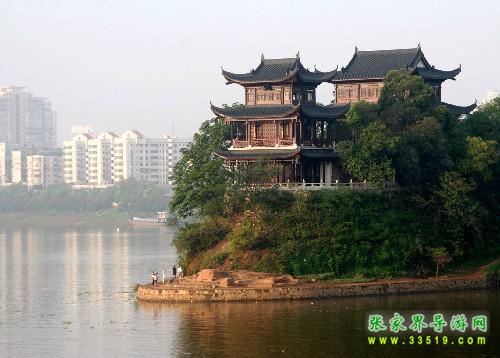
“The Shigu landscape is splendid and beautiful” — this is a poet's praise of the Shigu landscape. If you could visit in person, it would surely make you feel refreshed and delighted, lingering without wanting to leave, and you would feel that this poetic line still far from captures the full grandeur of the Shigu landscape. Shigu is located north of Hengyang City, at an elevation of 69 meters, covering an area of about 4,000 square meters. Though not as tall as Mount Lu with its “four hundred twists up to the verdant heights,” it has the same precipitous abruptness of “a mountain soaring by the great river.” Nor is it as majestic as Seven Star Rock with its “jade-like peaks arrayed beyond the window,” yet it possesses the same profundity of “immortal caves and precarious towers half emerging from the forest.” Its perilous mountain forms and elegant water colors truly make it a rare spectacle among the world's famous mountains and scenic waters. The Zheng River winds around its right, coming slowly from Shaoyang; the Xiang River embraces its left, surging from Lingling; the Lei River crosses before it, rolling from Chenzhou. The three waters converge, mighty and vast, flowing straight down to Dongting Lake. And Shigu stands right at the confluence, fearing not the wrath of the water god Fengyi, resisting the fury of Yanghou, cutting across the river's flow, calm and unperturbed — this is the timeless wonder of Shigu.
In spring, summer, autumn, and winter, the scenery has its own distinctive charm: in spring, sunlight pierces through the willow banks, waves dance and tides sing; in summer, mist locks the plank bridge, green shadows float with red hues; in autumn, water and sky merge in one color, sunbirds soar high; in winter, all is wrapped in silver, fishing alone on the cold river. Laiyan and Zhuhui, two pagodas stand before it; Yueping and Huiyan, two peaks flank behind it; Mount Heng stands to its northwest, the Five Ridges stretch across its southeast, concentrating the finest spirit of the Three Xiang and offering the most extraordinary views of all four seasons. As Fan Chengda of the Song Dynasty wrote in “Record of Shigu Mountain”: “Shigu occupies a great strategic meeting point, much like a hegemon of the Spring and Autumn period summoning the feudal lords to serve the king; the Zheng and Xiang rivers come together like brother states rushing to assemble, receiving orders and bearing records, proceeding in unison to pay homage. Such is its strategic position.” Liu Zongyuan of the Tang Dynasty praised it as “waters blue without a speck of dust.” Zhu Xi of the Song Dynasty hailed it as “encircled by river currents, the finest spot in the entire prefecture.” Huang Qinglao of the Yuan Dynasty called it “winding corridors and deep pavilions, distant peaks densely arrayed, towers and terraces as if suspended in the void — truly the finest scenic spot in Hunan.” Xu Xiake of the Ming Dynasty, after traveling the world, ascended Shigu and found it extraordinarily novel, considering that Shigu combined the advantages of such famous sites as “Tengwang Pavilion and Yellow Crane Tower,” and “was not comparable to Ji'an's White Egret.” When the name Shigu originated is too far back to verify. One account says that Shigu is open on all four sides and shaped like a drum, hence the name, as recorded in the “Commentary on the Water Classic”: “The mountain form is green and round, exactly resembling a drum; the mountain body is pure stone without soil, hence named for its shape.” Another account says it is because it is surrounded by water on three sides, and the waves striking the stone sound like a drum. Whether by observing its shape, following its sound, or both, looking at the whole it is but a fist-sized rock — how did the name Shigu spread far and wide, forever preserving its splendid years? According to the “Commentary on the Water Classic,” before the Qin Dynasty, the name Shigu was already recorded in historical texts. Its transformation from a natural scenic spot requiring no decoration or carving into a cultural resort renowned throughout the land was a matter of the period after the Han Dynasty.
Since the Han and Tang dynasties, generation after generation passed it down, famous worthies followed one after another, leaving behind countless traces and gathering countless anecdotes! It was first said to be the place where Zhuge Liang, the Marquis of Wu of Han, supervised taxes. The people of Hengyang, in memory of Zhuge Liang's noble integrity of “bending to the task until death,” built the “Marquis Wu Shrine” on the left of Shigu Mountain for worship. The place became famous through the person, and thus Shigu's name spread widely. The spirit of the mountains and rivers, the relics of former worthies, their fragrant fame endures forever, inscribed without boundary. Especially Han Yu's poem “Hejiang Pavilion”: “The red pavilion rests on the Xiang River, the Zheng waters meet on its left. Gazing out over the vast emptiness, so green and pure one could not spit into it…” was regarded as a masterpiece, adding luster to Shigu and color to the mountains and rivers. Poets and literati who matched its rhymes were never lacking through the ages. More than ten such poems are collected in the “Qingquan County Annals” and “Hengzhou Prefecture Annals.” Later generations also renamed “Hejiang Pavilion” as “Green Purity Pavilion,” taking the meaning of “leaving a masterpiece through the ages, so green and pure one could not spit into it.”
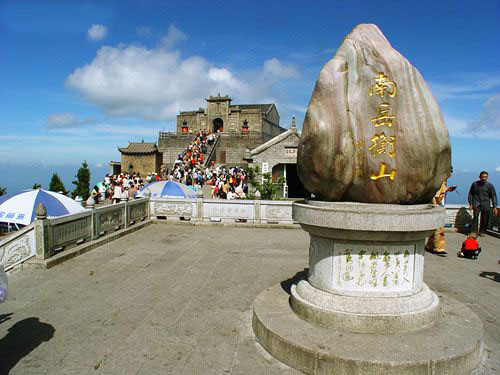
In the third year of the Zhidao era of the Song Dynasty (997), Li Shizhen of Hengyang Prefecture founded an academy. In the second year of the Jingyou era (1035 AD), the imperial court bestowed the plaque “Shigu Academy,” making it as famous as the Songyang Academy and White Deer Academy of the time, known as one of the four great academies of the nation. Zhu Xi, the Neo-Confucian philosopher and educator who synthesized the doctrines of Confucius and Mencius, lectured here, giving Shigu an unprecedented boost. Also, statesman Fan Chengda, Wen Tianxiang, military strategist and poet Xin Qiji, and thinker Wang Fuzhi visited or lectured here, composing immortal poems and carving indelible inscriptions, vividly and thoroughly depicting Shigu's scenic grandeur. Today, upon entering the main gate, on the right side of a rectangular lawn stands a large stone drum sculpture 2 meters high and 1.6 meters in diameter, symbolizing Shigu's scenic form. Ascending to the summit, there is a broad flower garden surrounded by winding corridors and pavilions, and iron and wooden railings are also installed at the cliff edges around the mountain. Above and below the former site of the Daguan Tower, the Hejiang Pavilion has been rebuilt and the Green Purity Pavilion restored, with green glazed tiles, flying eaves reaching the clouds, carved beams and painted rafters, flowing with color and brilliance. If one stands within the pavilions, there is no clamor of the dusty world to irritate the ear, no foul air to assault the heart. As an ancient poem says: “Shigu is truly as clear as in a mirror, pavilions and terraces ripple east of the painted bridge.” No wonder the ancients regarded this as a reading resort.