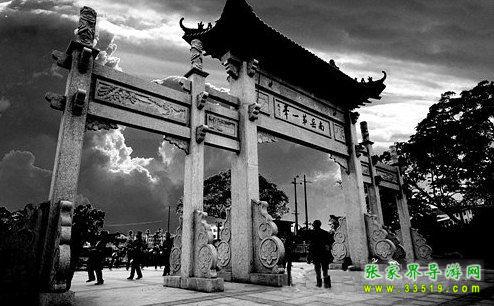
This attraction introduction is compiled from historical materials in the "Zhangjiajie Tour Guide Network" (33519.com · Scenic Spots section). Ticket prices, opening hours, transportation, and contact information mentioned in the text may be outdated. Please refer to the latest official announcements from the scenic area before traveling; some content consists of historical background/cultural introductions and is for reference only.
[Ticket Price Information Update · 2026-09-14]
- Hengshan Central Scenic Area: 110 yuan (ticket valid for 48 hours, with multiple entries and exits)
- Nanyue Grand Temple: 58 yuan (uniform price year-round from 2025-08-05); Shuilian Cave: 30 yuan; Wanshou Great Tripod: 29.5 yuan
If old ticket prices/opening hours appear in the main text, they are historical materials and may be outdated, for reference only.
Mount Heng (Nanyue Hengshan) is one of China's Five Great Mountains, located within Hengyang City, Hunan Province. Its peaks tower majestically, and its 72 peaks stretch 800 li across seven counties and cities. The main peak, Zhurong Peak, rises 1,290 meters above sea level. Since ancient times it has been renowned for its beautiful scenery as the finest of the Five Great Mountains, its long history and great fame, and the coexistence of Buddhism and Daoism with wide influence. It has long been known as the "Mountain of Longevity of China," the "Finest of the Five Great Mountains," and the "Civilized Wonderland." It is now a national key scenic area, a demonstration site of national civilized scenic tourist areas, and a national AAAA-level tourist area, receiving more than 3 million Chinese and foreign visitors each year.
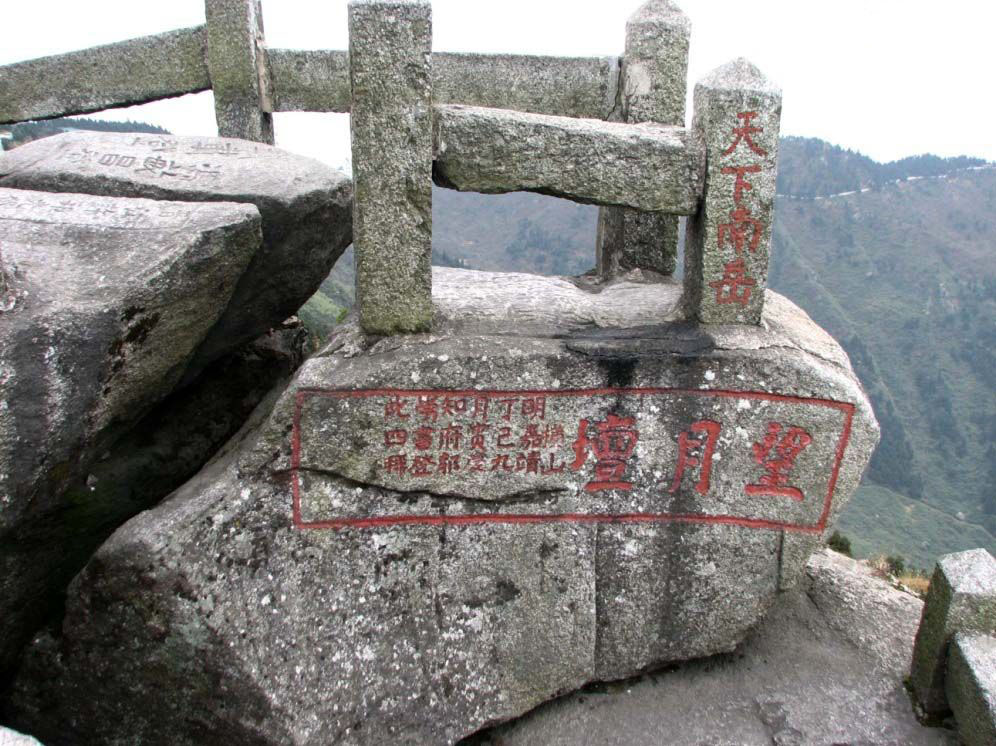
Mountain of Longevity of China: Nanyue's longevity culture has a long history. The Classic of Stars records that Mount Heng (Nanyue) corresponds to the Zhen star among the 28 lunar mansions, and the Zhen star governs the lifespan of all living beings, hence Nanyue is called the "Mountain of Longevity." Emperor Huizong of Song inscribed the giant stone carving "Shou Yue" (Mountain of Longevity) at Nanyue, which still stands today on Emperor Rock at Jinjian Peak. The first line of the Record of Rebuilding the Nanyue Temple, personally composed by Emperor Kangxi, reads: "Nanyue is the great guardian of the southern heavens, corresponding above to the Jade Balance of the Big Dipper, and is also called the Mountain of Longevity." Thus the emperor once again designated Nanyue as the "Mountain of Longevity." Historical records and gazetteers of successive dynasties also often respectfully referred to Mount Heng (Nanyue) as the "Mountain of Comparable Longevity" or the "Mountain Governing Longevity." Ciyuan defines "Shou Yue" as "Mount Heng (Nanyue)," and Nanyue is therefore honored as the "Mountain of Longevity of China."
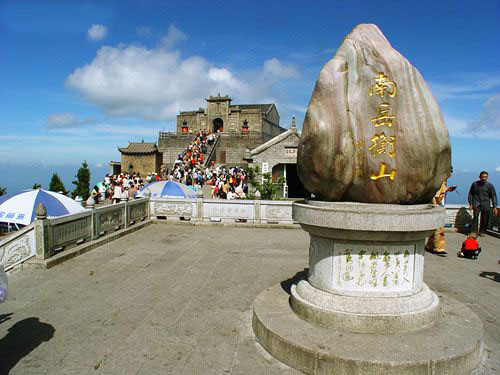
Long History: Nanyue was first enfeoffed in the Tang and Yu periods and was a place where ancient emperors made inspection tours and offered sacrifices. Legend has it that Yao, Shun, and Yu came here to sacrifice to the gods of soil and grain and to hunt on inspection tours; Yu the Great once killed a horse here to sacrifice to heaven and earth, obtained the "golden slip and jade book," and erected the "monument to flood control," leaving behind ancient sites such as Baima Peak, Jinjian Peak, and Yuwang City. Through the ages, famous thinkers, military strategists, statesmen, and men of letters—including Li Bai, Du Fu, Han Yu, Liu Zongyuan, Zhu Xi, Wang Chuanshan, Tan Sitong, Zhou Enlai, Ye Jianying, Guo Moruo, Tian Han, Tao Zhu, Hu Yaobang, Qiao Shi, and Zhu Rongji—came here drawn by its fame, leaving behind more than 3,700 poems, lyrics, songs, and rhapsodies and 375 cliff inscriptions at Nanyue, making it one of the treasure houses of Chinese national culture and art.
Coexistence of Buddhism and Daoism: Nanyue's feature of Buddhism and Daoism sharing one mountain and coexisting in one temple is unique among China's famous mountains. In the history of Chinese Buddhism and Daoism, Nanyue's Buddhism and Daoism held important positions, and exerted great influence especially in Japan and Southeast Asia and even worldwide. As early as the Western Zhou period, Daoism established cave-heavens and blessed lands at Nanyue, and by the Tang Dynasty there was the flourishing scene of the "Ten Great Forests" and "Eight Hundred Thatched Hermitages." Both religions had their doctrines and scriptures, and ultimately formed the distinctive feature of Buddhism and Daoism being jointly revered and flourishing together. With the gradual implementation of the Party's religious policy, the Buddhist and Daoist communities of Nanyue raised more than 80 million yuan and successively restored more than 10 temples, monasteries, palaces, and halls damaged during the Cultural Revolution, and added more than 100,000 volumes to their scripture collections.
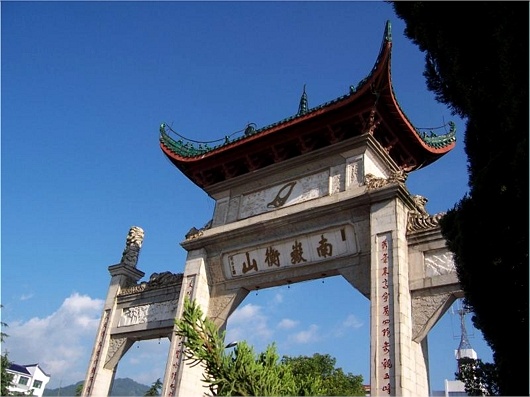
Among the Five Great Mountains, Mount Heng (Nanyue) enjoys better climatic conditions than the other four, with dense forests and tall bamboo everywhere, green all year round; rare flowers and exotic plants give fragrance in all four seasons, and the natural scenery is exceptionally beautiful, earning it the name "the Finest of the Five Great Mountains." The Qing-dynasty scholar Wei Yuan said: "Hengshan is like walking, Mount Tai is like sitting, Mount Hua is like standing, Mount Song is like lying down—only Nanyue alone is like flying." This is praise for Mount Heng.
"Seventy-two lotus blooms under the blue sky"—Mount Heng is composed of seventy-two towering peaks, including Yuelu Mountain in Changsha and Huiyan Peak in Hengyang. The first peak of Nanyue is right at the south gate of Hengyang's city center—Huiyan Peak. Starting northward from the "First Peak of Nanyue Under Heaven," driving by car along Zhengxiang North Road for more than an hour, with dozens of lotus-like, gracefully shaped peaks flashing past your eyes, you enter the scenic wonders of Nanyue. If traveling by train on the Beijing-Guangzhou Railway, you get off at Hengshan Station and transfer to a bus; after only 15 kilometers, you can fully enjoy the scenery of Nanyue.
The beauty of Nanyue lies in the fact that no mountain is without greenery, no mountain is without trees. The continuous, flowing mountain ridges and the dense forests covering the mountains stay green through all four seasons, like a vast natural park. With deep forests and abundant trees, just hearing the names of the trees is moving enough: golden larch, Chinese yew, Bretschneidera, silver magpie tree, fragrant fruit tree, white sandalwood, green cypress, as well as the evergreen camphor, the wondrous scented daphne, the fiery red maple groves, and ancient vines. According to statistics, Nanyue has more than 1,700 kinds of landscape trees and other plants. This is the crystallization of the blood and sweat of dozens of generations, and many of them are rare treasures. The ginkgo at Fuyan Temple is said to have been ordained by the Chan master Huisi during the Six Dynasties period, making it at least 1,400 years old; its trunk cannot be encircled even by three adults joining hands. The white magnolia behind the Sutra Library Hall is also four to five hundred years old, yet still blooms every spring, its fragrance filling the mountain. The ancient pines at Banshan Pavilion, at three or four hundred years old, are still mere youngsters! In the primeval forest behind Shangfeng Temple, many trees are decrepit, bent and hunched, covered in moss, with no visible grain. At first glance, they grow gnarled and unspreading, with irregular crowns, twisted roots and tangled branches, leaning on one another, like a group of ragged old men in bitter cold huddling together for warmth—arousing pity rather than admiration for their elegance. Yet on this high mountain pass, through hundreds and thousands of years, amid the "relentless assault of wind like knives and frost like swords," they hold each other tightly, supporting one another; some even grow from the same root, their branches intertwined—not only standing out in beauty, but also deep in affection.
If Nanyue were only the beauty presented by these trees, it would not be enough to make it so remarkable among the famous mountains of the world. This beauty is only its external charm; that within this beauty there is the "supreme" is its profound inner meaning. People summarize Nanyue's scenic wonders as the "Eight Supremes of Nanyue," namely: "the height of Zhurong Peak, the elegance of the Sutra Library Hall, the depth of Fangguang Temple, the seclusion of Mojing Terrace, the wonder of Shuilian Cave, the antiquity of the Yu Stele, the grandeur of the Nanyue Temple, and the peril of Huixian Bridge." It is precisely because the "Eight Supremes of Nanyue" are outstanding that it has earned the well-deserved title of "the Finest of the Five Great Mountains."
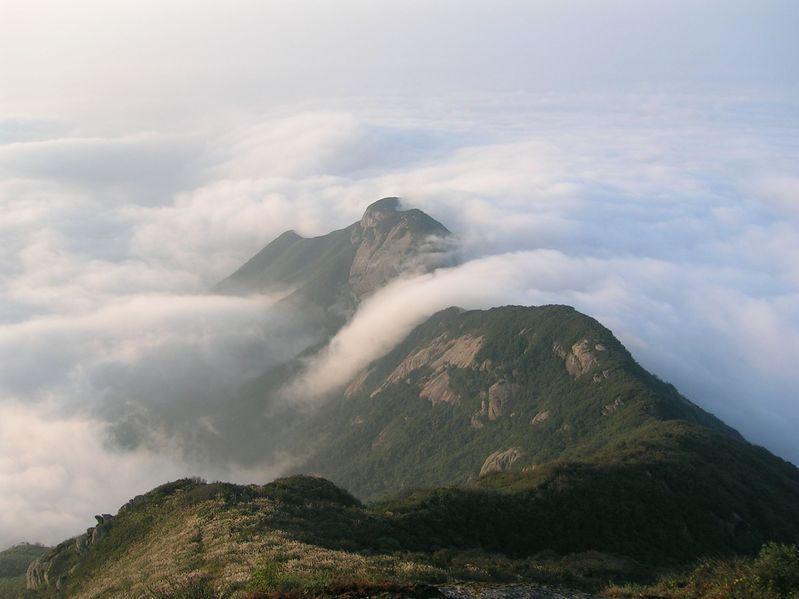
At the mountain summit stands Zhurong Peak, 1,290 meters above sea level. Set off by mist and clouds and layered against the surrounding peaks, it forms the majestic posture of "Zhurong rising ten thousand zhang from the ground, seen yet unseen amid the light mist." Climbing atop it, one can see to the north the vast misty waves of Dongting Lake, faintly visible; to the south, rows of peaks like screens and barriers, with the Xiang River winding like a jade belt; to the west, the snowy peaks with silver waves surging—a myriad of scenes all taken in at a glance.
The Sutra Library Hall in the mountains is hidden deep in a secluded valley, surrounded by ancient towering trees and shaded by green branches. Birds fly and streams flow, their calls answering one another, showing boundless vitality and a serene, transcendent quiet.
Fangguang Temple has beautiful forests, springs, and mountain ridges, with a deep and serene environment. Visitors here are sure to feel a sense of "deep seclusion," hence the predecessors' saying: "Without reaching Fangguang, one cannot know its depth."
Standing on Huixian Bridge, looking around at rare treasures, golden radiance and surging green waves create a magnificent spectacle. One can also see a huge rock beside Zhurong Peak shaped like a turtle, known as "Golden Turtle Paying Homage to the Sage." The peril of the bridge can truly be called supreme—truly, infinite scenery lies on the perilous peak.
Below the mountain lies Shuilian Cave, where a flying waterfall pours down like a cascade, its curtain-like shadow hanging high. Bi Tian of the Song Dynasty wrote a poem on Shuilian Cave specifically describing its wonders: "At the cave mouth a thousand feet of flying stream hangs down, jade shattered and pearls strung, cold spray in autumn; through the ages no one knows who rolled it up—green vines for a belt, the moon for a hook." This shows how extraordinary the scenery is.
Nanyue is also a famous Buddhist holy site. Within hundreds of li around the mountain, there are more than 200 temples, monasteries, nunneries, and Daoist abbeys. The Nanyue Grand Temple in the ancient town of Nanyue is the largest ancient architectural complex in Jiangnan, China, covering more than 9,800 square meters and modeled after the layout of the Forbidden City in Beijing, with nine successive courtyards. The grand temple faces south, surrounded by red walls with towering corner towers. The Shoujian Mountain spring flows around the walls. Inside the temple, there are 8 Daoist abbeys on the east side and 8 Buddhist temples on the west side, symbolizing the equal coexistence of Buddhism and Daoism at Nanyue. The Nanyue Grand Temple is a treasure of historical significance and artistic value; its grand scale, exquisite architecture, complete structure, and meticulous layout are truly rare. In the ancient town of Nanyue there is also an ancient Buddhist temple—Zhusheng Temple. It is located on the east street of the town and, together with Nantai Temple, Fuyan Temple, and Shangfeng Temple on the mountain and Qingliang Temple outside Hengshan City, is collectively known as one of the Six Great Buddhist Forests of Nanyue. Legend has it that Yu the Great came here while controlling the floods and established Qingleng Palace here to make offerings to Emperor Shun. During the Kangxi reign of the Qing Dynasty, it was extensively rebuilt as an imperial traveling palace and renamed Zhusheng Temple. Now the temple is surrounded by verdant ancient trees, with incense smoke curling inside and the sound of wooden fish and bells and chimes never ceasing; Buddhist images and statues fill the eye. Those interested may also go inside to chat with the monks and taste Nanyue's famous vegetarian feast. Others such as Guangliu Temple, Xiangnan Temple, Danxia Temple, Tiefo Temple, Fangguang Temple, Chuanfa Court, and Huangting Abbey are all ancient temples from before the Ming Dynasty; though differing in scale, each has its own charm.
Mount Heng (Nanyue) also has many scenic spots, historic sites, and myths and legends that have attracted people of all kinds through the ages, forming a rich and colorful cultural accumulation, like a vast giant park where human culture and landscape culture are harmoniously unified and seamlessly blended.
Best Time to Visit Mount Heng
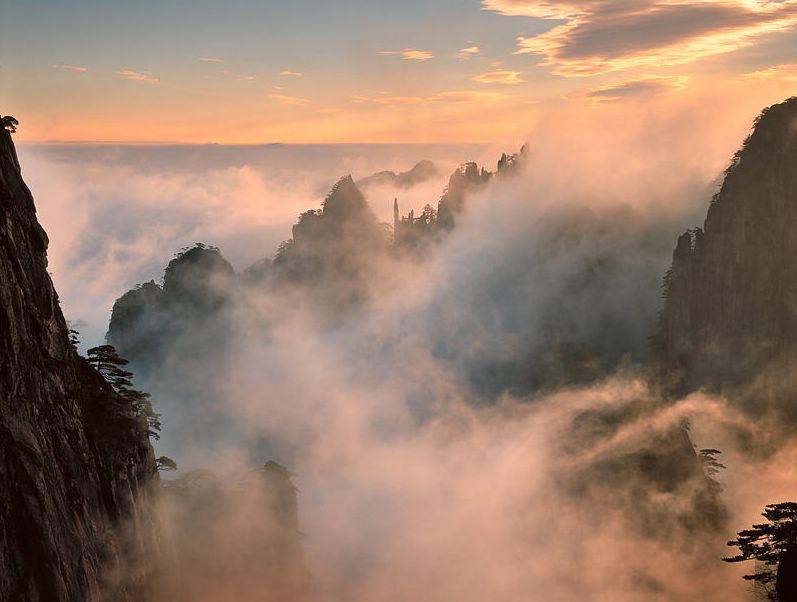
Mount Heng's scenery is at its finest in each of the four seasons: in early spring you can enjoy the profusion of flowers, in midsummer you can watch the sea of clouds, in golden autumn you can gaze at the sunrise from afar, and in winter you can admire the snow scenery.
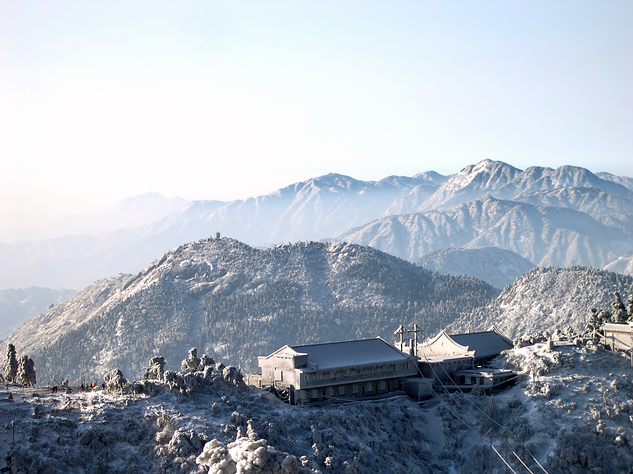
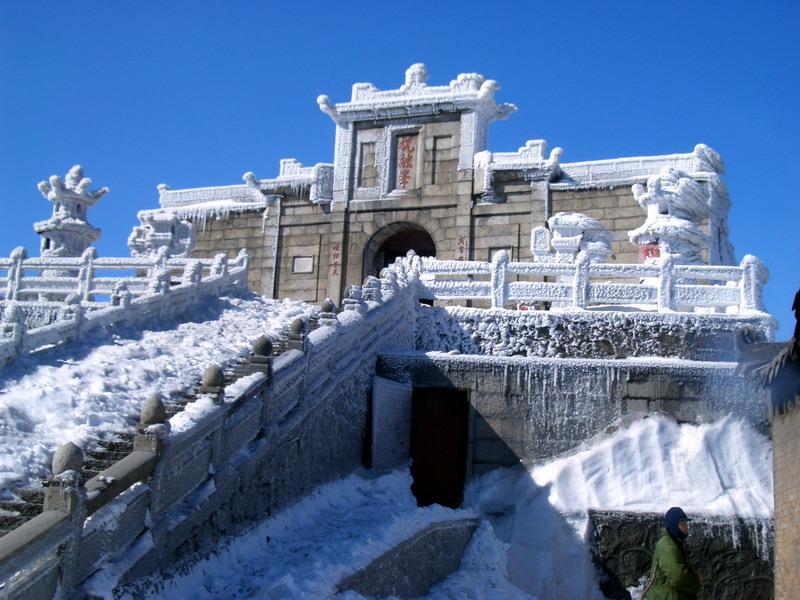
The best tourist season for Mount Heng is late summer and early autumn, when the weather is cool, the vegetation is still lush, and the scenery is relatively beautiful; of course, from December to early February of the following year, you can enjoy the famous snow scenery of Mount Heng. Due to special climatic conditions, Mount Heng has the wonder of rime ice that nowhere else in the south has.
Mount Heng Cuisine
As a famous Buddhist mountain, Nanyue's cuisine is naturally mainly vegetarian. Nanyue vegetarian cuisine began in the Eastern Jin Dynasty, and over more than a thousand years its techniques have become increasingly refined, developing from ordinary vegetarian food to high-grade vegetarian banquets, which the major temples and restaurants are all skilled at preparing.
The Nanyue vegetarian banquet uses various vegetarian dishes to imitate banquets bearing the same names as meat dishes. The main ingredients are local mountain delicacies and seasonal fruits and vegetables, such as Hunan lotus seeds, mushrooms, bamboo shoots, and red and white radishes. The dishes are mainly cooked in vegetable oil, sesame oil, and peanut oil, seasoned with scallions, garlic, ginger, and chili, with flavors that are sour, sweet, spicy, and crisp. The vegetarian banquet usually includes: First-Rank Fragrance, Second Plum Blossom, Three-Fresh Soup, Four Seasons Green, Five Lanterns Gathering, Six Sons in a Row, Seven-Story Tower, Eight Great Bowls, Nine as You Wish, and Ten Varieties Scene.
Getting to Mount Heng
External Transportation
To visit Mount Heng, you can take a train and get off at Hengshan Station; alternatively, you can get off at Hengyang or Zhuzhou Railway Station. All three stations have shuttle buses to Nanyue District of Hengyang City (formerly Nanyue Town, the gateway to the Mount Heng scenic area). There are roads on the mountain; at the foot of the mountain you can take a tourist shuttle or taxi to Banshan Pavilion and Mojing Terrace.
Visitors coming from the direction of Guangdong and Guangxi can take the Beijing-Guangzhou or Hunan-Guangxi railway to Hengyang, get off, then take a city bus to Hengyang West Bus Station and transfer to a Hunan Transport long-distance bus, getting off at Nanyue District Bus Station—a journey of 45 kilometers.
Visitors coming from the direction of Beijing and Zhengzhou can take the Yuehan railway to Changsha and get off. Then from Changsha South Bus Station take a Hunan Transport long-distance bus and get off at Nanyue Town Bus Station (about 150 kilometers); you can also get off the train at Zhuzhou, Hengyang, or Hengshan Station and transfer to a Hunan Transport bus to Nanyue District (distances of 135, 45, and 15 kilometers respectively).
Visitors coming from the direction of Shanghai and Fujian can take the Zhejiang-Jiangxi railway to Zhuzhou or Changsha and get off, then transfer to a Hunan Transport bus and get off at Nanyue District (distances of 135 and 150 kilometers respectively).
Visitors coming from the direction of Yunnan and Guizhou can take the Hunan-Guizhou railway to Zhuzhou—Qingshuitang and get off, then transfer to a bus to Nanyue Town; or get off at Changsha and take a Hunan Transport bus to Nanyue Town.
Internal Transportation
Within the Mount Heng scenic area you can ride the Nanyue cableway. This cableway is 1,710.8 meters long in total, with a vertical drop of 472 meters; riding it allows you to easily enjoy the mountain scenery.
Ticket Prices
Mount Heng: 100 yuan; students (including university students) uniformly get a 50% discount
Nanyue Grand Temple: 40 yuan, plus an additional 2 yuan incense insurance; Shuilian Cave scenic area: 20 yuan