This attraction introduction is compiled from historical materials in the "Zhangjiajie Tour Guide Network" (33519.com · Scenic Spots section). Ticket prices, opening hours, transportation, and contact information mentioned in the text may be outdated. Please refer to the latest official announcements from the scenic area before traveling; some content consists of historical background/cultural introductions and is for reference only.
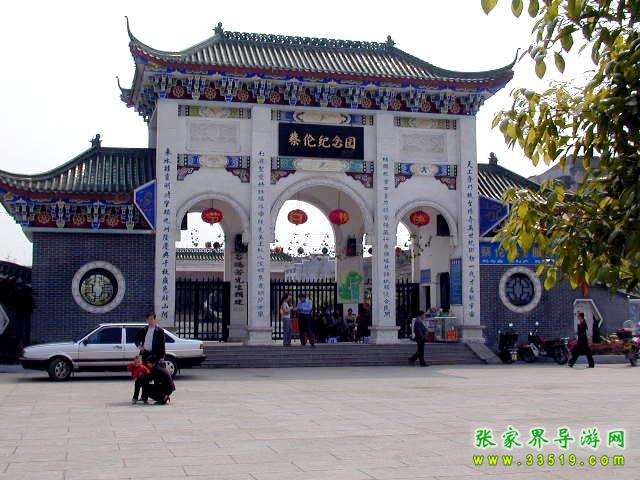
The Cai Lun Memorial Park in Leiyang City, Hunan Province, is an important site built by the CPC Leiyang Municipal Committee and the Leiyang Municipal People's Government to commemorate the great inventor of papermaking, Cai Lun. It is located by Caizi Pond on Caihou Road in Leiyang City, covers an area of 116 mu, with an investment of 140 million yuan, and reopened to the public on August 28, 2001. It is an important national tourist attraction.
Paper and papermaking are one of the Four Great Inventions of ancient China. In the first year of the Yuanxing reign of the Eastern Han (105 AD), Cai Lun used cheap and readily available materials such as tree bark, waste hemp, old cloth, and worn fishing nets to produce a lightweight, inexpensive plant-fiber paper suitable for writing, historically known as "Cai Hou paper." It replaced cumbersome bamboo slips and expensive silk, making outstanding contributions to the spread of human culture and the progress of world civilization, and has been revered and commemorated by people for thousands of years. The existing Cai Hou Shrine, Caizi Pond, stone mortar, and the Cai Lun papermaking workshop in the park are important historical witnesses to Cai Lun's synthesis of predecessors' experience, his invention of papermaking, and the generations of people who applied and spread papermaking technology. They are important physical materials for studying Cai Lun and the history of papermaking craftsmanship.
Since the founding of the People's Republic, Cai Lun Memorial Park has become an important site for promoting science, transmitting civilization, and conducting patriotism education, receiving attention from central leaders and widespread concern from all sectors of society. Guo Moruo, Zhou Gucheng, Hu Sheng, Zhou Guangzhao, Mao Zhiyong, and others have successively inscribed calligraphy for Cai Lun's Tomb, the Cai Lun Memorial Hall, the Cai Lun Memorial Park, and the Science and Technology Inventors' Square. In 1985, the Hunan Provincial People's Government designated the Cai Hou Shrine and Cai Lun's Tomb as provincial key cultural relics protection units. In 1996, the State Education Commission, the Ministry of Civil Affairs, the Ministry of Culture, the State Administration of Cultural Heritage, the Communist Youth League Central Committee, and the General Political Department of the People's Liberation Army named the Cai Hou Shrine (Cai Lun Memorial Hall) as one of the hundred "National Patriotism Education Bases for Primary and Secondary Schools."
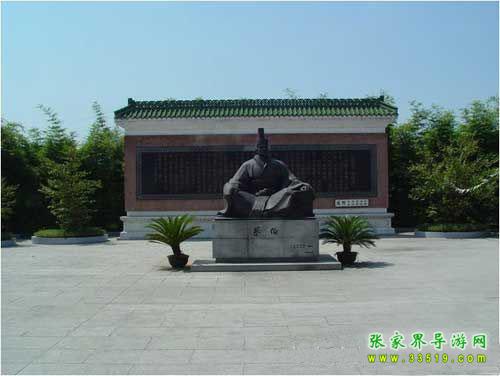
Cai Lun Bronze Sculpture
The statue is 3.7 meters tall, designed by Professor Hu Bo of the Guangzhou Academy of Fine Arts and produced by the Guangzhou Daguan Environmental Sculpture Studio. Cai Lun's image features sword-like eyebrows and bright eyes, a full forehead, and a tall, stalwart figure, expressing the demeanor of a great nation. Cai Lun sits on the ground in accordance with the seating customs of his era. His left hand rests on a stack of paper, his right long sleeve falls naturally over his right knee, and his slightly tilted head gazes into the distance as if deep in thought, expressing the inventor's distinctive intelligence and wisdom, indomitable character, and unyielding spirit.
Caizi Pond
Rectangular, 190 meters long and 47 meters wide. Legend has it that it was built when Cai Lun returned to his hometown to teach papermaking. The pond water is clear and shimmering, with green trees providing shade. Later the banks collapsed and the pond silted up, becoming desolate. Since 1949, the Leiyang Municipal People's Government has repaired it several times, lining the banks with stone strips, with green trees gracefully surrounding the pond and a stone bridge (2 meters wide, 47 meters long). On moonlit nights on the stone bridge, one can see the reflection of a double moon rippling in the pond. A poem on the Eight Scenes of Leiyang says: "Only the double moon of Cai Pond is beautiful." In 1997, a stone pavilion was built on the bridge, named "Double Moon Pavilion," also known as "Sihou Pavilion."
"Huaisheng Terrace"
Covering an area of 2,000 square meters, in a half-moon shape. The terrace surface is paved with 1,600 square meters of granite, and the perimeter is inlaid with 99.8 meters of white marble railings. The relief wall has a radius of 19 meters, an arc length of 55 meters, and an effective picture area of 43 meters. It displays the entire process of Cai Lun's tireless and dedicated invention of papermaking, highlighting the great contribution of "spreading to all nations, none but Lun's paper." "Huaisheng Terrace" was first built in August 2001 and named by then Municipal Party Secretary Comrade Lei Liangyu.
Stele Corridor
66.8 meters long and 3.6 meters wide, it is a semi-enclosed pseudo-classical garden structure laid out in a zigzag shape. The stele corridor has 44 cylindrical columns and 75 marble steles. The inscriptions consist of construction records, evaluations of Cai Lun by notable figures and famous works from ancient and modern times, and reserved space for future generations to continue the records. The construction techniques adopt the traditional Chinese architectural style of golden dragon and imperial seal polychrome painting. The entire stele corridor is carved with dragons and painted with phoenixes, resplendent and full of color. Construction of the stele corridor began in August 2001.
Cai Lun Papermaking Workshop
In August 2001, the Cai Lun Papermaking Workshop was rebuilt on its original site in the architectural style of the Eastern Han Dynasty. It is said to be the place where Cai Lun taught his apprentices to make paper. The workshop displays the ancient papermaking processes of soaking materials, pounding materials, sheet-forming, pressing paper, separating paper, and drying (or air-drying, sun-drying) paper. It also houses the stone mortar said to have been used by Cai Lun for pounding materials when he taught papermaking: the "Cai Lun Paper-Pounding Mortar." Visitors can operate it themselves to experience this ancient papermaking craft and can keep the coarse paper they make as a souvenir.
Incense Burner and Precious Tripod
In the Cai Lun Memorial Park, there is a hexagonal pavilion. Inside the pavilion stands a white marble stone carving called the "Treasure Tripod," which consists of two parts: upper and lower. The upper part has a four-cornered pyramidal roof, with the two characters "Treasure Tripod" engraved in intaglio on its front, and a couplet also engraved in intaglio that reads: "A fire burning for a thousand years within the stove, ten thousand generations of fragrance in the vase." It was added during the Qianlong reign of the Qing Dynasty, with the stone inscription "Erected in mid-spring of the 35th year of the Qianlong reign of the Qing Dynasty." The middle section is drum-shaped, resting on a Sumeru pedestal, appearing quite antique and elegant, and at the latest it must be an artifact from the Tang Dynasty. Originally, it was said there were two of these tripods, but only one remains today. It was used by the people of Leiyang to burn paper money in sacrifice to Cai Lun.
Cai Hou Shrine
Originally the former residence of Cai Lun (63–121 AD), the Eastern Han inventor of papermaking. Later generations built a shrine on the site of his residence to commemorate Cai Lun. The "Commentary on the Water Classic" records: "(The Leishui River) flows northwest past Cai Zhou; west of the island is Cai Lun's former residence, beside which is Caizi Pond."
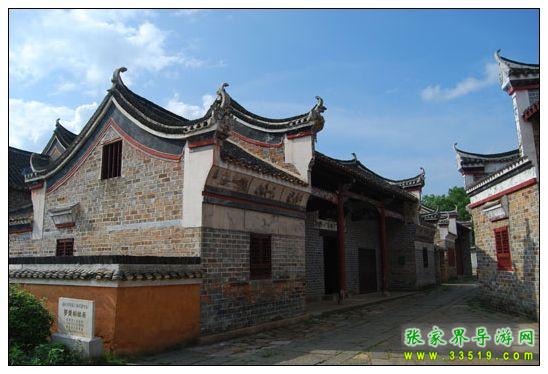
The exact date of the Cai Hou Shrine's original construction is unknown. It was rebuilt in the fourth year of the Zhiyuan reign of the Yuan Dynasty (1338) by Chen Zongyi, the prefect of Leiyang. After several cycles of decline and restoration, the existing building was rebuilt in the Qing Dynasty and is simple and elegant. It covers an area of 408 square meters, faces south with its back to the north, and has a brick-and-wood structure. It consists of three sections and two courtyards. The front hall has three bays with a single-slope small green-tile roof, with corridors on both sides; the central axis has a covered passage connecting to the middle hall. The middle and rear halls have three bays each with overhanging gable roofs, also connected by walkways and passages. The stone plaque on the main gate reads "Cai Hou Shrine," and the stone couplet reads: "The fragrant pond reflects the moon; the style of the old residence endures."
Cai Lun Ancient Well
18.3 meters deep and 0.9 meters in diameter, a cylindrical vertical well with walls of hard yellow clay, and the well surround paved with granite, 3.9 meters long and 3.9 meters wide. It is said to be the well from which Cai Lun drew drinking water. The water is clear with a sweet taste and quality, and is said to strengthen the body and prolong life. After Cai Lun went to the capital to serve as an official, the Zi family moved to this place. Later generations, remembering the source of the water, repaired and expanded it on the original site as a memorial.
Cai Lun's Tomb
Built in the late Eastern Han Dynasty, it is Cai Lun's cenotaph. The tomb is a single-chamber barrel-vaulted brick tomb. The chamber is 2.2 meters high, 7.84 meters long, and 2.7 meters wide, with a granite tomb enclosure. There is a tomb gate and steps leading into the chamber, and the bricks bear geometric patterns common to Han tombs. In August 2001, the Leiyang Municipal People's Government built a stele-protecting pavilion in front of the tomb. The front of the tombstone bears the inscription "Tomb of Cai Lun" written by Guo Moruo in 1959; the back bears an epitaph written by the Leiyang Municipal People's Government for Cai Lun.