This attraction introduction is compiled from historical materials in the "Zhangjiajie Tour Guide Network" (33519.com · Scenic Spots section). Ticket prices, opening hours, transportation, and contact information mentioned in the text may be outdated. Please refer to the latest official announcements from the scenic area before traveling; some content consists of historical background/cultural introductions and is for reference only.
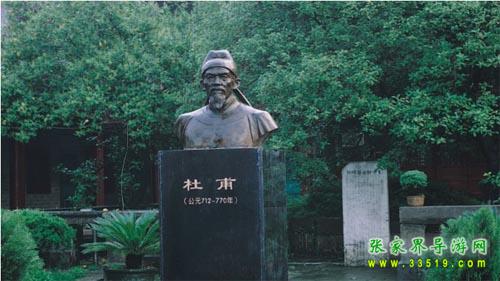
In the fourth year of the Dali reign of the Tang Dynasty (769 AD), Du Fu entered Hunan from Hubei, ascended the Yueyang Tower, toured Dongting Lake, and traveled up the Xiang River to Leiyang, where he died of illness in April of the following year. According to the "Old Book of Tang: Biography of Du Fu," Du Fu was visiting the Yue Temple in Leiyang when "a great flood suddenly came, and for ten days he had no food. The county magistrate sent him beef and white wine; Du Fu drank too much and died one night," and was buried here. Around his tomb there is a stone railing, covering an area of one hundred square meters. The tomb is round, about 12 meters high, with a base diameter of 5 meters. The tombstone is inscribed "Tomb of Duke Du, Ministry of Works of Tang," with the postscript "Erected by County Magistrate Wang He in the Guihai year of the Jingding reign of the Song Dynasty." It is a provincial key cultural relics protection unit.
Located within Leiyang No. 1 Middle School in the northern urban area of Leiyang. In the third year of the Dali reign of the Tang Dynasty, Du Fu went down the gorges to Jingnan and traveled up the Yuan and Xiang rivers to ascend Mount Heng. In the fifth year of Dali, he continued toward Chenzhou to visit relatives but was blocked by the sudden rise of the Leishui River and stayed in Leiyang, where Magistrate Nie of Leiyang received him as an honored guest. That year, Du Fu contracted an epidemic disease and died. Magistrate Nie arranged his burial and built the tomb, oriented with its back to the scriptures and facing south, with stone railings around the tomb and a Southern Song stone carving on the front reading "Tomb of Duke Du, Ministry of Works of Tang." In the fourth year of the Tianyou reign of the Tang Dynasty (907), the Du Gong Shrine was built around the tomb, facing south with its back to the north, a courtyard-style enclosed multi-story building with a earth-and-wood structure. The main hall in the center houses a sandalwood statue of Du Fu, and there are more than ten rooms in the east and west wings for sacrifices and tomb-keeping. In the Song Dynasty, the Duling Academy was established on the site of the Du Gong Shrine. In 1940, Du Fu's Tomb was repaired, and a stone stele inscribed by Provincial Chairman Xue Yue commemorating the repair of the Tomb of Duke Du of the Ministry of Works was erected in front of the tomb. In July 1956, the tomb and shrine were designated as a Hunan provincial key cultural relics protection unit. In 1975, when Leiyang No. 1 Middle School was established, the main hall of the shrine was demolished, leaving only the west wing of the rear section and a damaged stele by the Qing scholar Peng Ershu. In 1996, the municipal government repaired the tomb and the remaining buildings.