This attraction introduction is compiled from historical materials in the "Zhangjiajie Tour Guide Network" (33519.com · Scenic Spots section). Ticket prices, opening hours, transportation, and contact information mentioned in the text may be outdated. Please refer to the latest official announcements from the scenic area before traveling; some content consists of historical background/cultural introductions and is for reference only.
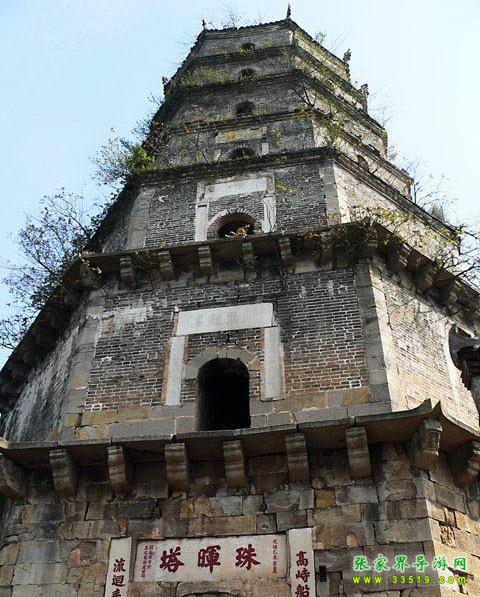
Zhuhui Pagoda is one of the three pagodas of Yancheng. It is located in Outang Village of Chashanao Town, standing majestically on Baiting Mountain on the east bank of the river. It was initiated and built by Wang Zhichun, a native of Hengyang who served as Anhui Provincial Governor during the Qing Dynasty, costing 60,000 taels of silver and taking 13 years, and was completed in the Dingyou year of the Guangxu era (1897).
The pagoda is 10 zhang 5 chi tall, of brick-and-stone construction, with seven stories and eight edges, and a spiral stone staircase. The main gate faces southwest, and above it a white marble horizontal plaque is engraved with the three large regular-script characters "Zhuhui Pagoda," while on both sides white marble is carved with a regular-script couplet: "Towering high at Chuanshan, far extending the veins of learning; flowing back to the Lei River, broadly aiding the waves of culture." Around the base of the pagoda are carved figures of birds and beasts, and within the pagoda's arched doorways are embedded stone inscriptions, written by Wang Xianqian, Jiangsu Education Commissioner, and inscribed by Huang Ziwen, Prefect of Ningxia; originally there were 6 blocks, of which 4 remain. In front of the pagoda were built corridors and several monks' rooms. The copper finial at the top of the pagoda shines in the sunlight.
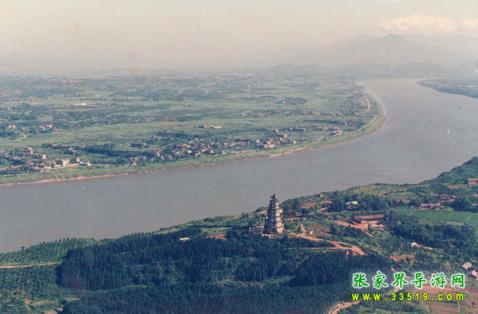
Why is the pagoda so named? Because of its high position, it welcomes the morning glow at dawn and is draped in rosy clouds at dusk, dazzling to the eye like pearls and jade giving off radiance, hence the name. Climbing to the top of the pagoda, one can take in the magnificent mountains and rivers for dozens of li around. Looking south to Yancheng, the scene is infinitely varied; gazing north to Mount Heng, there are sails and sand birds, and a vast expanse of mist, making one feel relaxed and joyful. Below the pagoda is the May Fourth Tree Farm, with shady trees and fragrant wild flowers, whose serene and beautiful charm surpasses even that of the Laiyan and Jielong pagodas.
Hengyang's mountains and rivers are spiritually beautiful, and its literary elegance and refinement converge between the Xiang River and the Lei River. The Zhuhui Pagoda was built to face the original Laiyan Pagoda across the river, forming a mutually supporting corner, locking in the feng shui so it would not dissipate, and ensuring that Hengyang's spiritual veins and earthly energy would forever remain undiminished.