This attraction introduction is compiled from historical materials in the "Zhangjiajie Tour Guide Network" (33519.com · Scenic Spots section). Ticket prices, opening hours, transportation, and contact information mentioned in the text may be outdated. Please refer to the latest official announcements from the scenic area before traveling; some content consists of historical background/cultural introductions and is for reference only.
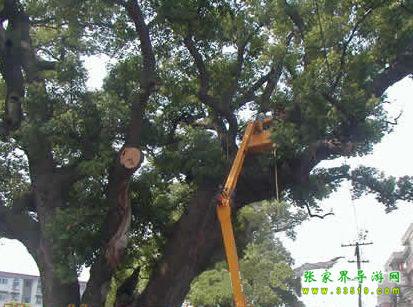
On Huangchaling Main Street in Yanfeng District, Hengyang, there are two huge ancient camphor trees with trunk circumferences of more than 11 meters. According to the "Hengyang City Gazetteer," these two trees have a verifiable history of at least 1,240 years. In the past, when Huang Chao's uprising forces were here, horses were tied to these trees, and for this reason Huangchaling is also called Huangchao Ridge.
The planned area of the Ancient Camphor Park is 161,500 square meters, of which the park paths and revetment area is 14,180 square meters, the water body area is 5,590 square meters, the paved area is 22,600 square meters, architectural ornaments cover 6,400 square meters, and the green area is 112,730 square meters.
At Huangchaling in Yanfeng District there are two thousand-year-old ancient camphor trees to which Huang Chao, the peasant uprising leader of the late Tang Dynasty, once tied his horse. Their branches are luxuriant and their canopy like clouds. In the past they were always hidden among low, old residential buildings and attracted little attention. According to the city's plan, the dilapidated houses around the ancient trees have now been demolished, and an Ancient Camphor Park integrating viewing and leisure has begun to take shape.
Facing this ancient tree in such a conspicuous position, people cannot help asking: Why is this tree so coincidentally located right in the middle of the railway station square? Was the station built first and the tree transplanted later, or was the tree there first and the station built afterward?
The answer is: the tree was there first, and the station was built later. The tree's special, prominent position was deliberately arranged in the railway design.
The reason for such certainty is that Engineer Huang Quan, who participated in the survey and design of this railway in those years, taught at the Central South College of Civil Engineering and Architecture in the 1950s. According to the recollection of Teacher Wen Minsheng, who studied there at the time and now teaches at Hengyang Railway No. 1 Middle School, when Teacher Huang Quan lectured on "Selection and Design of Surface Features and Railway Routes," he discussed the selection and design of Hengyang Station. At that time, in order to protect this centuries-old ancient camphor tree and make full use of its historical value to deepen passengers' impression of Hengyang Railway Station, it was decided to determine the central position of Hengyang Station according to the location of the ancient camphor tree, so that it could be appreciated by more people and add a touch of charm to Hengyang Station.
However, there is another folk tale about how the ancient camphor tree escaped being cut down when the station was being built. It is said that during the construction of Hengyang Station, many trees were felled, and this ancient camphor tree was also slated for cutting. But on the night before it was to be cut, the organizer of the tree-cutting had a dream in which a white-bearded old man said to him: "This tree is my home. Please do not cut it down. Otherwise, your life will be in danger." But the organizer had no authority to decide whether the camphor tree should be cut or kept, and he did not believe in dreams. The next day, he organized the workers as usual to cut down the ancient camphor tree. When the workers struck the first axe blow, something unusual happened: from the cut flowed a yellowish liquid tinged with red, and they immediately reported it to the organizer. Without thinking, the organizer uttered the word "Cut." Who would have thought that when the second axe blow fell, the axe head flew off its handle and headed straight for the organizer's head. Terrified, he dodged to one side, and the axe head whistled past his forehead and landed heavily beside his feet. Only then did he remember the dream from the night before. He hastily covered the wound on his forehead with one hand and waved the other wildly: "No more cutting, no more cutting!" Later, after requests and reports were made, this ancient green life was preserved, and only then could people passing through Hengyang today behold the elegance of this famous ancient camphor tree, nearly four hundred years old and still full of vitality.