This attraction introduction is compiled from historical materials in the "Zhangjiajie Tour Guide Network" (33519.com · Scenic Spots section). Ticket prices, opening hours, transportation, and contact information mentioned in the text may be outdated. Please refer to the latest official announcements from the scenic area before traveling; some content consists of historical background/cultural introductions and is for reference only.
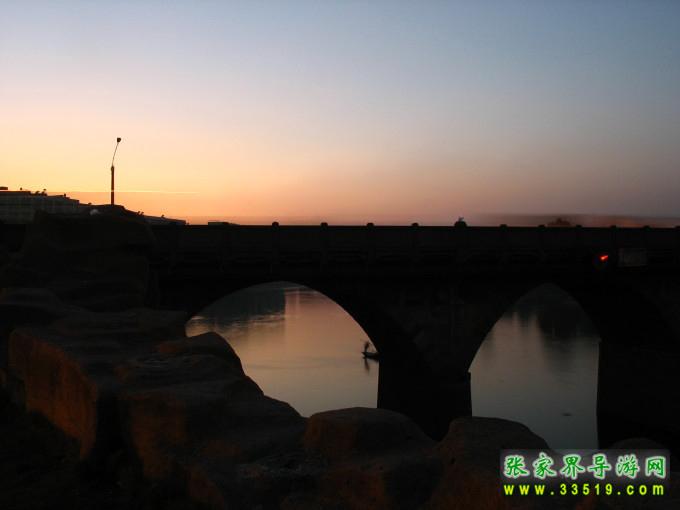
"The Eight Views of Xiao and Xiang are hard to paint; I especially love Hengyang's Qingcao Bridge. After rain, leaning on the railing as the new moon rises, fishing songs echo as oars splash and sway." This is praise for Qingcao Bridge from Zhu Peilian's "Miscellaneous Chants of Qingquan" in the Qing Dynasty.
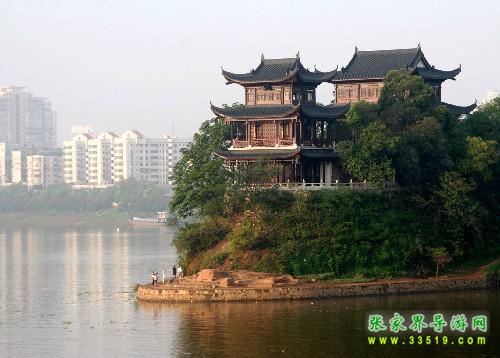
At the confluence of the Zheng and Xiang rivers, beside the left side of Shigu, stands Qingcao Bridge. From its construction to the present, it has lasted nearly eight hundred years. In the thirteenth year of the Chunxi reign of the Southern Song Dynasty (1186 AD), when Xue Boxuan served as prefect of Hengzhou, he built a wooden bridge at Qingcao Ferry, which was the first generation of Qingcao Bridge. Beginning in the third year of the Zhengtong reign of the Ming Dynasty (1438 AD), it took more than four years to complete a stone bridge, renamed Yong Bridge. In the second year of the Yongzheng reign of the Qing Dynasty (1724 AD), railings were built; after reconstruction during the Qianlong reign, it was still called Qingcao Bridge. In 1933, the north and south arches were destroyed by floods, and the following year it was repaired as a seven-arch bridge. In 1944, it was bombed and destroyed by the Japanese invaders. In 1956, the Municipal People's Government rebuilt a spacious stone bridge, which opened to traffic on New Year's Day the following year. Qingcao Bridge spans north and south like a rainbow, with boats shuttling beneath, making it appear even more graceful.
Qingcao Bridge was originally a semicircular arch bridge with pointed piers, of relatively high architectural artistry, demonstrating the wisdom and talent of the ancient people of Hengyang. On both ends of the bridge, shops were packed closely together, making it a bustling place for market trade. Together with the famous scenic spot of Shigu Mountain, it attracted many visitors. Among the shops, wine houses were especially numerous, hence the line in the Eight Views: "At the head of Qingcao Bridge, a hundred wine houses." When one stands at the bridgehead, one feels as if placed within a painting: "Grass enters the curtain green, water sinks jade-bright. Little boats come and go, lanterns bright as stars on both banks, oars brushing the snow of half the river."
Today, Qingcao Bridge as a scenic spot is even more worth viewing. Its role is also growing ever greater: it not only connects north and south, linking the city center with the Wanmin New Village and industrial area in the north of the city, opening the bottleneck from Hengyang to Mount Heng and Hengshan, bearing all kinds of transport vehicles, but also forms a naturally unified scenic area with Shigu Park, Zhuling Cave, and Wuyi Bridge, truly fulfilling its role as a bridge.
The story told of Qingcao Bridge
Qingcao Bridge in Hengyang City is beside Shigu Academy in Shigu District. Qingcao Bridge spans the Zheng River and is the only old bridge in Hengyang now mainly built with stone piers. Although it now looks worn and even out of place with modern Hengyang City, Qingcao Bridge still serves the people of Hengyang simply and sturdily, with heavy traffic and streams of pedestrians on the bridge as before.
Older Hengyang residents all know that one of the Eight Scenic Spots of Hengyang, "At the head of Qingcao Bridge, a hundred wine houses," refers to the many wine houses at the bridgehead. Through the ages, talented scholars and literary figures have loved to linger here, drinking and conversing merrily, so many good stories have been passed down that even most Hengyang people do not know them.
The Tang Dynasty was the most flourishing period for Chinese poetry, including couplets. In those years, Han Yu, later praised by posterity as one of the Eight Great Prose Masters of the Tang and Song dynasties, studied at Shigu Academy beside Qingcao Bridge. In today's popular phrasing, Han Yu was doing advanced studies at Shigu Academy. During the Tang Dynasty, the country was stable and the people prosperous, so Emperor Dezong of Tang also enjoyed traveling among mountains and waters—in today's terms, going down to the grassroots to inspect and show concern for the people's conditions.
As soon as Emperor Dezong arrived at Hengzhou Prefecture (present-day Hengyang) and heard that Han Yu was studying at Shigu Academy in Hengyang, he was overjoyed. People of the Tang Dynasty also liked to chase after literary stars, just as our society today follows singers and movie stars. Emperor Dezong also loved literature and especially loved couplets, so he arranged for Han Yu to serve as the emperor's guide in Hengyang.
Han Yu was a man of letters and even more a man of virtue. Though immensely talented, he was approachable and all the more respectful of the common people. Along the way, Han Yu introduced the beautiful scenery of Hengyang to Emperor Dezong and from time to time spoke of the intelligence and talent of the Chu people (the people of present-day Hunan and Hubei).
Emperor Dezong was displeased. He thought to himself: The Chu people are clever? Even a talent like Han Yu praises the Chu people as clever? Everyone knows when an emperor is displeased—as emperor, of course he did not like everyone being clever, especially when someone said to his face that every Chu person was clever. Did that not imply that the emperor was not clever?
So when Emperor Dezong came to Qingcao Bridge and saw its beautiful scenery, he could not help blurting out: "Beneath Qingcao Bridge, green grass carp hold green grass in their mouths." The emperor said to Han Yu: "You say every Chu person is clever, then let any Chu person be called over to match the second line. What do you think?"
So the emperor ordered an attendant to tell this first line to a peasant woman in the yellow-flower field beneath Qingcao Bridge. When the peasant woman heard it, her head swelled. How could she possibly know how to match it? She hastily shook her head and waved her hands, flustered while holding daylily flowers. Standing on the bridge, Emperor Dezong saw this scene from afar and said to Han Yu with a laugh: "The peasant woman cannot match it, she cannot match it!"
At this moment Han Yu also understood clearly: How could a peasant woman possibly match a couplet? It was simply that the emperor wanted to make the Chu people look foolish, as a joke!
Han Yu also laughed and said: "Your Majesty, in fact the peasant woman has already matched the second line with her bodily movements."
The emperor was suddenly baffled. In fact, emperors are human too, and easy to baffle! The emperor opened his mouth and asked: "What do you mean, Brother Han?" (Once a person is foolish, he forgets who he is; even emperors have their foolish moments.)
Han Yu said: "Your Majesty, your first line is 'Beneath Qingcao Bridge, green grass carp hold green grass in their mouths,' and the peasant woman, waving her hands and dancing before you, in fact gives the second line: 'In the yellow-flower field, a yellow-flower girl picks yellow flowers with her hands.'"
The emperor was stunned. After coming back to his senses, Emperor Dezong could only admire the Chu people from the bottom of his heart.
Later, the emperor traveled all the way to Mount Heng and finally to the last peak, Yuelu Mountain. Along the way, the emperor still kept posing couplets for the Chu people to answer, and Han Yu answered them one by one. In the end, he thoroughly cleansed the emperor's mind, and the emperor admired the cleverness of the Chu people! Finally, on the gate of Yuelu Academy, he inscribed: "Only Chu has talent; here it flourishes most."
In fact, how could it be that every Chu person was clever? It was still the brilliance of Han Yu, this man of virtue.
The reason he was a man of virtue was precisely that he respected and cared for the common people, and did not mock them as ignorant and incapable just because he had studied for a few more years and taken a few more exams.
Throughout his life, Han Yu dedicated his culture and knowledge to the people, taking the promotion of social progress as his pursuit!