This attraction introduction is compiled from historical materials in the "Zhangjiajie Tour Guide Network" (33519.com · Scenic Spots section). Ticket prices, opening hours, transportation, and contact information mentioned in the text may be outdated. Please refer to the latest official announcements from the scenic area before traveling; some content consists of historical background/cultural introductions and is for reference only.
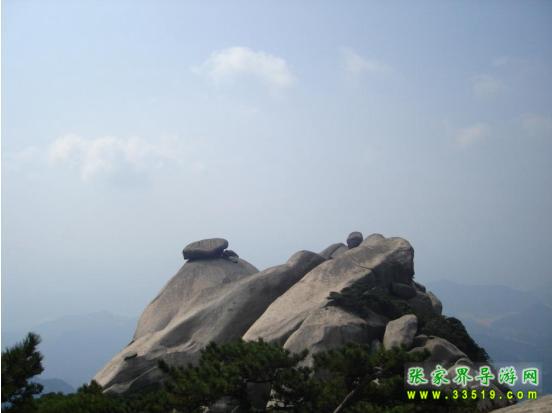
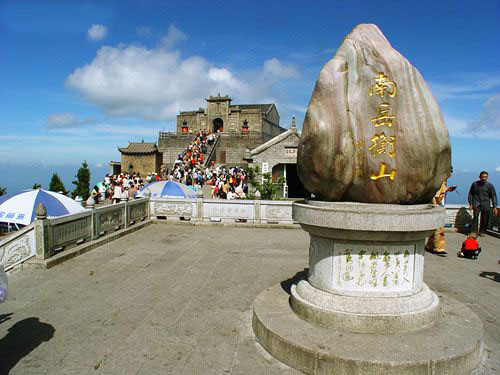
Located at the Chisongzi Altar, there are several dozen huge rocks towering on the mountaintop, said to be flying stones from elsewhere. Legend says that Yumu Mountain and Nanyue Mountain are sister mountains; Nanyue Mountain is the elder sister and Yumu Mountain the younger sister. The two sisters often competed in magic power. The elder sister summoned a turtle spirit, which stretched its head toward the sky once every night; however high it stretched, the mountain peak grew that much higher. The younger sister summoned the toad spirit of Yumu Mountain, which jumped upward once every night; however high it jumped, the mountain peak grew that much higher. The elder sister's magic power was no match for the younger sister's. Fearing that Yumu Mountain would become higher than Nanyue, she devised a plan and summoned a large red stone to press down the toad spirit, so that from then on it could no longer jump, and the Big Belly Top could no longer grow higher. But the mountain's big belly rapidly expanded instead, so the elder sister again flew three hoops from Nanyue to bind Big Belly Ridge tightly. Seeing this, the younger sister hurriedly summoned the iron bell from Tian Temple and pressed it toward the turtle spirit of Nanyue. As the iron bell flew over Hengyang, it encountered a flock of wild geese. The geese felt something was strange, so they surrounded the iron bell and forced it down onto a small hill at the southern end of Hengzhou. This hill is today's Huiyan Peak. Because the elder sister's magic failed, Nanyue Mountain therefore grew higher every night, and is now much higher than Yumu Mountain. The elder sister of Nanyue did not forget the geese of Yan Peak and ranked Yan Peak first among the 72 peaks of Nanyue. Pilgrims who go to offer incense at Nanyue all first burn a stick of incense at Yan Peak in Hengyang. The local people compiled this legend into a ten-line doggerel:
Nanyue and Yumu, two sister mountains dear, competed in magic to see whose peak would rear.
Yumu grew a zhang each night, Nanyue grew a chi each night.
Nanyue's elder sister harbored ill intent, flew a stone to press the toad spirit down.
Yumu's flying bell was stopped by Yan Peak, while the turtle rose upward night by night.
Nanyue did not forget the wild geese's grace, and so ranked Yan Peak as the first peak.
The Flying Stone was deified by local people and suspected to be a stone that flew in from beyond the heavens, hence the name "Flying Stone." In fact, it is because rain erosion and rock weathering were slow, leaving the rock strata exposed at the mountaintop.
Below the Flying Stone there is a small cave, said to be an immortal's cave. Only the cave mouth remains, and the cave mouth can never be opened, because dazzling treasures are hidden inside. For many years, some elderly people tormented by poverty would come to sit quietly by this cave mouth for three days after being wronged, and after returning home they would be safe and sound.
On the rock wall on the south side of the Flying Stone, there are four seal-script characters "Chisongzi Altar" carved by Jiang Xun, magistrate of Qingquan during the Qing Dynasty. In the Tang Dynasty, a poet visiting Yumu Mountain wrote a five-character regulated verse: "Cranes dance on thousand-year trees, rainbows fly over a hundred-foot bridge. The red pine stone does not move, while floating clouds easily drift." According to Records of Immortals, Luxi, and Cihai, the Chisongzi Altar refers to Chisongzi, a legendary immortal who attained the Way and served as the rain master for Shennong. Local people say Chisongzi was the teacher of Diku and could summon wind and rain, so they offered sacrifices to both Diku and Chisongzi. It is said that Yumu Mountain was originally named Yunwu Mountain. During the Yongzheng reign of the Qing Dynasty, Zhu Daotai of Hengzhou, because of a long drought without rain and the people suffering disaster, came by reputation to the Chisongzi Altar on Yumu Mountain to pray for rain. "With devout worship, rain immediately fell." Therefore he said, "Now Yunwu Mountain has no clouds and no fog; this is rain bestowed by the Rain Mother," and changed the name of Yunwu Mountain to Yumu Mountain, and bestowed a golden plaque with the three characters "Yumu Mountain." Later, Jiang Xun, prefect of Hengzhou, sacrificed for rain at the Chisongzi Altar and carved "Chisongzi Altar" on the stone, signed "Jiang Xun." The Yumu Mountain area was historically a long-term dead corner of drought. People's helplessness before nature gave rise to dependence on and belief in gods, which evolved into this sacrificial cultural landscape.