This attraction introduction is compiled from historical materials in the "Zhangjiajie Tour Guide Network" (33519.com · Scenic Spots section). Ticket prices, opening hours, transportation, and contact information mentioned in the text may be outdated. Please refer to the latest official announcements from the scenic area before traveling; some content consists of historical background/cultural introductions and is for reference only.
The depth of Fangguang Temple, one of the "Four Wonders of Nanyue." It is located on the central flower stamen of Lianhua Peak in Nanyue Hengshan. According to the Gazetteer of Nanyue, the temple was first built in the second year of Tianjian of the Liang Dynasty in the Southern Dynasties (503 AD). Huihai, one of the eminent monks of Nanyue, came to this long narrow valley surrounded by eight green peaks. Seeing that this place was isolated from the world and that the cliffs and ravines were deep and secluded, he built a thatched hermitage here. According to the Comprehensive Gazetteer, one day when Huihai was reciting sutras in the hermitage, five stalwart men suddenly came to seek an audience. The visitors had different faces, in the five colors of blue, yellow, purple, white, and black, and all wore white robes. The five asked Monk Huihai to permit them to listen to sutras and learn Buddhism. Huihai asked where they were from, and they replied that they were the five dragon gods of Nanyue Mountain. If permitted to listen to the sutras, they were willing to yield a piece of flat land and dedicate it to Huihai for building a temple. Huihai agreed to their request. That night, dark clouds suddenly rose in the valley, and in an instant thunder rumbled, rain poured down, and waves of crashing sounds came. Early the next morning, when Huihai got up and looked, he saw a broad flat area appear below the mountain. Huihai went everywhere to seek alms and donations, and on this flat land built a large-scale temple named Fangguang, implying the Buddhist Dharma "spreading in the ten directions." This is the story recorded in the Gazetteer of Nanyue of the so-called "five dragons listen to sutras, flat sand offers land."
According to the Gazetteer of Nanyue, this ancient temple from the Six Dynasties was renamed Fangguang Shengshou Temple in the Tang Dynasty, and in the early Song Dynasty was granted the name Fangguang Chongchan Temple. The temple underwent five rounds of construction through the Sui, Tang, Song, Yuan, and Ming dynasties, repeatedly repaired and repeatedly abandoned, repeatedly abandoned and repeatedly revived.
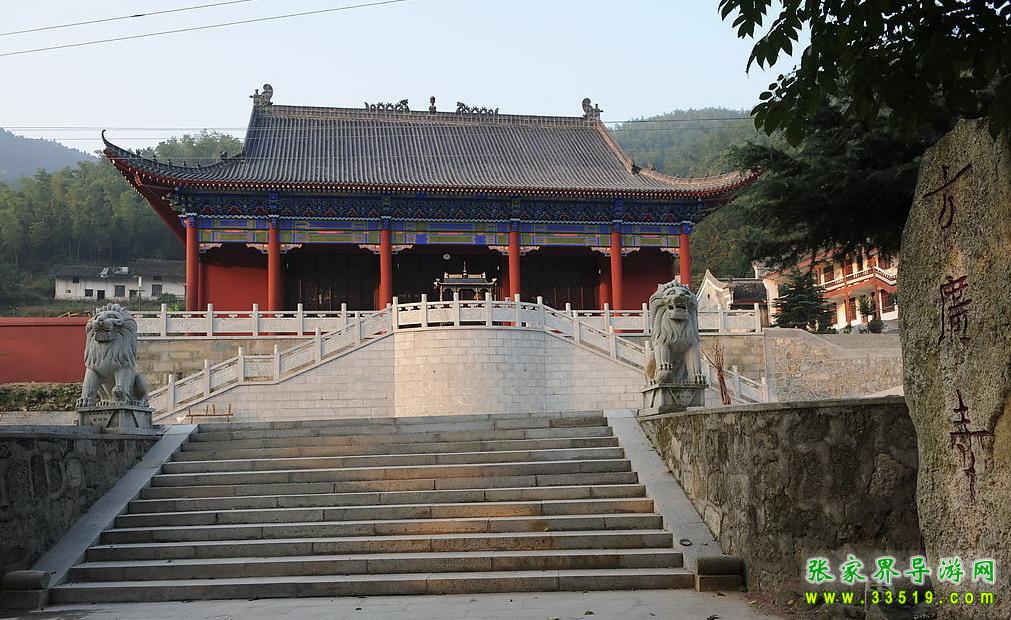
In the early Ming Dynasty, Monk Haokong rebuilt the temple into a plank house, covered it with iron tiles, and added a Buddha hall. He also carved dragons and painted phoenixes inside the temple, decorating it completely anew. In 1594 AD, Emperor Shenzong of Ming bestowed on Fangguang Temple a set of Buddhist scriptures, Buddha statues, and precious banners, and specially built a scripture repository to house them. Later the temple collapsed. In the 16th year of Chongzhen of the Ming Dynasty (1634 AD), Wang Fuzhi and his brothers, along with Xia Rubi and others, entrusted by Grand Coordinator Chu Yinxi, again raised funds and rebuilt it. After two years, Fangguang Temple was completely renewed and magnificent. In the tenth month of the fifth year of Shunzhi of the Qing Dynasty (1648 AD), Wang Fuzhi organized an anti-Qing righteous army below Lianhua Peak and once gathered in Fangguang Temple. Although it later failed, from then on Fangguang Temple became widely renowned.
Before long, Fangguang Temple was destroyed by fire, and "no gates or corridors were maintained; the monks repaired thatched huts to live in." It was not until the Daoguang reign of the Qing Dynasty that it was rebuilt by Zeng Guoquan, younger brother of Zeng Guofan and former Governor-General of Shaanxi and Gansu, at a cost of more than 20,000 taels of silver, and only then did it reach its present scale.
In the main hall of Fangguang Temple there was originally a golden plaque with the four characters "Tianxia Mingshan" written by Emperor Huizong of Song. In front of the temple there is a small stream, and to the left of the temple is Shijian Pool. Spring water flows down over the rocks, becoming a waterfall that pours into a bottomless pool with a sound like a bell. Here the forests, springs, and mountain ridges are beautiful, and the setting is quiet and profound. Visitors who come here inevitably feel a sense of "seclusion and depth," so predecessors said, "Without reaching Fangguang, one cannot know its depth."
In 1167 AD, the famous Southern Song Neo-Confucian scholar Zhu Xi, at the invitation of Zhang Shi, Hunan judicial commissioner,
went to Yuelu Academy in Changsha to lecture. In the winter of that same year, they came to Nanyue through the snow. Zhu Xi could not help but feel his poetic inspiration surge. Within seven days, the two exchanged poetic replies and composed 149 poems. One third of these poems were written at Fangguang Temple. Later generations, to commemorate their splendid excursion, specially built the Erxian Shrine beside Fangguang Temple and enshrined the spirit tablets of Zhu and Zhang in the Jiahui Hall within the shrine, so that they might forever enjoy Confucian offerings.
The characteristics of Fangguang Temple are: deep temple, deep mountains, deep forests, and deep cultural origins.
Note: The golden plaque with the four characters "Tianxia Mingshan" written personally by Emperor Huizong of Song was destroyed during the ten years of havoc.