This attraction introduction is compiled from historical materials in the "Zhangjiajie Tour Guide Network" (33519.com · Scenic Spots section). Ticket prices, opening hours, transportation, and contact information mentioned in the text may be outdated. Please refer to the latest official announcements from the scenic area before traveling; some content consists of historical background/cultural introductions and is for reference only.
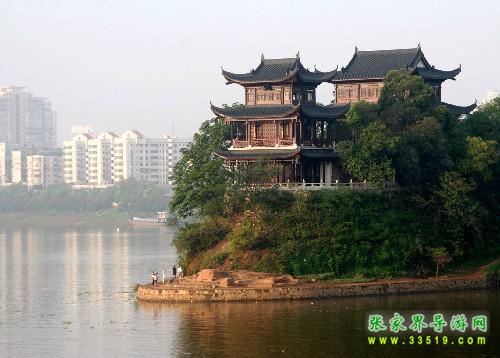
Du Fu Park was formerly Dongzhou, also called Huazhou, Xuzhou, Yapozhou, or Yuanyangzhou. It is located in the middle of the Leishui River in the urban area, slightly to the east. Separated from the east bank by a stretch of water, a small islet has formed, creating two islets of different sizes surrounded by water, elegantly known as Yuanyangzhou (Mandarin Duck Islet). The name Xuzhou (Boot Islet) is said to come from the story that when Du Fu was traveling by boat to Chenzhou, he dropped a boot here, and people retrieved it and buried it on the islet, hence the name. The name Yapozhou (Duck Islet) refers to how when the river water surges, the islet is hard to submerge, appearing like a duck floating in the vast floodwaters, giving a sense of the duck rising with the water. The name Huazhou (Flower Islet) refers to how when spring arrives, a hundred flowers bloom on the islet, peaches and plums compete in beauty, willow catkins drift lightly, and orioles sing and swallows dance. In 2000, the Leiyang municipal government converted it into Du Fu Park, adding further splendor. Even more eye-catching is the magnificent Zhang Fei Cable Bridge built across the middle from the west bank to the east bank, making it convenient for visitors to cross the Leishui River, enjoy the water scenery, and then tour Du Fu Park. Visitors strolling on the Zhang Fei Cable Bridge, with flowing lights and colors, fluttering colored flags, stars sinking into the Milky Way, and water and sky merging into one hue, cannot help but utter the couplet:
Above and below, shadows sway with the moon beneath the waves;
Coming and going, people cross the bridge within the mirror.
Du Fu Park is as beautiful as a painting. The golden sun radiates its light, shining over the entire park: the statue of Du Fu, head raised gazing at the sky, patriotic and caring for the people, inspiring admiration; the Thousand-Hand Guanyin, ferrying all beings across; the South Sea Guanyin, saving the suffering and delivering the distressed; Guanyin seated on a lotus, so beautiful and moving that even monks would return to secular life; Nezha stirring up the sea, subduing the dragon palace, inspiring the fighting spirit of youth; two dragons playing with a pearl, dancing in pairs, revealing the world of ultimate bliss—an Eastern paradise. The giant dinosaur, summoning clouds and spitting mist, embodies the spirit of the Chinese nation; the hibiscus-like women, beautiful as celestial beings, neither servile nor overbearing, cheerful and graceful, standing elegantly. And so on—truly it can be said:
In the park, the scenery is elegant and beautiful;
Beneath the bridge, the jade belt's ripples shimmer coldly.