This attraction introduction is compiled from historical materials in the "Zhangjiajie Tour Guide Network" (33519.com · Scenic Spots section). Ticket prices, opening hours, transportation, and contact information mentioned in the text may be outdated. Please refer to the latest official announcements from the scenic area before traveling; some content consists of historical background/cultural introductions and is for reference only.
Xiyan Immortal Cave is located in Xiyan Village, Ronghuan Township, at the southern foot of Fenghuang Peak, one of the seventy-two peaks of Mount Hengshan (Nanyue). It is about 4 kilometers from the former residence of Marshal Luo Ronghuan and has long been honored as "the finest scenery south of Chu." According to the "Comprehensive Gazetteer of Hunan Province": "In the Jin Dynasty it was called 'Xiyan'; legend has it that Monk Jigong subdued demons and eliminated evil here. In the Tang Dynasty it was bestowed the title of Immortal Cave, and in the Ming Dynasty 'Xi' was changed to 'Xiyan' (tin), and since then it has been called Xiyan Immortal Cave, a name still used today." The cave was first discovered by people in the early Yonghe era of the Jin Dynasty (345 AD), more than 1,600 years ago.
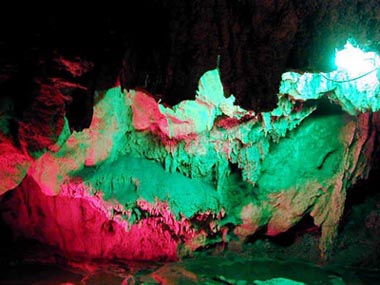
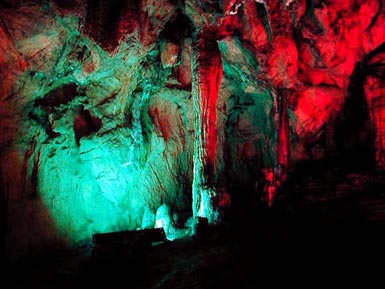
The entire cave has only one crack-like entrance and consists of three groups of caverns and 18 "halls," unfolding in an asymmetrical branching pattern. The cave has a cumulative length of 1,870 meters, with a total cave area of 84,150 square meters. The passages inside are winding, secluded, and wondrous, with grotesque rocks growing in clusters. About 300 meters into the cave, looking around, it seems like "mountains multiply and streams double back, suspecting there is no way out," but upon careful exploration, above there is actually a small opening about a chi wide, round as a mirror, only large enough to squeeze through. After squeezing in, it is "a sudden glimpse of a bright village beyond the dark willows and bright flowers," entering a great cavern that leaves one dumbfounded. In Cave No. 3, the underground flying spring and waterfall—of which only the sound is heard and the form is hard to see—sounds like a tiger's roar and thunder, making one's hair stand on end. Walking to the depths, a deep pool blocks the way, and a narrow, slippery natural "small bridge" spans above it, making one hesitate to proceed. The rear section of Cave No. 2 is a blessed cavern. The "skylight" in the depths is like a bright moon hanging high, a strange spectacle that makes one even more reluctant to leave. The stalagmites, stone forests, stone pillars, and stone curtains of Xiyan Immortal Cave are a dazzling array, in a thousand postures and forms, with supernatural craftsmanship, remarkably true to life. The "Pearl Umbrella" scenic wonder is incomparably beautiful.
The "Hengshan County Gazetteer" compiled during the Guangxu era of the Qing Dynasty describes it thus: "More than a zhang high, the handle as large as a sheng, extending over four chi around; dripping milk forms the garment, knotted like pearls, below a small child's eyebrows and hair all appear, smiling as it leans against the handle, as if afraid that visitors—this umbrella is specially for protection, also a wondrous scene." Xiyan Immortal Cave is not only renowned throughout the Three Xiang for its unique scenery, but also famous across the Four Rivers for its bizarre myths. In those years, when Emperor Yan was managing water, gathering herbs, and teaching farming in the Mishui River basin, he often ate, slept, and worked here, so the cave retains sites such as the "Emperor's Resting Platform," "Medicine Washing Pool," and "Eighteen Mounds of Fields"; Emperor Yan brought the brown dragon that endangered the Mishui River into the cave to tame it, hence there are also scenic wonders such as "Dragon-Hiding Cave" and "Brown Dragon Drinking Spring." The legend of Monk Jigong subduing demons and eliminating evil here is even known to all the old and young in the surrounding area. Not far around the immortal cave are four caves—Wind, Cloud, Water, and Thunder—guarding it like the "Four Heavenly Kings." The immortal cave has cool wind whistling year-round, the cloud cave has mist rising in all four seasons, the water cave has flowing water babbling all day, and the thunder cave has thunder rumbling at all times. Some men of letters and poets either named the scenery based on its forms and sounds, or composed poems and lyrics to express their lasting memory, causing natural landscapes and cultural landscapes to enhance each other, making it even more alluring.