This attraction introduction is compiled from historical materials in the "Zhangjiajie Tour Guide Network" (33519.com · Scenic Spots section). Ticket prices, opening hours, transportation, and contact information mentioned in the text may be outdated. Please refer to the latest official announcements from the scenic area before traveling; some content consists of historical background/cultural introductions and is for reference only.
"The Miluo River is where Qu Yuan met his martyrdom. The people along the banks of the Miluo River built structures to commemorate Qu Yuan long ago. According to the Jin Dynasty's "Records of Gleanings": 'The people of Chu established a shrine for him, which still existed in the Han Dynasty,' indicating that a temple was built shortly after Qu Yuan's death; by the Han Dynasty, there were already inscriptions recording events. In the Tang Dynasty, the Temple of the Three Lǘ Grand Master Qu Yuan was built; during the Five Dynasties, Qu Yuan was enfeoffed as the Marquis of Zhaoling, and in the Yuan Dynasty, he was further honored as the Duke of Loyalty, Purity, and Ardor, with the temple named after these titles. During the Ming and Qing Dynasties, the Qu Yuan Temple was repeatedly destroyed and rebuilt. After repairs in the 21st year of Emperor Qianlong's reign, people moved the Qu Yuan Temple from the banks of the Miluo River to Yusi Mountain, which is now the Quzi Temple."
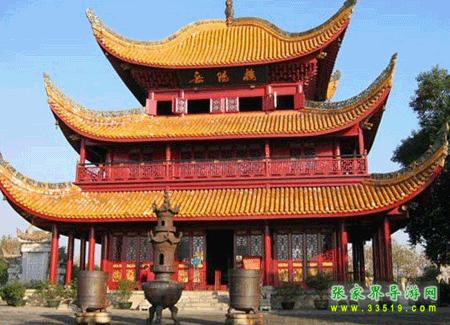
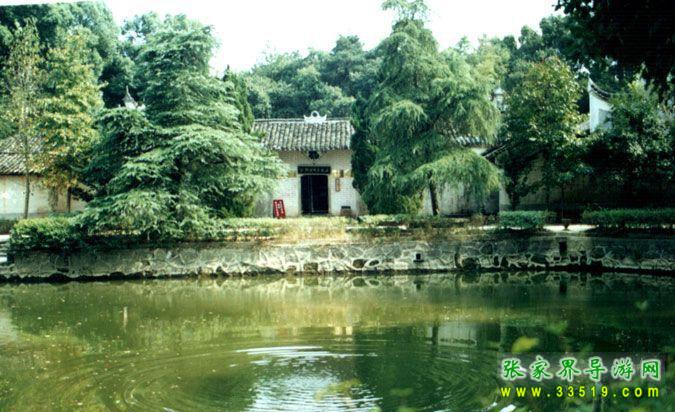
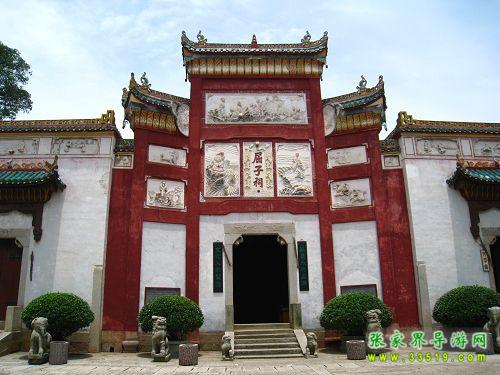
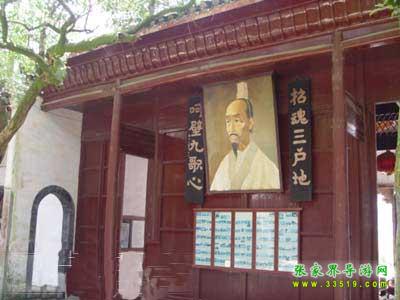
"The Quzi Temple is over 100 li south of Yueyang City, more than 20 li from the seat of Miluo County. The beautiful Miluo River winds around the front of the mountain, and the tranquil Yushui Stream flows at its foot. Here, ancient trees tower to the sky, and the scenery is serene and secluded. Stone steps lead directly from the foot of the mountain to the summit. A temple-style building stands majestically on the wide flat area at the top. Beside the main gate is carved the couplet 'Vast lakes mourn the departure from the state, a river for all ages belongs to this man,' and the three vigorous large characters 'Quzi Temple' on the front gate shine brilliantly in the sunlight. The lintel is adorned with 17 relief sculptures depicting Qu Yuan's life. The entire Quzi Temple complex covers 1,334 square meters, with three courtyards and three halls, fourteen side rooms, seven large and small skylights, and four flower beds; the halls, rooms, corridors, and pools are arranged in an orderly and harmonious manner. In the hall entered through the main gate, the lower wall is embedded with a carved screen of Sima Qian's "Records of the Grand Historian: Biographies of Qu Yuan," above which hangs a horizontal plaque reading 'Glory Rivals the Sun and Moon,' and on both sides are couplets written by the Qing Dynasty scholar Li Yuandu: 'A low official, who was he, with only three households left, how could he bear to let the loyal and good perish; Grand Historian, a true confidant, with judgments for a thousand years, can make the sun and moon shine.' 'Below the river, peaks are green, the Nine Songs echo afar with the Xiang spirits' tunes; south of Hunan, grass is green, threefold calls repeatedly summon Song Yu's soul.' On the north and south sides of the gable walls of this hall, granite inscriptions feature couplets written by Su Dongpo of the Song Dynasty and the modern revolutionary elder Dong Biwu. After passing through the fragrant golden osmanthus flower bed, one arrives at a sacrificial hall, where a plaque reads 'Spirit Seat of the Late Chu Three Lǘ Grand Master Qu Yuan,' with a large bell hanging on the left and a large drum placed on the right; on the hall pillars hang couplets written by the Qing Dynasty scholar and diplomat Guo Songtao: 'Mourning Ying's loss of lone loyalty, among the three hundred poems, uniquely revering the transformed elegance to open new styles; embracing the sand and sinking here, two thousand years later, only the sound of the shoals remains as before.' Passing through the arched door, one enters the rear hall, where stands a tall statue of Qu Yuan, with his hand on his sword, head raised and gazing upward.
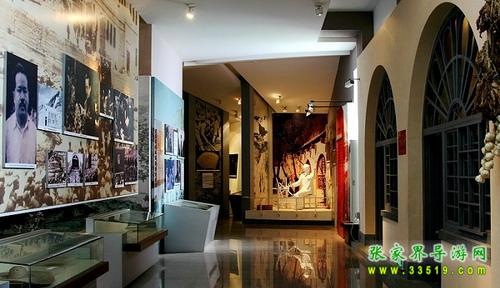
The statue expresses a sense of concern for the country and the people, evoking infinite reverie. On both sides of the statue hang calligraphy by Yu Liqun of Guo Moruo's compilation of lines from "Li Sao": 'Gather lotuses to make garments, and plant a hundred mu of orchids; lead the clouds and rainbows to welcome, and go to observe the four wilds.' The side rooms on both sides of the hall have been converted into exhibition rooms, introducing Qu Yuan's life and his influence on later generations; displaying various editions of Qu Yuan's works and the results of later research on them. At the same time, artifacts from the Chu State unearthed at Qu Yuan's hometown site and the Luozi State tomb are exhibited here. These artifacts reveal the social conditions in the Miluo River area of southern Chu where Qu Yuan was exiled over two thousand years ago." Visitors to the Quzi Temple to pay their respects are invariably moved by Qu Yuan's spirit of concern for the country and the people and his relentless pursuit of truth, receiving an education in patriotism and historical materialism.
"Coming out of the Quzi Temple and stepping to the right, a plaque with the three characters 'Duxing Pavilion' comes into view; this is the handwriting of the famous writer Mao Dun. In front of the pavilion stands a stone stele, which is the 'Record of Rebuilding the Duxing Pavilion' written during the Jiajing period of the Ming Dynasty. It is said that during Qu Yuan's exile in Miluo, he often conversed with fishermen at the ferry pavilion at the foot of Yusi Mountain. Later generations, to commemorate him, renamed the ferry pavilion 'Duxing Pavilion.'"
"Passing through a winding mountain path shaded by dense foliage and covered with moss, one arrives at the 'Sao Altar' located on the southwest slope of Yusi Mountain. According to the "Records of Xiangzhou," 'Qu Yuan composed the Nine Songs here,' and a stone stands in the pavilion with the full text of 'Sao Altar' inscribed on it. At the foot of the Sao Altar, there is also a Zhuoying Bridge, under which a small stream called Yushui flows south into the Miluo River. It is said that Qu Yuan often washed his hat tassels and feet here. The line in the "Chu Ci: The Fisherman"—'When the waters of Canglang are clear, I can wash my hat tassels'—refers to this place."
In June 2001, the Quzi Temple was designated by the State Council as a Major Historical and Cultural Site Protected at the National Level.