This attraction introduction is compiled from historical materials in the "Zhangjiajie Tour Guide Network" (33519.com · Scenic Spots section). Ticket prices, opening hours, transportation, and contact information mentioned in the text may be outdated. Please refer to the latest official announcements from the scenic area before traveling; some content consists of historical background/cultural introductions and is for reference only.
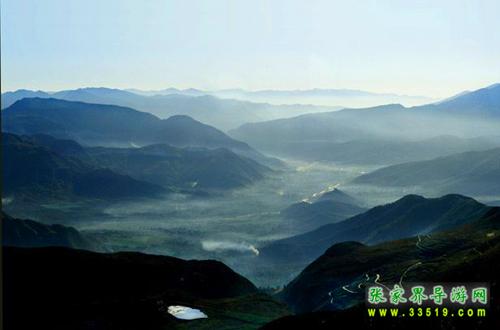
The tomb of Liu Daxia is located near Xiangtang in Huagang Village, Shengfeng Township, 10 kilometers east of Huarong County seat, between longitude 112°18'3" to 113°1'32" and latitude 29°10'18" to 48'27". It is situated in the hilly area north of Dongting Lake and south of the Yangtze River. The protection area is the southern slope of Huagang Mountain, with Longxiu Mountain tea fields and rice paddies to the north. Centered on the tomb, within a radius of 30 meters, fir trees are planted in front of the tomb. Its natural environment belongs to a subtropical monsoon humid climate, with an average annual temperature of 16.7 degrees Celsius and an average annual rainfall of 1,205.8 millimeters.
Liu Daxia (1435–1516), courtesy name Shiyong, was a native of Huarong and a jinshi in the eighth year of the Tianshun era of the Ming Dynasty (1464). In the early Chenghua era (1465), he served as a principal secretary in the Ministry of War, later promoted to langzhong. In the spring of the sixth year of the Hongzhi era (1493), the Yellow River breached its banks at Zhangqiu (in present-day Dong'e County, Shandong). He went to manage the waters, dredging the upper reaches to divert the water flow and building a long dike of 360 huali. Once the breach was sealed, he also built Huangling Hill, and the flooding ceased, and Zhangqiu Town was renamed Ping'an Town. For his merits, he was promoted to Left Vice Censor-in-Chief. Later, he resigned due to illness and returned home. Two years later, he was reinstated as Minister of War, overseeing military affairs in Guangdong and Guangxi. He was promoted to the second rank as Zizheng Dafu. In the first year of the Zhengde era (1506), he was granted the title of Grand Guardian of the Heir Apparent. Because he offended the eunuch Liu Jin, he was demoted and exiled to Suzhou (present-day Jiuquan). After Liu Jin was executed, he was pardoned and allowed to return. He died in the eleventh year of the Zhengde era (1516) at the age of 81, with the posthumous title Zhongxuan. He authored "East Travel Drafts," "West Travel Drafts," and "Record of Imperial Summons."
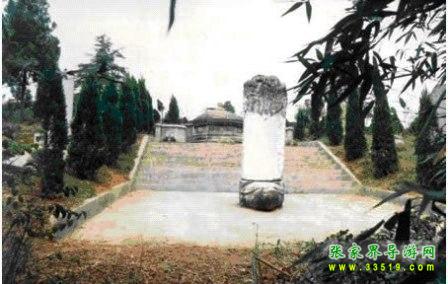
The extant stone tomb now faces north-south. The tomb is in the form of an octagonal Sumeru pedestal, faced with granite blocks, each side 1.2 meters wide, with a remaining height of 1.6 meters. The base foot is about 12 cm high; above it is the lower architrave, 22 cm high. There are two layers of lower corbelling: the lower layer 18 cm high, the upper layer 10 cm high, each layer with a bulging profile. The waisted middle section is 30 cm high, with carved corner pillars but no ornamental gateways. There are three layers of upper corbelling, each 12 cm high; only the top third layer has a concave curved profile, while the other two have bulging profiles. On the pedestal rests a flattened round stone drum, tapering gradually toward the tomb top, which has been destroyed. The layer beneath the base foot resembles the single-mixed earth brick described in the "Yingzao Fashi" (Treatise on Architectural Methods), exposed above ground. Judging from the blending of upper and lower cornices, with the secondary elements overpowering the principal ones, this appears to be a Qing dynasty technique. According to the account of an elderly man surnamed Lei from the locality, it was rebuilt in the Qing dynasty.
In front of the tomb there remains a pair of stone pedestals, square in shape with a recessed waist, carved in relief with eight claws.
In front of the tomb stands a Hongzhi-era imperial mandate stele, built in the Ming dynasty, with a white marble stele body, a tortoise base below, and a stele head in the form of a haloed top with two dragons intertwined around the stele ridge; the stele
Height 1.9 meters, width 81.5 centimeters, thickness 18 centimeters, total height 2.45 meters. The stele head is incised in seal script with the four characters Fengtian Gaoming, each character over 10 centimeters in diameter. The stele inscription is incised in medium regular script, written vertically from left to right, in thirteen lines, with twenty-eight characters per line, totaling three hundred and thirteen characters, each character over 3.5 centimeters in diameter. There are also four small regular script characters Zhigao Zhibao and the date. It has Ming Dynasty style and is rarely seen in the Dongting Lake area.