This attraction introduction is compiled from historical materials in the "Zhangjiajie Tour Guide Network" (33519.com · Scenic Spots section). Ticket prices, opening hours, transportation, and contact information mentioned in the text may be outdated. Please refer to the latest official announcements from the scenic area before traveling; some content consists of historical background/cultural introductions and is for reference only.
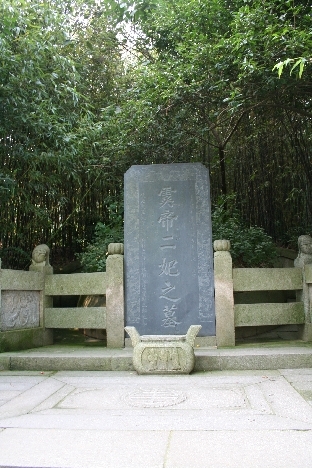
The Tomb of the Two Consorts, fully named the Tomb of the Two Consorts of Emperor Yu, is at the western end of Spotted Bamboo Mountain on Junshan. According to the "Records of the Grand Historian: Annals of the Five Emperors": Shun "ascended the throne for thirty-nine years, made a southern inspection tour, died in the wilds of Cangwu, and was buried at Jiuyi south of the Yangtze (present-day Mount Jiuyi in Ningyuan County), which is Lingling." At that time, Shun's two consorts, seeing that their husband had long been away and had not returned, searched everywhere and came to Junshan in Dongting. Suddenly hearing the news of Emperor Shun's death, they were heartbroken, fell ill from grief, and died without recovery, and were buried at Junshan. The tomb of the two consorts was repeatedly built and destroyed over the ages; in 1979 the Hunan Provincial People's Government allocated funds to restore it. The tomb is round and built of stone, with stone pillars in front carved with qilin, lions, and elephants, and a tombstone standing in the center inscribed "Tomb of the Two Consorts of Emperor Yu," in the handwriting of Peng Yulin, Governor-General of Liangjiang in the Qing Dynasty. In front of the stele is a stone incense burner. Descending several steps from the incense burner is a 1.5-meter-wide sacrificial path, flanked by stone steles inscribed with the Eastern Han scholar Liu Xiang's text "Yinxin Stone House." On a pair of 2.8-meter-high guiding pillars twenty meters in front of the tomb of the two consorts is engraved a couplet written by Shu Shaoliang in the seventh year of the Republic (1918):
The two souls of the lord's consorts, fragrant through the ages;
The many speckles on the mountain bamboo, tears for one man.