This attraction introduction is compiled from historical materials in the "Zhangjiajie Tour Guide Network" (33519.com · Scenic Spots section). Ticket prices, opening hours, transportation, and contact information mentioned in the text may be outdated. Please refer to the latest official announcements from the scenic area before traveling; some content consists of historical background/cultural introductions and is for reference only.
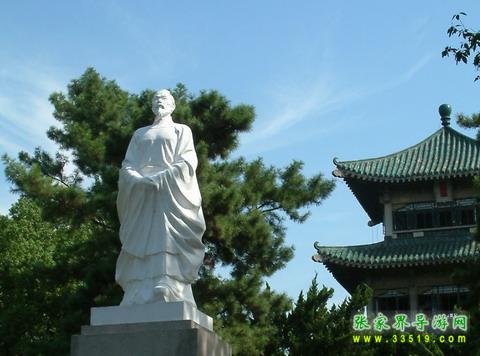
Qu Yuan's Tomb is located at the top of Miluo Mountain north of Miluo City. Within a two-kilometer radius there are twelve tall burial mounds, said to be Qu Yuan's 'twelve false tombs.'
There is a saying in Yueyang: "Nine sons cannot bury their father; one daughter makes a golden head." It is said that Qu Yuan was not recovered until ten days after he threw himself into the Miluo River, and unfortunately half of his head had been bitten off by a great fish. His daughter Nüxu (academics offer several interpretations, calling her a sorceress or a student) fitted him with half a golden head and buried him on Miluo Mountain. From this comes the phrase "one daughter makes a golden head." Not long after, the Chu nobles who opposed Qu Yuan, using the pretext of disinterring the body to flog it, sought to seize the golden head. When Nüxu heard of this, she used her skirt to carry earth and hurriedly built false tombs. Her spirit moved the surrounding common people, who all lent their utmost aid, and overnight eleven false tombs shaped like small hills were built; together with the original tomb there were twelve in all—these are the twelve false tombs that survive today. Because the tomb mounds were so tall, the place where earth was taken was dug into a pond of more than a hundred mu, which later generations called "Chu Pond." To commemorate Nüxu, people renamed Miluo Mountain "Lie Nü Ridge," and the small bridge below the mountain that Nüxu passed while carrying earth in her skirt was named "Lie Nü Bridge."
Qu Yuan (340 BCE - 278 BCE), given name Ping, courtesy name Yuan, was a native of the State of Chu during the Warring States period. He was a great patriotic poet of our country and a world cultural celebrity. In his twenties, he served as "Zuotu," and later, due to slander by treacherous ministers, he was demoted to "Sanlü Dafu." After the Qin general Bai Qi captured the Chu capital Yingdu, he and the King of Chu "In the past, you and I made a pact, saying we would meet at dusk," came to the southern Hu-Xiang region of Chu to carry out activities to "resist Qin and restore Ying." Eventually, because powerful villains dominated the court and the state was declining, the King of Chu no longer trusted him, removed him from his position as "Zhangmeng," causing Yingdu to remain "unrecovered for nine years now." With no hope of restoring the state, he resolutely threw himself into the Miluo River to die and demonstrate his resolve, arousing the people to resist the strong Qin (this follows Zhang Zhongyi's New Biography of Qu Yuan). In September 1996, the Mao Zedong Poetry Collection published by the Central Party Literature Press included the poem "Seven-Character Quatrain · Qu Yuan": "Qu Zi in those years composed the Chu Sao, in his hand he held a killing knife. Ai and Xiao were too abundant, Shu and Lan too few, with one leap he rushed into the ten-thousand-li waves," which also sings of this period of history.
Qu Yuan's Tomb on Miluo Mountain was recorded relatively early in the Tang Dynasty "Yuanhe Prefecture and County Gazetteer": "The tomb of Zuo Tu Qu Ping is seventy-one li north of the county (referring to the former Xiangyin County)." Du You's "Comprehensive Institutions" of the Tang Dynasty records: "Luo River has Qu Yuan's tomb; today there is a stone stele whose text reads 'Stele of Qu Dafu, Banished Minister of Chu,' the remaining characters effaced." The Qianlong edition of the "Xiangyin County Gazetteer" of the Qing Dynasty also records: "Miluo Mountain is seventy li north of the county; the Miluo River flows out below it, and on it is Qu Yuan's tomb." Other prefecture and county gazetteers give roughly the same account. Today, in the roughly two-square-kilometer mountain area of Miluo Mountain, Qu Yuan's twelve false tombs stand towering, among which the one behind Zhaojia Chong is the largest, 6.5 meters high with a base diameter of more than thirty meters; in front of the tomb stands a stone stele erected in the sixth year of Tongzhi of the Qing (1867): "Tomb of the Late Chu Sanlü Dafu." The rest were all erected in the twenty-eighth year of Guangxu of the Qing (1902). In 1956 it was declared a provincial-level cultural relic protection unit.