This attraction introduction is compiled from historical materials in the "Zhangjiajie Tour Guide Network" (33519.com · Scenic Spots section). Ticket prices, opening hours, transportation, and contact information mentioned in the text may be outdated. Please refer to the latest official announcements from the scenic area before traveling; some content consists of historical background/cultural introductions and is for reference only.
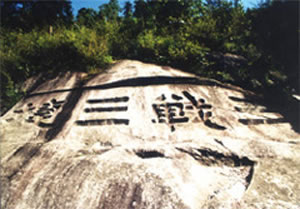
The Monument to Three Battles and Three Victories at Dayun Mountain was erected to commemorate the three battles and three victories of the Chinese army during the War of Resistance Against Japan in the Battle of Northern Hunan. It is now a key cultural relic protection unit of Hunan Province.
During the War of Resistance Against Japan, the Japanese army burned, killed, looted and plundered in the Dayun Mountain area, arousing the anger of the Chinese people and meeting resistance from Chinese soldiers and civilians. The three Battles of Changsha fully demonstrated the patriotic fervor and spirit of heroic resistance of the Chinese soldiers and civilians.
In September 1939, in order to open up the north-south communication line, the Japanese army invaded Changsha three times. To control Changsha, one first had to control northern Hunan. Dayun Mountain, the throat of the gateway to northern Hunan, was naturally among the enemy's targets. The first battle took place from September 14 to October 10, 1939. In the northern Hunan direction, our forces were the 52nd, 37th and 79th Armies under the command of Guan Linzheng of the 15th Group Army, and Wang Jianbo's guerrilla column. In this battle, our army resisted step by step and had established positions available for use. The Japanese army was the attacker and often exposed itself in front of our positions. 42,190 enemy troops were wiped out, and our army also suffered heavy casualties. The second battle took place from mid-September to early October 1941. The Japanese forces in northern Hunan and Tongcheng in southern Hubei numbered 120,000. Our forces were the 4th, 20th, 58th and 37th Armies under the command of Yang Sen of the 27th Group Army, and Wang Jianbo's guerrilla column, later reinforced by Luo Zhuoying's 19th Group Army and Wang Lingji's 30th Group Army, totaling about 270,000 troops. On September 7, the Japanese army first attacked Dayun Mountain. On September 8, the Zushi Hall of Dayun Mountain was occupied by the Japanese army. Yang Sen adopted the tactics of tailing, flanking and intercepting attacks, and on the 10th recaptured Dayun Mountain in one vigorous effort. After 11 days of fierce fighting, the Japanese army failed to break through the Chinese defense line and retreated to its original positions, but our army lost nearly 100,000 troops. The third battle took place from late December 1941 to mid-January 1942. The Japanese force was 120,000, while our forces were the 58th, 20th and 37th Armies under Yang Sen's command, as well as Luo Zhuoying's and Wang Lingji's units, totaling 14 armies, with Yang Sen as overall commander. 56,900 enemy troops were wiped out, achieving the great victory of the War of Resistance in northern Hunan and the great victory of Changsha.
While fighting in northern Hunan, Yang Sen's troops were once stationed at Badouqiu, Nanchong, Yueyang County. In August 1942, accompanied by Wang Jianbo, county magistrate of Linxiang County (the county government was then relocated to Dayun Mountain), Yang Sen went up Dayun Mountain to inspect the defenses. When they reached Huangliangsan, recalling the officers and soldiers who had died in the War of Resistance in northern Hunan, they decided to carve a monument on Dayun Mountain in their memory. Yang Sen ordered Wang Jianbo to supervise the carving. They chose a huge cliff outside Longxing Palace on Dayun Mountain. With an inscription written by Yang Sen himself, they invited 40 stonemasons and spent two months cutting the cliff into a 90-square-meter flat surface, completing the stone-carving task. The four large characters "San Zhan San Jie" (Three Battles, Three Victories) each occupy 2 square meters. On the left, 64 explanatory characters were carved: "The Japanese bandits invaded our China and held out in northern Hunan for five years, during which they launched three large-scale invasions of Changsha. Thanks to the cooperation of the people and the dedication of the officers and soldiers, they were all repulsed. The people of the nation are now sincerely united and determined to clear away the invaders. This stone is carved in mutual encouragement. Inscribed by Yang Sen. December, 31st year of the Republic of China." Ten meters below Yang Sen's inscription, another stone tablet, "San Jie Quan Yuan" (Source of the Three Victories), was also carved, inscribed by Xia Jiong, commander of the 133rd Division of the 20th Army under Yang Sen. After the victory of the War of Resistance, Wang Jianbo, commander of the 7th Advance Column, erected a "Monument to the Victory of the War of Resistance at Dayun Mountain." Today, these stone carvings are all well preserved.