This attraction introduction is compiled from historical materials in the "Zhangjiajie Tour Guide Network" (33519.com · Scenic Spots section). Ticket prices, opening hours, transportation, and contact information mentioned in the text may be outdated. Please refer to the latest official announcements from the scenic area before traveling; some content consists of historical background/cultural introductions and is for reference only.
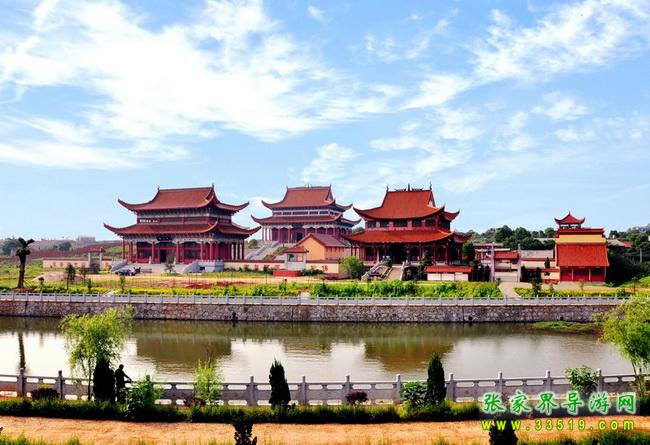
About five li southeast of the Xiangyin county seat, there is a scenic and historic site called Nanquan Temple. According to the "Record of the Restoration of Shuanglin Chan Temple on Nanquan Mountain in Tanzhou" from the 33rd year of the Kangxi reign (1694): Nanquan Temple was one of more than forty temples in Tanzhou. During the Shaoxing period of the Song Dynasty (around 1140), Patriarch Pu'an traveled and rested here, dug a well and obtained spring water. The spring water was clear and cold, so he cut thatch and established the Dharma, founding Shuanglin Chan Temple. Because the spring was south of the temple, it was named "Nanquan Temple."
Since the temple was founded, from the Song through the Yuan to the Ming Chenghua period (around 1470), altogether more than three hundred years passed. Later, because the abbots were not suitable, the rules declined, and the Dharma hall grew deep with grass. During the Bingxu year of the Ming (1406), a monk named Deyong was diligent in Buddhist affairs and deeply won people's support, and he continually restored the temple halls. Within a few years the halls and pavilions stood towering, the Buddhist monks flourished, and the old appearance was greatly changed. During the Zhengde period (around 1510), the imperially appointed Hongjie masters and others again carried out major repairs and expansion, and the temple's appearance was completely renewed. At that time the county magistrate Lord Wang even erected a stele record for this. From Zhengde to the Xinhai year of the Jiajing period of the Ming (around 1551), because of long neglect of repairs, the halls and buildings collapsed, eroded by rain. A man named Huang Tingkai presided over fundraising and received sponsorship from prominent people of the time, and again repaired the temple halls, monk quarters, and gates to look new. Afterwards another stele record was erected. At the time of the transition between the Ming and Qing, it suffered military fire again, and this temple was once more reduced to ashes. In the Jiaxu year of the Kangxi reign of the Qing (1694), the Great Dragon Master Chongshan Deding Chan Master, heir of Chubo Yuya Shangfang Tianmu Kai the Elder, lamented that Nanquan Temple had been abandoned, so he brought his disciples to build huts beside the ruined temple and planned to rebuild it. With the help of County Magistrate Tang Ji, workmen were finally gathered for construction, and he established the double gates and precious hall, broad buildings and long corridors, making the Buddha images radiant, with purple-gold light gathering and golden drums sounding together. Thereupon donors from the ten directions were pleased near and came from afar, and lofty worthies from lakes and seas rushed like clouds and water. The sound of bells and drums could be heard several li away, and incense smoke never ceased all year round. This was the peak period of Nanquan Temple.
After the Kangxi reconstruction, among the presiding monks whose names can be verified were: Chongshan Deding Chan Master's Dharma heirs Xinghe, this mountain's Fayang Xingjian, Huyu, Hujian, Zongrong, Zonglin, Zonglan, and others. At present only Shengen is still alive. Shengen's original surname was Jiang. At age seven he received ordination at Nanquan Temple, once lived in Ouhua Hall Temple, and after Liberation lived in Xiangyang Village where Nanquan Temple is located. In 1984, as a representative of religious circles, he served as a member of the second county CPPCC committee.
Nanquan Temple originally had its own produce: three to four shi of paddy fields at Fanjiazhou, one to four shi at Sichongli, and 0.25 shi at Songjialong. Before Liberation, it collected fifty to sixty shi of rent grain each year. In addition, the temple's rear mountain areas such as Tashan Garden and Wujiapo were broad, and each year thatch and firewood could be cut for the temple's fuel.
In 1930, the temple's first gate could still be seen, with a horizontal plaque reading "Shuanglin Ancient Temple." The second gate was inscribed with the horizontal plaque "Nanquan Mountain." On both sides of the second gate were passageways. In front was enshrined Maitreya Buddha, and behind was a statue of Skanda. The third section was a broad courtyard, with bell tower and drum tower on both sides, and in the center the Mahavira Hall. In the main hall were three Buddha Bodhisattvas: Amitabha Buddha, the Medicine Buddha Who Eliminates Disasters and Prolongs Life, and Shakyamuni. The Twenty-Four Heavenly Beings and Forty-Eight Arhats were arranged on both sides. The statues were dazzling with golden light and lifelike in posture. The main hall had a couplet that read:
This Buddha, this Bodhisattva, after all do not depart from this bell sound and drum sound; who can, within sound, hear the soundless, and quietly contemplate freedom;
What am I, what are heavenly beings and humans, ultimately what is this woodcutter's dream or butterfly dream; I wish, within the great dream, to seek the undreaming, the pure and tranquil Tathagata.
The abbot's room and meditation rooms were located behind the main hall. To the west of the main hall were also the general affairs room, bedrooms, dining hall, and miscellaneous rooms. Extending westward was the Guanyin Hall, and further west the reception hall. Whether distant or near visitors or fellow monks came here, the temple monks received them all with great warmth, brewing tea and boiling water, fragrant and tasty.
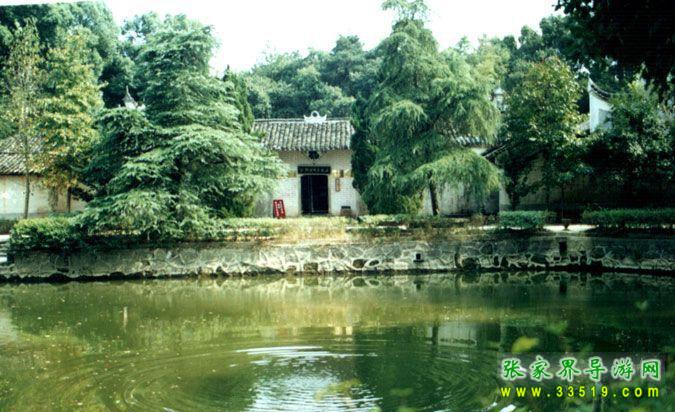
The temple environment was elegant and secluded. In front was Yangsha Lake, with rippling blue waves; behind was a mountain with dense forests and tall bamboo, spring throughout the four seasons. In the forest were many trees so large several people could embrace them, among them forty-eight maple trees and twenty-four chinquapin trees. A grove of trees covered the sky and hid the sun. Besides trees there was bamboo; the nan bamboo grew so densely that people could not walk into it. In the deep recesses of the jungle, human traces were rare. In the heat of summer, if one went to rest under the shade, before long the summer heat vanished and one felt refreshed in spirit. One could not help but recite the seven-character regulated verse "Ode to Nanquan" by the Qing Dynasty Nanquan Temple monk Deding:
The ancient temple's fame has lasted several hundred autumns; rise and decline have not been uniform, and stele records remain.
Clouds follow the crane's dream, the soul has no fixed place; the moon chills the pine branches, whose green seems about to flow.
Lamplight flashes open the eyes of a thousand sages; bell sound breaks through the sorrows of ancient and modern times.
Facing the wind I am ashamed, vainly melancholy; I do not know who will protect the ancestors' plans.
In 1937, the former Kuomintang anti-Chiang patriotic general Chen Jiayou was buried on the east side of the temple. The grave site covered more than one mu, surrounded by granite built into a large arc, low in front and high behind, with a tombstone embedded at the high point, a stone altar at the gap in front of the arc, stone ornamental columns on both sides, and the tomb in the center. Apart from the vivid Eighty-Eight Arhats in the stone enclosure, all around were large maple trees. Every late autumn, red leaves drifted down, and the grave site was covered with a layer of golden maple leaves. Because the grave site here is solemn and majestic, and the tomb stones are smooth and can be sat upon, visitors to Nanquan Temple often love to come here to enjoy the scenery.
In 1930, when Xiangyin County Middle School was founded at Nanquan Temple, it occupied only part of the temple buildings and did not change the temple's appearance. Monks still lived in the temple, and incense did not cease. During the War of Resistance Against Japan, the city often suffered air raids, and the then Xiangyin County Government twice moved to Nanquan Temple to work. After the victory of the War of Resistance, Nanquan Temple was taken back by the monk Anxing. It is said that Anxing had once served as county magistrate. In 1952, Xiangyin County Middle School moved to Xiajia Grave Hill north of the city and built new school buildings, and once dismantled building materials from Nanquan Temple, leaving a small part to run Nanquan Primary School. Later the primary school caught fire, and Nanquan Temple became ruins. In 1958 a tea and mulberry farm was established here. Today only the stone stele "Record of the Restoration of Shuanglin Chan Temple on Nanquan Mountain in Tanzhou" remains, and that ancient well was filled in during the 1978 conversion to jasmine fields. The former Shuanglin Chan Temple has completely vanished.
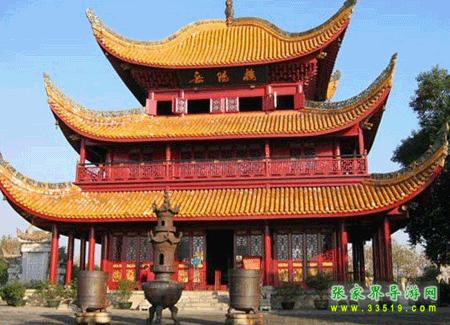
In January 2002, the monk Shi Laixiu, admiring the fame of Nanquan Temple, traveled here as a wandering monk and built a thatched hut as a temple hall, broadly forming good connections. Thousands of devout men and women came to pay homage because of its fame, and for a time incense was flourishing. Beginning in 2001, the many devout men and women solicited donations from all sectors of society, raising more than 1.2 million yuan for temple construction. From October 2001, groundbreaking began on the original site of Nanquan Temple, and by November 2002 the first building, the "Three Buddhas Hall," was completed. The "Three Buddhas Hall" covers 425 square meters and is 19.8 meters high. Its architecture has carved beams and painted rafters, and is very magnificent. Inside the hall are enshrined three Buddha images: Shakyamuni, the Medicine Buddha Who Eliminates Disasters and Prolongs Life, and Namo Amitabha. Incense burns without cease all year round, and it is very spectacular.
In early 2003, the county party committee and county people's government vigorously promoted investment attraction, making Nanquan Temple a tourism development scenic spot in Xiangyin and incorporating it into the county government's key construction projects. On May 28, 2003, Executive Deputy County Magistrate Li Lifeng convened a meeting of heads of relevant county departments to specifically study the reconstruction and expansion of Nanquan Temple, and decided to allocate 100 mu of state-owned land to Nanquan Temple at one time for development, and made relevant provisions on related policies and development forms. On June 16 of that year, the foundation-laying ceremony for the Mahavira Hall of Nanquan Temple was held as scheduled. Deputy County Party Secretary Zhou Shanlian, Standing Committee Member and Minister of the United Front Work Department Zhou Yijun, and relevant heads of the government office and the ethnic and religious affairs office attended the ceremony and laid the foundation, reflecting that the party and government respect religious undertakings and care about religious undertakings. This is a blessing for Nanquan Temple and the many devout men and women.