This attraction introduction is compiled from historical materials in the "Zhangjiajie Tour Guide Network" (33519.com · Scenic Spots section). Ticket prices, opening hours, transportation, and contact information mentioned in the text may be outdated. Please refer to the latest official announcements from the scenic area before traveling; some content consists of historical background/cultural introductions and is for reference only.
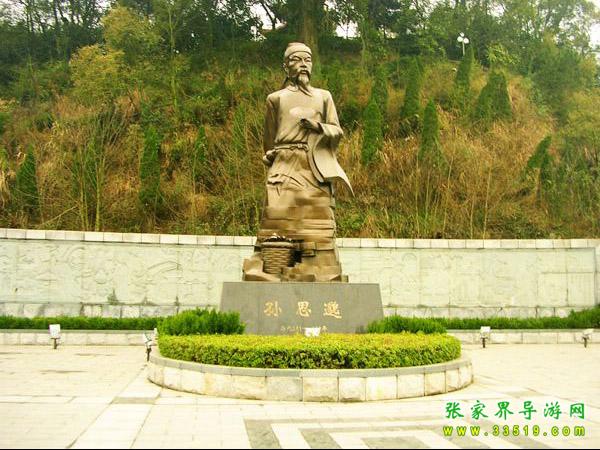
Sunyin Mountain is located east of Liuyang City. According to legend, it was the reclusive dwelling place of the great Tang Dynasty physician Sun Simiao. At the foot of the mountain are such historic sites as Shengchong Temple, the Medicine-Washing Bridge, the Medicine-Washing Well, and the Alchemy Terrace, all named in memory of Sun Simiao.
Sun Simiao (581?–682), a Tang Dynasty hermit, was a native of Huayuan in Jingzhao (present-day Yaoxian, Shaanxi). He mastered the Hundred Schools, was skilled in discoursing on the learning of Laozi and Zhuangzi, and also versed in yin-yang divination and astrological calculation. He once lived in seclusion on Taibai Mountain. Emperor Wen of Sui summoned him as a National University Scholar, but he did not accept. Emperor Taizong of Tang summoned him to the capital, but he declined the appointment and returned to the mountain to live in seclusion. He died at over a hundred years of age. He wrote the 93-volume Qianjin Fang and the Qianjin Yifang; the two books record a great many ancient medical prescriptions and their indications, with extremely rich content.
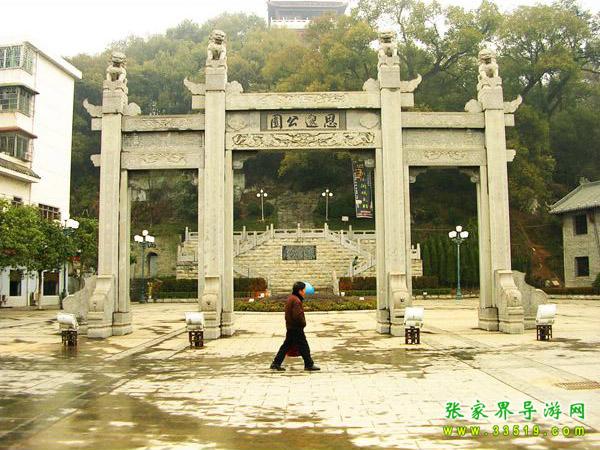
Shengchong Temple is at the northeast foot of Sunyin Mountain, by the Liuyang River. The date of its founding is unknown, but it already existed in the Song and Yuan dynasties. The temple originally had two successive halls, respectively enshrining statues of the three teachings of Confucianism, Daoism, and Buddhism. The front hall had a bronze statue of the Medicine Master, 2.3 meters tall, which unfortunately was smashed in 1958 by the local subdistrict office, which organized manpower under the pretext of eliminating superstition. The halls of Sunyin Temple were also demolished, and today only the rear hall remains, occupied by the county bamboo ware factory. The statues and other ancient objects in the hall have completely vanished; only the four ancient camphor trees behind the hall are unharmed, 20 meters tall, lush and full of vitality. The Medicine-Washing Well is near the wall on the right side of the rear hall of Shengchong Temple. The well is round, about 50 centimeters in diameter, built entirely of bluish strip stone. The well water is clear and slightly bitter, said to be so because Sun Simiao washed medicines there. Nearby residents mostly draw and use this well water. In 1979, the Liuyang County Real Estate Company built residential housing beside Shengchong Temple and actually filled in and destroyed the ancient well. The Medicine-Washing Bridge is outside the east gate of the county seat, at the Liuyang River port, that is, today's Jichuan Bridge. This bridge was rebuilt in the first year of the Jiajing era of the Ming Dynasty (1522), destroyed by water in the sixth year of the Tongzhi era of the Qing Dynasty (1867), and later rebuilt with funds raised by the local people. In 1964 the county people's government rebuilt it, replacing it with a reinforced concrete bridge. The present bridge is 7 meters high, 20 meters long, and 6 meters wide, an important route in and out of Liuyang County. "Medicine Bridge Spring and Stones" is one of the Eight Scenes of Liuyang County.