This attraction introduction is compiled from historical materials in the "Zhangjiajie Tour Guide Network" (33519.com · Scenic Spots section). Ticket prices, opening hours, transportation, and contact information mentioned in the text may be outdated. Please refer to the latest official announcements from the scenic area before traveling; some content consists of historical background/cultural introductions and is for reference only.
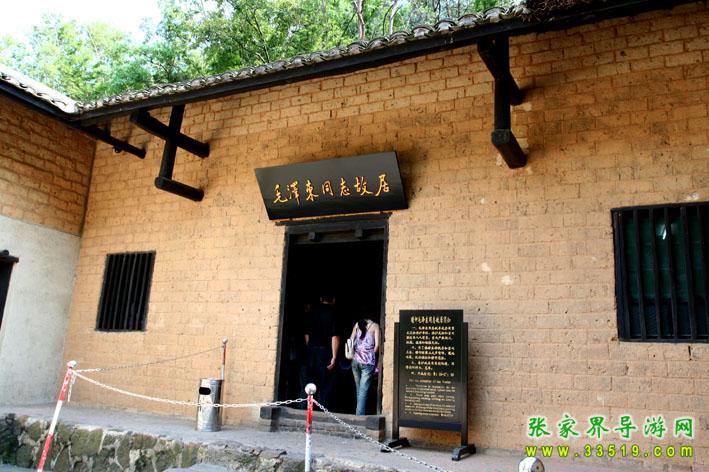
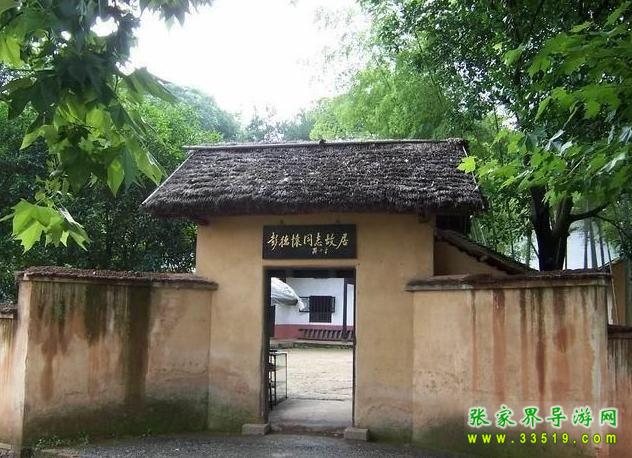
Mao Zedong's former residence is located in Shaoshanchong, 104 kilometers from Changsha. Also known as Shangwuchang, it sits in a mountain valley lush with dense woods and green bamboo. The house is an ordinary Jiangnan farmhouse of the "one load of firewood" style, with a total floor area of 472.92 square meters and occupying 566.5 square meters. It faces north with its back to the mountain and front to water. In front of the house, the Lotus Pond and the South Bank Pond lie adjacent, their green waters shimmering, ripples rising in wisps when the wind passes. With green hills stretching before it and emerald bamboo behind, the green water, dark pines, and jade bamboo set off this ordinary farmhouse with vibrant life.
On December 26, 1893, Comrade Mao Zedong was born in the eastern end of this house. The thirteen and a half tiled rooms on the east side belonged to Mao Zedong's family, while the five and a half mud-brick thatched rooms on the west side belonged to the neighbors. This ordinary farmhouse has weathered many vicissitudes. Its repairs and expansions embody the painstaking efforts and sweat of Mao Zedong's grandparents, parents, and their brothers.
From the five and a half thatched rooms when Mao Zedong's grandfather settled here in 1878, through three generations of arduous struggle and repeated repairs—enduring fire and robbery along the way—it was not until 1918 that the thatch was replaced with tiles, a rear courtyard was added, and it was expanded into thirteen and a half tiled rooms (including utility rooms; the half room refers to the central hall shared by two families). In April 1929, the Kuomintang reactionaries confiscated all of Mao Zedong's houses and property in Shaoshan. As a result, this house and its furniture suffered severe damage again. After Liberation, the people's government carried out numerous repairs, essentially restoring it to its original appearance. In 1950, the former residence was opened to domestic visitors as a revolutionary memorial site. Two years later, it was officially opened to foreign guests.
In March 1961, the State Council officially designated it as one of the first batch of national key cultural relics protection units. The seven large gilded characters on a black background reading "Comrade Mao Zedong's Former Residence" were inscribed by Comrade Deng Xiaoping, then Chairman of the Central Military Commission, on April 2, 1983.
On May 5, 1920, to expand the movement to expel the Hunan warlord Zhang Jingyao, Mao Zedong led the "Hunan Petition Delegation for Expelling Zhang" to Shanghai, where he led Hunan student representatives in Shanghai in the struggle to expel Zhang. At that time, he lived at No. 29 Minhou Lane, Hatong Road (now No. 63 Anyi Road) for more than two months.
Minhou Lane connected Hatong Road (now Tongren Road) at one end and Annan Road (now Anyi Road) at the other. No. 29 was a two-story brick-and-wood structure. The main entrance consisted of ordinary removable door panels. The front half of the ground floor was the shop area; the rear half had a kitchen on the right side and a small courtyard on the left. Between the shop area and the kitchen was the staircase. Going up the stairs, the front room was a spacious, bright main room with a small balcony outside; the rear room was a small garret, above which was a drying terrace separated from the neighbors by a pointed wooden fence. The doors, windows, staircase, and wall panels in the rooms were all painted dark red.
After arriving in Shanghai, Mao Zedong quickly rented this house. He himself and the 15-year-old Zhang Wenliang, who had come to Shanghai with him, stayed in the front main room. In the room were two single wooden plank beds. Mao Zedong's bed was placed crosswise under the floor-to-ceiling window, with a square tea table at the head of the bed piled with various newspapers and periodicals. On the small balcony was a rattan lounge chair, where Mao Zedong often sat reading. Before long, Li Si'an, a member of the petition delegation who had arrived in Shanghai earlier, moved in and stayed in the kitchen. The shop area downstairs was not used for sleeping; it served for meals, receiving guests, and meetings. Near the staircase was a round charcoal brazier, with a charcoal basket placed under the stairs. All the furniture was borrowed and pieced together from various sources.
At that time, Mao Zedong, living here, led a very simple and frugal life. The three of them each had only 3 yuan per month for pocket money, and often ate rice cooked with silkworm beans and vegetable-and-tofu soup. To supplement their living expenses, Mao Zedong washed clothes for others here. In a letter to a friend, he said: "Washing clothes is not hard; it's just that getting there and back requires taking the tram, and the money earned from washing clothes is spent again on tram fare." During his time in Shanghai, he continued tirelessly to campaign and call for the expulsion of the Northern Warlord Zhang Jingyao, who occupied Hunan.
Mao Zedong also took advantage of his temporary stay in Shanghai to actively carry out activities. On the third day after arriving in Shanghai, May 8, he and members of the New People's Study Society then in Shanghai went to Bansong Garden in the southern city (now within No. 480 Bansongyuan Road; the original site was destroyed during the War of Resistance) to hold a meeting to see off members about to go to France on the work-study program. Mao Zedong believed he should still stay behind to study China more, and canceled his plan to go to France on the work-study program.
Mao Zedong also made a special visit to Chen Duxiu, who was then discussing party-building issues with representatives of the Communist International. He later recalled this meeting in Yan'an to the American journalist Snow, saying: "This was my second meeting with Chen Duxiu; the first was in Beijing. This time Chen Duxiu and I discussed the Marxist books I had read. In my life, this was a period of transition. It can be said that Chen Duxiu's impression on me was extremely profound, perhaps more than anyone else. By the summer of 1920, in theory—and to some extent in action—I had become a Marxist, and from then on I considered myself a Marxist."
In June 1920, Zhang Jingyao withdrew from Hunan under the unanimous condemnation of the people nationwide and the pressure of the Hunan army. Due to the change in circumstances, Mao Zedong gave up his plan to study in the Soviet Union. In early July, after seeing off the New People's Study Society members going to France on the work-study program, he left Shanghai and returned to Changsha, Hunan.
From June 12 to 20, 1923, the Communist Party of China held its Third National Congress in Guangzhou. After the congress, Mao Zedong, elected as secretary of the Central Bureau and head of the Organization Department, went to Shanghai to preside over the daily work of the Central Bureau, staying at the Central Office at Sanzeng Lane at the intersection of Xiangshan Road and Gongxing Road in Zhabei (now the intersection of Xiangshan Road and Gongxing Road).
Sanzeng Lane was only one or two li from Shanghai North Railway Station. The lane had only three house numbers, hence the name "Sanzeng Lane." One of the houses was rented in the name of Wang Hebo, a member of the Third Central Committee of the CPC, a member of the Central Bureau, and Minister of the Central Peasant-Worker Department. Mao Zedong and Yang Kaihui with their child, Cai Hesen and Xiang Jingyu with their child, and Luo Zhanglong's family—ten people in all—lived here. For the sake of concealment, the three families presented themselves to the outside as one family of "the Wang brothers," with Xiang Jingyu as the head of household. Therefore, this place was also called "the Three-Household Building."
This was an ordinary two-story lane house with two rooms up and two down, totaling eight or nine rooms. Mao Zedong's family lived in the front wing room. The three families ate from a common pot, and meals were managed by Xiang Jingyu. Mao Zedong lived here for nearly three months. Using the occupation of "customs broker" (helping people fill out foreign-language forms for customs declaration) as cover, he presided over the daily work of the Central Bureau. In 1923, in order to promote the struggle against the reactionary warlord Zhao Hengti and to prepare for the establishment of the Hunan General Branch of the Kuomintang, Mao Zedong moved his family from Shanghai back to Changsha.
In January 1924, Mao Zedong went from Hunan to Guangzhou to attend the First National Congress of the Kuomintang and was elected an alternate member of the Kuomintang Central Executive Committee. In mid-February, Mao Zedong returned to Shanghai again, continuing to serve as secretary of the CPC Central Bureau while also holding posts as executive committee member, organization department secretary, and head of the documents section of the Kuomintang Shanghai Executive Department. This time, he lived at No. 7 Yunlan Lane, Weihaiwei Road (now No. 7, Lane 583 Weihai Road). Around the Dragon Boat Festival, Yang Kaihui and her mother brought the two-year-old Anying and the newborn Anqing to Shanghai as well.
No. 7 Yunlan Lane was an old-style two-story brick-and-wood shikumen house. Cai Hesen and Xiang Jingyu's family lived in the upstairs wing room, while Mao Zedong's family lived downstairs. Mao Zedong's quarters were simple and plain. Against the wall was a wooden plank bed covered with a fine-cloth mosquito net, and beside the bed was a small Ningbo-style cradle for Anqing to sleep in. Under the window was a three-drawer desk. At that time, Mao Zedong suffered from neurasthenia and was very frail, yet during the day he still insisted on going to the Kuomintang Shanghai Executive Department on Huanlong Road to work, and at night, except for occasionally going to Shanghai University to give lectures, he would bend over this desk working until late at night. In the middle of the room there was also a square table and several stools. Besides caring for the two young children and managing daily household chores, Yang Kaihui often helped Mao Zedong at this square table by collecting materials, copying manuscripts, and doing proofreading, and sometimes she found time to teach at the workers' night school in Xiaoshadu (now Caojiaodu). It was not until December 1924 that Mao Zedong, due to illness, ended his work at the Kuomintang Shanghai Executive Department and took his family back to Hunan to recuperate.
The original site of Sanzeng Lane was destroyed by Japanese aircraft during the "January 28" War of Resistance in 1932. The original site at Yunlan Lane on Weihaiwei Road is now residential housing and is a cultural relic protection unit of Shanghai Municipality.