This attraction introduction is compiled from historical materials in the "Zhangjiajie Tour Guide Network" (33519.com · Scenic Spots section). Ticket prices, opening hours, transportation, and contact information mentioned in the text may be outdated. Please refer to the latest official announcements from the scenic area before traveling; some content consists of historical background/cultural introductions and is for reference only.
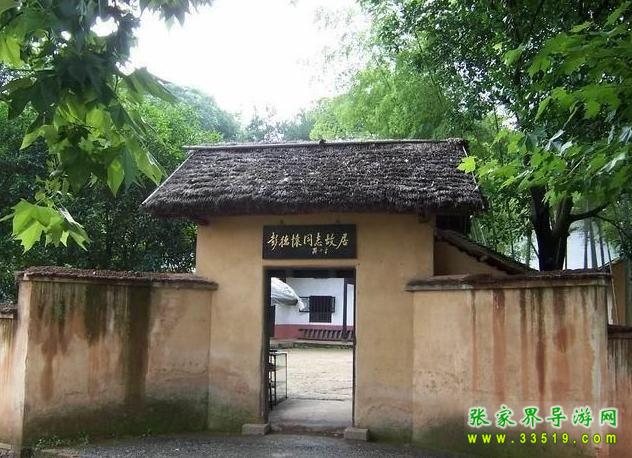
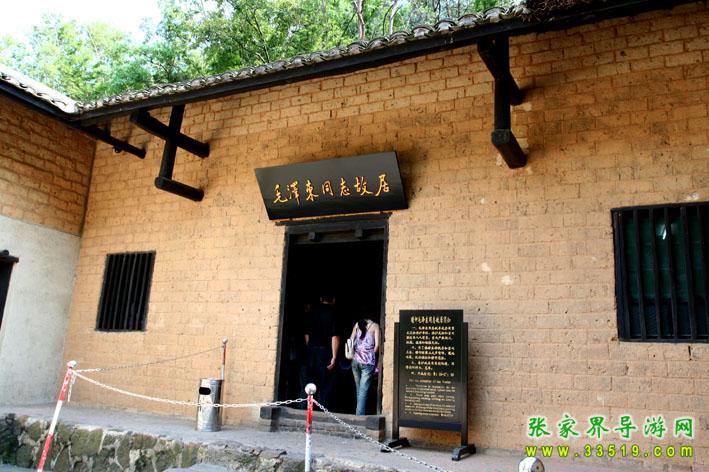
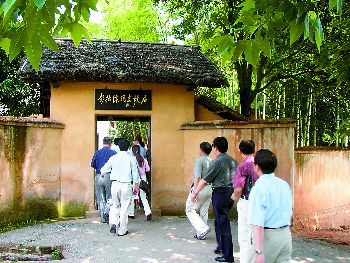
Peng Dehuai's former residence is located in Wushizhai in the southwestern part of Xiangtan County, about 40 kilometers from Xiangtan City. Wushizhai has a steep peak that rises abruptly and pierces the clouds, just like a towering monument. It is called Wushi Peak. General Peng's former residence is at the foot of this Wushi Peak. Here bamboo and trees are lush, an earthen wall surrounds the compound, and the courtyard gate is thatched. It is an eye-catching farmhouse. On each side of the courtyard gate stands a luxuriant, fruit-laden pomelo tree, planted by General Peng himself when he returned home in 1961. After crossing the spacious triple-soil threshing ground, one reaches the main house. On the lintel of the central hall is embedded a horizontal plaque carved from Qiyang stone, with the seven characters "Former Residence of Comrade Peng Dehuai" written by Comrade Deng Xiaoping, shining with golden light. In the center of the central hall hangs a huge color photograph of General Peng wearing a marshal's uniform, appearing very dignified and serene; on both side walls are listed the chronology of the main events of his life.
The east main room is the bedroom where General Peng stayed on his two returns to his hometown after liberation, and it remains as it was. The bed, desk, stool, wardrobe, washstand, and other items were all victory fruits distributed during land reform to the family of a revolutionary martyr, General Peng's sister-in-law Long Guoying. Because they were used by General Peng, they are now all kept intact and displayed in the room. In 1958 and 1961, General Peng stayed in this room for 36 days in total. During the day he received visiting villagers, went out for investigations and research, or took part in productive labor; at night he sat before a kerosene lamp and wrote rural investigation reports. At that time, his nephew worried that what he wrote would again cause trouble and urged him to rest and not stay up late. General Peng said: "I am a Communist Party member. Having eaten the people's food, I must always do something for the people. I will write down these true conditions, which may also serve as a reference for Chairman Mao." He wrote late into the night every day. He wrote four such reports in all. The loyal heart of a Communist Party member toward the Party and the people beat tenaciously in just this way.
On the wall of the east side hall hang the memorial photographs and brief biographies of General Peng's younger brothers Peng Jinhua and Peng Ronghua, and his sisters-in-law Zhou Shushen and Long Guoying. All four comrades joined the Party in the early period of the War of Resistance Against Japan. In August 1937, General Peng wrote a letter urging Peng Jinhua to go to the Anti-Japanese Military and Political University in Yan'an for study. Peng Jinhua joined the Party at the university, and the following year the Party organization sent him back to his hometown to carry out underground revolutionary struggle. He actively developed Party organizations, established the Pengjiaweizi Party branch, and served as its secretary. In the same year, his wife Zhou Shushen, his younger brother Peng Ronghua, and his sister-in-law Long Guoying also joined the Party one after another. Pengjiaweizi became the main meeting place of the underground Party branch. In the early morning of October 4, 1940, Peng Ronghua was unfortunately shot dead by Kuomintang reactionaries at the back door of the former residence's kitchen; Peng Jinhua was arrested and secretly killed seven days later at Yijiawan. The remains of the two martyrs were buried together on the hill behind the house. Comrade Wang Zhen inscribed the tombstone for the two martyrs.
In the three side rooms at the west end of General Peng's former residence is an auxiliary exhibition room on General Peng's glorious life. Here are displayed more than 60 photographs and more than 50 cultural relics, among them a copy of the "Ten-Thousand-Word Letter" submitted by General Peng during the Lushan Conference. These photographs and cultural relics tell people about General Peng's glorious and heroic life.
General Peng was born on October 24, 1898, and was named Dehua. In childhood and adolescence he experienced the hardships and bitterness of the world. He began studying at age 6. At age 8, because his mother, Mrs. Zhou, died of illness and his father, Peng Minyan, fell ill from prolonged toil, the family was utterly poor and he could not continue school, so he cut firewood at home. From age 10 to 12 he herded cattle for a rich peasant family, and from age 13 to 14 he worked as a child laborer in a coal kiln. At age 15, he took part in a struggle by starving people to seize grain, and because the militia wanted to arrest him, he fled to the shores of Dongting Lake and worked for two years as a dike laborer. After joining the Hunan Army as a soldier in 1916, he made friends with some intellectuals and soldiers of poor origin, secretly organized a Poor Relief Society, and actively carried out activities to save the country and love the people. His poor origins and the devastation of a dark society tempered in him a firm and resolute character opposed to oppression and exploitation, and he gradually established the idea of seeking liberation and a better life for the poor.
In August 1922, General Peng changed his name from Dehua to Dehuai and was admitted to the Hunan Army Officers' Military Academy. After graduating in August of the following year, he returned to the Hunan Army and successively served as company commander, battalion commander, and regimental commander. In the spring of 1928, under severe White Terror, General Peng resolutely joined the Communist Party of China. On July 22 of the same year, he led the famous Pingjiang Uprising. From then on, under the leadership of the Party Central Committee and Comrade Mao Zedong, General Peng campaigned arduously through every period—from the Agrarian Revolutionary War, the War of Resistance Against Japan, the War of Liberation, and the War to Resist U.S. Aggression and Aid Korea to the periods of socialist revolution and socialist construction—and established indelible merits.
In the late 1950s, leftist errors—marked chiefly by unrealistic high targets, blind commandism, exaggeration, and the "communist wind"—spread rampantly, causing grave losses to the nation and the people. Marshal Peng saw it all and was deeply anxious. In December 1958, accompanied by Zhou Xiaozhou, First Secretary of the Hunan Provincial Party Committee, Peng returned to his hometown, which he had left 33 years earlier, for an inspection tour. When he heard a report that the Wugongtang production team's single-season rice had exceeded a thousand jin per mu, that very night he took a flashlight to the fields himself, pulled up a rice stump and counted the stalks, then said: "I've visited many places recently. Some claim several thousand or even ten thousand jin per mu, boasting outrageously. I don't buy that at all. Measured against the ten standards for a Communist Party member, I fall far short in many ways, but there is one thing I have done: I dare to speak the truth and seek truth from facts." The next day, he inspected schools, kindergartens, a home for the elderly, and an iron-smelting plant. Holding the hand of the brigade Party secretary, he said with deep feeling: "We cadres must carry forward the Party's fine style of seeking truth from facts and maintaining close ties with the masses!"
After Peng returned to Beijing, he often recited a poem written to him by a disabled Red Army soldier in Pingjiang: "Grain lies scattered in the fields, sweet potato leaves wither; the young and strong have gone to smelt iron, leaving children and old women to bring in the harvest. How will we get through the years ahead? Please speak up for the people." In July 1959, the Party Central Committee held a meeting at Lushan. Based on the true conditions he had learned over more than a year of inspections across the country, especially in his hometown, Peng wrote a long letter to the Party Central Committee and Chairman Mao, stating his views. Unfortunately, because of this letter, he was wrongly criticized and disciplined.
In November 1961, with the agreement of the Party Central Committee and Chairman Mao, Peng returned to his hometown once more for an extended period of investigation and study. He took part in productive labor many times, and together with the commune members turned the Huangni Daping into rice paddies that gave guaranteed harvests in both drought and flood, leaving an even deeper impression on the people of his hometown. He loved the people with such deep and fervent devotion, and the people held him in boundless respect.
During the Cultural Revolution, Peng suffered cruel persecution at the hands of Lin Biao and the "Gang of Four," and sadly passed away on November 29, 1974, with his name unjustly wronged.
After Peng was rehabilitated and his name cleared, the people remembered him all the more deeply. An elderly man wrote the following poem, giving voice to the common feelings of the broad masses:
He rose in uprising in Hunan, then marched ever farther on; his monumental achievements through the ages are fairly judged by all.
Sword in hand in the northern land, wind and thunder shook; spurring his horse toward the eastern neighbor, tigers and leopards were startled.
The ten-thousand-word petition in his hand sprang from a loyal heart; he risked death nine times over for the common people.
The angry tide is heard day and night from rivers and seas; one can picture the general's commanding shout.