This attraction introduction is compiled from historical materials in the "Zhangjiajie Tour Guide Network" (33519.com · Scenic Spots section). Ticket prices, opening hours, transportation, and contact information mentioned in the text may be outdated. Please refer to the latest official announcements from the scenic area before traveling; some content consists of historical background/cultural introductions and is for reference only.
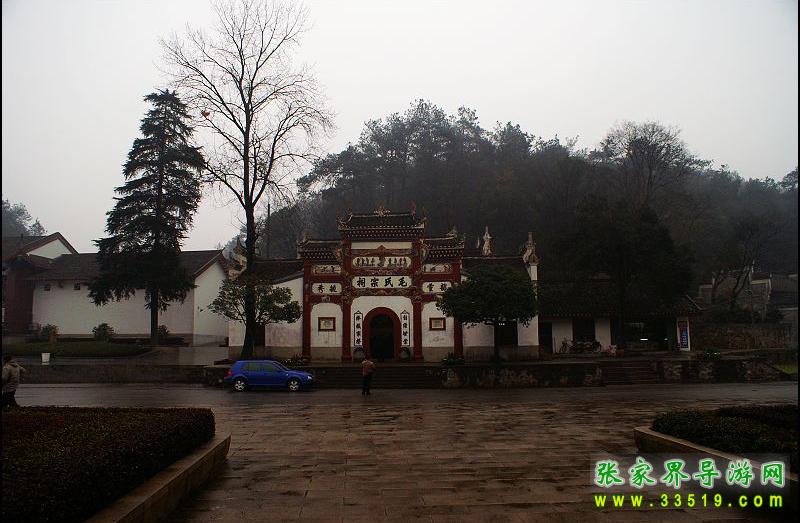
The Mao Family Ancestral Hall is located at the foot of the Eighteen Arhats Mountain and was completed in the 28th year of the Qianlong reign of the Qing Dynasty (1863 AD). The hall faces northwest with its back to the southeast, is of brick and wood structure, with a building area of 688.8 square meters, and the door plaque reads "Mao Family Ancestral Hall." Outside the door, a stone drum stands on each side, with a couplet on both sides reading: "The hereditary calling of annotating classics; the family reputation of receiving official summons." The interior is divided into three sections: the first section has a facing tower; the second section is the central hall, where the entire clan deliberated, held sacrifices, and hosted banquets; the third section is the offering hall, named "Dunben Hall."
In 1925, Mao Zedong returned to Shaoshan to carry out the peasant movement and established more than 20 peasant night schools, of which this was the earliest. The central hall served as the night school classroom, where Yang Kaihui once taught. In 1968, the Mao Family Ancestral Hall underwent comprehensive renovation and restoration display, opening to the public on December 26. On September 1, 1972, it was designated as a provincial-level cultural relic protection unit.
In the 1990s, the Mao Family Ancestral Hall was comprehensively restored, and an exhibition on Mao Zedong's family history was added, officially opening to visitors in November 1993. It immediately became a tourist hotspot. The restored Mao Family Ancestral Hall is magnificent and quite imposing. The gate tower is in the style commonly seen in ancient Chinese architecture, with upturned eaves, fish-shaped dragon tails, a spacious stage, and a plaque reading "Reflecting on the Past to Observe the Present." A couplet on the stage pillars reads: "A small place can hold family, country, and world; ordinary people can be cultured, martial, and surpass gods." A black-lacquered plaque hangs high in the central hall, inscribed with "Attentively Listen to the Constant Teachings," and on the white walls to the left and right are large characters reading "Loyalty, Filial Piety, Integrity, and Righteousness." In the central hall there are two couplets: "To truly learn, one must master the ways of Yao, Shun, Yu, King Wen, King Wu, the Duke of Zhou, Confucius, and Mencius; to be a complete person, one must cultivate the relationships of ruler and minister, father and son, brothers, and friends."
"The blessings of the present come from ancestors and must be enjoyed, and when enjoyed must be repaid; the blessings of the future are left to descendants and must be cultivated, and when cultivated will surely flourish." On the two pillars of Dunben Hall, an extremely antique couplet in clerical script of black characters on a white background reads: "The Supreme Ultimate gave birth to all, accumulating auspicious energy through the ages; from noble lineage shall surely come accomplished people." Hanging on the walls are the Mao family's "Ten Family Instructions," "Ten Family Admonitions," "Hundred-Character Motto," and "Eighteen Family Rules."
The exhibition on Mao Zedong's family history is divided into two exhibition rooms. The first room systematically introduces the origins of the Mao family. At its end is transcribed the record of Mao Zedong's life from the "Shaoshan Mao Family Genealogy": Zedong, broad-minded and expansive, devoted to the country and forgetful of family. Courtesy name Yongzhi, third in birth order, born in the 19th year of the Guangxu reign, guisi year, eleventh month, nineteenth day, chen hour. First wife Ms. Luo, born in the 15th year of the Guangxu reign, jichou year, ninth month, twenty-sixth day, chou hour, died in the 2nd year of the Xuantong reign, gengxu year, first month, second day, yin hour, buried at Nanzhutuo, Tudi Chong, Nan'an, Shaoshan. Second wife Ms. Yang, accompanied her husband abroad, birth and death to be recorded upon return. Third wife Ms. He, accompanied her husband abroad, birth and death to be recorded upon return.
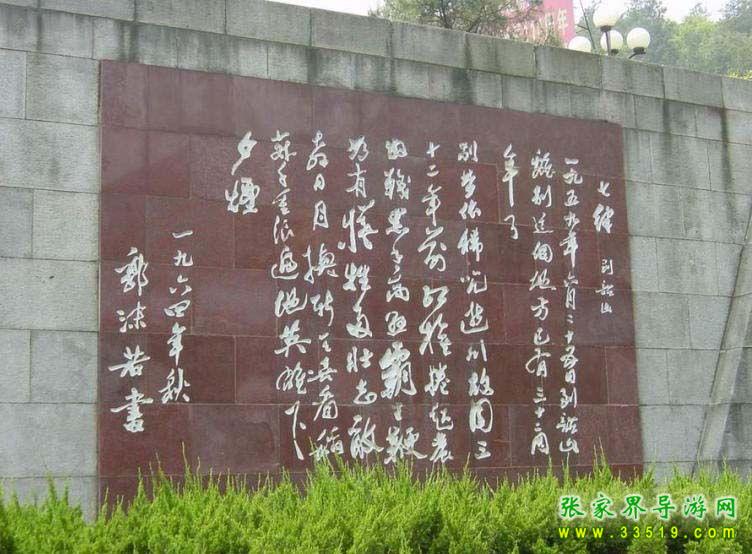
This is the earliest record in existing materials of Mao Zedong's birth time. The second exhibition room comprehensively summarizes the history of Mao Zedong's family, all loyal and heroic. In the room is Mao Anqing's handwriting. Mao Zedong's only surviving son, Mao Anqing, suffered greatly in his early years and was afflicted by illness throughout his life, all because his father sacrificed family for country. He once wrote in Shaoshan, with trembling hands, in Russian and Chinese, words formed of blood and tears: I love Shaoshan! The "Family History Exhibition" concludes with the handwritten inscription by Jiang Zemin dated March 11, 1991, in Shaoshan: Carry forward the revolutionary spirit of "for sacrifice we have great resolve, daring to make the sun and moon exchange for a new sky"!