This attraction introduction is compiled from historical materials in the "Zhangjiajie Tour Guide Network" (33519.com · Scenic Spots section). Ticket prices, opening hours, transportation, and contact information mentioned in the text may be outdated. Please refer to the latest official announcements from the scenic area before traveling; some content consists of historical background/cultural introductions and is for reference only.
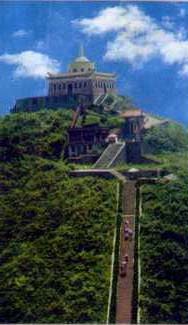
Lion Mountain stretches across the central part of Shaoshan City, 10 li from Shaoshanchong. Many people who come to Shaoshan, before enjoying the natural beauty of Shaoshanchong, first behold the majestic posture of the lion swallowing the sun.
"Eats Xiangxiang, lies in Xiangtan, defecates in Ningxiang" is a vivid folk description of its mountain form. The lion's head faces southwest and its tail trails to the northeast. The mountain body winds for ten li, cutting the Shaoshan River valley into two halves. Beneath the shadow of the male lion there is also a lioness, and beside the two lions is Qiushan, thus forming the scene of lions playing with an embroidered ball. The lion's head is jagged with interlocking teeth-like rocks and layered dangerous cliffs, with stone walls three zhang high; on the lion's back the trees are uneven, just like the mane standing up when it is angry, and the lion's eyes, nose, and lips are all very lifelike. Lion Mountain has four scenes, known as the Four Wonders, namely: the lion's head smiling upward, the golden basin storing water, Swallow Cave, and the Four Immortals Carrying Treasure.
According to legend, Lion Mountain was originally a living creature. At dawn, when it heard the rooster crow at the Golden Rooster Temple in Xiangxiang, it would come out to eat crops, swallowing thirty mu in one bite, and the people regarded it as a deep calamity. Later, when the Heavenly Emperor learned of this, he sent a heavenly deity to subdue the demon. With a flash of lightning and a peal of thunder, the lion's jawbone was struck off, and this fierce beast was pinned down in the fertile fields.
It is also said that when Emperor Zhengde of the Ming Dynasty toured south of the Yangtze, he climbed this mountain and lingered there endlessly. After returning to court, he ordered that all the temple statues on the mountain be gilded, and thereafter Buddhist activities flourished there, with incense smoke curling everywhere. The temples grew from the original Yutong Temple, Yunxi Temple, and a few others to 48. When the Ming fell, Ming princes and high ministers fled one after another to this mountain and shaved their heads to become monks. Unexpectedly, this matter was discovered by Qing troops, who came in great numbers and killed all the real and fake monks alike, with only a very few escaping disaster (there are still many people surnamed Zhu at the foot of Lion Mountain; examining their genealogies, they turn out to be descendants of Zhu Yuanzhang). From then on, the temples of Lion Mountain fell into ruin, leaving only broken tiles and crumbling walls. A great bird transformed from a wronged soul also flew back and forth over this mountain from then on, wailing for several hundred years.
In September 1944, the Japanese invading army occupied Lion Mountain and used it as a main base, raiding in all directions. Communists and patriots of Shaoshan fought bloody battles with the Japanese here many times, and to this day the remains of the trenches from those years are still preserved on the mountain.
West of Lion Mountain is the broadest stretch of open country in Shaoshan and also Shaoshan's most important rice-producing area. Looking into the distance, the Shaoshan River stretches straight over from the direction of Qingxi Temple, and the Xiangning Highway crosses the Shaoshan River and leads through Ruyi Pavilion toward Ningxiang.
Three or four li north of Lion Mountain, there is a mountain with its head raised and hooves galloping, exactly like a tall horse pressing bravely forward. This is Lemma Mountain. As the saying goes, "Riding both Lemma and Lion, one's sons and grandsons will rely on the court," and folk belief regards it as a "treasure land of feng shui."
Sixty years ago, this area was a place where Mao Zedong and Yang Kaihui frequently carried out activities for the peasant movement. Yang Kaihui once founded a peasant night school at Ruyi Pavilion. When Mao Zedong escaped danger in Shaoshan, he went straight from the foot of Lion Mountain to Ningxiang.